Category Archives: Uncategorized

A ministry of presence

Our theology house in Eluru, India: "Christu Dehon Nivas"

Our theology house in Eluru, India: “Christu Dehon Nivas”

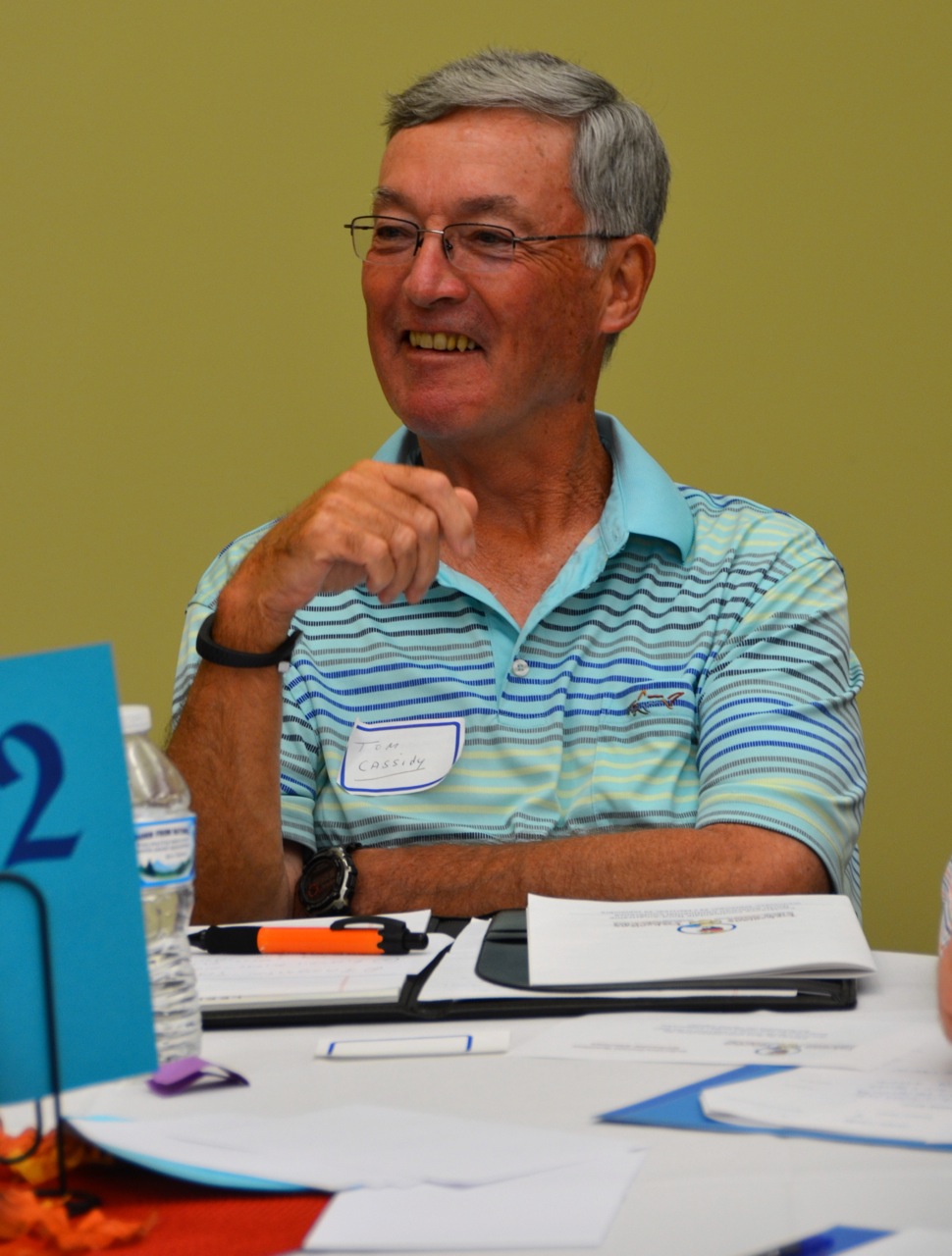
As noted previously, Fr. Tom Cassidy, SCJ, spent much of the last two months with our theology community in Eluru, India. Before leaving last week he had a final Mass with the students. 

“The Mass was my last opportunity to address the students in a formal setting,” he said. “Basically I told them that when I get back home I’m sure one of the questions I’ll be asked is: ‘What did you do?’ My answer will be: ‘All I did was eat and pray with the theologians and postulants.’

“I call it a ministry of presence.

“Then I told the students that if I had any advice to offer it would be this: The people of God are not stupid and all the beautiful words you offer them will count for nothing if you don’t live them. 

“’Think everyday of St. Francis’ admonition to ‘preach the Gospel always and if necessary use words.’”
Screen Shot 2014-03-18 at 8.31.22 AM

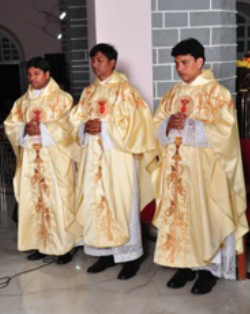
One of Fr. Tom’s last blog posts from India was about going to a First Mass of Fr. Gopu, SCJ, and Fr. Gangarapu Marianand, SCJ. In it he writes:

At supper last evening Fr. Gopu informed me that we would leave for Sacred Heart Parish at 5:30 a.m. rather than with Fr. Jojoppa, SCJ, and the three theologians who would depart at 4:45 a.m. Getting up at 5:00 a.m. is so much better sounding then 4:15 a.m.!,” wrote Fr. Tom.

It was to be a First Mass for both Fr. Gopu and Fr. Gangarapu Marianand. Fr. Gopu’s first assignment will be to assist Fr. Jojoppa at his parish in addition to his duties as the new treasurer of Christu Dehon Nivas.

Fr. Marianand’s will be at our Sacred Heart parish/shrine in Nambur. Last year he did his deacon ministry with Fr. Jojoppa while Fr. Gopu worked with Fr. Dharma, SCJ, at the parish in Nambur.

Since Fr. Marianand previously served in the Eluru parish he was the main celebrant at this morning’s liturgy, along with Frs. Gopu, Jojoppa and me as concelebrants.

It was a long Mass! We started at 6:00 a.m. and it was about two hours before the end was in sight. Of course I did not understand a word of it as the entire Mass was done in Telugu. At times like this during a long homily one’s mind begins to wander and mine began thinking of all the places around the world that I have had the opportunity to celebrate Mass.

Some of the places I recalled included Uganda Martyrs parish in apartheid South Africa, pre-Amazon forest parishes in northern Brazil, and my little favorite of Bualan on the Island of Mindanao (Philippines).  I have had many opportunities in the course of my service as general councilor and later as provincial superior. In each case, while the language was foreign to me the heart of the liturgy was not. And while there are always some local customs particular to a country and/or culture the liturgical drama always unfolds telling the same story over and over in only God knows how many languages and dialects.

A couple of examples of Indian practices we would not find back in the States:

(1) There is always a long introduction to the liturgy, almost a mini-homily at the start of Mass.

(2) Frequently the Prayer of the Faithful is not said, especially at weekday Masses.

(3) Music is essential to the celebration and all songs are sung from start to finish, or at least I presume they get through all the verses given the length of each song.

(4) Intinction is customary for the priest as well as the people (when the cup is offered).

(5) There is a very small spoon (similar to what some Eastern Rites use) to mix the water with the wine at the offertory.

(6) The Sign of Peace is a bow with hands folded. The priest will first offer this gesture to the people who return it to him and then to any priest on his immediate right and left.

This morning at the offertory procession everyone came to offer either money, rice or another food item such as eggs. The food items are for the use of the parish priest.
 

A young and growing SCJ entity

Prayer in Guntur-XL

As noted previously, Fr. Tom Cassidy is assisting with the formation program in the District of India. Today he writes about the some of the SCJs in the district, noting that youth is both a blessing and a challenge for the congregation’s presence in India.

Yesterday Fr. Gopu Bala Joseph Reddy, SCJ (Gopu) moved to Eluru as he will assume the duties of treasurer for the community on April 1, 2014. He will replace Fr. Jojoppa, SCJ, who will then be able to devote full time to his duties as pastor. I believe Fr. Gopu, SCJ, will split his time between the theologate and assisting in the parish.

Fr. Gopu, SCJ, did not arrive alone; he came in a novitiate vehicle along with some of the novices and Fr. Gangarapu Marianand, SCJ. He and Fr. Gopu, SCJ were ordained earlier this month.

Finally Fr. Ajit Kumar Basla, SCJ, accompanied the group. Fr. Ajit is from north India where at the moment the SCJs are present only in Mumbai. Indians tend to think of their country in terms of north and south with Andhra Pradesh being the boarder state, i.e., anything north of here is in the north and Andhra and any state south of here is southern India.

Fr. Ajit, will be going to Spain this summer to study at ESIC, a well-known business school run by the SCJs. I presume he is being groomed for future work in finance. He has already completed the formation program for treasurers our general administration offered several years ago

Fr. Ajit, main celebrant, will be going to Spain this summer to study at the SCJs' ESIC business school

Fr. Ajit, main celebrant, will be going to Spain this summer to study at the SCJs’ ESIC business school

I am not sure what assignment Fr. Gangarapu, SCJ, has received, but in addition to Fr. Gopu, SCJ, being assigned here he will be joined by Fr. Siju Saloman, SCJ, who was ordained on March 1st in Kerala. I met Fr. Siju at Kumbalanghy where he served on the formation staff as a deacon while also assisting in a local parish. Now that the number of theologians will increase (they will double next year!) and with the postulant program moving elsewhere, having at least two full time formation staff is important.

The fact that both Frs. Gopu and Siju are so young underscores the reality of both the challenge and the blessing of our young district. 2014 marks the 20tht anniversary since our arrival in India. Starting from scratch is never easy and it was even more difficult here since the Indian government does not permit foreign missionaries to work. With the help of some benevolent bishops and lay people, and the efforts of many SCJs from around the congregation, we were able to plant the SCJ charism first in Kerala and now in several other states including Andhra Pradesh as well as the metropolis of Mumbai.

The challenge for the district is that they are so young and lack the experience that comes with age. Fr. Thomas Vinod, SCJ, is the first Indian District Superior and he will turn 35 this coming December. His age may be the average age of the district. It also might also be lower as the nine novices will make their first profession on May 1, 2014, and the nine postulants who were here will begin their novitiate year.

The first US Provincial Fr. Richard Keefer, SCJ, is often quoted as saying: “You build with the bricks you got.” That certainly was true in the early years of the US Province and is most certainly true here!

The Indian District has made a conscious effort not to isolate itself. It has sent men to study and minister in:

• Indonesia
• Philippines
• Brazil
• South Africa
• Cameroon
• Scotland and Ireland
• Venezuela
• Rome
• Germany [two Indian SCJs are awaiting visas]

Students wave-XLHere in India many men are involved in formation programs to ensure a future for the community. The district also staffs three parishes. I have spoken of all three: Mumbai, Nambur and here at Eluru. Again the pastors are all very young SCJs. Fr. Dharma, for example, at Nambur was tasked with building his parish church, which was dedicated in January. He will turn 31 in September. Fr. Jojappa turns 34 in June and he will relinquish his duties as treasurer here so that he can devote all his time to time to the parish, including the challenge of finding the money for the land and construction of a parish rectory. Fr. Benzigar Aji, SCJ (Mumbai), will turn 40 in October and was among the first to join the SCJs.

Actually the genesis of my coming to India was a request made by Fr. Thomas Vinod  at our last General Conference held in Neustadt, Germany. Fr. Thomas asked provinces to consider sending older SCJs to spend time with their Indian SCJ brothers since they are so young and don’t have the historical perspective that older SCJs represent.

While I have spent most of my time living with the theologians and postulants, by the time I complete my stay here I will have visited most of the houses of formation. I will miss the philosophy house in Aluva though I am familiar with it as it was the first stop on my trip in 2011.

Rushing to catch a train… Indian style!

OLYMPUS DIGITAL CAMERA

As noted previously, Fr. Tom Cassidy has spent the past month with the theology community in Eluru, India. He wrote the following after a week’s retreat with the students:

I just returned from a pilgrimage with the postulants. When we met Friday evening as a group for the last time Fr. Vimal, SCJ, was kind enough to thank me for my presence not only for being on the pilgrim journey, but for the time I gave to the postulants. I filled in for him and taught class for four days early on in my stay at Eluru. He and the postulants gave me a small statue of Our Lady of Health as a remembrance of our time together. In turn I told the group this.

Screen Shot 2014-03-02 at 7.44.00 AM“Any first-year teacher, and I think Fr. Vimal will attest to this, will say: ‘You [postulants] have taught me much more then I have taught you.’ I can say the same I have learned much from you and am most grateful. Earlier I said, partly in jest, that in saying ‘yes’ to coming on the pilgrimage with you I might regret it. But I can say honestly that I have no regrets! It has been a wonderful journey for me — well I suppose the train rides leave something to be desired, but you can’t get here if you don’t take the train. Besides, I’ve now fulfilled Gandhi’s admonishment: ‘If you want to really experience India you must travel by train.’ There were many highlights for me, but certainly saying Mass at the tomb of St. Thomas the Apostle, ranks as my No.1 as he is my patron saint. Thank you from the bottom of my heart and know you are in my thoughts and prayers. If I have the opportunity to return next year I certainly hope to have time in the novitiate to see where each of you are on your spiritual journey and in discerning God’s will.”

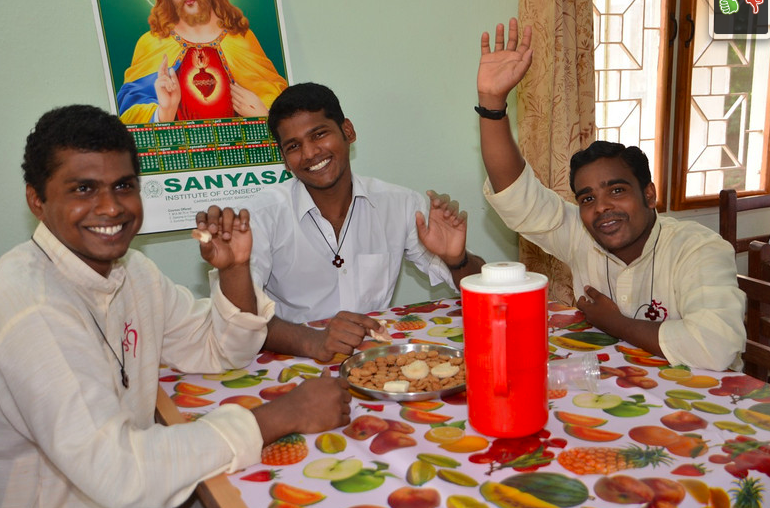
We enjoyed our last meal together in one of the many small local restaurants. Fr. Vimal did something I like to do as each day: we ate at a different place giving us the opportunity to experience cuisine from the many styles that can be found in this vast country. A few even featured Chinese cooking on the menu. I suspectChinese cooking can be found almost anywhere in the world.

It took me a day or so to know that if you ask for a meal you’ll get rice and several kinds of curries and condiments to go with it. I opted for this style once but the rest of the time I went for a specialized dish such as egg chapatti.

We were informed that the train would depart at 10:15 p.m. and that we should be prepared to meet in front of the priest guesthouse at 9:00 p.m. I thought to myself “Good, it gives me time for a bath, shave and to finish packing.” I had just finished my bath and shave when there was a sharp knock on my door. Dressed only in a towel I met Fr. Vimal, who quickly announced: “Mega had the time wrong and the train will depart at 9:00 p.m., we need to hurry!” Luckily I had most of the packing done and I rushed as fast as I could to dress, pack and be in front of the guest house ASAP!

Now began what I can best describe as one of those scenes from an early Charlie Chaplin silent movie where the cops are chasing after the robbers in a typical Keystone Cop routine! With muster called and all present we rushed (fast trot you might say) with bags in hand or on our backs to the nearest motor- rickshaw stand. Fr. Vilmar, did his usual negotiations for three rickshaws and off we raced. I was in the first rickshaw with Fr. Vilmar and Manish (he usually traveled with us as he’s the smallest of the postulants). I think Fr. Vilmar got his message across to our driver as it was FULL SPEED AHEAD — well, as fast as a fully loaded motor-rickshaw put-put engine would carry us. Fortunately, the train station is not very far and we arrived with a couple of minutes to spare. I suppose with a bit of apprehension in each of our heads we waited for the other two rickshaws to come flying around the corner with the other eight postulants.

Wouldn’t you know it, the train was on track No. 2 so most of the postulants jumped down onto track No. 1 as it was by far the shortest way as we only had a couple of moments to spare!

I blurted out: “I can’t do this!” So Fr. Vilmar rushed with me across the overhead bridge as Jesu grabbed my bag.

Screen Shot 2014-03-02 at 7.43.51 AMAt the last moment I said to myself “Go for it!” And so Fr. Vilmar and I jumped down and crossed track No.1 and luckily the doors on the cars were open on both sides and all managed to get on board with just seconds, or so it seemed, to spare!

Though I would have preferred to stay in second class with the postulants and Fr. Vilmar, he had purchased a ticket in a sleeper three-tier air-conditioned class. He was kind enough to take me to my bunk and I settled down for the night journey. We’d arrive in Chennai around 5:45 a.m. It was the last stop so I was told: “Don’t worry about getting off.” I was a bit anxious about that as trains do not make any announcements on station arrivals and depending on where you are in the car and tier arrangement you may or may not catch sight of a stop’s name.

My anxiety was well founded! At about 5:50 a.m. we arrived at what looked like Chennai and the station from which we departed Wednesday evening. Many people were getting off so I got off as well. I know my car was near the front of the train and the rest were somewhere behind my location. I started walking toward the rear a bit surprised I did not see anyone from our group. At about that moment from the window of one of the cars Libin called out:

“Father, this isn’t our stop it’s the next one!”

I got back on the train, this time in second class and road the rest of the way with the postulants. And that was the real end to our Keystone Cop experience!

Screen Shot 2014-03-02 at 7.44.13 AM

Pizza in India

bgPizza-v01

The start of a new pre-Lent custom?

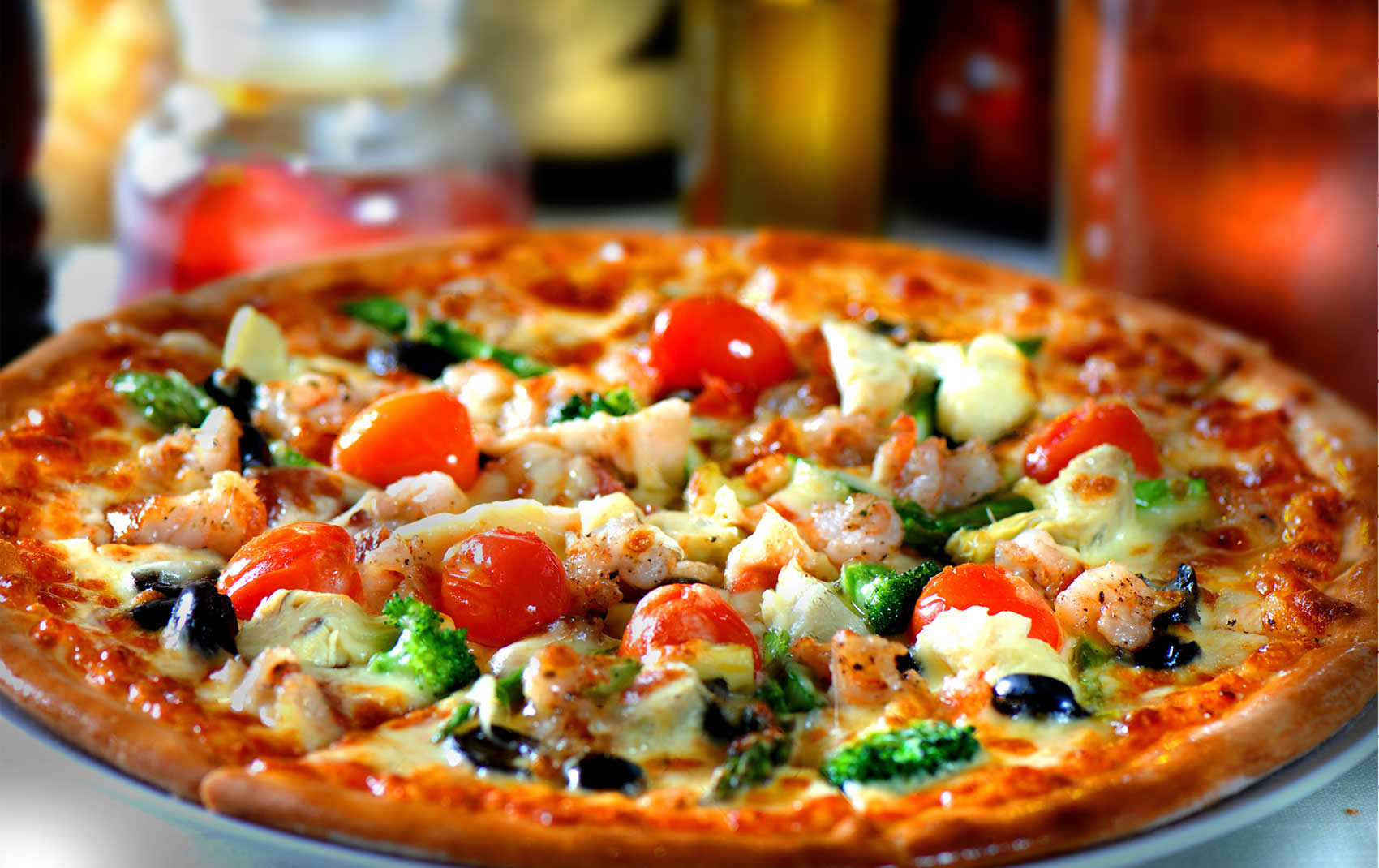
Perhaps a week ago at the supper table we were talking about Fat Tuesday and differing customs, and from that conversation I said that I would take everyone out for pizza the day before Lent begins.  There seem to be no local customs such as donut eating that we do in Milwaukee the day before Lent begins.

When our house cook had to return home unexpectedly (his uncle was seriously injured in an accident), we moved up our pizza day.

In the afternoon I gave Fr. Mariano some US dollars to convert for me to pay for the meal. He got a good exchange rate of 60 rupee for one US dollar. I was well armed with plenty of local currency.

On Saturdays adoration and evening prayer take place at 7:00 p.m. so the plan was that we would leave after that in the van and jeep. Fr. Jojoppa and one of the students would come later by motorbike as someone had to wait for the milkman to make his Saturday delivery. All together we had 20 people headed to a U.S pizza parlor. I was told Guntur has an honest-to-god Pizza Hut.

Looking back we probably should have held a class on what is pizza, and how to order it as there was some confusion when first we got there. The pizza parlor was not very large, but we managed to grab enough tables and chairs for the 18 of us who arrived first and saved room for the two coming later.

As for the pizza, it was similar in style to thick crust pizza or Chicago style. I’m not sure how each table decided to place its order but at ours we each ordered a medium pizza which would be comparable in size to the personal pizza one finds in Rome for example. At my table we ordered different combinations, like Texas Style, or Mexican, or Sicilian, etc.

As this is India there was a good selection of vegetarian pizzas on the menu as well. Best as I can tell no one went with vegetarian. Our drinks consisted of water though I had a cup of espresso at the end. No beer or wine is served, nor sodas, though one could get a fruit drink or what I would call an ice cream soda.

As it turned out, no one, with the exception of Frs. Mariano and Vimal, who studied in Rome, ever had pizza before. That accounts for some of the confusion we started with. I said to Fr. Mariano that it was funny to watch everyone at the other tables eat the pizza with a fork as pizza is certainly a dish that in the States that is socially acceptable to eat with your hands. For a group that, if given the choice, much prefers to eat with their hands I found it a bit funny.

We ended the meal with ––  yes, you guessed it –– ice cream. In an e-mail I received this morning one of my sister’s remarked: You seem to get a lot of ice cream. I just had the good fortune of being here for the month of February when the community celebrates six birthdays. I also think given the hot climate and hot food ice cream is appreciated.

Indian rap accompanies car trip

Screen Shot 2014-02-19 at 8.34.38 AM

In this post Fr. Tom Cassidy, who is spending February with the theology community in India, writes about a recent car trip with the community to an ordination; he promises to write about that ordination in a future post.

Our drive took just under three hours. We (Fr. Mariano and six of the theologians) left Christu Dehon Nivas at 1:35 p.m. and arrived more or less around 4:30 p.m. Our trip home took a bit less time as there was less traffic. Since the theologians are young men around 24 to 26 years old I was treated to almost three hours of what I could best describe as Indian rap or Indian hip-hop music. Every once in awhile a couple of familiar words would come out between the Telugu: “Michael Jackson.”

I was glad we got to the ordination early as it gave me an opportunity to meet up with some Indian SCJs I have met over the past couple of years. I was not the only foreign SCJ present. Joining in the ordination celebrations were Frs. Sebastian Pitz, SCJ (Brazil), Martin van Ooij, SCJ (Indonesia, but Dutch by birth), Jesus Manuel Baerna (Spain) and Dwijo, SCJ (Indonesia). I have spoken of all but Fr. Dwijo before. He came because one of the newly ordained is working in Gisting at his parish.

Gisting is famous among SCJs for its mild climate. It is located several thousand feet above sea level, which accounts for its very mild condition (temperatures much cooler than the rest of the country). Perhaps the one downside for visitors to Gisting is that the water for bathing, which is heated only by the surrounding air, makes for, let me say, a rather invigorating morning bath! Fr. Dwijo is the parish priest, our Indonesian novitiate is also located in Gisting.

As we waited for the ceremony to begin I got a chance to speak with our  altar  boys  (the boys were surprised when I told them that in  the States  we  had  altar  servers  and many  of  them are girls).  Their English was of varying qualities; the young  man  in  the shirt (pictured above) was  my  chief  interpreter as  he  is  going  to an English School. He eventually got into a server’s outfit before we processed into the cathedral.

Look closely to the two servers standing next to him and note the holes in their surplices near the hemline. The server who carries the thurifer (incensor) keeps the lid open and swings it back and forth. Believe me it is filled to the brim with burning charcoal. I have visions of burnt feet but they assured me it doesn’t  happen, but as for burn holes in the surplice, now that’s a different story. It was fun talking to the boys. I have found that often when a stranger comes to a foreign land, especially from North America or the British Isles, young people like to ask questions and show off their command of English.

Fish day

little-india-singapore-fish

Everyone pitches in on fish day

It is a very popular dish around here. More fish is served than chicken or any other kind of meat. A fair number of our SCJs come from fishing villages in Kerala and naturally have a taste for fish. Here in Eluru we are about 2 1/2 hours from the coast so I can’t say the villages around here hold many seafaring men. However, I suspect fish may be the least costly source of protein in the local diet.

When Frs. Mariano and Jojoppa returned yesterday afternoon I asked them what time they left as the night before I was told the trip was planned for a 2:00 AM departure. I thought my watch said 4:00 AM when the old diesel jeep cranked up outside my window. Even if I had been in a deep sleep the racket would have pulled me back to a conscious state. At any rate, the answer I got was 3:30 AM. The discrepancy in time may be my watch as I have a setting for Milwaukee time and local time. MKE time is 11 1/2 hour behind India’s one time zone.

I asked Fr. Mariano about their trip. The road to the coast is not very good right now as a lot of it is under construction (don’t we know about that back home!). Although the traffic was light there was a lot of mist and fog along the way. At times, he said, they could hardly see 10 meters ahead (30 feet). The two of them managed to arrive in plenty of time to catch the boats. Although people plan on the boats coming in around 6:00 AM more often not they’ll be at least a half hour later. A lot depends on how good the fishing was, and I’m sure both the weather and currents and tides may have something to say about arrival time as well.

Fish day at the theology house

Fish day at the theology house

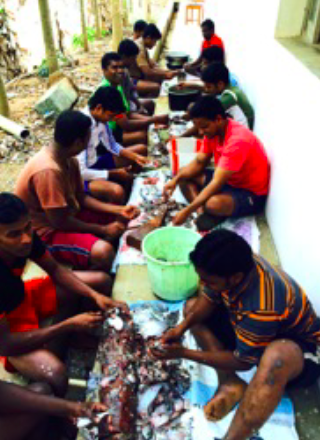
About 2:00 PM the jeep came rumbling up our driveway with its horn a-blaring. The signal for: “All hands on deck.” The jeep was packed with three or four large styrofoam boxes containing the iced fish. When asked how many kilos he brought back, Fr. Mariano replied: Oh about 200 or maybe 250 kilos. That should last  the community of 20 around two months. With their summer vacation coming in mid-March and the postulants leaving here around March 1st for a couple of weeks vacation before they have to report to the novitiate at Nambur I think this load may last a bit longer.

Both the theologians and postulants were all gathering to begin the process of cleaning the fish and getting them ready for the freezer. Fr. Sebastian asked: “How can you keep the fish frozen with the frequent electrical outages?”

Most of the outages are of a short duration of no more then 15 to 30 minutes. Freezers will keep stuff frozen for that duration. For longer times the house has a generator that seems to me can run the entire electrical needs of the community. We’ve used it a couple of time since I’ve been here. I haven’t figured out how, when or why the generator kicks in as most of the time it does not. My working theory is some outages are planned and our generator is fired up during these. I’ll have to ask for a better explanation.

Three kinds of fish were brought back: A red fish, a black fish, and one large fish. The latter I missed as it was cleaned near the end of the afternoon and I missed seeing it. In any case, none of the students could tell me what it was other than: “It was a big fish.”

The fish cleaning party took place behind the kitchen. It took a little while to round up all the students but before too long music was a blaring and laughter and chatter could be heard even from the roof when I was up there to send my afternoon e-mails and journal/blog to the provincial office. As the fish cleaning party is a regular occurrence (about every two months) everyone had an idea of what he was supposed to be doing. Since some of the students do come from fishing villages they probably have done similar work, perhaps not on this scale, within their families.

Keeping in mind that the 440 pounds of fish would be reduced in volume/weight as scaling and cleaning took place for a community of 20 at the full weight of 440 it amounts to 22 pounds of fish per person and about 1/3 of a pound per day. As I’ve said, it is the probably the chief source of protein.

We were talking about the local diet at breakfast and comparing it to what we eat back home. I said: Americans would want more vegetables, especially green vegetables, than what is served in the house. Obviously lots of rice form a major source of calories in the diet. A cup of short-grain white rice has 242 calories that include 53 grams of carbohydrate and four grams of protein. Believe me, the students plates are piled with a lot more then a cup of rice as it is the mainstay of most meals.

The students worked all afternoon before they could call it a day and put the 200-plus kilos of cleaned fish in the deep freezer for future use. They enjoyed the fruits of their labors at our evening meal. A small token of thanks showed up at the end of the meal in a dish of vanilla ice cream for all.

That reminded both Fr. Mariano and Sebastian of Fr. Tom Garvey, SCJ, who holds a special place in the development of our Indian SCJ presence. I spoke about him earlier. His name came up because Tom was well known for his love of ice cream. He did not develop that taste here in India but brought it with him from the States for there too his love of ice cream, especially vanilla, was well known.

The many languages of India

Screen Shot 2014-02-13 at 9.18.24 AM

As noted previously, Fr. Tom Cassidy, SCJ, is spending February with the theology community in India. Here he reflects on the many languages of the country:

Language! 

Most of the postulants, and for that matter, members of the Indian District, come from the states of Kerala and Andhra Pradesh. There are a few from Goa where Fr. Mariano, the superior of the theologate, hails from, and in recent times a few come from north India. Each state has its own language and, I suspect, a number of dialects and local languages as well, especially where migration has taken place. For example, here in Andhra Pradesh the state language is Telugu while in Kerala it is Malayalam.

Hindi is considered the national language and is the lingua franca. English is also an important national language. It is the language used in education, especially as one moves up the ladder from primary to secondary to university level. Because our students come from different states English is also the lingua franca of our SCJ community.

India langauge map

The many languages of India

Because of the language issue, it is not so simple for the district superior and council to assign men to ministry. Especially since, with the exception of Mumbai, the parishes we have are in rural areas where the local language must be used. So someone from Kerala can’t be assigned to Andhra Pradesh for parish ministry unless he knows the local language. In Mumbai at Divine Mercy Parish, Mass rotates between English, Hindi and, I believe Telugu, as the community consists of migrants who have moved into the area looking for work.

For the majority of Americans, speaking a second or third language is rare. Certainly in the past 20 years or so Spanish has become an important second language in the States given our large Hispanic population.

Most of our students in India know two or more languages besides their command of English. For a Westerner learning any of the local languages of India is compounded by the fact the script is so different from our own. It’s like studying Hebrew or Greek where the first thing you need to do is learn the alphabet. Telugu has 54 characters in its alphabet as opposed to our 26.

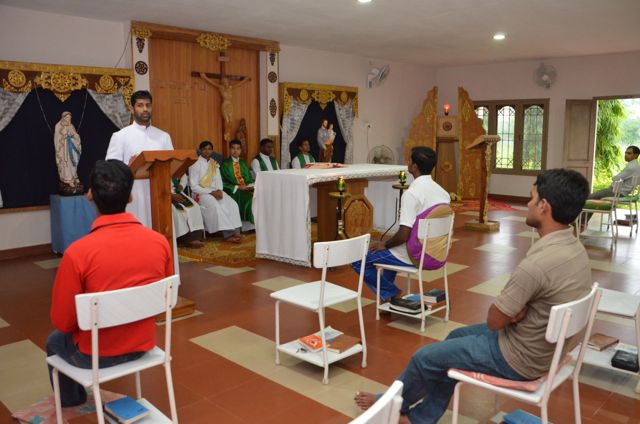
Our liturgies are in English, though some of the songs are done in other languages. These local songs are ones the students know by heart. Liturgical music is a part of both Mass and Adoration. We often will chant the psalms as well during morning and/or evening prayer. While in the States we often will sing two or maybe three verses of a song; so far every one we have done here has been sung from beginning to end.

Leave your shoes behind

shoes_at_door


Fr. Tom Cassidy will be with the theology community in Eluru, India, through the end of February. Today he writes about some of the customs of his temporary home:

One of the joys of visiting a foreign country, especially one out of your comfort zone, is learning about local customs that are often so different from your own personal experience. I’d like to explain several that are a daily part of Indian life.

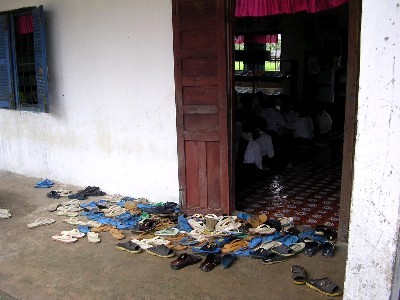
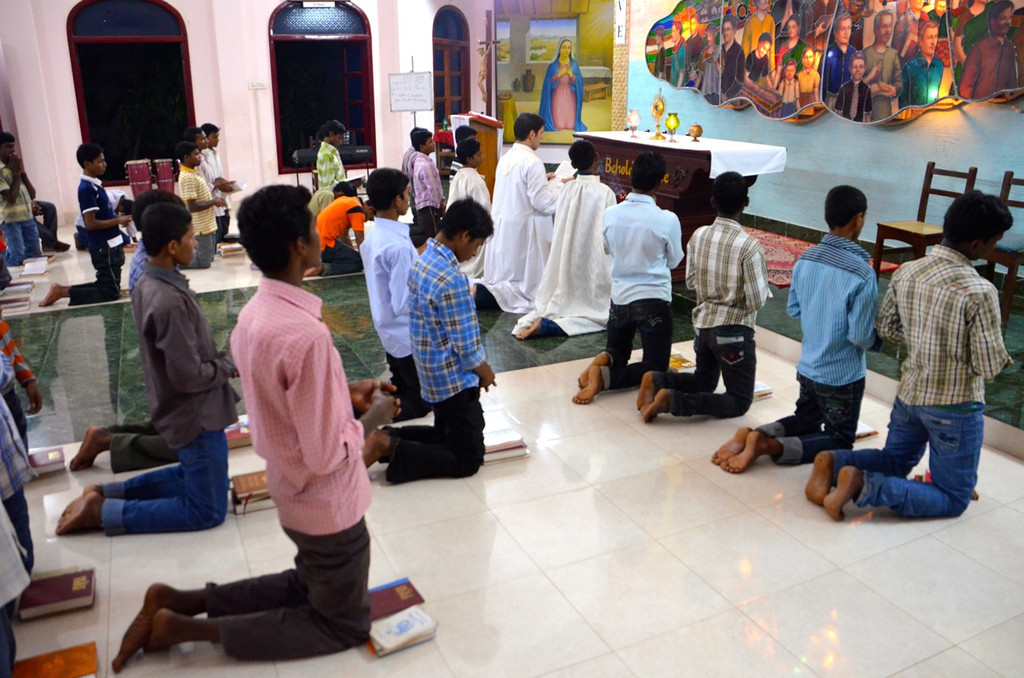
One custom that is part of daily life, at least in rural India, is shoe removal. As you walk down the hallway to the chapel you see both walls lined with sandals left by the students and priests.

This is not the only place where one removes his/her shoes. You’ll know a student is in his room because his shoes will be outside the door. It’s perfectly fine to wear shoes in the hallway, but not in your room. I can’t begin to fathom where this custom began or its significance, but I have found one very practical use for it. Our floors are tiled and cool and one way to feel cooler in a hot climate is to have cool feet. It works right now, but when the 100 degree temps arrive I’m not sure how cold the floor will be.

Students prayer India

Students at prayer

Since we are taking our shoes off and putting them on so often during the day what kind of shoes are worn is also important. Most in the house where flip-flops or thongs. It makes for easy on and off. I have a pair of Tevas that I have had for years (served me well on all my Asian trips since 1991). I don’t like anything between my toes so this uses straps. Obviously I do a lot more bending over then those who can simply slip on and slip off at will.

A second cultural custom, or perhaps better put –– practice –– takes a bit of getting used to coming from the west. Where I come from when giving a no answer it can often be accompanied, especially for emphasis, by turning your head left and right. Here what we take for a no means yes – the way the head bobs. Not only does it mean “yes” but I don’t think even with lots of practice could reproduce the movement of an Indian’s head when he says “yes” There is an elegance to it that I find hard to describe.

I have also discovered the head movement sometimes accompanies a conversation as if the yes movement is confirming that the point has been understood and well taken. I must also confess Indian English is not always easy for me to understand. The students here are soft spoken and each has his own accent. Some of these accents are easy for the ear to catch but others are more difficult.

An example: In chapel when we are going to sing there are three books a song may be taken from. The one most frequently used is divided into sections starting with a letter and followed by a number. I find it extremely difficult to pick up many of the letters. My ear can’t often distinguish between a D,E,T or P, when the student announces the song.

In all fairness I should point out MY OWN accent and speed can be a problem for our students to pick up and understand. I do try my best to slow down, especially when preaching in chapel, but at times I find myself falling back into my usual speech patterns. It will be interesting to see if by the end of my visit our mutual understanding will improve. I’ll have to ask Br. Hari about that since he’s the one who pointed out to me how difficult it can be to understand a non-Indian’s English.

It all depends on what your ear is used to!

Chasing down the buffalo

water-buffalo

Fr. Tom Cassidy will be with the theology community in Eluru through the end of February. Here, he writes about a recent morning that started on the roof, chasing down a WI-FI connection and continued on to the hunt for the community’s escaped water buffalos:

It turned out to be a rather interesting morning. As usual, after breakfast I got Fr. Mariano’s computer and marched up to the roof to connect to the internet and download any important e-mails and trash the rest.  I also upload any e-mails I may have written from the day before.

Speaking of the internet, a number of the students are following what I am writing on the province blog. So far all the local reviews are positive. However, keep in mind these are my own reflections, and as much as I try to be accurate, impressions are sometimes in error. I do try as best I can to correct any mistakes I make along the way.

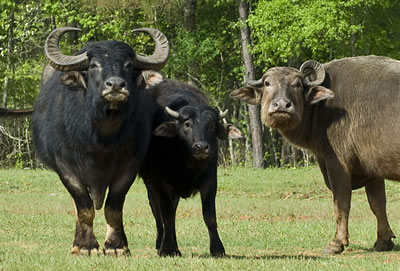
About the time I finished posting my journal and a few other emails  there was a knock at my door. Mahesh, one of the postulants, reported that our three buffalos had gotten out as someone left the front gate open and he and some of the other postulants (theologians were in school) would go looking for them. I’m guessing this was about 10:15  AM when the roundup began.

The postulants have lunch at 12:30 PM during the week and when I arrived only Jesu was there as he had just returned from town shopping with Fr. Jojoppa. I had a good conversation and learned a lot. We first talked about the missing buffalo. We have one adult female who supplies the house with milk; a lot of which is turned into yogurt that I think they call curd.  It is on the sour side but everyone takes it at lunch and supper as it helps cool the stomach after a diet of rice and spices — I take water to cool my innards. Our other two buffalo are young males destined at some later date for the table.

Fr. Tom Cassidy

Fr. Tom Cassidy

Finding our three wayward beasts is not as simple as it sounds. They are not marked (branded) so trying to find them, say if they are in a field with other buffalo, well you can imagine as the saying goes they all look alike might very well apply here. I imagine the best clue is the three might well stick together. Another problem arrises if the buffalo are eating grass in some farmer’s field. He’ll want some form of compensation for lost grass. I am happy to report sometime in the early afternoon postulants and buffalo came marching down our road.

Jesu did say that if the buffalo were village animals they would be used to moving about and would know their own way home. Our beasts are kept inside our property, unless they manage to find the front gate open, and have no idea where they go once out.

Jesu and I also spoke about the morning shopping experience. It turns out Jesu is a good bargainer and jawing with merchants is an important part of getting things at the best price. I was impressed with Jesu saying: “We depend on many poor people who are our benefactors and it is important to value each and every rupee.” From his minor seminary days Jesu has been bargaining on behalf of the community.

He also told me some about his family. He was surprised that I was a priest since I was the only son in my family and would not carry on the name. It is important in the Indian context to continue the family line. Male children inherit while females do not as their dowry when they marry is in a sense their inheritance. Of course, if there are no male heirs it is a different story. In Jesu’s case he has several brothers and sisters. Families in India are getting smaller especially as more and more move into urban centers.

I read this morning saying summer is about to arrive. The temperatures are rising now, and averaging around 90°F during the day, though the nights are sill very comfortable. Perhaps I’ll have to crank up the air conditioner one of these days but so far I have been quite comfortable.

Sunday in rural India

Fr. Tom Cassidy will be with the theology community in Eluru through the end of February. Here, he writes about traveling to celebrate Mass at a nearby parish:

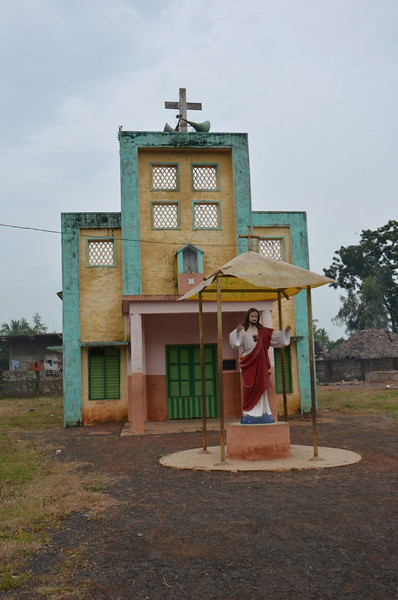
Sacred Heart Church in Eluru

Sacred Heart Church in Eluru

Yesterday Fr. Jojoppa, scj, invited me to accompany him and three theologians to celebrate the 9:30 am. Mass in our parish of the Sacred Heart. We would first pick up four Dominican Sisters who help with the music. Their convent is located in Eluru not too far from the bishop’s residence, which was pointed out to me as we drove to the convent.

Br. Bernarji played the key board and led the singing this morning. He also had a group of girls perform two dances for me after Mass. He taught them these dances as past of a Christmas celebration. I am not a dancer but appreciated it and thought the girls did an excellent job. They certainly knew their routines and kept in time together.

All of us were out and on the road at the appointed time of 6:45 a.m.. About five minutes down the road Fr. Jojoppa asked if Harish had remembered to bring the flowers for our blessing of the two statues. Oops! We turned back and the cook was waiting at the front gate with flowers in hand, and after a quick turn around we headed back to Eluru to pick up the sisters.

Our parish (Sacred Heart) is normally about a half hour drive from the theologate. Our detour to Eluru did add a few minutes to the drive. In addition to the main church it has three sub-stations. The stations average around 40 families each while the parish church has about 190 families. Shades of the American South before segregation were evident –– there are two substations in the same village as they are two different caste.

Screen Shot 2014-02-03 at 8.26.09 AMAs is common in mission areas, in addition to the pastor the church employs catechists as assistants. Mr. Somaiah was preparing to hold Sunday’s worship service in Saints Peter & Paul sub-station when we drove up.

After making the rounds of the three sub-stations to give me the big picture we arrived at Sacred Heart. The Sunday routine begins with rosary at 8:30 a.m. followed by a half hour of Eucharistic Adoration at 9:00 a.m. then followed by Mass. The times are a bit elastic as Mass itself began closer to 9:50 a.m. The parishioners don’t all arrive at the same time. It took until about the time of the homily for the church to fill up. As I’ve previously noted men and women sit on separate sides of the church and with few exceptions (mainly for age) sit on the floor.

Following communion and before the final prayer I was asked to bless the statues of the Blessed Mother and St. Joseph. They are not new statues, but were recently refurbished. Using the ritual for the blessing of sacred objects with Fr. Jojoppa’s assistance I blessed them both and then placed the traditional garland of flowers over each statue.

We finished Mass sometime after 11:00 a.m. and it was then that I was treated to the dance performance by Benarji’s dance troop.

On our way home Fr. Jojoppa drove pass the piece of land he hopes to buy for a parish house. Bishop Jaya Rao Polimera wants the SCJs to live close to the people. This plot of land will put them somewhere in the middle of the parish and not too far from the main road.

Screen Shot 2014-02-03 at 8.26.00 AMAccording to Fr. Jojoppa, because Eluru is a poor mission diocese the bishop does not pay religious as they are expected to fend for themselves. When I asked: Is this common in India? Yes, was the answer I received.

This photo also shows the type of roads found all around Sacred Heart parish once you get off the main highway. In the villages, at least the main street is often paved. Travel during the rainy season can get a bit dicey when these roads turn to mud but Fr. Jojoppa assured me that rarely did he need to use the 4 wheel drive jeep. He usually travels around the parish by motorbike.