Eew, snakes!

We seem too be on a snake theme this week. Yesterday's post from Fr. Wayne feature our archivist holding a snake and today Fr. Tom writes about a snake in the library of the student house in Eluru, India.

We seem to be on a snake theme this week. Yesterday’s post featured a picture of Fr. Wayne Jenkins holding a snake in Vietnam and now Fr. Tom Cassidy begins his blog post with news of a snake in the Eluru (India) student library: 

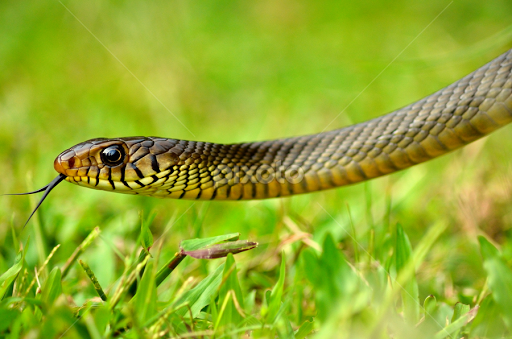
Br. Hari told me just before lunch that he walked into the library and was startled to see a large snake! Two of the students managed to kill the snake, which turned out to be a rat snake. It was not poisonous but so many people have a fear of snakes that the temptation to kill one when it is seen is almost overpowering.

I was in the library earlier in the morning, but it must have been before the snake crawled in. There is a small hole in the screen that apparently the snake used to enter. The hole is thanks to rats, or at least that’s what Fr. Mariano told me. The cobra is native to India and I hope I never run into one, for that matter even the rat snake is something I hope to avoid as I fall in the category of the fear and/or hate factor in regards to snakes. I know it’s a bit irrational as the rat snake (and even the cobra) help to keep the rodent population down.


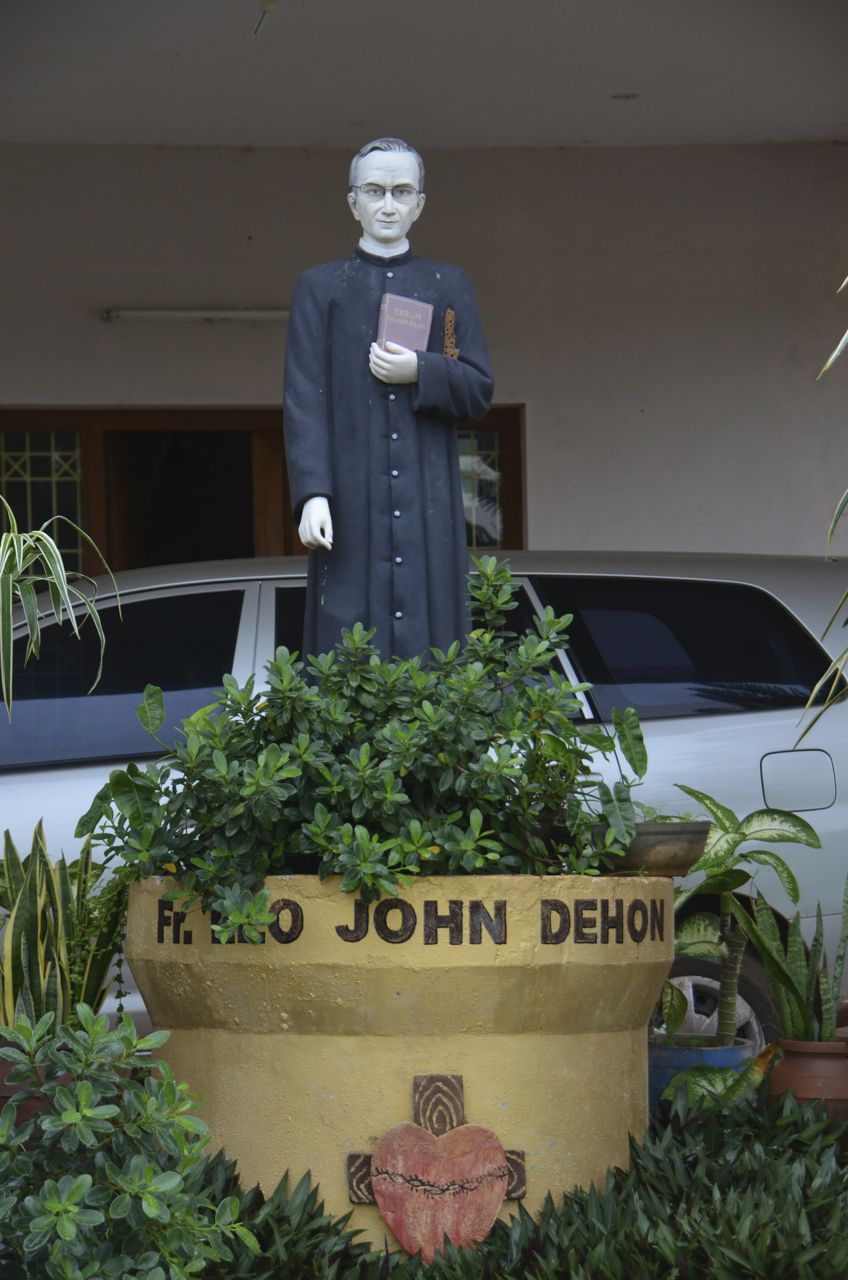
A statue of Fr. Dehon at Eluru

A statue of Fr. Dehon at Eluru

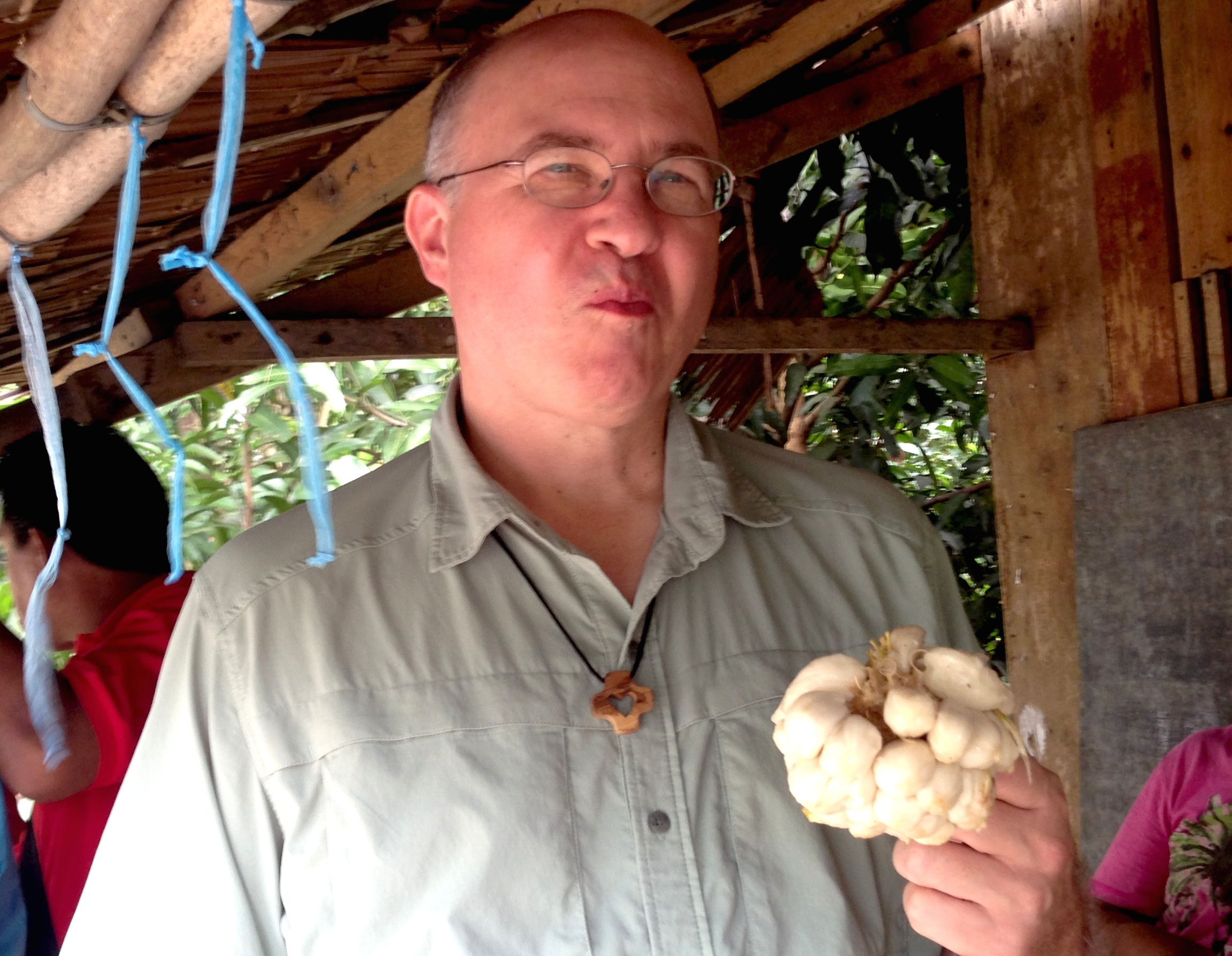
Fr. Joseph, our house treasurer, went shopping this morning with John our cook. Among their purchases were grapes served at lunch. Not paying as close attention as I should have I said that I found it odd that some Italians I know peel the grapes before eating them while I and most Americans enjoy the skins. As that last word spilled out of my mouth I noticed all the students around me were spitting their grape skins out and putting them on their plates. Apparently tradition at least in this part of India dictates skin-free grape eating.

The community here in Eluru includes two priests and 17 students. Next year, there could be 27 students,depending on how many novices profess vows in May. The house is a large two-story structure, not counting the covered roof area. There is the main living wing and a one-story dining room/kitchen wing. It is one of several religious houses clustered in about a five mile area around Vinjannilayam School of Theology.

The house has room for 40 students and has six faculty rooms. Each student has a room and private bath. The rooms are spacious and would be the envy of any student at Sacred Heart Seminary and School of Theology in Hales Corners!

For students, the bicycle is the chief means of transportation to and from school; the one exception is when it rains the battered old house jeep is employed to chauffeur the students to and from school.

More often then not when one of the priests or students travels longer distances it will be by bus. Today Fr. Joseph Gopu went to Guntur. That’s a three-hour bus ride from Eluru and includes a change of buses in Vijayawada. Even though this is now my third visit to India I have still not experienced bus travel.

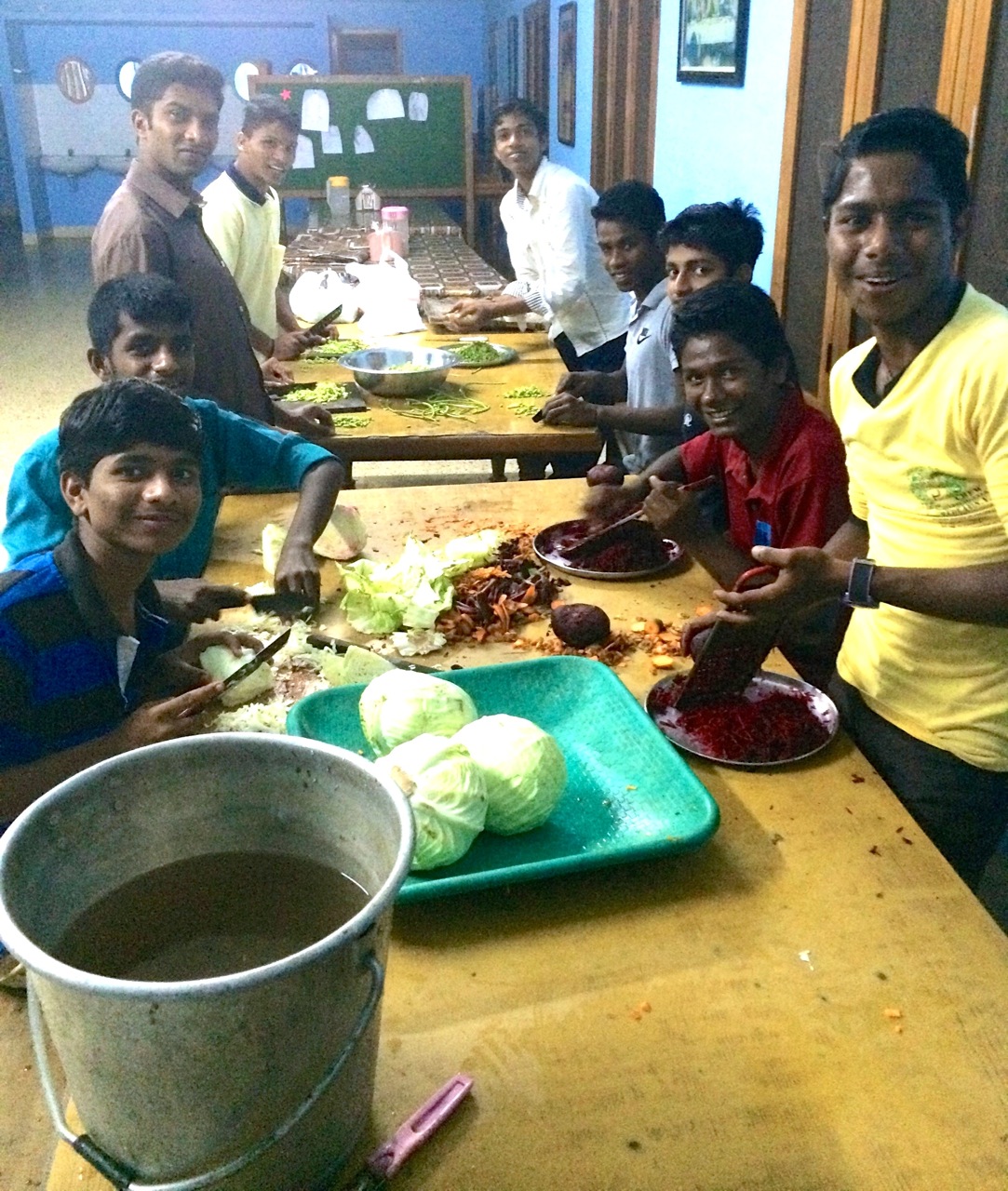
Most of our students here come from farming or fishing backgrounds. However, one of the third-year students, Tinu Thomas, informed me that his father is a mason. True to form, in today’s extended work period he and serval other students were laying bricks with mortar and trawls in hand.
I’ll be here until Saturday, when I move to the novitiate about an hour away.

Sunday in Ho Chi Minh

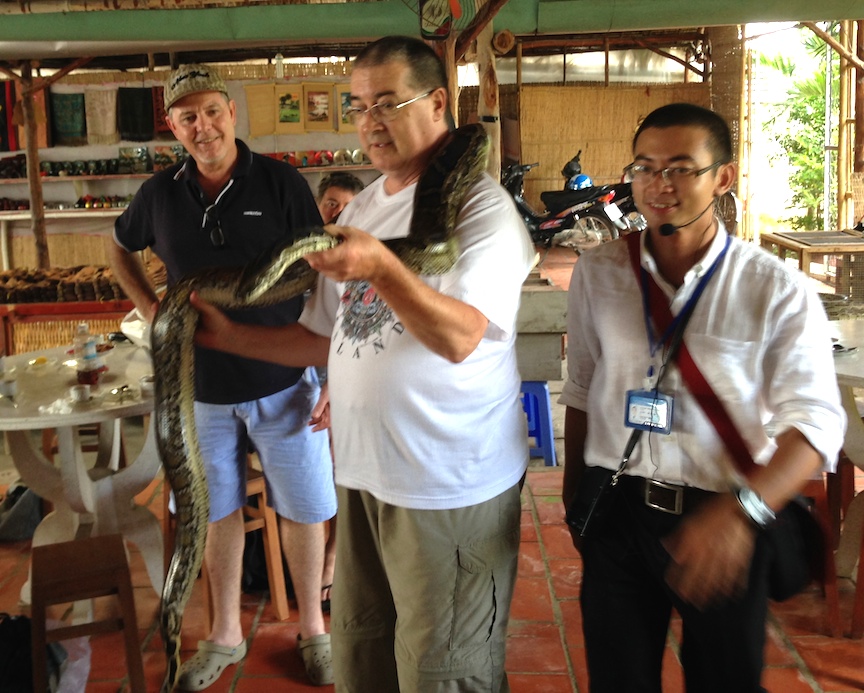
Fr. Wayne shows off his adventurous side in Vietnam, holding a python during travels with Fr. Steve.

Fr. Wayne shows off his adventurous side in Vietnam, holding a python during travels with Fr. Steve. Fr Wayne is in Vietnam helping the district set up an archives.

If you have read Fr. Steve’s posts you know that Fr. Wayne Jenkins, archivist for the US Province, has been in Vietnam during the past few weeks helping the district to set up an archives. Fr. Wayne writes about a typical Sunday in Ho Chi Minh:

This was my second Sunday in Ho Chi Minh City.  For the Vietnamese SCJs and for the students, they use their motorcycles to travel to parishes and to convents for the celebration of the Eucharist and for teaching religious education. For the foreigners like myself, I can celebrate in the community house or in one of three places where foreigners may concelebrate only!

For Saturday evening, the celebration of the Eucharist is at 6:00 p.m. at the Archdiocesan Pastoral Centre.  The Filipino community organizes things with the Carolus Barlomeus Sisters. The Youth Choir is wonderful!  The priests are from the Philippines, Italy, Belgium, India and Canada.  Our students are the altar servers and the greeters.  The seating is like in the theatre.  The international community in Ho Chi Minh attend.

Since this month is the celebration of the moon, the children carry paper lanterns down the stairs to the altar.  I am amazed by how the mothers manage to accompany them!  Everyone mingles after the liturgy to share what they had been doing during the week.  It is a friendly and warm community.

For Sunday morning, the cathedral has a celebration of the Eucharist for tourists at 9:30 a.m.

In the afternoon, at 2:30 p.m., there is a celebration of the Eucharist at a Dominican monastery.  Once again, the Filipino community organizes things.  It is a much smaller group of people in a chapel.  The youth choir is very energetic!  A Filipino priest presided while Fr. Rino, SCJ, Fr. Vincent, SCJ, another Filipino priest and I concelebrated.  After the liturgy, everyone was invited to have snacks in their hall.  A volunteer makes a noodle dish.  Coke or water is served with some bread.  The noodles were very tasty!  It is like coffee and doughnuts after a liturgy on Sunday in North America.

Each celebration is different.  Our SCJs enjoy liturgies at the Pastoral Centre and Dominican monastery.  I can understand why!

A week with our SCJs in Vietnam

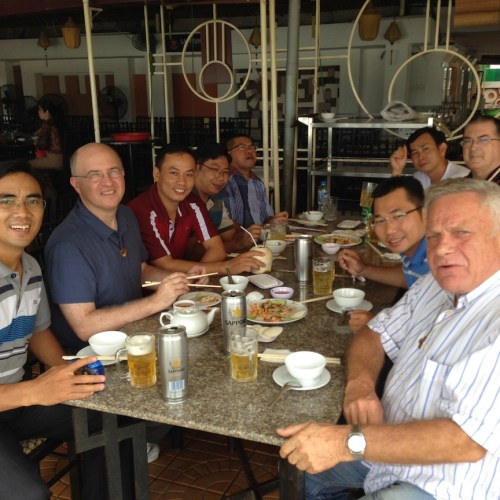
Fr. Steve joins SCJs in Ho Chi Minh for a meal

Fr. Steve and Fr. Wayne join SCJs in Ho Chi Minh for a meal

As noted previously, Fr. Stephen Huffstetter has been in Asia during the past few weeks visiting our SCJ communities in the Philippines and Vietnam. This morning we received several blog entries from him, starting with Fr. Steve’s travel from the Philippines to Vietnam:

Tuesday, September 16; Ho Chi Minh City (Saigon), Vietnam

Vietnam was large in my conscience during my growing up years, as we heard reports from the war every night on the news. Later, I learned more about the country when I served in formation; most of our seminarians then were Vietnamese immigrants. I’m sure this will be an eye-opening experience for me, though I know that six days will only be enough for a brief introduction.

Our SCJ community has begun the process of applying for official recognition to be able staff parishes and engage in other works. This will take several more years. For now what we are able to do is offer education for those men who wish to become SCJs. Most of the candidates have already finished college and are fairly sure about having a vocation to religious life as they enter the discernment process.
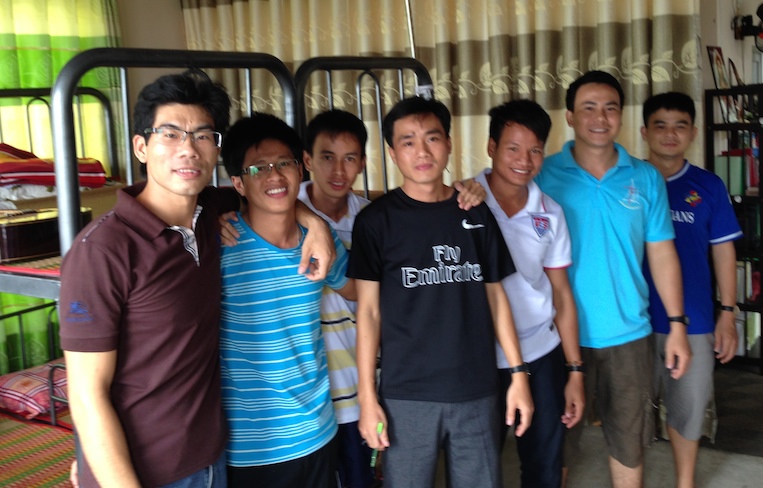
Students at the dorm

Students at the dorm

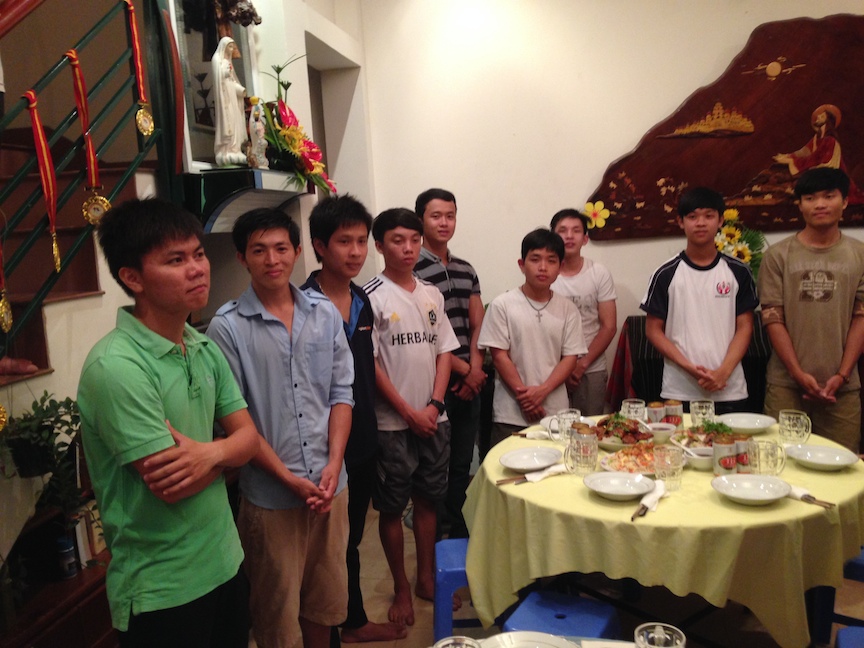
Forty students and SCJs live in neighboring houses in an area north of downtown. The main house is thin and tall, with the chapel on the roof, which offers a good view of the city. The students share dorm rooms with three sets of bunk beds. Some of the candidates arrived just over a week ago and their main challenge is to improve their English. I was asked the basics: “What is your name?” “Where are you from?” “How are you today?” Many times. The language in the house and at prayer is English to prepare them for philosophy and theology studies in the Philippines.

We took a taxi from the airport. The community owns no cars, only motorbikes. The ratio of motorbikes to cars on the road must be at least 20:1 and it is mesmerizing to see them weave around one another, especially around intersections and traffic circles.

My main purpose in visiting is to better understand the needs of the growing district and look at ways in which the U.S. Province might collaborate with it as the SCJ charism finds new expression in a new land.

Fr. Rino is the district superior, originally from Italy. Fr. Thai was ordained just a couple of years ago and is from the second group of professed Vietnamese SCJs. We sat on a balcony overlooking the neighborhood as they filled me in on how they developed these houses and programs, and some of their future hopes and plans.

Once the sun went down it was time for adoration and evening prayer. We took our shoes off to enter the chapel, as is the custom here. During the quiet time all the lights were turned off, and only candle light illuminated the monstrance with the Blessed Sacrament. It was a calm and peaceful chance to recollect after a full day. When the lights came on for the prayers and hymns I was pleased with the gusto with which the group sang and participated.
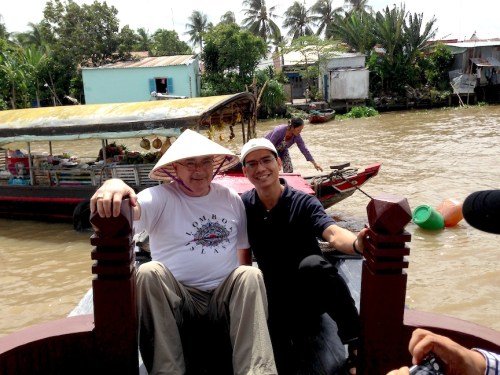
 

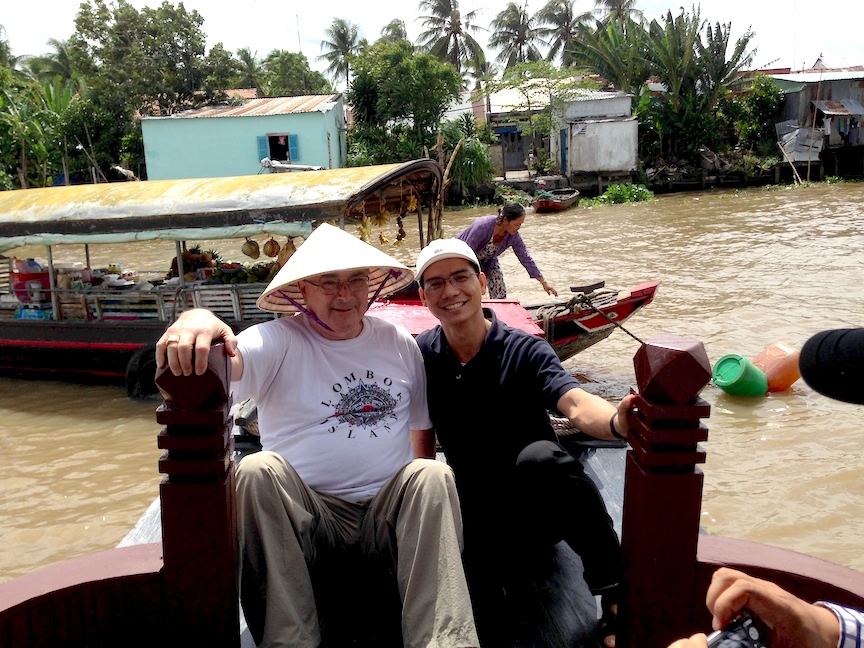
Fr. Wayne and Trung on the Mekong Riover

Fr. Wayne and Trung on the Mekong Riover

Wednesday, September 17; trip to the Mekong Delta

While in the Philippines I spent most of my time touring our SCJ apostolates. Since we haven’t yet developed such projects here, the community suggested that  I use some of my time to get better acquainted with the culture of the country. Today we took a bus and boat tour of the Mekong Delta, a couple hours south of Ho Chi Minh. Bat, a theologian serving his pastoral year, and Trung, a candidate, were guides for Fr. Wayne Jenkins and me. Fr. Wayne is helping the community set up its archives, and has also tutored English. His favorite classroom is in one of the neighborhood coffee shops where students can work on the art of conversation.

While waiting for our tour bus to arrive, we strolled around a park near the city center. The public space sprang to life with activity even in the early morning hours. Elders did more gentle movement exercises while another group did aerobics to lively music.

Once we cleared the metro area we passed acres and acres of rice fields. Most of the work is still done by hand. Scattered among the fields are family graves. Working alongside of the graves of ancestors strengthens the ties to the.

When we reached the Mekong River we switched to a boat. The area features a floating market, with many goods, especially fresh produce, sold from boats on the river. Many of the boats also serve as homes for the merchants. We pulled alongside a fruit boat and had fresh bananas and rambutan.
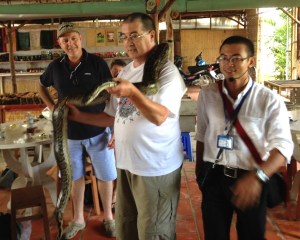
Fr. Wayne, told that the snake is "used to people," gets up close and personal with a python

Fr. Wayne, told that the snake is “used to people,” gets up close and personal with a python

We sampled green tea and coconut candy at a village shop where everything was made from scratch. I didn’t try any of the snake wine, but Fr. Wayne and I did hold a live python after reassurances from its handler that is was used to people.  There were many local crafts for sale, creatively using byproducts from coconuts in every way imaginable. These folks depend on tourist dollars for their livelihood, so I felt guilty for being more of a window shopper. I appreciate the work, yet try not to buy what I do not need.

Lunch featured local fish and produce. The restaurant was surrounded by orchards where we could see papaya, jackfruit, mangos and other fruits growing. Locals displayed their traditional music and dance, which told ancient stories of life on the river and in the fields. Around the tables we met some new friends, including a fun group of Malaysian women celebrating a 15 year class reunion with a girls road trip.

Back in town we toured the marketplace. A stack of U.S. $100 bills about three inches tall caught my eye. When I saw that they weren’t real I learned that when remembering deceased ancestors the custom is to burn items that they will need to ensure a good life in the hereafter. They also showed me paper houses, with cars and furniture that can also be used for the same purpose.
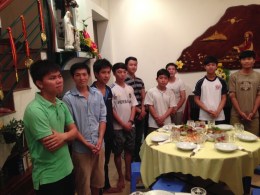
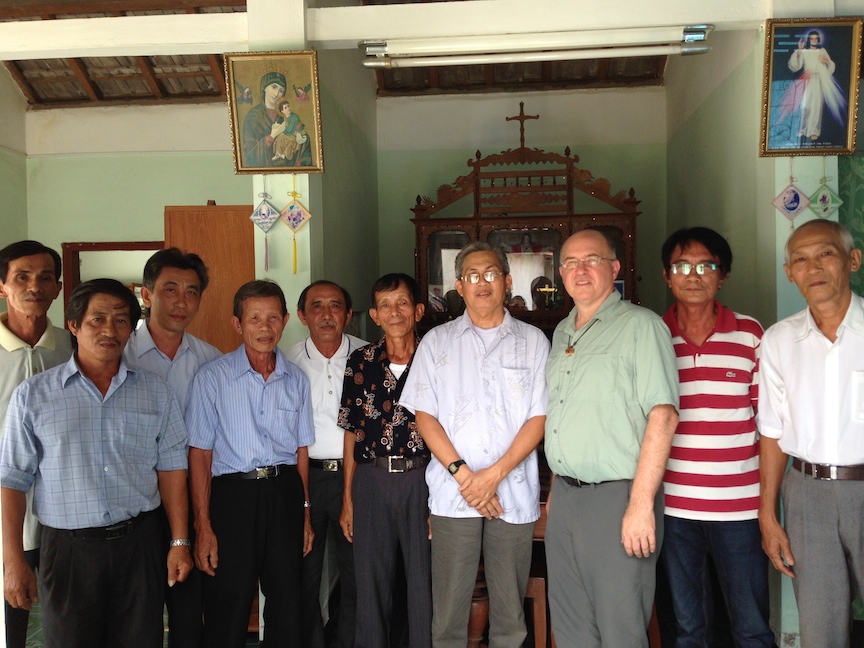
Members of the Apostolic Fraternity

Members of the Apostolic Fraternity

Back in the city, Fr. Vincent Dung invited us to his home for supper. Vincent and Fr. Joseph joined the SCJs through the French Province even before the international district began. He serves a nearby parish and oversees the Apostolic Fraternity, a house of discernment to develop the faith of about 30 Catholic men attending school. Several past students have gone on to become priests in the diocese. They prepared a speech of welcome, and also shared gratitude for the help the SCJs have given them.
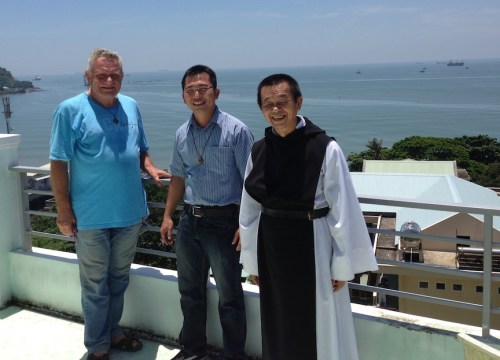
 

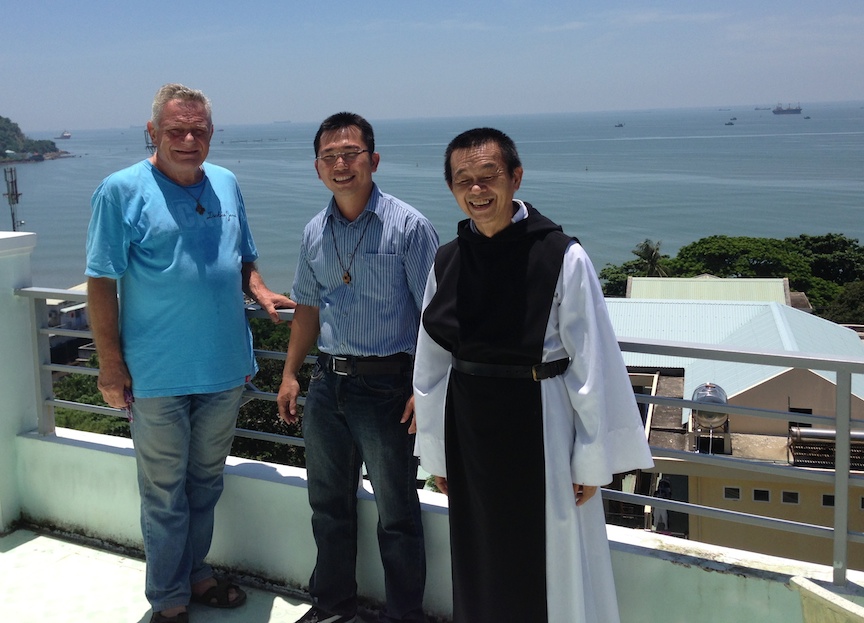
Fr. Rino, Fr. Loc and Abbot Matthew Vu

Fr. Rino, Fr. Loc and Abbot Matthew Vu

Thursday, September 18

Today we traveled south to the coastal town of Vung Tau to visit the Cistercian Monastery. One of their confreres, Fr. Nam is in residence at our Chicago Formation house. When Abbot Matthew came to visit him last year he extended a warm invitation to me to see their community.
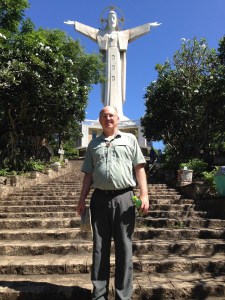
Fr. Steve at the Shrine of Vung Tau

Fr. Steve at the Shrine of Vung Tau

Vung Tau has two well known Catholic Shrines. First we stopped to visit the statue of the risen Jesus, which sits atop a coastal mountain, arms spread in welcome. We worked up quite a sweat climbing some 800 stairs to reach the top. In the last part of the ascent, inside the body of the statue, we were asked to take off our shoes. When we emerged at the top we stood on the shoulder of Christ, with a breathtaking view of the seas and city below.

The second shrine is dedicated to Mother Mary. The stairway leading up had life-size Stations of the Cross for pilgrims to pray and reflect at while catching their breath. While Catholics are less than 10% of the population, the people’s practice of the faith is quite public and strong.

We reached the monastery in time for midday prayer, chanted by about 60 monks. They have over 100 in their foundation, with 30 novices in the process of joining them. My Vietnamese language skills are non-existent. Fr. Loc was gracious to translate my greetings and prayers for each of them.

This evening I met up with an old friend and former member of the community, Ha Tran. We met outside the Cathedral of Notre Dame, and went to a nearby restaurant for a snack and drink. Ha now lives in California but was spending time in Ho Chi Minh. He says “hello” and thanks all the SCJs who helped him along the way.
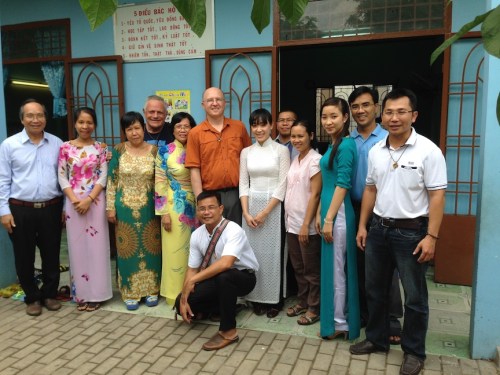
 

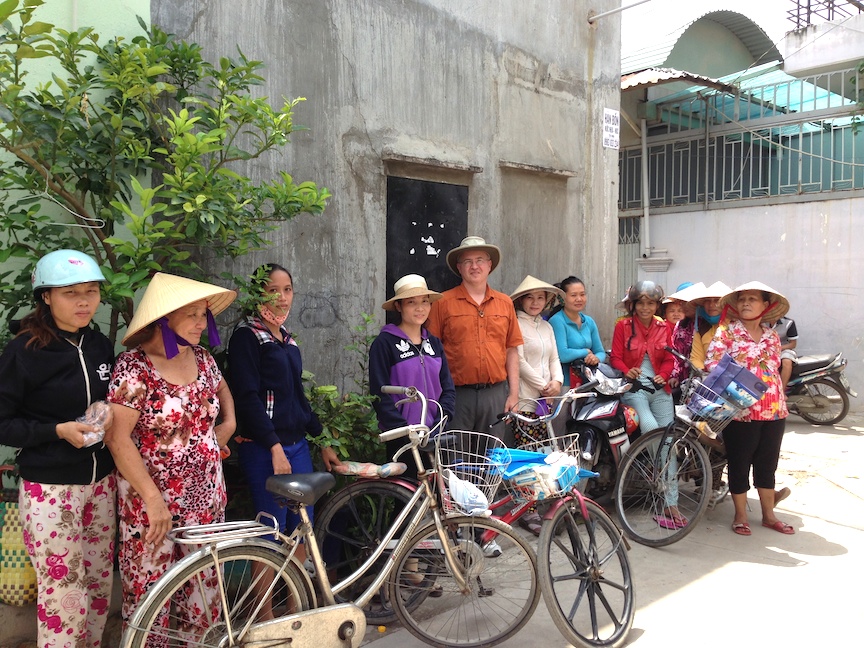
Fr. Rino and Fr. Steve with school staff

Fr. Rino and Fr. Steve with school staff

Friday, September 19

I presided at morning mass for the students with instructions “to keep the homily short because the new guys won’t understand too much of what you say anyway.” Still, their faith and enthusiasm is an inspiration to me. Many come from agricultural backgrounds or fishing villages. All will finish college before going to study philosophy in the Philippines.

Frs. Rino, Vincent and Loc took me to St. Paul parish where the SCJs do help-out ministry and seminarians can do their internship. The diocesan pastor, also Fr. Vincent, has seen tremendous growth in the parish over the 39 years he has been assigned there. He started with 700 parishioners and now serves 13,000. More than half are recent migrants to the city looking for work in the many factories. Ho Chi Minh produces many products, but especially shoes and clothes in this area. One factory we drove by employs 50,000 workers!

The parish has a shrine to the Vietnamese martyrs. From some of the earliest days of Christianity in this part of the world, people have known the true cost of discipleship. It has produced a deep and enduring faith.
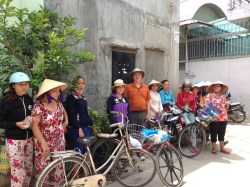
Parents wait to pick up their children from school

Parents wait to pick up their children from school

We visited the school the SCJs help sponsor for migrant children new to the area. Each of the three classrooms is about the size of a two-car garage, and seats 40-50 children. The dedicated teachers work two shifts, with younger kids in the morning and third and fourth graders in the afternoon. The materials are low tech, with chalk and blackboard and lots of group recitation. The youngest were taking turns with a pointer going through the letters of the alphabet. The children are motivated to learn.

We enjoyed a folk dance the youngest girls performed for us. Afterward we met some of the parents who were waiting by their motorbikes to pick up their children. Lots of smiles and words of gratitude to the SCJs for helping to provide a better future.

The school is currently in a rented building. The lease expires in another year-and-a-half, and the owner wants it back to expand his business. The community has found an alternate site, but it will require some significant money. In Ho Chi Minh City, like any major metropolis, the land is more expensive than the actual building. They have some local pledges of support, and the district asked me to see if the U.S. Province can also find ways to help.

When we arrived back at the formation house the students were busy with work period.  They were fencing in a garden to grow herbs and vegetables. I wasn’t much help with the construction project so I tried to increase their English vocabulary with words like “pliers,” “wrench,” “nuts” and “bolts.” I don’t know if that will be much help to them in their study of philosophy or not!

In the evening I was treated to a water puppet show, a beautiful, ancient tradition. The synchronized swimming of the puppets was worthy of an Olympic medal. Dragons, fish, farmers and kings paraded in color before our eyes. The music was enchanting even if I couldn’t grasp the lyrics.
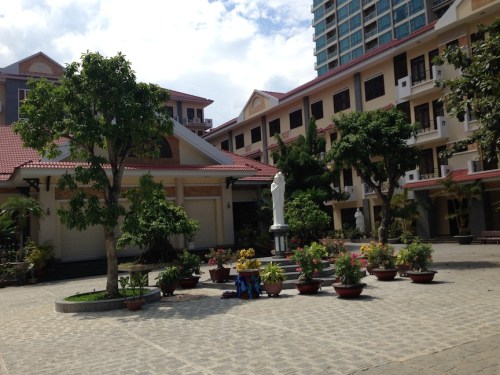
 

Bishop's residence

Bishop’s residence

Saturday, September 20; Nha Trang

When Fr. Loc told me he’d arranged for us to stay at the bishop’s house I imagined something completely different than the six story, 200 room complex we pulled into. The rooms themselves are simple, with a bamboo mat on top of the bed frame, a desk and closet. There are enough rooms for all the priests of the diocese to stay for meetings, retreats and days of recollection. Nah Trang is a beautiful coastal city which has developed itself as a tourist destination. In addition to shoppers and sunbathers walking along the sidewalk, 100 seminarians gathered this evening in circles of ten in the courtyard, bibles in hand, for their weekly faith sharing.

When I took a stroll down the sidewalk, people passed out fliers for nearby restaurants. They were all in Russian, since that is where so many of the tourists this time of year are from.

A good number of our first SCJ vocations came from this diocese. The community arranged for me to meet several of their families to get a feel for everyday life and the role that families play in nurturing vocations.
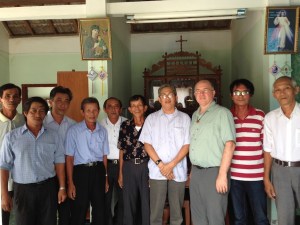
Visiting the family of one of our Vietnamese SCJs

Visiting the family of one of our Vietnamese SCJs

Our first stop was at the boyhood home of Fr. Thai, where his brother and family now live. They have three-year-old twin girls. It was funny to hear Saturday morning cartoons like Tom & Jerry speaking Vietnamese. Fr. Thai’s brother works on a farm where mangos are the area specialty. He also crafts large clay pots that are used for trees and decorative floral displays. His wife runs a beauty shop, a small 10 x 20 foot concrete building next to their home. She only has one beauty chair, but works with care and attention.

Most of the homes I’ve visited have one room that proudly displays family pictures, especially placing deceased parents and grandparents in places of honor. There were also many statues and holy pictures. The room is used to welcome guests and for family prayer.

Next we saw a nearby monastery; it is a growing community with 15 new novices. The chapel was completed 10 years ago and has a wonderful cultural touch. The roof is shaped like a field worker’s hat, honoring the common laborer. Their garden held statues of Vietnamese martyrs set up in an “S” shape just like the country itself.

Fr. Loc’s family hosted lunch –– a fun and lively crew. Courses of the festive meal were punctuated with the local toast: “mot, hai, ba, zo!” shouted out with gusto. His father laughed and told many engaging stories that had everyone smiling, though I had to wait for the translation to get the punch line. Many family members and friends joined in as it was an occasion for all of them to get together. They were honored that I came to their home, while I was humbled and honored by their care and generosity.

Fr. Quang Nguyen (same name as one of our SCJs in the States) has been working in a parish here, but will soon be moving to Rome for advanced studies in psychology. While the district is young they already see the Importance of preparing this generation to assume local leadership. He invited us to concelebrate the evening mass. In another touch of inculturation we carried three incense sticks into the church to honor the Trinity, and placed them in a clay pot in front of the altar. Many of the common prayers have a chanted quality, which actually kept everyone together and made the mass parts much easier for me to follow along.


Parish carnival in Nha Trang

Children at a parish festival in Nha Trang

Sunday, September 21

The days begin much earlier here than back home. We got to “sleep in ” until 6 a.m. because we had the second parish mass of the day at 7 a.m. This was the start of the new catechetical year. Students wear different colored scarves to symbolize the levels they have achieved. When the students reach 18 or so, and know their catechism well, they receive red scarves and become catechists themselves, teaching the younger children. Today a half dozen of them were honored and took up the mantle.

Today was a parish carnival for the children. Over the summer each time a child attended daily mass s/he received a ticket good for one game, which included dart toss, spin the wheel, kicking a ball into a goal, and shooting baskets. Some of the kids had quite a fistful of tickets when the games began. Where we often have a ring toss around pop bottles, the most surprising game to me had a pen with six live ducks roaming around and the goal was to loop a ring around their neck to win a prize.

After breakfast and a conversation with the pastor, Fr. Dominic, we visited yet two more homes for a light snack and then for lunch. Fr. Quang and Fr. Phuong’s families again set a wonderful table. My only complaint about the food is that they feed me too much. My saving grace is that I’m very awkward using chopsticks, and that slows me down. Some of the crowd giggled at my style, and offered coaching. Lest I go hungry there was always a spoon at my ready!

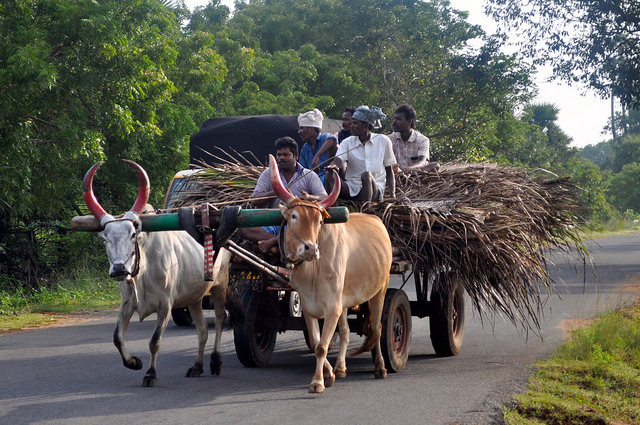
Ox in the road

A typical ox-drawn cart in India

A typical ox-drawn cart in India

As noted previously, Fr. Tom Cassidy is in India until October 20 assisting with formation and administrative tasks. He writes:

Since it is Sunday morning all the students are out on pastoral assignments. Just to give you a few examples: Harish, Benarji, Thambi and Syam (two second and two first-year theologians) are at Vempada, our own SCJ parish; while Anu and Vineeth, both third-year theologians, are at the cathedral.

Instead of staying home alone I took Fr. Joseph Gopu’s 7:00 a.m. Mass at the Holy Family Brothers House of Studies. It’s just down the road from us. Since it is a religious community of brothers they do not have a priest to celebrate the liturgy and our community provides the service. Fr. Joseph is the regular provider. He has two other Masses today; one at the cathedral and another in one of the substations of our parish.Br. Mary Babu and Br. Ajith joined me for Mass. They came by bicycle and Br. Prasad (all first year theologians) came by motorcycle after Mass with the intent of driving me home. I told Prasad that I vowed that I’d never get on a damn fool machine like that and would walk home.

I was offered the chance to ride as a passenger on one of the two bicycles Mary Babu and Ajith used to get to the brothers’ house for mass. I said no, I’d rather walk as I enjoy walking (what I didn’t say it I think walking is a bit safer then a bicycle). Because I decided to walk they all decided to walk!
The walk home took 20 minutes. It gave me a good chance to talk with Prasad and learn a few things about him and how he’s enjoying theology as a first-year theologian. Prasad is from the city of Guntur where a number of our students come from and where ordinations took place at its cathedral last February.As it turned out my decision to walk paid off as two ox carts were passing by and I have been trying since last January to get a good shot of this mode of transport. I call these carts our “sand stealers.” Across the road from our house runs a river that often is very low and is a good source of sand. The government allows locals to take the sand for use on their own land. However, I’m told more often then not they will sell the sand as a way of making a living.

The carts can be seen coming and going all day and even into the dark of early evening. They can be a traffic hazard as they have neither head nor tail lights. The only way of seeing them at night before you run into them is a reflection off the bullocks since all the ones I have seen are an off white color.Since the cart can only go at a bullocks pace they are very slow on the road. That’s not too difficult on our country road but you can find them on the four lane highway between here and Vijayawada more often than not taking cane to a sugar cane factory. Even though they are a road hazard I must confess I’ve never seen an accident involving one of them in my time here.

PS: I forgot to note that on the way home we also met up with a monkey! The few times that I’ve seen them along the road they have usually been in a group. Br. Prasada told me when we spotted the monkey that one of the students was attacked by monkeys last week. It couldn’t have been much of an attack as this was the first I heard of it and none of the students came home with any injuries.

Getting back online

Fr. Tom arrives in Eluru

Fr. Tom arrives in Eluru

As noted previously, Fr. Tom Cassidy is in India through October 20 assisting with formation and administrative tasks in the district. He writes today about getting back online in a country where WiFi is a luxury, not an easily found convenience around every corner. 

Yesterday morning Fr. Joseph Gopu (the house treasurer) took me to Eluru to get my MacBook set up to connect to the internet via a Reliance 3 modem. It permits me to connect anywhere in India via satellite. It’s not the fastest system in the world but it works. You pay by the month so I’m good until October 17th.

Now I mention all this sort of as an introduction to the experience of getting set up while shopping in a strange land. We take so much for granted when it comes to our purchases that when we’re taken out of our element it can become a strange and perplexing world. First off I would have been helpless without Fr. Joseph as the technicians were not English speakers.

The two of us left our house a little bit after 9:00 am for downtown Eluru, about a seven kilometer trip (4.3 miles) where we got ourselves in a real traffic jam. The road is not very wide to begin with and trucks, as in lots of trucks, were lined up and not moving. Joseph said they were lined up to be loaded with rice. A bus passed us going the same direction but in the other (opposite direction) lane. Joseph decided to follow the bus thinking “who’s going to argue with it!” It was the wrong decision and we soon came to a halt blocking both lanes coming and going. A few motor bikes managed to work their way around it, but for the most part we all were stuck as stuck could be. Finally, an enterprising gentleman (middle age I would say) got the bus and us and a few vehicles behind us to back up. We backed up about a quarter of a mile and turned left unto a side road Joseph knew about and worked our way around any and all obstacles and into the center of town.

Arriving at our Reliance 3 shop we were told it was closed for a holiday (or that’s what I understood was said). I think that something was lost in translation but they did eventually open their doors. By the way the shop is tucked away behind an ice cream parlor. I noted the ice cream parlor had a large generator out front since we lose electricity all too often it would be a disaster at a place that makes its money selling ice cream.

I must say that even working in translation the technicians were able to set up my computer (actually I could have done it myself). Now here’s where the surprise comes for a stranger to Indian ways enters the picture. First of all, we all removed our shoes before entering the shop. I don’t think this happens in all shops in Eluru but certainly here everyone automatically removed their shoes.

Here comes the surprise, in order to pay for the modem and one month use Fr. Joseph had to produce two identity cards, a small photo and then run out to another shop to have the cards and photo copied. I have no idea of why this was all required but I do know we could not leave the store with the modem unless and until these steps were completed.

It took almost noon before we got home. That being said, I am a happy camper. When I opened my e-mail for the first time there were 65 messages. I could imagine if I had to wait a few days how many more would be sitting there! Naturally, probably 55 were pure junk!
A few more reflections from the road in the Philippines

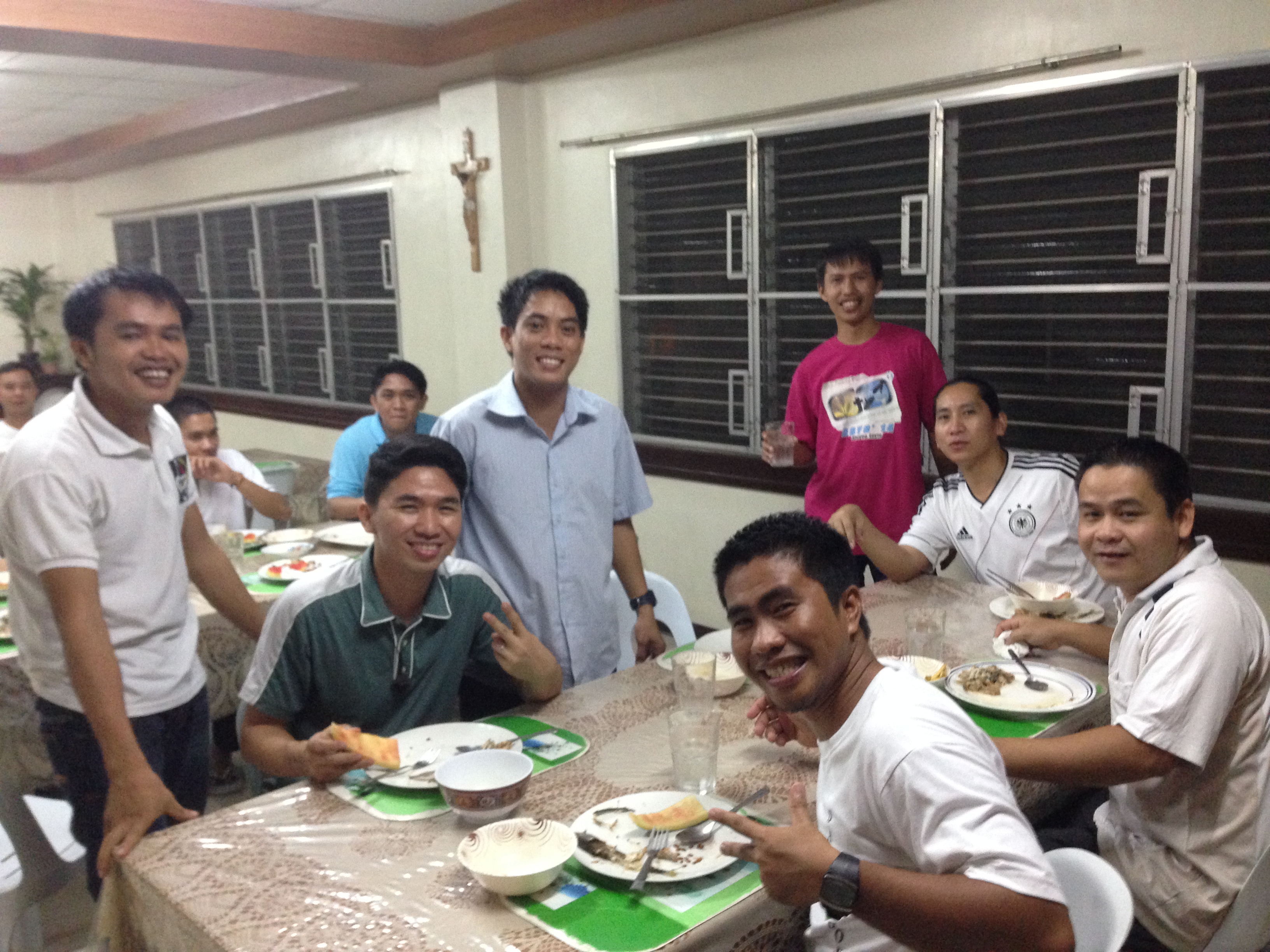
"I've been trying a lot of food I've never had before!" said Fr. Steve. We aren't sure if this face means that he likes his latest Philippines meal or?

“I’ve been trying a lot of food I’ve never had before!” said Fr. Steve. We aren’t sure if this face means that he likes his latest Philippine meal or?

As noted earlier, Fr. Stephen Huffstetter is visiting our communities and ministries in the Philippines. Today we have a “two-fer” — one text written on Sunday and one today for the province blog. Internet connections being a bit unreliable when traveling, we got both at once: 

Cagayan de Oro

I’ve seen and experienced so much in such a short time. I have much to think about and process and so many questions about a culture so new to me. Fr. Aloisio and Fr. Khoa served as today’s tour guides and gave me background on how our parish projects and formation programs developed and changed in the 25 years since the first SCJ foundations here. Fr. Al said that when he first arrived 20 some years ago he was ready to write a book about all his observations. A year later as he began to learn the nuanced complexities which are true of any culture, he wasn’t sure he could write even a page. I can identify with that already.

At the Shrine of the Divine Mercy

At the Shrine of the Divine Mercy

The Divine Mercy Prayer and devotion has caught on with many Filipinos, and they suggested I visit the shrine. The picture I had in my mind was completely blown away by the size and scope of the place of pilgrimage. The statue of the Sacred Heart of Jesus was as tall as a ten story building, his face alone bigger than me. We climbed up a staircase built upon the rays shining forth from the heart, and found a heart shaped chapel where people knelt in prayer. Signs encouraged people to “approach the Heart of Jesus” in prayer.

At the foot of the statue are beautiful gardens and lawn that are use for gathering spaces for outdoor prayer. Behind the statue is a large church, with seating for perhaps a thousand.

The shrine was built by lay people, and is run in conjunction with the diocese and a group of priests from the Marion Helpers community. We dropped by the rectory where Fr. Valerian told of his work hearing confessions, saying mass and providing programs for visitors. We had a lively discussion about “religious tourism.” The goal of any such devotion or shrine is to help people have a lively, daily faith and commitment to their community rather than be just an occasional filling station that makes people feel good for a short while. I suppose that’s the challenge in all of our parishes and other ministries.

In town we visited two contrasting shopping areas. The air conditioned mall could have been in most any Milwaukee suburb. It’s one of the few public places with (as they call it) “air con” and many townspeople just come in to cool off, window shop ands people watch. Then we stopped at the public marketplace, a vast concrete warehouse with rows upon rows of farmers selling fresh fruits, vegetables and dried fish of all shapes and sizes.

Students at work!

Students at work!

We arrived home as the students were finishing work period. I saw then sweeping off the basketball court with brooms made from coconut leaves. This Hoosier was tickled to find that basketball is also king of the sports in the Philippines. I picked up a ball and started shooting around with one of the guys. You can have a great conversation between shots and the students were grinning to watch the old man nail a few jumpers.

I met a group of young women visiting the compound for a Dehonian Youth Missionaries gathering. The Philippine Province has tried to spread Leo John Dehon’s message to a wide audience, and I’m encouraged to see it taking root among the laity.

After supper we visited the SCJ parish in the nearby Aluba neighborhood. The formation house is within its boundaries and in makes a good training ground for seminarians to do apostolic work or Deacons to intern. Fr. John spoke of the challenges of having sections of the parish both wealthy and poor, and trying to bring the two together as a faith community.

Celebrating Mass

Celebrating Mass

Locuban

Yesterday I presided at morning mass with the students in Cagayan. We took a couple of group pictures, then I felt like a rock star or visiting celebrity as they lined up for individual pictures before I bid them farewell.

Fr. Arthur (Totong) is the district treasurer, vocation director, and like most every religious, wears many other hats as well. He was born and raised in the area, and proved an entertaining and informative tour guide as we wound our way five hours through costal villages and mountain huts, rice paddies and colorful villages in the Zambuanga del Sur region. Some years ago there were clashes with militants in the area, but recently it has been calm. We did pass a couple of police checkpoints as they try to keep the area safe.

Totong spoke of his hopes for the SCJ community as it grows and matures in the Philippines. He described a Filipino value of wanting to show generosity and give back, and hopes one day they will provide missionaries to areas of the world and congregation in need.

We ate at a few local spots Totong knew along the way. The chiles here are way too hot for my taste and he prevented me from trying one I surely would have regretted biting into. I’ve been willing to try many different foods and accept the hospitality of what I’m offered. So far I’ve held up well, and he complimented me for having a “missionary stomach!”

I was told the novitiate in Locuban is one of the most beautiful spots in the congregation. It is build on the side of a mountain, and the chapel overlooks rolling mountains and lush green valleys. With mist rising over the hills I felt like I was in the Blue Ridge or Great Smokey mountains until I noticed that most of the trees are palms. The setting is remote and so very calm and quiet. Once the sun set the view out chapel windows looked like solid black paint in the absence of any light.

Three SCJ priests and a deacon serve the Dumalinao community about 15 minutes away. They are responsible for 92 chapels. Some are accessible only by foot and it is a special occasion whenever they are able to say mass in those communities. They put a lot of emphasis on training local catechists and lay leaders who can pass on the faith and keep it vibrant.

Fr. Lukas, originally from Indonesia, studied ESL in Hales Corners in 1996-97 before being missioned to the Philippines. He asked about many of our guys he fondly appreciates, and we reminisced about some who have since gone on to their eternal reward.

A selfie with students

A selfie with students

The SCJs invited me to a favorite local restaurant to sample yet more local specialties. The place also featured Karaoke, which is another Filipino passion. They called for the American to sing something so with two beautiful backup singers with real talent and the church organist from the cathedral on the keyboard for support, I belted out “Let it Be.” We left with smiles and happy memories.

This morning I had mass with the novices, and after communion shared a little about myself and our province. They had lots of follow up questions at breakfast. Then they went off to take care of morning chores, feeding the chickens, watering the garden, gathering eggs and the like. They raise goats and cows as well.

Fr. Totong drove us further west to visit our parish in Kumalarang. We were joined by Fr. Yohanas from novitiate, and Juliette, a college-aged woman who has helped work in the various churches since she was nine. I asked her what she knew and thought of Fr. Dehon. She is so grateful the SCJs go to where people are and ask not just for their help, but for their opinion and input.

In Kumalarang the SCJs again serve many remote and hard to access chapels in the mountains. The pastoral team relies on some 120 catechists, and other groups of lay leaders and councils to meet the ongoing needs of the people. They have a simple guest house where those coming for monthly trainings can stay overnight due to the complications of travel in the area. A few couples were arriving to take part in a marriage encounter type program. The chapels and church halls are sturdy yet simple, with open air sides to cope with the tropical heat.

Visiting students and ministries on Mindanao

College program

As noted previously, Fr. Stephen Huffstetter is spending much of September learning about our communities and ministries in the Philippines and Vietnam. Today he writes from Cagayan de Oro, where he visited with undergraduate formation and the Kasanag Daughters Foundation.

Cagayan de Oro, Mindanao

Our boat arrived in port just after sunrise. Watching the crew maneuver the large ship into the dock with fist-sized ropes and mechanical winches gave me an appreciation of their skill at a complex task. Too often I take for granted the daily labors that produce and transport our daily bread.

Our pre-novitiate formation house is located in this university town. When we drove through the college campus I was surprised to see all the students wearing high school-type uniforms. It saves a lot on student expense as they don’t have to compete with the latest styles, and gives campus security a clue as to who are visitors. Tuition and fees here would run about $800 per year. While that seems so little compared to costs in the United States, that represents a year’s income for about a third of the population.

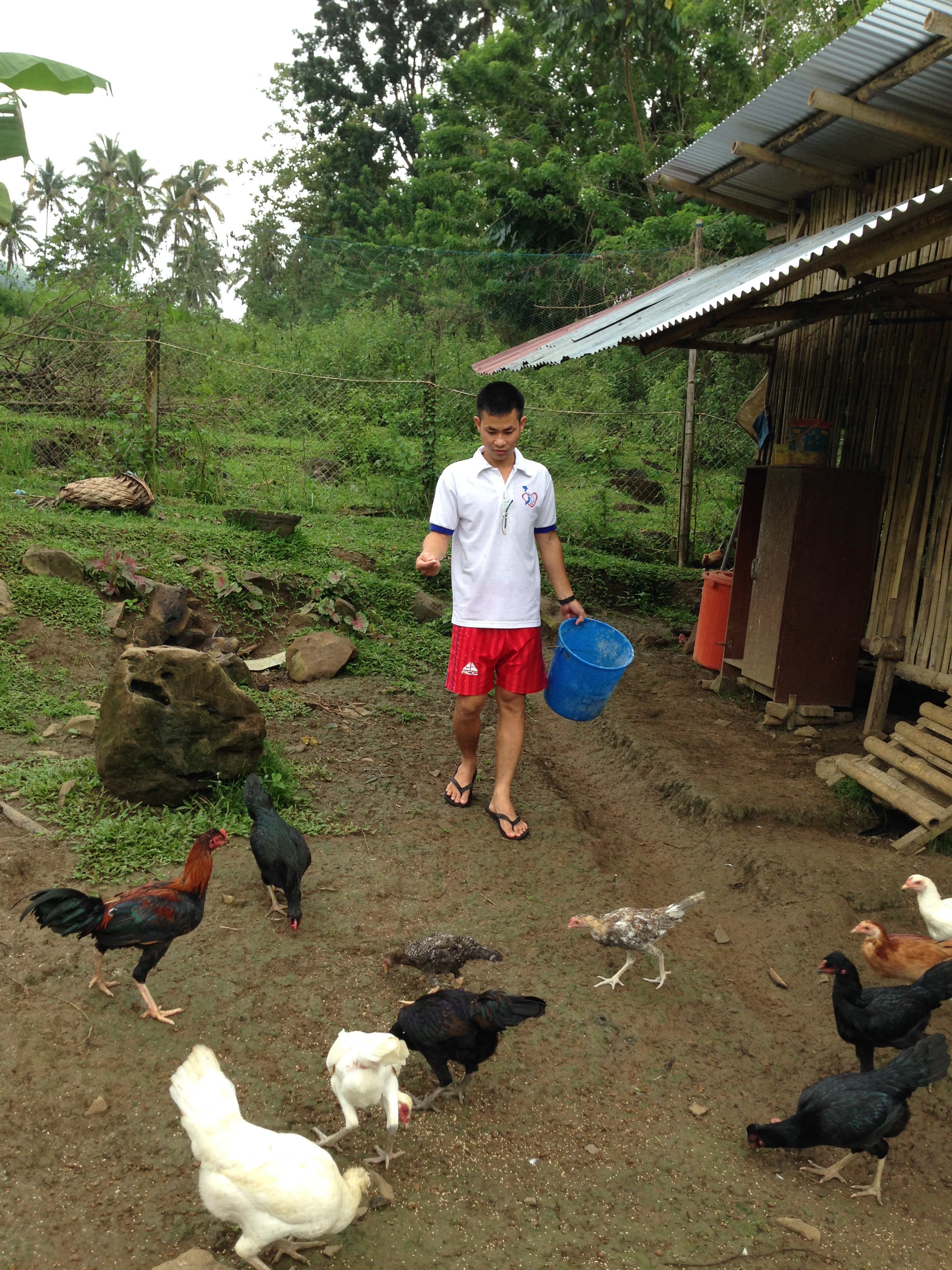
A student feeds the community chickens

A student feeds the community chickens

The formation house holds several different programs. The largest group is those earning a degree in philosophy. A smaller group is in an initial orientation program to learn about the SCJs and community life. Often these students improve their English skills to get them ready for college-level work. One section of the building is for the postulants, who after philosophy, are preparing to enter novitiate.

We headed away from the coast into the interior hills where SCJs staff a parish encompassing some 30 small chapels. As we drove I noticed people using the paved road to dry and even grind corn and other produce. The area is rich in coconuts and tropical fruits. Many of the people are tenant farmers who are able to get by only with the basics. I saw a good number of school-aged children along the way. When their families can’t afford uniforms or school fees the children often work in the fields or other jobs.

The parish sponsors a dormitory near the high school, which enables students from more distant villages to attend school. The place is simple, with sleeping mats rolled up during the day in the two common rooms. On weekends some will walk 10 miles home to spend time with their family.

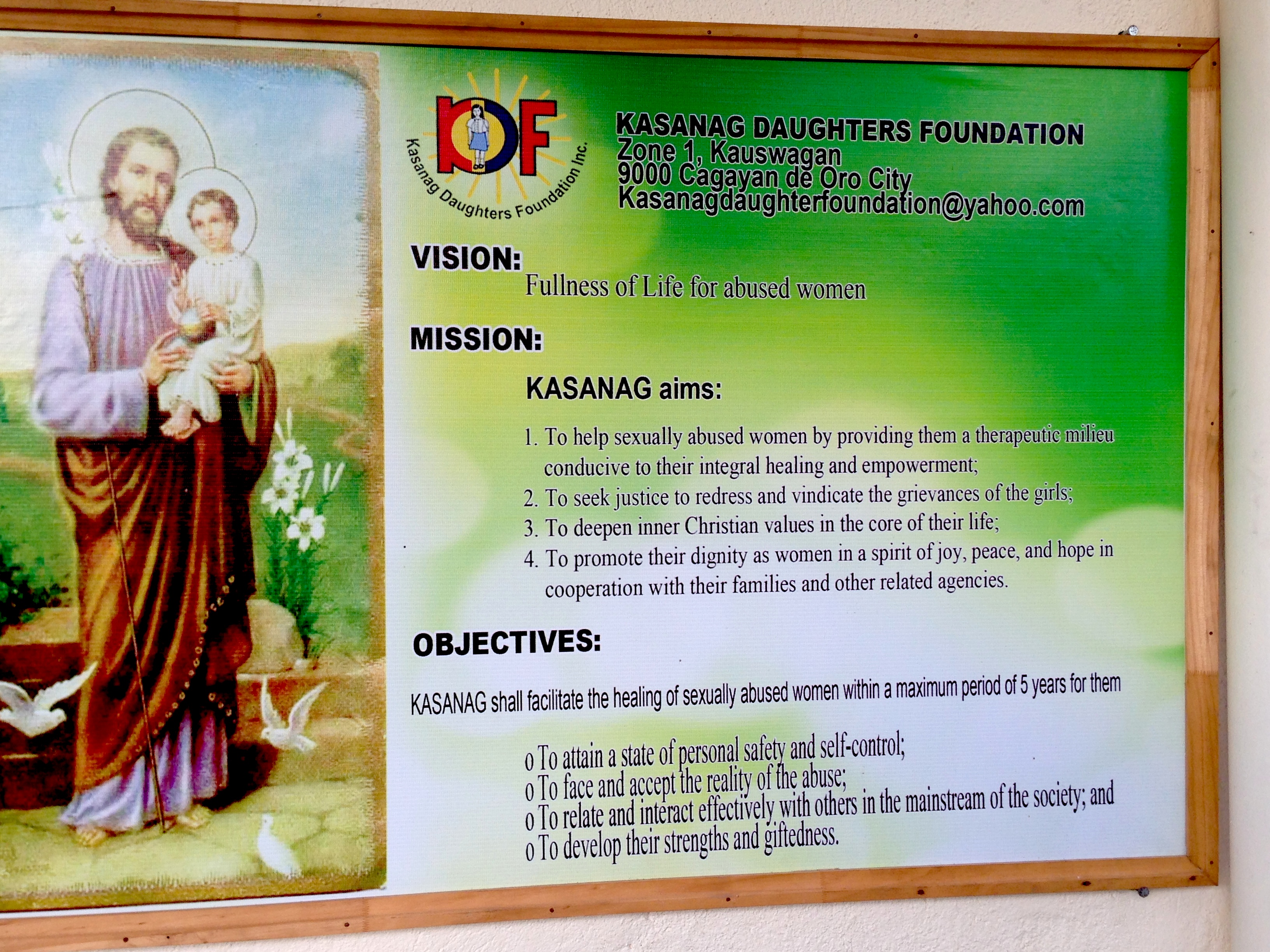
A sign describing the Kasanag Daughters Foundation

A sign describing the Kasanag Daughters Foundation

We visited the Kasanag Daughters Foundation, a home and place for healing for girls 11 and up who have been sexually abused. Kasanag symbolizes sunlight, rays, and the dawning of a new day. With the support of a house mother, social worker and counselors the girls attend school and try to rebuild their lives. This was the SCJ project I was most interested in seeing.

After a tour of the house, I sat in the living room with five of the residents who have been in the programs for several years. Two are finishing college, two are in high school, and one is still in elementary school.

They were fairly nervous in the presence of a stranger, but Fr. Robertus’ presence, since he is their chaplain, helped some. When I told them about my work with Native American children who often came from difficult family backgrounds, that helped as well.

I learned about their daily routines and the support they get that is allowing them to finish school and build a future. When asking about interests and talents, one girl loved music so I asked if she would mind playing a tune on her guitar. The whole group joined in with lovely harmonies on a hymn that was so uplifting. When it came time for a goodbye, I was asked to give them a blessing. I asked if they knew the song Amazing Grace. They all did, when I borrowed the guitar to lead a few verses they all joined in. Through many dangers, toils and snares I have already come… I appreciate the difficulties these young women and girls have been through and prayed for their continued healing.

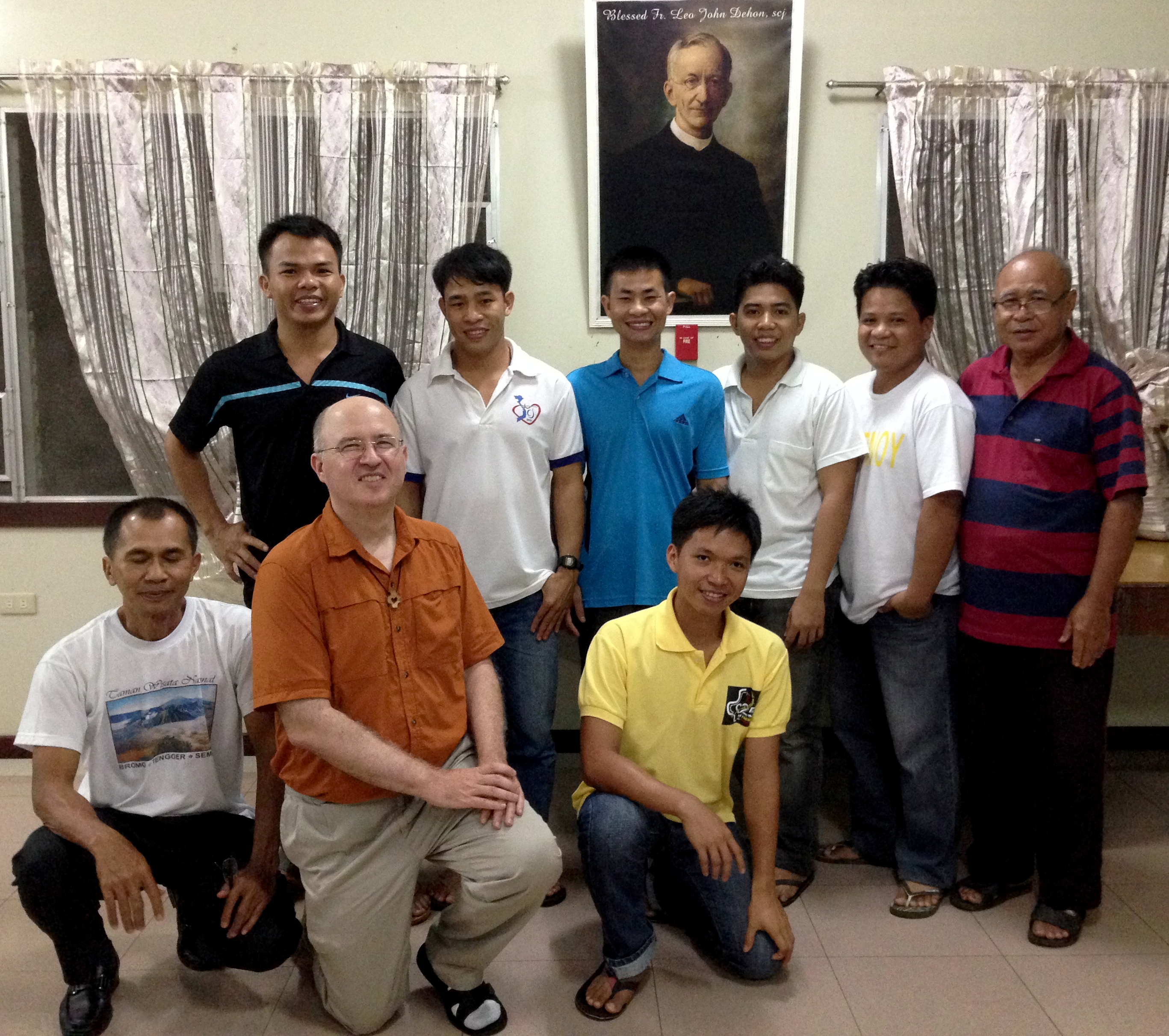
Fr. Steve with novices

Fr. Steve with novices

I was invited to have a conference with the formation students after supper. I spoke briefly about my vocation story and background of the kinds of ministry I’ve done, then opened the floor up for questions. They ranged from who is my favorite basketball player to who is my favorite philosopher. I’ve never been asked that one before. They also asked good questions about how you handle doubts and struggles along the way as you try to discern God’s call in your life. They had lots of questions about our US Province and asked about possibilities of someday studying or ministering in the States.

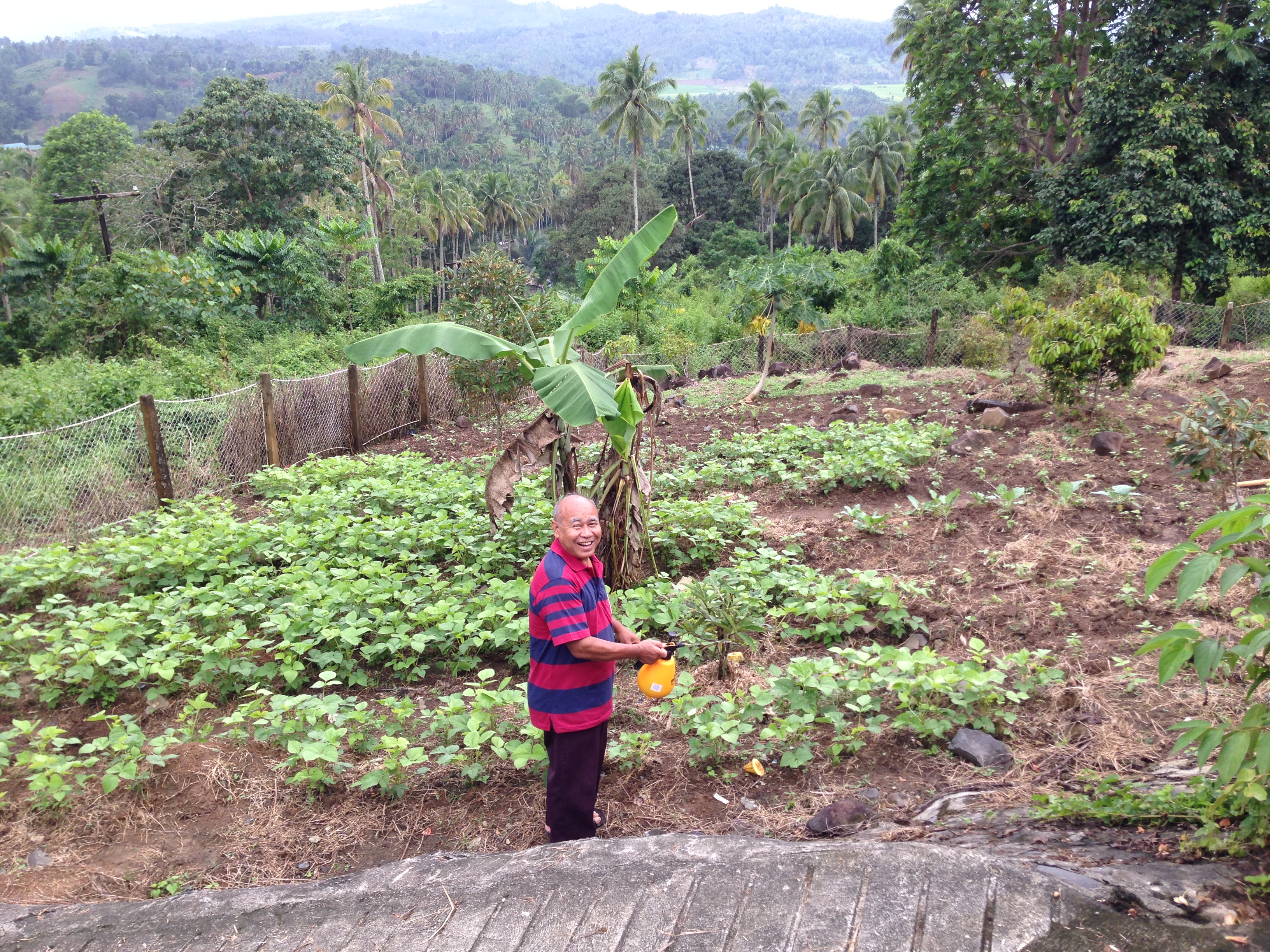
The formation staff double as farmers in student community!

The formation staff double as farmers in student community!

Back in India!


The new Indian District administration.

The new Indian District administration.

Fr. Tom Cassidy is in India until October 20, assisting with formation and administrative tasks. During his last week there he will be the moderator at the Indian District Chapter. Fr. Tom often keeps a journal while traveling; the following is taken from his first week of journal entries.

New district administration

Today began my three-day meeting with the new district administration who officially took office on this the feast of the Birthday of Mary. It was, by the way, also the 52nd anniversary of my own religious profession. We began the day with morning prayer and then the parish Mass.

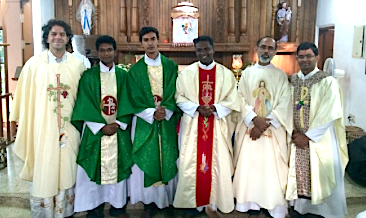
IMG_0814At the Mass I used as my theme the “yes” of Mary that made both the incarnation and thus human salvation through the acts of Jesus Christ possible. I used that to show there were three other expressions of “yes” we were experiencing: 1) the “yes” of Fr. Dehon who said his inspiration to establish our congregation came together at a visit to the shrine of Loretto, 2) the “yes” of the students to their call to explore their vocation with the SCJs, 3) and finally the “yes” of Fr. Thomas and his council to accept the responsibility of leadership of the Indian District.

Our meeting day began at 08:30 a.m. and we planned four sessions for each day, two in the morning and two in the afternoon. I called one of the first day’s sessions the “Game of 20 Questions.” Although this is my third visit, there is still so much I do not know of the SCJ Indian reality, especially within the context of church and society. The questions were a way for me to get a better understanding of the district and India itself.

I think we had a good day of meetings with a lot accomplished. Fr. Michael Benedict was asked to take minutes since a district secretary was a position still to be filled and he did it for a couple of years during the last administration.

I managed to get my walk in after lunch. Mother Nature was good to me as it stayed dry most of the afternoon.

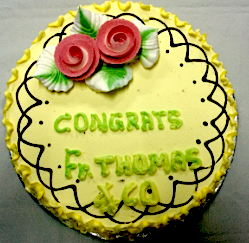
Screen Shot 2014-09-12 at 9.55.35 AMOn the last day of the meetings we celebrated the start of Fr. Thomas’ second term as district superior and the new term of his council. Fr. Emmanuel brought a cake, although it actually took a couple of days before we were able to eat it. Fr. Thomas and several councilors were away from the house for a few evenings, taking advantage of errands they could do in the larger city.

Speaking of travel to the city, all of the council travel is done by train. It takes most of the councilors 20 hours to get here by train. Much of that travel will be at night, so they’ll have second class sleeper arrangements: bunks stacked three high with no air-conditioning. No dining cars on the train. Meals are made in the community kitchen and packed for the ride.

Our last day of meetings ended at noon and I took my afternoon walk on one of the few streets of Kumbalanghi.

As I began my walk I ran into a Catholic funeral procession headed to St. George’s Church.

I knew it was a Catholic funeral since the procession was led by a purple banner bearing a cross. Instead of a line of cars with headlights on and funeral flags flying this procession was a long line of men and women dressed in their best, walking in silence heading toward the church.

At the end of the procession the body was carried on a cart pulled by men.

It was no ordinary cart but one built especially for a funeral. The body of the deceased was in a glass enclosed case, dressed in white with the face exposed. The top of the cart was covered with flowers as were the corners of the glass case. Just in front of the funeral cart the priest and servers walked behind men carrying banners representing various church organizations.

As a six-foot American I do stand out when strolling the street. I’ve been here since Saturday and have taken a daily stroll so that by now I think I’m less of an oddity — though I’m sure some wonder why in the world would someone want to take a walk for no other purpose other than to walk! Many people will greet me with a “hello” or more often a nod of the head that may well come from not knowing English. The children are the most expensive both in trying to speak English and in their broad smiles.

When I returned home I saw some of the students playing badminton. This and cricket are among the more popular games here.

Screen Shot 2014-09-12 at 10.43.18 AMOn Monday the church celebrates the feast of Our Lady of Sorrows, which, I am told, is a big feast day in this part of Kerala. Fr. Emmanuel, who hails from Andhra Pradesh, was saying to me this morning how vibrant the church is in Kumbalanghi and, I presume all of Kerala. He attributed that in part to the fact the church is strong [large number of Catholics] here and has long and deep roots in this part of India.

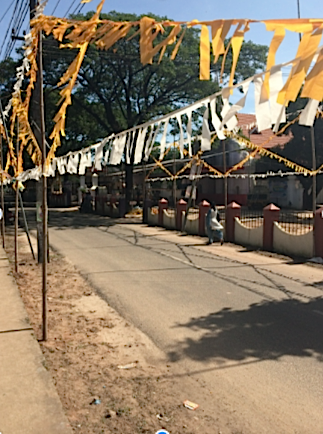
Near by St. George’s parish is getting ready for the celebration. It is a tradition to line the street in gold and white streamers. I will not at all be surprised if there is a large procession as part of Monday’s celebration. The decorations reminded me of the 175th anniversary celebration right here at St. George’s that I participated in last January.

Seeing the impact of SCJ community in the Philippines

Fr. Steve with SCJs in the Philippines

Fr. Steve with SCJs in the Philippines

As noted yesterday, Fr. Stephen Huffstetter is visiting our missions in the Philippines and Vietnam this month to learn about the community and its ministries there. Today he writes on the way to Mindanao:

In the past few days I’ve traveled using many different modes of transportation. I write this from a bunk in a cabin on a ship bound overnight for the Island of Mindanao. The Philippines consists of over 7,000 islands, and in many places, water is the primary means of passage.

photo 1a

SCJ parish in the Philippines

Monday we toured an SCJ parish on the outskirts of Manila. St. Roque is in the Bagonsilang district of Caloacan City. Fr. John Karl, the pastor, tells me that there are 50,000 families here in one of the densest parts of the city. He, Fr. Nino and Deacon Chris live in a simple concrete block structure from which they reach out to the needs of their flock. We arrived shortly after the feeding program for elders and youth. A worker was putting the finishing touches on a shower that homeless people could use. They also participate in a government program to sell, at cost, rice to poor families. They take seriously Fr. Dehon’s call to get out of the sacristy and go to the people.

At 4 a.m. yesterday, while driving to the airport, the retro radio station played the Jackson 5 version of “Santa Claus is Coming to Town.” And here I thought we began Christmas way too early in the States! In the Philippines, however, the Christmas shopping and decorating season officially kicks off with the advent of months ending in “ber.”

Fr. Steve rides the ferry

Fr. Steve rides the ferry

We flew to Cebu City and began a three-hour drive to the other side of the island where we caught a ferry and motorized tricycle to a remote part of Bantayan Island devastated last November by hurricane Yolanda. Working with the group “True Life in God,” the Priests of the Sacred Heart have helped sponsor and build 72 homes in two locations. Built with the labor of the affected families themselves and volunteers, people can have a basic cinderblock and bamboo/ plywood home for about $1,200. Francis, an architect who is giving his time to the project, and his wife, Beth, were our hosts and guides.

The government has been overwhelmed by the scope of the devastation so it has been necessary for private charities to step in. The first three months after the hurricane were merely relief efforts, making sure people had food and water to survive. It wasn’t until June, six months after the disaster, that people began moving into their homes and rebuilding a life for their families. Many of the men fish the sea for a living, and most of the village boats were destroyed as well.

photo 1

Above is a photo of a banner that hung at the entrance to the village. It says “Welcome Priests of Sagrado Corazon. A million thanks to your congregation for helping us. Building our home and bringing back our dignity as human beings.”

With the size of the homes, and many children sharing one room, I was reminded of my past ministry in Cherry Creek, SD, on the Cheyenne River Indian Reservation. Besides seafood, people tend goats and plant gardens and gather nuts and bananas from the countryside. Groves of bamboo provided housing and furniture material. As we visited one home I was amazed to see a middle aged woman scale a 50 foot palm tree in a matter of seconds to break off some coconuts and send them crashing to the ground.

While life is simple and poor here, I see people with joyful hope and gratitude. It’s humbling to see tears of appreciation and receive credit when it was not I but our generous donors who have made this project and many others throughout the world possible.

photo 2In the first location we stayed in one of the homes built to house volunteers who work with the communities. The amenities were very basic, yet the view of the sea and volcanic islands was priceless. A small gecko perched on the ceiling above. I was told not to worry because they are friendly. The first night villagers sat around us to tell the story of what they experienced in the aftermath of Yolanda and how they’ve begun to rebuild their lives. While I didn’t understand the language, except for a few brief translations, I could see in the emotions and expressions of how traumatic the devastation was. Yet many people spoke of how it has also pulled them together as a community and deepened their faith and they have emerged stronger and more united.

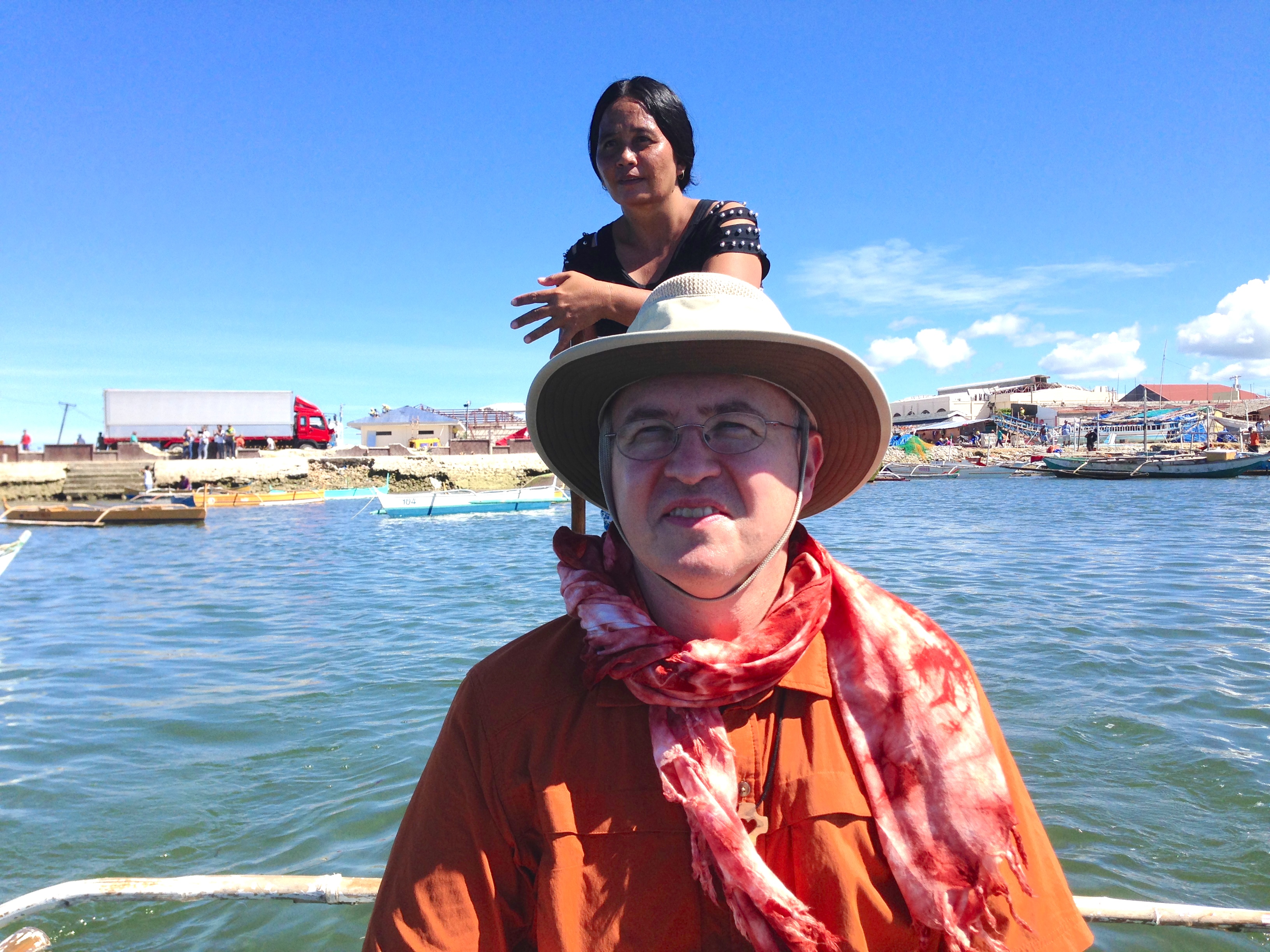
The second location was on a small island. I climbed aboard a small wooden outrigger canoe and a young man used a long pole to propel us across the shallow waters. Children gathered under a tent provided by UNICEF as their school. I laughed to hear them singing the same ABC song I learned as a child.

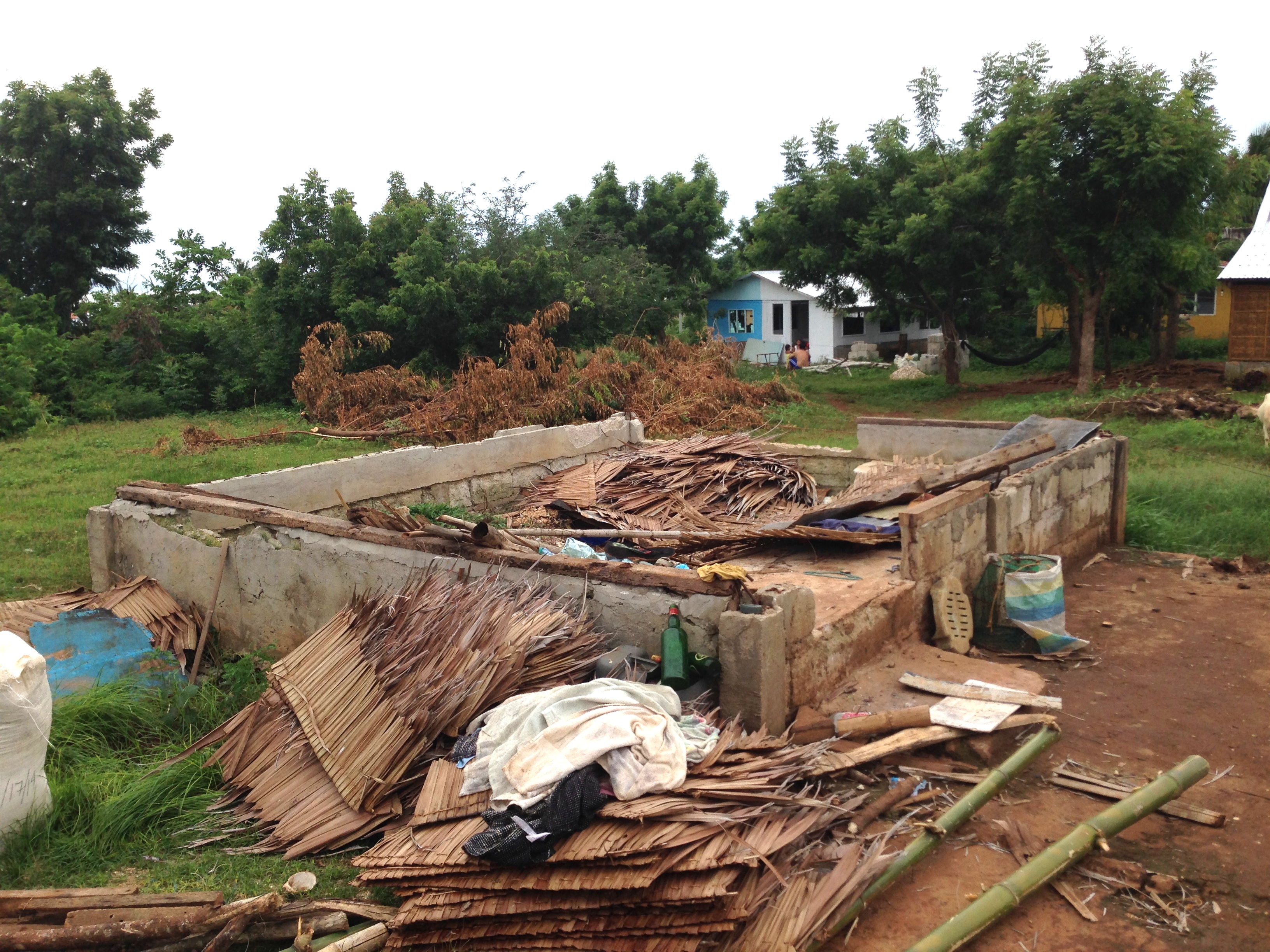
Hurricane damage is still obvious

Hurricane damage is still obvious

Part of the reconstruction was the building of a chapel and folks were gathered waiting our arrival. I was given the chance to address the community and tell them of our prayers and solidarity. Several of the typhoon victims then recounted their stories of survival.

We toured the homes that have been rebuilt so far, and the makeshift building where families on a waiting list slept. There is still much work to be done. All of the homes had a picture of the Sacred Heart of Jesus enthroned in a prominent place, and a few had carved or painted an image of a heart on the door.

When we returned to the chapel, the women of the village had each brought some of the day’s catch: fresh crab and squid and shrimp, other fish I didn’t recognize, along with fruits from the area. The Filipinos brag that their mangos are the world’s best and I won’t argue with them!

Fr. Steve with parishioners in the Philippines

Fr. Steve with parishioners in the Philippines

Quezon City, the Philippines

A few of our theology students in the Philippines

A few of our theology students in the Philippines

Fr. Stephen Huffstetter is spending much of September visiting our communities and ministries in the Philippines and Vietnam. His first stop is the Manila area (Quezon City is a part of the Philippines Capitol region) where he is staying with our student community there. From there he writes:

After a trio of flights lasting two, 12 and 4 hours I was a weary traveler when I finally landed in Manila Friday night. I was warmly greeted by Fr. Delio, the head formator, and Sergio and AJ, two of our students. Metropolitan Manila has around 12 million people, and even at 10 p.m. the mass of cars, motorcycles and jeepnys was bumper to bumper. We drove past highly developed  shopping and nightlife areas with advertisements like you might find in Times Square, as well as row upon row of densely packed cinder block and corrugated metal homes. As with any part of the world, the contrasts between the “haves” and “have nots” is striking.

The SCJs have 15 theologians studying at one of three area seminaries and living in community. Those in final vows hail from Argentina, the Philippines, Poland and Vietnam. Most of the students are native Filipino, joined by four Vietnamese and one Brazilian.

The first Saturday of the month is a day of recollection for the students. They left for a nearby retreat center to discuss their Community Plan of Life. Each of them shared how they are trying to be faithful to the SCJ Rule of Life in relation to the individual and community goals they have set for the year.  Looking at their community life and dedicated prayer routine challenges me to look at how I can also improve.

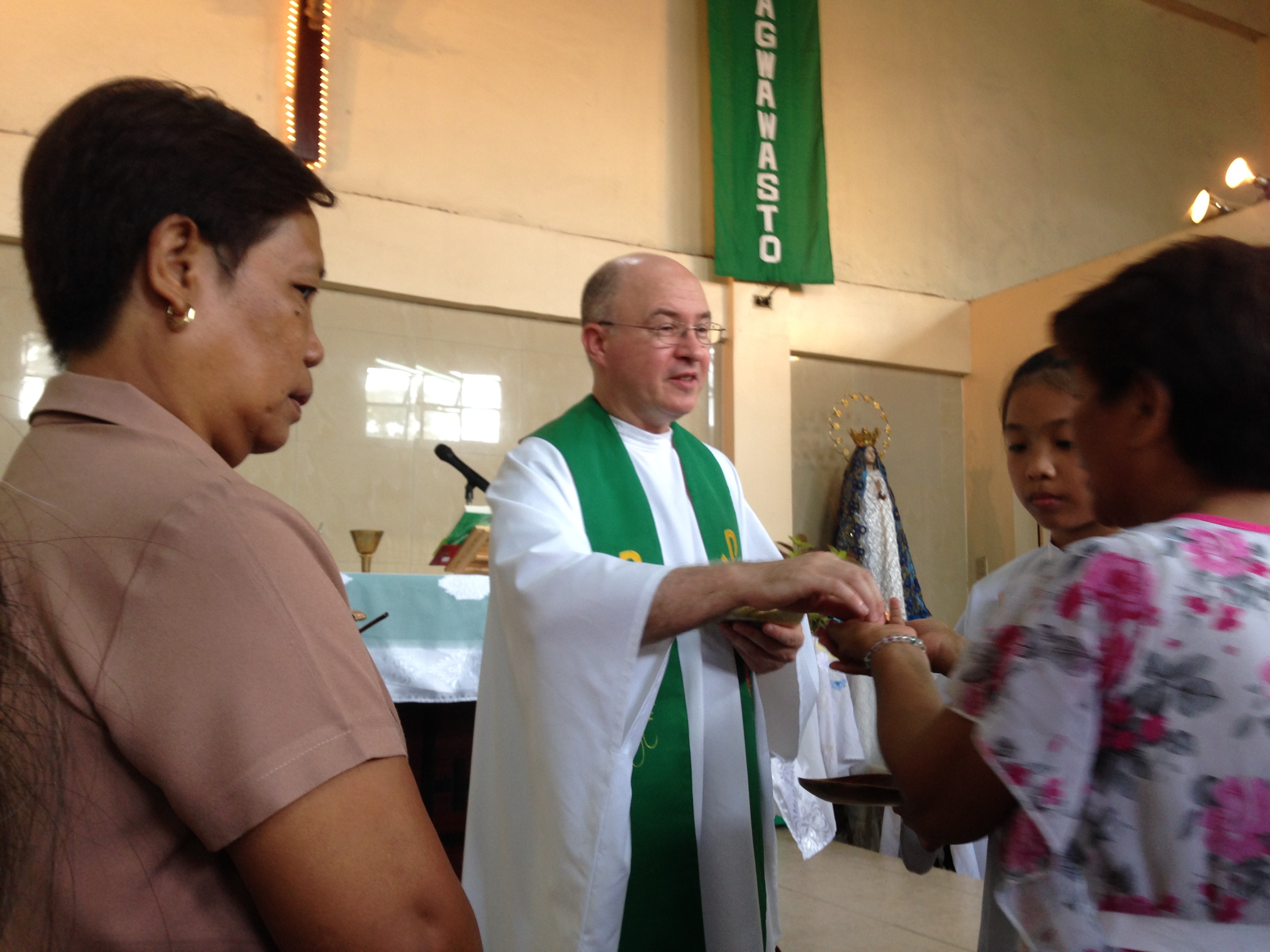
Fr. Steve shares communion

Fr. Steve shares communion

Fr. Indra invited me to Mass at the parish just a five-minute walk from our house. I noticed no parking lot and everyone was walking to church as those who arrived early prayed the rosary, which was broadcast over loudspeakers to the neighborhood. The music, lead by a youth choir, was quite melodic. While Mass was in English, many of the songs were in Tagalog.

In a devotional custom new to me, instead of shaking hands the parishioners lightly grasped my hand and gently raised it to their forehead for a blessing. The prayer and devotional life here are rich with art, decoration and communal prayer.

My favorite part of being here is sitting at table with the scholastics and hearing how they came to the SCJs, and of their hope and dreams for the future. While the needs here are great, the members also have a missionary spirit. One of the more recently ordained priests is preparing to go to the SCJ region in Finland, where perhaps 30% of the Catholics there are Filipino.

The community of 20 shares two cars, so rides have to be coordinated. One of the vehicles is both truck and van which seats 15. Navigating that through winding marketplaces full of bikes and people carrying poles with goods balanced on each end made me glad I wasn’t the driver!

Fr. Delio and Fr. Steve concelebrate

Fr. Delio and Fr. Steve concelebrate

Youth active in Church

Sunday Mass was celebrated in a church packed with mostly young people who walked from the surrounding neighborhood. In the States we often comment on the graying of our congregations, but here 95% of the crowd had a full head of dark hair. People sang and prayed with gusto. When the gifts were brought up I noticed several useful food items to keep the parish priest fed.

I followed along as best I could since this Mass was in Tagalog. I got a quick crash course so I could at least say “Katawan di Christo” as people approached to receive our Lord in communion.

The closing procession included a blessing with holy water as we made our way down the aisle. At most sprinkling rites that I’ve done people try not to get wet, but here people raised their hands to make sure water came their way. Afterwards, I was surrounded by parishioners thanking me and asking for the hand to the forehead blessing.

Part of the area we drove by included the House of Representatives, an impressive modern complex in what was once the capitol. Nearby was a huge garbage dump area where people scavenged for items to recycle so they could earn, at least their daily a bread. The contrast was striking.

Close to home we stopped to see the campus of the School of Theology. We arrived just as their parish Mass was ending and we were invited to stay for a meal in honor of the parish feast day. I was treated to a smorgasbord of dishes, with many fruits and vegetables new to me, but all deliciously prepared.

Today the students got back into their school day routine. Most are up well before sunrise as adoration began at 5:45 a.m. When I worked in formation students complained about a 7:30 a.m. start to the day! Prayer is slowly prayed in choir accompanied by piano, guitar and percussion, as several students share their musical talents.

Students take turns cooking breakfast, which consists of rice and a few accompaniments. Today, Sergio’s specialty was a beef hash mixture, with fish on the side. I have eaten quite well here, but did take a pass on fish so early in the day!

While they are in school the plan is for me to learn more about our parish outreach projects.