Formation communities and visit to Auschwitz

Fr. Tom Cassidy, now on sabbatical after completing his second term as provincial superior of the US Province, is writing a journal during his trip to Poland in October. During his sabbatical Fr. Tom is spending time in many of the locations for which he had responsibility when he was on General Council. Next spring he will spend extended time in Asia, helping in the missions of India and the Philippines. Here, writes from Poland:
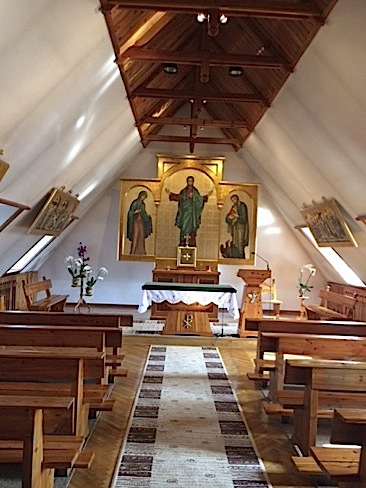
Chapel at the SCJs' novitiate in Poland

Chapel at the SCJs’ novitiate in Poland

Fr. Micheal Ciemiçega and I drove from Warsaw to Stadniki with a stop for lunch at the SCJ novitiate located at Stopnica. The building has a long and storied history that goes back several centuries. It was purchased from the Franciscans after World War II and as with many buildings in Poland, it suffered extensive damage during the war.

There are currently three novices who began their novitiate year last month. I was told there are eight postulants though their house is about 100 kilometers from Stopnica.

In addition to stopping to see the place it also afforded us the opportunity to join the community for lunch.

Upon our arrival at Stadniki, where SCJ students study philosophy and theology, I had the opportunity to get in my daily walk. Stadniki itself is not very big but happily there was a sidewalk that kept me out of the road, though traffic was light to say the least.

At present there are 19 students. The majority are Polish but several other Eastern European countries are represented, i.e., Croatia, Byelorussia and, if my memory serves me, Moldavia. I had the chance to spend a half hour with the students this evening talking about SCJ life in the United States. All the students are studying English but their grasp of the language varied greatly so two of the students translated from time to time.

The school year here began last week. They follow the European tradition of an October start. In addition they follow the Jesuit model of Thursday off and classes on Saturday. All of their studies are done here at Stadniki. The deacons travel to Krakow for a course and practicum at a hospital a bit akin to CPE (Clinical Pastoral Education) in the US.
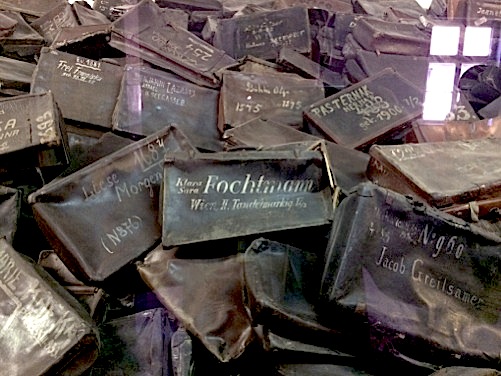
Suitcases left behind by those who were sent to Auschwitz-Birkenau

Suitcases left behind by those who were sent to Auschwitz-Birkenau

Auschwitz-Birkenau

On my first visit to Poland I did not have time to visit the Auschwitz-Birkenau concentration camps and wanted to make sure I could find the time to see first-hand this sad chapter in history. Words in many ways fail to convey what took place and how sinister human beings can become in their treatment of their fellow human beings.

It is good that much of what took place here has been preserved and that so many come to see for themselves how the “final solution” was carried out with such precision.

Stadnike is about an hour and a half drive to Auschwitz, but here in Poland it is called Oswiecim. When the Nazis defeated the Poles and took over they changed the names of places so that they would be easier to pronounce in German. The reason Auschwitz was chosen as a concentration camp was both its location that provided excellent rail transportation as well as the fact that it was the site of a Polish military camp — that’s why most of the buildings in Auschwitz are made of brick.

AushwFr. Michael and I left the house about 8:30 so that we could be there in time for the first English tour at 10:30. For most of the day there are English tours every hour while other language groups may be less often or perhaps have their own guide with them, as is often the case for Jewish groups I was told.

I certainly spotted a number of groups of young Israelis during our 3 1/2 hour tour. The tour takes you through Auschwitz (1) and then the groups are bused over to Birkenau — it’s about a five-minute ride. Auschwitz was actually a series of camps that began with the military barracks (Auschwitz 1) and over time grew to encompass Birkenau where most of the mass killing occurred as well as labor camps where prisoners worked, actually worked to death might be a better way to put it.

As I said in the first paragraph words cannot really describe what took place and what is felt by visitors today. Only what is left behind can give a voice to those who died here.

Celebrating “name day” and getting a sense of life in Poland

Fr. Tom Cassidy, now on sabbatical after completing his second term as provincial superior of the US Province, is writing a journal during his trip to Poland in October. During his sabbatical Fr. Tom is spending time in many of the locations for which he had responsibility when he was on General Council. Next spring he will spend extended time in Asia, helping in the missions of India and the Philippines. Here, writes from Warsaw:

Fr. Artur, receives well-wishes on his name day

Fr. Artur, receives well-wishes on his name day

A number of SCJs from the Warsaw area and beyond came to the provincial house to celebrate Fr. Artur Sanecki’s name day. [Fr. Arthur is the Polish provincial superior and in Poland, “name days” or saint days upon which a person shares the same name, are celebrated much like birthdays are celebrated in the United States.] We had Mass at 11:30 AM followed by a short gathering to toast Artur and wish him well. After the presentation of the toast each person would clink his glass with Arthur’s, shake his hands and in the style common in this part of the world, brush their cheeks three times.

We then had our meal consisting of soup, about four different kinds of salads and vegetables, potatoes and rice and a selection of meats (chicken, beef and pork). Following the meal we returned to the hall to have coffee and dessert — a very delicious four-layer cake.

Since Mass was not until 11:30 I took the opportunity to take a walk before. Not far from here is a Jesuit church it was impressive to see the number of people arriving on foot for Mass and, I might add, it was young and old. During the afternoon I passed by several other Churches that were filled to capacity for the evening Mass.  That’s not to say there are no problems facing the Church here in Poland.

Our own SCJ community has experienced a decline in Polish vocations. Now many of the students come from the missions in Eastern Europe, such as the Ukraine, Croatia and Moldavia, to name just a few. The sex abuse scandals that we have become familiar with back in the States has finally been felt here as well. In addition, if you look around the globe as a country becomes more prosperous, interest and participation in religion tends to decline. That, to some degree at least, is felt here as well.

In the afternoon Artur took me via the subway to Old Warsaw. The style of architecture is certainly old but you have to remind yourself that much of it was reconstructed following World War II. Much of Warsaw was destroyed first in 1939 at the beginning of the war and then the Polish uprising and the final liberation of the city added to its destruction.

I should note that as in any major city in Europe the public transportation system is excellent. We could have gotten to the central city by bus, tram (street car) or subway. This being Sunday the subway was crowded with folks out for a Sunday stroll. The old city was packed with people, again young and old, enjoying the sunny crisp weather (the temperature was around 60° F). Our tour of the old city ended with the stop at a famous deli and bakery where, according to Artur, one could enjoy the best doughnuts (Paczki) in the city. Naturally we had to try.

I’ll close today with a few photos taken on our walk around the old city. Tomorrow we are headed to Stadniki, the theologate of the Polish Province that, by the way, has just celebrated its 50th anniversary.

Cassidy Poland pic

Poland-bound

Fr. Tom speaking during a recent gathering. After completing his second term as provincial superior he began a sabbatical that is taking him to several of the places for which he had responsibility when he was on General Council.

Fr. Tom speaking during a recent gathering. After completing his second term as provincial superior he began a sabbatical that is taking him to several of the places for which he had responsibility when he was on General Council.

Fr. Tom Cassidy, now on sabbatical after completing his second term as provincial superior of the US Province, is writing a journal during his trip to Poland in October. We will post excerpts from it on our province blog. Here is the first entry, written on October 3:

I’m off for Poland! At the moment I’m sitting in Chicago’s O’Hare Airport waiting my flight to Frankfurt and then on to Warsaw. I leave Chicago at 6:25pm and will land tomorrow in Warsaw at 1:50pm. It’s a long trip but I have some much longer than this one. I managed to bring everything I needed with the exception of my Magnificat Daily Missal. It’s not a great loss as both my iPad and iPhone have the iBreviary app that also includes both the daily readings and Mass prayers in English. It would be hard for me to follow it all in Polish.

The chief purpose of this trip is to attend the dedication of a conference center in Kracow that our United Sates Province help to fund. It is actually the renovation of a large building owned by the Polish Province. I saw the building several years ago on my first visit to Poland following the meeting of the European SCJ Major Superiors that the major superiors of Canada and the US were invited to attend. Secularity was the theme, and although there are differences on what that means and how it is applied in Europe and the US as well as Canada.

Fr. Artur Sanecki is the current Polish Provincial. He has just started his second three-year mandate. I know Artur from his days as a student in Rome where he obtained his doctorate in scripture. Artur is no stranger to the US as he spent several months living at Villa Maria (our old retirement community).

Artur invited me to attend the dedication/blessing of the new conference center since the US Province helped fund the project. I reminded Artur that my time as provincial has come to an end, but he said to come anyway and since Fr. Stephen Huffstetter, our new provincial, is just settling into office I got the chance to represent the US. It also fits into what I am going during this transition year (sabbatical). I am taking time to visit the various provinces and regions I worked with while on our General Council, as well as doing some work for the congregation by spending several months in India early next year as well as assisting with English in the Philippines in April and May.

I’ll bring this to a close as it is about time to board the flight from Chicago to Frankfurt.

Reflecting on the loss of a seminarian

Two Dandelion Seed Heads

The living reality given to us by God

The following reflection was written by Fr. Bernie Rosinski, SCJ, a frequent contributor to our province blog:

Yesterday at Sacred Heart School of Theology, the first day of the fall semester, I witnessed something that is hard to describe. It was like a “sobriety dance.” A sensible pall seemed to fall over everyone, staff, faculty, student alike. I knew it. I recognized it. I did not know what was causing it. Everyone walked as they usually walked, moved between room and class, office and conference room, in and out of the dining room. The usual bubbliness and hubbub were gone and a sensible reduction in sound and noise was evident. I noticed, too, that the usual laughter and loud bursts of conversation were lacking. Why the pall? Why the shroud over normal conduct? It was like some invisible weight was pressing down on flesh, causing it to flex and depress.

Then, at the lunch table, as I was seated with some Vietnamese nationals attending the ESL [English as a Second Language] program here – actually, two priests, a brother, and a religious sister – I was asked: “Why does God take some people when they are young?” I found the question strangely timed but valiantly tried to give the stock answer in an acceptable way. My hearers did not seem to buy it and the problem was not due to language. Shortly thereafter, Msgr. Ross Shecterle, the president-rector of the Sacred Heart School of Theology, came over our table to announce the death of one of the seminarians in case we hadn’t heard the news yet. He choked up a little as he spoke. I hadn’t known, but others at our table were aware of the death.  Now I knew the cause of the pall I had witnessed. I finally learned the answer to my wonderment. His name was Javier and he was from Mexico.

We humans ascribe to God a lot of things that happen, even dying. Earlier I had read a very intelligent and intelligible phrase in a brief essay by Douglas Bushman that said: “…the ultimate explanation of all that God does is that he is faithful to himself.” He has created the physical world of time and space that operates so very consistently that we can draw our “science” from it: the laws of physics, chemistry, zoology, biology, etc. In that same world of time and space, God allows living organisms to grow in evolutionary ways according to their own laws.

While we all have to die, God has meant us for life and that is why he sent his Son, Jesus, to show us the way to life – through death and resurrection. This same God once in time sent his Son, Jesus, to heal us and our world. In Jesus’ resurrected absence from our world, the healing art of medicine developed and made use of science. Unfortunately, the art of medicine, for all its science, is unable to keep up with evolving organisms. Where it does, there are cures; where it doesn’t the laws of nature follow their natural course and we die. Once again, the ultimate explanation of all that God does is that he is faithful to himself, to his work, his creation, the laws of science and the evolution of living organisms.

There is no blame. There is no fault. There is only living reality given to us by the God who is faithful to himself.

Let us remember Javier in our prayers.

Screen Shot 2013-08-27 at 2.10.56 PM

NOTE: Javier Ibarra Hernandez was a seminarian at Sacred Heart School of Theology for the Diocese of Salina, Kansas. The diocese posted the following on its website:

Javier Ibarra Hernandez, a seminarian for the Diocese of Salina, died Monday, Aug. 26, at Via Christi-St. Francis Hospital in Wichita.

Ibarra, 35, had been hospitalized several weeks and was being treated for an unusual strain of pneumonia.

“It is with a mix of human sadness and Christian trust that I share with you that our dear friend and seminarian, Javier Ibarra, died earlier today,” Bishop Edward Weisenburger said in a statement Monday. 

“As most of you know, Javier became sick several weeks ago. His condition quickly showed signs of being catastrophic, and for that reason we brought his elderly parents and his sister here from Mexico. We believe Javier received exceptional care from committed doctors and a very devoted nursing staff,” the bishop said. 

The day his family arrived, Ibarra was alert and able to communicate, Bishop Weisenburger said. 

“That day proved to be the last day that he was able to be alert for any lengthy period of time. It was an immense blessing that his family members were able to have that special day with him,” he said. 

“A great many of you have prayed for Javier throughout this sudden illness. Your concern for him was always apparent, and he knew of your affection. He treasured the new home he had found in the Diocese of Salina, his rapport with his brother seminarians and the good people of north-central and western Kansas. I know that he will be remembered by us with great kindness,” Bishop Weisenburger said in the statement.

Click here to visit the diocesan website.

Learning TWO new languages

Fr. Juan Carlos (“Juancho”) Castañeda Rojas is just about at the end of his novitiate year. He is scheduled to profess his first vows on August 15. As he prepares to do so, he shares the following reflection:

Juan Carlos Castañeda Rojas during the June Election Assembly, where he served as a teller.

Juan Carlos Castañeda Rojas collecting ballots during the June Election Assembly.

When I came to the United States, the first thing I had to do was study English. That is why I was part of the ESL program (English as a Second Language) at Sacred Heart School of Theology. It was a really good and challenging time for me. Learning a new language and a new culture was not easy, but here I am with my education in philosophy at Xavier University (Chicago) and getting ready to continue with my studies in theology at Catholic Theological Union (also in Chicago).

Well, my novitiate is almost over and I have had many great and powerful experiences. I will keep them always in my heart. It has been an amazing journey exploring the history and constitutions of the congregation, growing in faith, and strengthening my vocation and my desire to become an SCJ. As I told Fr. John Czyzynski, our novice master, after our trip through the different missions and ministries in Mississippi, Houston, South Dakota, Florida, and Milwaukee, I recognize the importance of studying our constitution and history. But I also learned a lot by listening to all the members of the SCJ community in our visits.

Today, because of one of those people who shared his experience as an SCJ, I realized that I was not only learning English but was and am learning another language, one that I now call DLH (Dehonian Language of the Heart). Thank you Fr. Byron [Haaland], you made me realize that in your sharing. ¨I speak Dehonian¨ were the words Fr. Byron spoke that had a huge impact on me. While ESL taught me how to speak English and communicate, DLH taught me to indentify myself as a Dehonian. And I will complement Fr. Byron’s words with Fr. PJ’s [McGuire] message in his homily in which he made reference to one of the sections from Fr. Dehon’s ¨The Retreat with the Sacred Heart.¨ It was  there that I found another new word for my vocabulary, which is “gauge.”  Meditation 34: Generosity is the gauge of love (by the way, thank you Fr. PJ for a wonderful translation) tells the story of a young man who received the gift of a vocation but lost it because of his lack of generosity.

English, as any other language, has many rules; grammar and correct pronunciation make it a hard language to learn. But I learned that the Dehonian Language of the Heart has only one ¨rule,¨ which is called “Generosity.” You may ask, “That’s it?” Well, DLH is taught from one heart to another; it is a language that is translated through actions as well. It is fairly easy and there is always a place for everyone. We are all called to this learning adventure.

In the same way that the young man from the meditation received the gift of his vocation, I have received mine. And I am very happy to realize that I have many teachers who can teach me every day not just new a word in English but also a new word in the language of Fr. Dehon, the Language of the Heart through their experiences and their examples of how they live.

On August 15, with the profession of my first vows, I will be saying yes to God. I will also be saying yes to the legacy of Fr. Dehon, and I will be able to say it in a Dehonian way by the way I conduct myself as an SCJ.


“I stand in awe of our young people”

SCJs from around the world are at the Generalate in Rome this week for a workshop on administrative skills -- the nuts and bolts of keeping a province running smoothly. Fr. Terry Langley (far left, second row) is representing the US Province.

SCJs from around the world are at the Generalate in Rome this week for a workshop on administrative skills — the nuts and bolts of keeping a province running smoothly. Fr. Terry Langley (second row, far left) is representing the US Province.

Fr. Terry Langley, provincial secretary, is in Rome this week for a secretaries’ workshop. No, there won’t be classes in shorthand, but instead there are presentations on the many tasks involved in the administrative needs of a province, region and/or district in the congregation. This is the second time that such a workshop has been hosted by the General Curia. Fr. Terry is joined by SCJs from South America, Asia, Africa and Europe.

 After his first day, he wrote the following:

I’m enjoying Rome. Heru and Roberto [Fr. Heru is the secretary general and Br. Roberto is vice general secretary] have organized an excellent meeting. Yesterday, Fr. John van den Hengel and Fr. Tullio Benini spoke about the mission and tasks of the provincial secretary.

Fr. John talked about the power of the written word, which is to say that the interminable letters we provincial secretaries have to write can be instruments that help further the mission of the congregation and also break down the social isolation that our confreres sometimes feel. Along the same line, Fr Benini said that the door of the provincial secretary’s office should always be open.

Fr. Terry (back to the camera) takes part in small group discussions

Fr. Terry (back to the camera) takes part in small group discussions

In the afternoon we broke up into small groups (according to language) and talked about specific duties we have as provincial secretaries in our respective provinces, as well as difficulties we often experience and ways in which our working relationship with the Secretary General might be improved.

This morning Fr. Marek Stoklosa, a canon lawyer from the Polish Province, spoke about things that all provincial secretaries must deal with regarding members: prolonged absences, exclaustration, dismissal, incardination. He will speak to us again this afternoon and most of tomorrow.

The local community here is most kind and welcoming but there are certainly things that I find so different from home: eating lunch at 1 p.m. and supper at 7:30; sitting at supper and sometimes having no one to talk to in English (thank God for Fr. John van den Hengel and Fr. Wayne Jenkins!); not having a TV in my room (and not missing it a bit; however, life without a computer would be another matter).

The internationality of our congregation is something to behold. I stand in awe of our young people from the countries we have recently entered. I am filled with hope for the congregation.

By the way, I was just feet away from the pope as he passed by me in St. Peter’s Square on Sunday right before the celebration of his outdoor Mass. We were surrounded by Harley bikers who were there for the 110th anniversary celebration of Harley Davidson.

“Priest-Fireman” on the job

baptism

“Like the miracle of loaves and fishes one baby multiplied to five waiting to be baptized”


Fr. Bernie Rosinski writes his last blog post from the Philippines where he has spent the past two months teaching English. This time he talks about filling in as a “fireman,” celebrating Pentecost with the unexpected baptism of five children.

As the son of a Detroit city fireman, I often heard my father speak of his work as a fireman. It meant extinguishing conflagrations that posed a threat to life and property. For awhile, growing up, I had a hyphenated vocation: priest-fireman and then gradually let go of the second part of the hyphenated name. Imagine my great joy when I heard that serving in a parish on a weekend to substitute for the pastor or assistant of a parish, particularly one where SCJs worked, was frequently referred to by my SCJ colleagues as being a “fireman”.

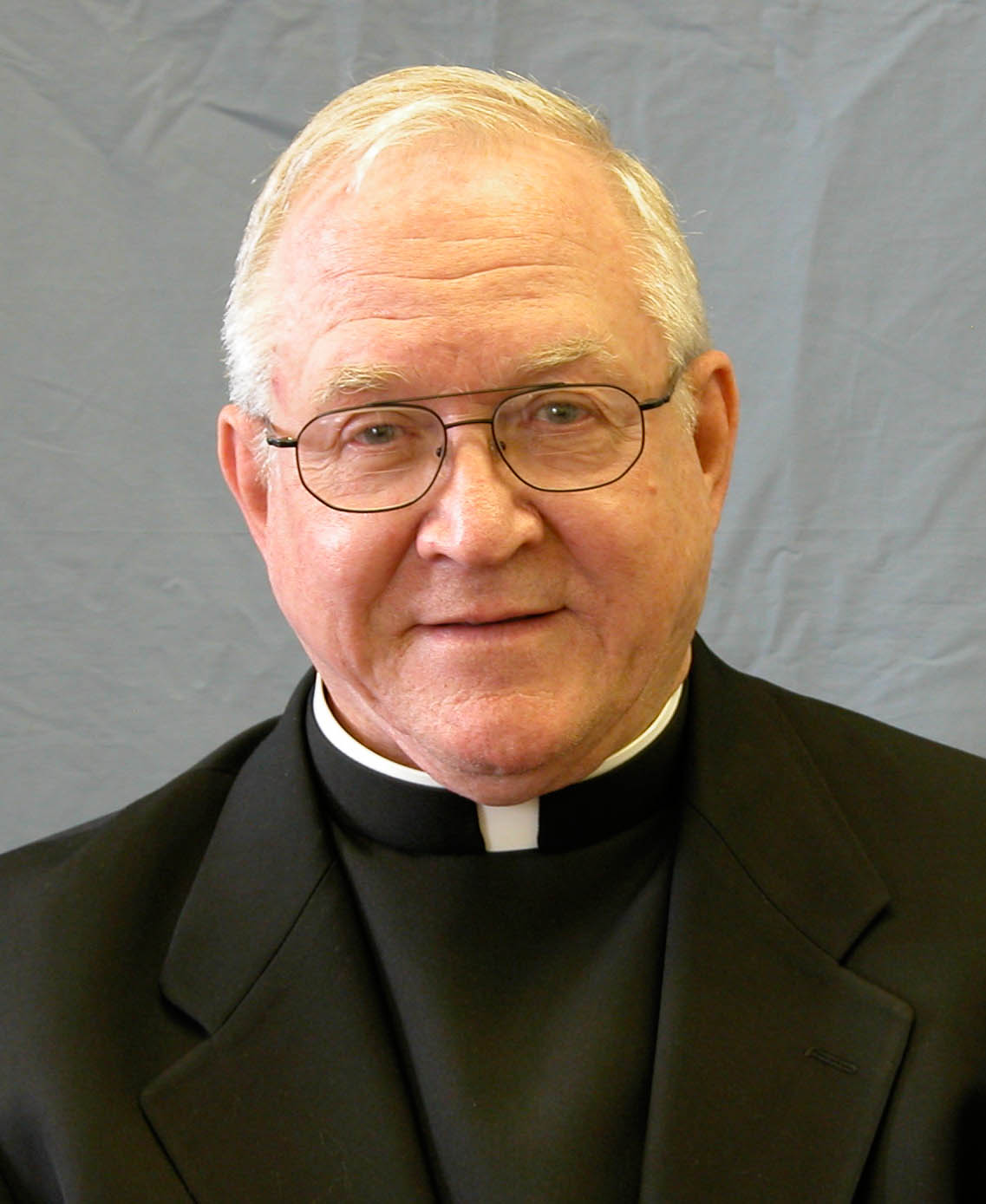
Fr. Bernie Rosinski

Fr. Bernie Rosinski

Recently, here in the Philippines, I was called on to be a “fireman”, to say an English Mass on Pentecost Sunday in Our Lady of Fatima Parish in the Archdiocese of Cagayan de Oro. My chief surprise was the fact that in the Philippines, parish churches frequently schedule Mass in English for their Sunday services.

During the course of the week leading up to my impending duty as “fireman” I also learned that I would be required to administer the sacrament of baptism to one child. When Sunday actually rolled round, like the miracle of loaves and fishes, one baby multiplied to five waiting to be baptized.

The baptisms took place before Mass at the front entrance to the church. Fortunately, the entrance was covered with an extended church roof that protected us from the sun. The entrance area was big enough to accommodate the 50-75 family, relatives, and friends of the parents and all, it seems, were fortified with cameras, especially cell phone cameras.

When I first saw the ritual book I panicked; it was in Filipino, which I do not know. I then prevailed upon a woman catechist to translate my English while I read from an English language ritual. We soon stopped the translating. Most of the people responded in English to the various questions that are asked during the course of the rite, e.g.: What do you ask of the Church for this child? Baptism! And: Do you renounce Satan and all his evil works? I do.

Mass followed in due course. And once again I was impressed with the manner in which Filipinos celebrate their Sunday Eucharist. The altar servers are properly dressed. The lectors or readers are suitably dressed in blue tunics and the women place a small white cloth on their heads. The ushers are women who have the same kind of tunics and head clothes, but the color is black. As a people who love music and singing, there are no one or two verse hymns in the course of the singing.

I was brought to the church by a young man in an SUV that had the archdiocesan coat of arms on its doors. The same man returned me home after Mass. I learned that the next day he was off to Manila to seek employment as a ship’s engineer for which he was licensed. He had great hopes but, as he told me, he had no sponsor. Employment was not sure. God grant him work!

Filipino English

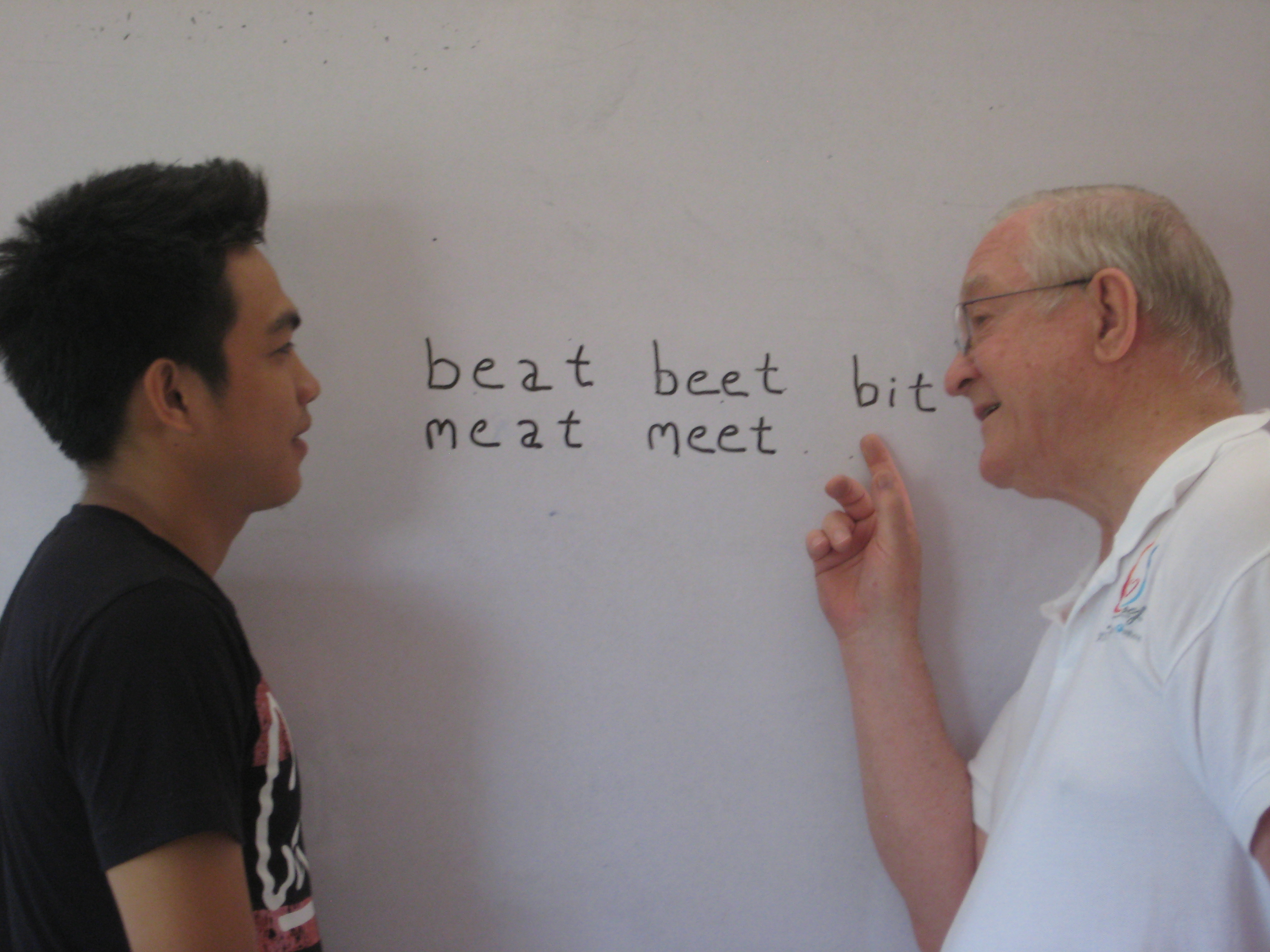
Fr. Bernie helps a student with pronunciation drills

Fr. Bernie helps a student with pronunciation drills

Fr. Bernie Rosinski is finishing his last week of teaching in the Philippines. The following is a reflection from him on “Philippine English” and his role in helping Filipinos to pronounce the language.

Linguistics is not my profession. I am not one of its teachers or practitioners except in a very incidental way. On two occasions now I have been to the Philippines to teach English pronunciation to Filipino and Vietnamese students. On those occasions I have tried to put into practice what I learned while obtaining a Master’s in Linguistic Science from Georgetown University. As my second tour of duty winds down, what have I learned from my experience? Was it worth going to the Philippines?

Let me deal with the initial question first. In my semi-professional opinion there is a reality I call “Filipino English.” It seems to me as valid a form of English as American, British, Canadian, Australian, South African, or any other form of English including Indian and Pakistani. Filipinos who speak English know its grammar and easily become familiar with it through media, sports and business interests. They only lack practice because it is not their first language. By preference they speak their native languages to each other. Only in international settings does their ability to use English manifest itself; also, it is one of the official languages of the country. Filipinos are schooled and instructed in it from grammar school on for better or worse. And this is a point that needs additional explanation.

Recording a student's pronunciation

Recording a student’s pronunciation

High school English instructors in the Philippines are not indigenous speakers of English; rather, they are native-born Filipino teachers. Many of these teachers are aware that their pronunciation of English is often inaccurate and thus have sought to obtain study visas to travel for immersion in English-speaking countries for a summer course, or a semester or two. Unfortunately, they are often denied the opportunity because immigration officials do not always approve the necessary paperwork. However, when Filipino English teachers are denied the opportunity to learn to pronounce a language, whether that pronunciation is American, British, or whatever, their Filipino students suffer.

Filipino English has some consistent pronunciation errors that indicate that they are systemic. Apart from the problems that printed words cause (English spelling and print causes grief throughout most of the world), pronunciation errors abound.

Here are just some examples of the systemic errors I have noticed: (1) the “s” sound; wherever it appears in print, the letter “s” receives the sound “sss,” thus the word “is” becomes “ISSS” instead of “IZ,” the word “his” is pronounced “HISSS” rather than “HIZ;” (2) words like “give,” “live,” and “river” which are pronounced “GEEV,” “LEEV,” “REEVER” respectively; and (3) “man,” “pat,” and “bat” are pronounced “MAHN,” “PAHT,” “BAHT.” In some English language cultures, these pronunciations are correct but Filipinos tend to want to speak American English.

Was it worth coming? That was the second question. In some respects, because the Filipino-style English tends to overwhelm all efforts at corrective pronunciation, an American coming to the Philippines to teach American pronunciation must feel like Sisyphus, the Greek condemned to pushing the huge boulder back up the hill.

However, my Filipino students assure me that my visit was very welcome: (1) they themselves desire to speak “American” English; (2) in the Philippines they are generally taught grammar and are given no pronunciation drills; (3) English is an important, worldwide means of communication; (4) special corrective courses in “American” pronunciation are extremely expensive and only the very wealthy can afford them; (5) although it isn’t necessarily the case in all cultures, Filipinos seem readier to hear and understand the American pronunciation of English than others.

These reasons were convincing enough for me. I am glad that I came.

Vows ceremony reminds blogger of own novitiate

logo1

Fr Bernie Rosinski, who is in the last two weeks of teaching English in the Philippines, writes about the recent first-vows celebration:

Four candidates professed their first vows as members of the Congregation of the Priests of the Sacred Heart for the Philippines Region at the novitiate in Dumalinao on the Island of Mindanao.

Bros. Joel, Ruel, and Alex are native Filipinos while Bro. Huan is from Vietnam. These four men were surrounded by their parents except in one case where the father was deceased. The mother and father of Bro. Huan came from Vietnam. Many, though not all of the men, also had brothers and sisters and nephews and nieces present. Additionally, many SCJs came from various places: the scholasticate in Manila, the seminary in Aluba, and parishes in cities near the novitiate. The ceremony took just about two hours , including the celebration of the Eucharist. Fr. Francis Pupkowski presided. He is the regional superior of the Philippines Region.

Fr. Bernie Rosinski

Fr. Bernie Rosinski

The ceremony concluded just about at midday; it was time to banquet and we did that royally. We even feasted on a whole roast pig. The banquet was conveniently catered and served buffet-style. People could grab a plate and eat inside in the dining room or roam outside to find table-and-chair settings under awnings and shade trees. During the course of the meal, which lasted several hours, an instrumental group of six elderly Filipinos played native Filipino music with its distinctive rhythms on three guitars, a mandolin, and two banjos. A number of guests danced, even two of our SCJs.  However, not this blogger!

While I have not visited all the novitiates of the congregation, I don’t think there is a more beautiful setting for a novitiate or for the celebration that we witnessed. Imagine an evenly shaped slope on a long ridge of a low mountain running east/west. Imagine that slope with areas cleared of trees except for coconut palm trees sparsely planted. Then imagine a set of connected one storey buildings built like a Chinese rice terrace up the side of that slope in one of the clearings. At the base of the terrace, imagine a chapel being made almost entirely of sliding glass panel walls facing East, West, and North with an immoveable glass wall facing South and looking out, down the slope, across a lengthy valley to another slope on an opposite mountain ridge about a mile and half distant and running parallel to the slope on which the novitiate is located.

Any novice who has to spend 14 months in this location must almost necessarily turn his mind to the Author of so much beauty, and prepare himself for a commitment that is total and unlimited.

When the ceremony and celebration ended, many visitors had to leave for their homes or work. Two SCJ parishes had parish feast days immediately following profession day (May 13): St. Matthias (May 14), and St. Isidore the Farmer (May 15). So they all scrambled. The afternoon, therefore, was almost novitiate-like in its quiet. This blogger spent nearly four hours reading, and looking, and wondering, and recalling his own novitiate days…

Celebration mixed with the mourning of lost innocence

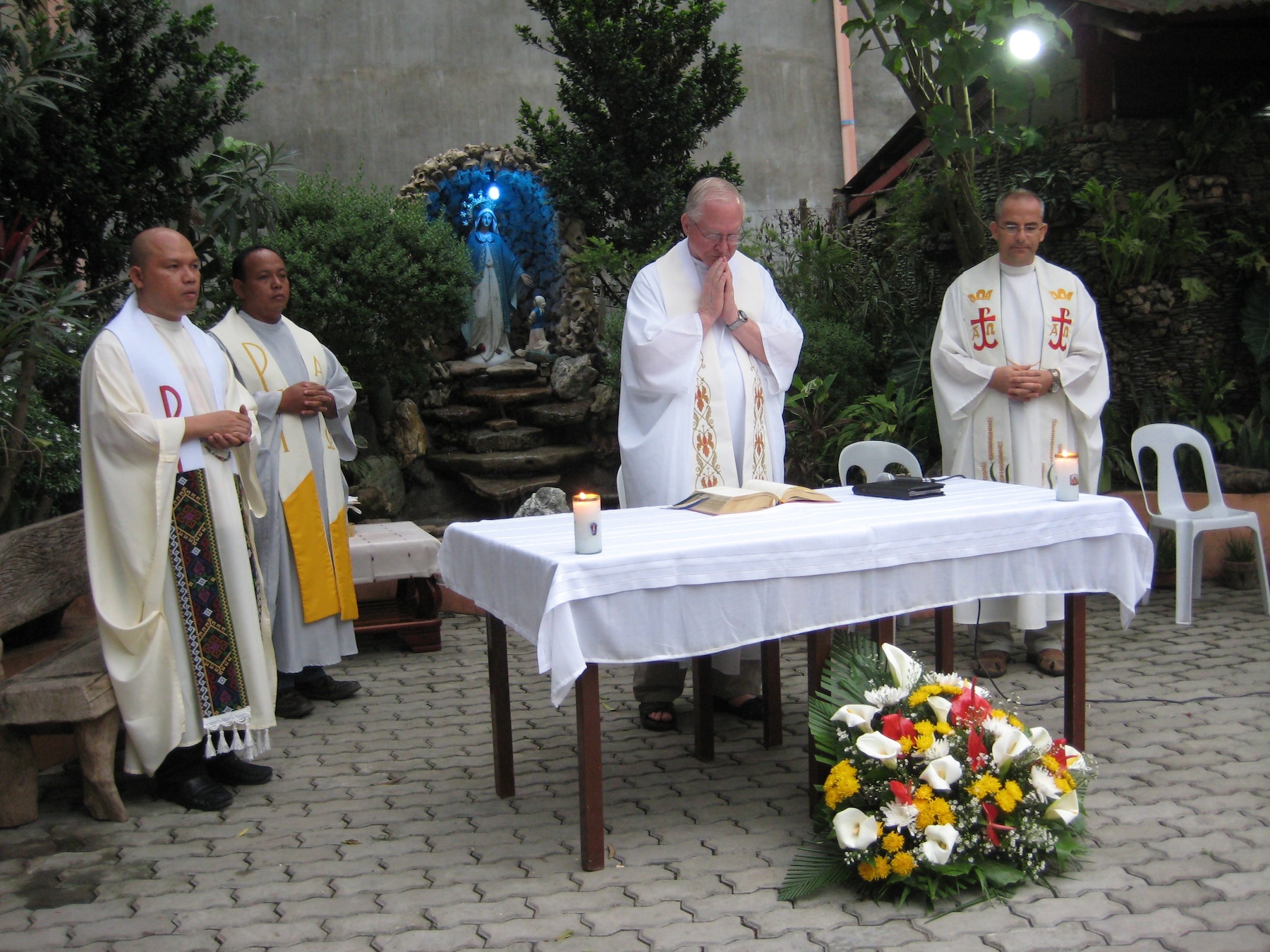
Fr. Bernie Rosinski (center) was the main celebrant at the Kasanag Daughters Foundation anniversary Mass

Fr. Bernie Rosinski (center) was the main celebrant at the Kasanag Daughters Foundation anniversary Mass

As noted previously, Fr. Bernie Rosinski has been writing blog posts from the Philippine Region where he has been teaching English since early April. The following is about his recent visit to the Kasanag Daughters Foundation, an SCJ program for abused women and girls.

I was invited to be the principal celebrant at an anniversary Mass on May 10, the 14th anniversary of the establishment of a refuge for abused girls called the Kasanag Daughters Foundation. The work was begun by Fr. Eduardo Agüero, SCJ,and has been carried on by SCJ successors ever since. The most recent is Fr. Boboy, whom I met two years ago when I made my first trip to the Philippines.

I had never been to this house of refuge. However, I knew that since my last Philippines visit it had gone through severe damage from a typhoon which caused such extensive flooding that over 1,000 citizens of Cagayan de Oro, in northern Mindanao, died. Though no girls from the refuge perished, for a period of several months they lived in a building on SCJ seminary grounds while their building was cleansed of the mud and debris that infested it and then restored to a livable condition. On our way there, Fr. Andrew Sudol, SCJ, showed me the level the rampaging river had reached. It went over the rooftop of the residence.

Young girls in the Kasanag program

Young girls in the Kasanag program

The Mass was to take place at 5:00 p.m.; due to a road accident that blocked our way, we arrived at about 5:30 p.m.. No one seemed terribly upset. Time has a different importance here. The refuge building has a small terrace-like yard outdoors and it was here that we found chairs neatly set and a table for an altar before the Virgin’s shrine. There was the inevitable loudspeaker system that seems a part of every Filipino parish or mission. Once we were vested, I was handed the microphone and Mass began.

We observed the usual opening rites and I was seated as the first reading took place and the responsorial psalm was sung. During that period, I noticed a very young girl sitting in the first row. I am guessing she was six inches shorter than her 20 or so “sisters” and could not have been more than 10-11 years old, definitely younger than the rest. All of the girls were wore a tee shirt of uniform color as did she. However, they seemed so eager and joyful whereas she seemed so weary and burdened; almost old. She had no smile on her face. Because she seemed so unlike the others this struck me forcibly. I drew some conclusions about her that I hesitated as an outsider to verify with the staff, but I surmised that she had arrived only recently and had been only recently been delivered from some horror whose effects still dwelt with her. I decided to keep an eye on her for the rest of the evening. Apart from one event at which she was animated and even laughed, she maintained that somber note as long as I observed her.

Mass proceeded through occasional drops of rain. The rain picked up at about communion time. And so our outdoor church conducted a rite for which the Roman Catholic Church has no guideline: we moved the outdoor altar to a place under a porch. It was there that we distributed Holy Communion and concluded with a blessing. The blessing seemed to affect the weather for the rain hesitated and then stopped entirely.

The entire Kasanag Daughters Foundation board and staff were introduced with a slideshow to the clergy and guests present. We learned that at the refuge there are college level students, high school students, and elementary school students among the girls. The refuge has a computer classroom that is very well equipped. One way up and out of poverty is by being computer savvy and thus employable. The slideshow was a PowerPoint presentation the girls themselves put together.

It was after all these introductions that that slideshow concluded with an exhibition of photos from the life of the girls at the refuge and the events they held and the places they visited. There was a lot of giggling as they recognized themselves in the photos. I saw that Fr. Johnny Klingler,  SCJ, was featured in some of them. He was the ESL teacher last year and had visited the refuge. It was during the slideshow that this youngest girl seemed happiest as she would hold up her hand and point her finger to various slides where she recognized her new friends from the refuge. I watched her new friends, too.  They seemed exceptionally kind and solicitous for her. My visit, however, was unlike anything I had expected. I am still mourning what seems like a child’s lost youth and innocence.