Category Archives: Uncategorized

Visiting a friend who is now a bishop; singing hymns in Zulu

Fr. Tom had the opportunity to visit his former colleague on the General Council, bishop Zolile in the bishop's new diocese of Kokstad

Fr. Tom had the opportunity to visit his former colleague on the General Council, bishop Zolile in the bishop’s new diocese of Kokstad

As noted previously, Fr. Tom Cassidy, former provincial superior, is spending his first months out of office visiting the countries for which he had responsibility when he was on General Council in Rome.  During his travels he is maintaining a journal; several excerpts from it are being posted on the province blog. The following two entries are from Pietermaritzburg:

Today (November 9) was a long day of travel from Aliwal North to Pietermaritzburg where the South African Province hosts an international formation (student) community. We began our travels at 8:30 a.m. and arrived at the scholasticate at 5:00 p.m.

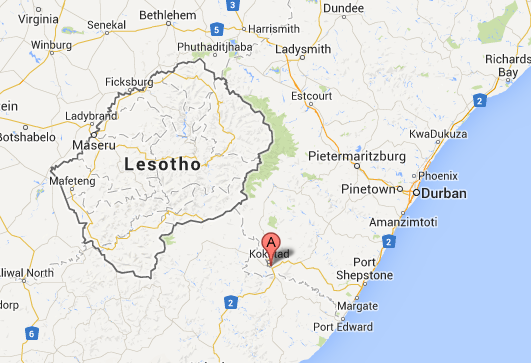
AScreen Shot 2013-11-10 at 8.29.41 PMfter dropping off a religious sister whose community was on the way we stopped for lunch in Kokstad, at the convent next to St. Patrick’s Cathedral. It took me a moment to realize that I was in Bishop Zolile’s diocese. [Bishop Zolile served on the General Council with Fr. Tom before returning to his native South Africa; he was named a bishop earlier this year.]
As I mentioned previously, Bishop Zolile was not there, though I will meet up with him in Pietermaritzburg tomorrow. I did have the opportunity after lunch to visit the cathedral and the bishop’s house where he now lives. It is a new facility having been built by the previous bishop about three years ago.

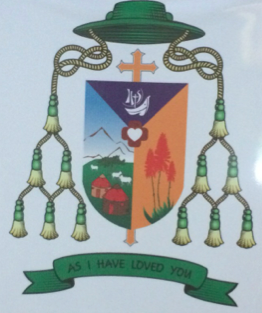
In touring the cathedral I spotted Bishop Zolile’s coat of arms. It is on the back of the bishop’s chair in the sanctuary. His motto is very Dehonian: “As I have loved you.” Another Dehonian symbol is the cross with the heart that has become the unofficial logo for the congregation.

According to Bishop Adam, most of the diocese consists of villages rather than towns or cities though Kokstad itself seems to be a good-sized city. This part of South Africa is called Kwazulu-Natal.
Screen Shot 2013-11-10 at 8.30.32 PM

November 10: Pietermaritzburg

There were two things on today’s agenda. The first was to concelebrate the 8:00 a.m. Mass at St. Francis Assisi Parish, about a 15 minute drive from the SCJ formation community house. This is a parish staffed by SCJs and it is the first parish outside of the De Aar and Aliwal North Dioceses entrusted to the care of the SCJs of South Africa.

In the last two years the SCJs have further expanded by opening a community house in the Johannesburg Archdiocese.  I will visit this community during the last few days of my visit to South Africa. It is hoped that the South African SCJs can expand their presence to urban areas such as Pietermaritzburg and Johannesburg where the large population centers offer the opportunity for more vocations than what is available in rural areas such as De Aar and Aliwal North.
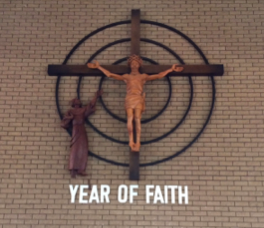
Screen Shot 2013-11-10 at 8.26.50 PMIt may be a little hard to see in this photo but the crucified Christ is an African with St. Francis of Assisi calling all to gaze on the cross and Christ. This parish is in the colored area of Pietermaritzburg. The 08:00 Mass was well attended with the church almost 100% full. The congregation was both young and old as well as a good mixture of men and women. If there were one group underrepresented I would say it was teens. I think, from what I overheard, the reason for this may be connected to the Teen Life Mass this age group had or will have attended this weekend.

The music was wonderful to listen to. Most of the hymns were in English, but because the words were projected on a screen they were impossible for me to see and thus sing along with the congregation. A few of the hymns were done in Zulu and I must confess I enjoyed them above all. What struck me was the stateliness of the tunes as well as the gusto with which the congregation sang them.

Two deacons assisted at this morning’s Mass. Both deacons are SCJs from Mozambique who have spent the last four years at our formation house while studying theology at Cedara. With the end of the semester only two or three weeks away they will head back to Mozambique to prepare for their ordination to the priesthood on December 22, 2013. The deacons thanked the parish for hosting them over the last four years and for assisting them in learning how to function in a parish setting and how to minister to the people of God in their capacity as deacons and as they looked forward to serving God’s people as priests.

Most of us in the States would have found the Mass to be long for our habits. The Mass itself lasted 1 hour and 40 minutes. The homily took 25 minutes. I think if this were a US parish those in the pews would be squirming at a homily of that length, to say nothing of a Mass lasting over an hour on a normal Sunday. From what I could tell young and old took it in stride as though it were (and I think is) par for the course.
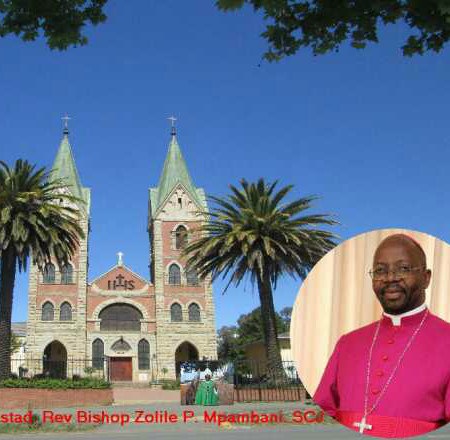
ZolileThe second matter of note on my agenda for the day was dinner at our SCJ community called Hilton Farm. Three SCJs (all from Poland) live here. Two teach at St. Joseph’s Theological Institute in Cedara (the school of theology for religious in South Africa) and one is the pastor at St. Francis of Assisi Parish where I celebrated Mass earlier in the day. I’m not 100% sure the pastor lives here full time, but at least he was here for the day and helped prepare the wonderful meal we had.

Bishop Zolile arrived late in the day so I had my chance to meet with him before he headed to Durban to catch his morning flight to Johannesburg and then on to the Southern African Bishops Meeting.
 

A last look at De Aar

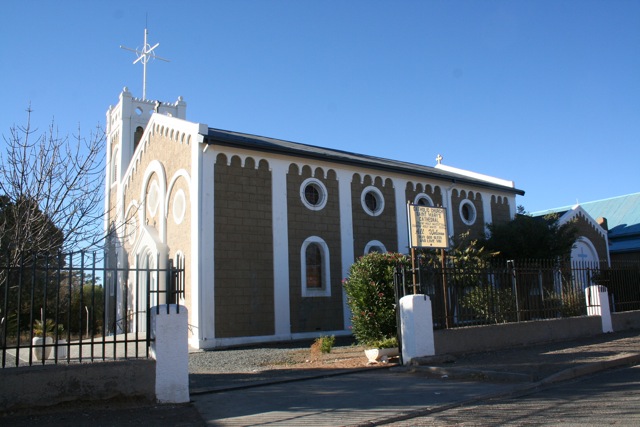
St. Mary's Cathedral in De Aar

St. Mary’s Cathedral in De Aar

As noted previously,  Fr. Tom Cassidy, SCJ, former provincial superior, is in South Africa for much of November.

During his travels Fr. Tom is keeping a journal. Periodically entries from it will be posted on the province blog. Today’s is written from De Aar, where he celebrated the feast of All Saints before continuing on his travels:

Here in South Africa the feast of All Saints is celebrated on Sunday rather then on November 1st. I had the 08:00 Mass at St. Mary’s Cathedral here in De Aar. If you think “cathedral” think small as the Diocese of De Aar is not very big, at least in numbers of people.

According to the 2011-2012 Catholic Directory for the Southern African Catholic Bishop’s Conference the diocese comprised:

An area of 67,248 sq. km. (25,965 sq. mi.)
Total population of 165,000
Catholic population of 5,747
1 bishop, 9 priests and 1 permanent deacon
I could find the addresses for 3 religious sisters working in the diocese as well

With those figures you can get a feel for the size of the cathedral. If I tried to compare it to one of our SCJ parishes in the United States the old Sacred Hearts of Jesus and Mary in Franklin comes to mind or perhaps Our Lady of the Sioux Chapel at St. Joseph Indian School might be a good comparison.

When I first visited St. Mary’s in 1987 it was for all practical purposes a “white” church. Today there is a mixture of blacks, colored (South African terminology) and whites.

One of my sisters asked me if I felt safe walking the streets of De Aar. I walk an average of at least an hour a day. Since I basically walk the Main Street where there is a lot of traffic I really don’t have any worries and have found that the people pretty much ignore me. I’m sure that even in this town of 30,000 I appear to be a stranger among them. Bishop Adam pointed out the many bed & breakfasts in the town which makes me think that strangers on the main drag are not all that uncommon.

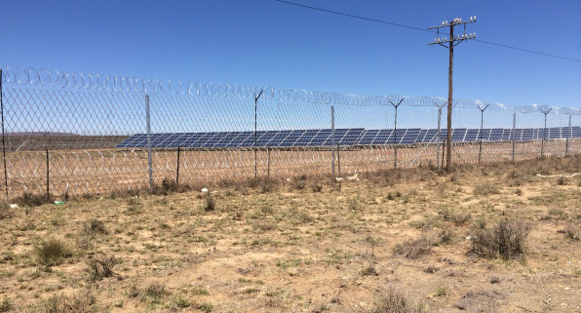
When I came back from my morning walk Bishop Adam was ready to take me to visit the cemetery where Fr. Cecil Wienan, who died on February 8, 2000, is buried. It took a little hunting for us to find the grave as Bishop Adam had the right plot number, but we were mistakenly in the wrong section. After saying prayers over the grave we took to the road so Bishop Adam could show me the solar farm being developed by Siemens. When finished it will produce 95 megawatts of electricity. The farm is 2.5 kilometers long (1.5 miles).

Screen Shot 2013-11-06 at 8.47.08 AMThis is one of two solar farms under construction. According to the bishop they are employing up to 600 people during the two-year construction phase. There are also plans to construct a wind farm in the area as well. The Karoo has plenty of sun and plenty of wind so the region is a good candidate for projects such as these.

Tomorrow is the meeting of the Diocesan Senate. In addition to running the meeting Bishop Adam is putting on his chef hat to  prepare the meal as the person who does the cleaning and some of the cooking has been gone while Msgr. Alcaster has been away. 

The charm of an old English settlement in South Africa

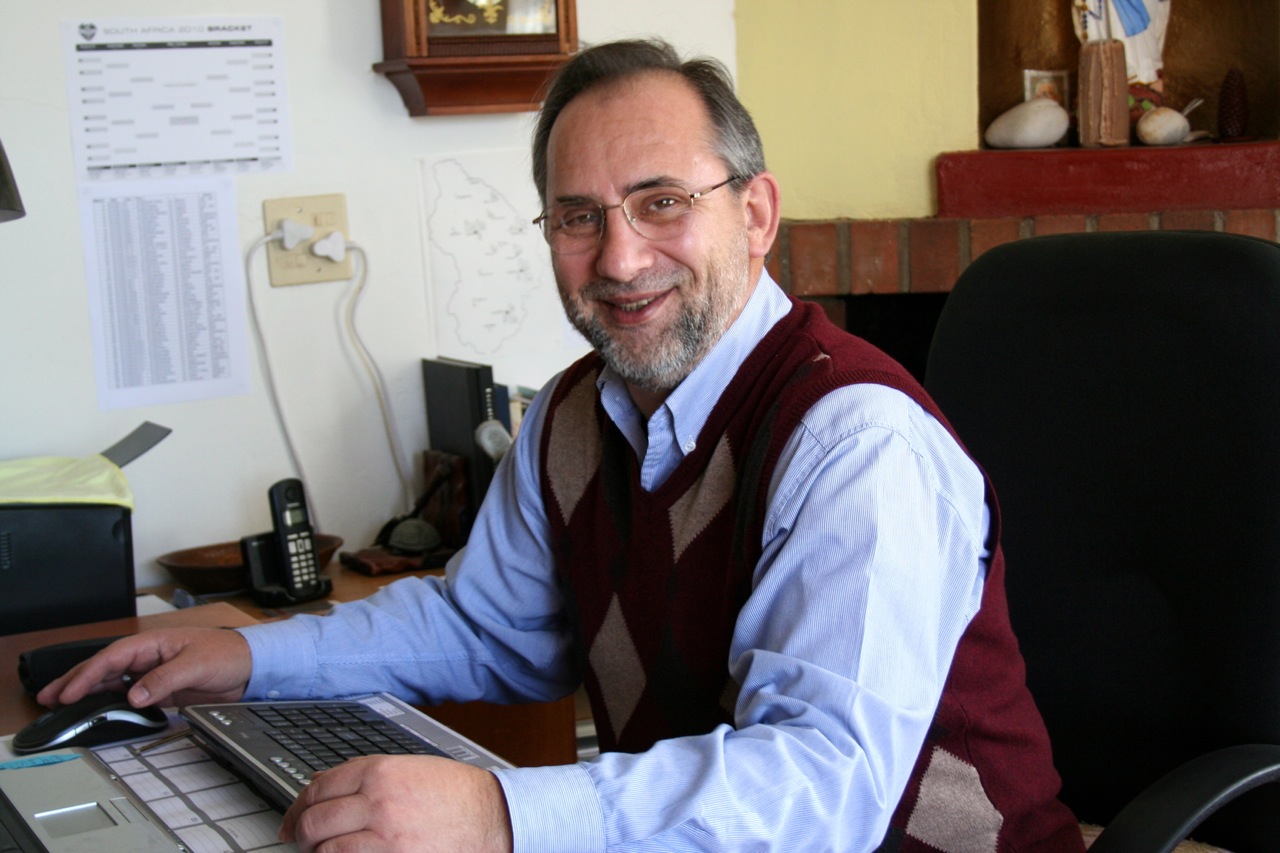
Bishop Adam Musialek at his desk in De Aar. He has been hosting Fr. Tom Cassidy during the former provincial superior's visit to the Diocese of De Aar.

Bishop Adam Musialek at his desk in De Aar. He has been hosting Fr. Tom Cassidy during the former provincial superior’s visit to the Diocese of De Aar.

As a part of his sabbatical Fr. Tom Cassidy, SCJ, is visiting the countries for which he had responsibility when he was on General Council. For most of November the former US provincial superior will be in South Africa. 

During his travels Fr. Tom is keeping a journal. Periodically entries from it will be posted on the province blog. Today’s is written after a visit to Graaff-Reinet:

Our trip from De Aar to Graaff-Reinet offered some of the best for scenery in this part of South Africa. The road takes you through two mountain passes, one of about 5,000 feet and the other slightly less. The vistas are broad, and with few trees you can see for miles. We managed also to catch a glimpse of springboks and monkeys on the way and a large turtle crossing the road upon our return home today.

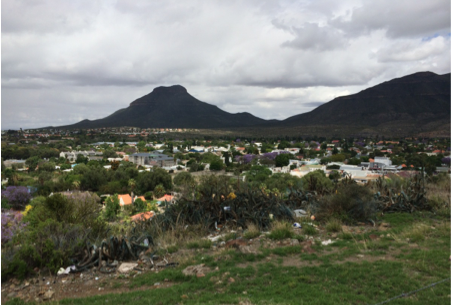
Graff-Reinet viewed from the black township.

Graff-Reinet viewed from the black township just outside of the center of town.

Graaff-Reinet is an old English settlement and still carries much of the charm of days long past. It is also larger (at least the town proper) than De Aar. The pastor at present is Fr. Kazimierz Gabriel, SCJ, who is originally from Poland. He has a green thumb and enjoys, among other things, to grow roses.

The purpose of our visit was a meeting of the parish council with the bishop. Bishop Adam and Fr. Gabriel thought it was a very profitable experience for all concerned.

After the meeting broke up the three of us went out to eat dinner. The place Fr. Gabriel chose was about a 10-minute walk from the rectory. It was a small restaurant with an interesting menu. I had the chance to order ostrich steak, but opted for Karoo Style Lamb Chops. Since Bishop Adam took the ostrich I had the chance to taste it. It really does have a flavor close to steaks — for once you didn’t hear: “Tastes just like chicken.”

This morning I had the chance to take a walk around town and capture a few pictures. Even though this was an English Settlement the biggest church in town belongs to the Dutch Reformed Church. Our own Catholic church pales in comparison. This being the first of the month another thing I noticed was the large number of people lined up at the banks and ATM machines — pay day!

After my walk the bishop and I had breakfast. At the table he told me the story of the recent storm that took off the roof of St. Teresa’s Church located in the “colored” section of town. One of the glaring leftovers of the apartheid era is the division of towns into three parts: white, colored and black. The lines have been blurred and you can find colored and blacks in the formally all white sections, but I think it would be hard pressed to find whites in the other two.

Fr. Angel took the two of us up to see St. Teresa’s; it is just about ready to reopen as a new roof has been put on and the painting inside is all but complete. By the time Bishop Adam returns at the end of November the outside will be painted and ready for the parish to celebrate a grand reopening.

Since tomorrow is All Souls Day we also took the opportunity to visit the grave of Fr. James Howley, SCJ, a member of the British-Irish Province who died suddenly of a heart attack in April of 1987. I never met him, but certainly knew his story and what good friends he was with Fr. Joe Nugent, another member of the British-Irish Province, who worked in South Africa for many years, and who I got to know well during my time on the General Council.

Then it was time for us to move on. Before getting back to De Aar for evening Mass, Bishop Adam wanted to show me Middleburg and visit Fr. Gabriel Jayaraj, one of two young Indian SCJs working in the De Aar Diocese. I met Fr. Gabriel two years ago when I was passing through South Africa on may way to the ordination of Archbishop Claudio Dalla Zuanna, SCJ, in Mozambique. I will get a chance to meet all the priests in the diocese on Monday when Bishop Adam holds a diocesan senate meeting.


Returning to South Africa


Screen Shot 2013-10-31 at 1.13.06 PM

As a part of his sabbatical Fr. Tom Cassidy, SCJ, is traveling to the countries for which he had responsibility when he was on General Council. On October 28 the former provincial superior left for South Africa.

During his travels Fr. Tom will maintain a journal. Entries will be posted on the province blog. He starts with the following:

I first visited South Africa in 1987 when it was an apartheid state. Unlike today it required a hard-to-get visa to enter the country, and because I am a priest it was even more difficult to get one; in fact, my visa was granted just the day before I was to travel. I’m guessing this visit is about my eighth since then and a lot has changed in the country.

It’s going on noon here in De Aar, my first morning in South Africa. The trip from Milwaukee was long.

Fr. Tom Cassidy

Fr. Tom Cassidy

It included a bus ride Monday afternoon from Milwaukee to Chicago, a flight from Chicago to Frankfurt that took eight hours, a ten-hour overnight flight to Johannesburg and finally a flight to Bloemfontein.

At Bloemfontein I was met by Bishop Adam Musialek, SCJ and Fr. Paul Koscielny, SCJ. A few more hours in the car and I was in De Aar at 6 p.m.

I was surprised to find Fr. Paul at the airport along with Bishop Adam. Paul explained he had a doctor’s appointment and since I was being picked up by the bishop the two of them came together. I forgot that a couple of years ago Paul fell off a roof and damaged his leg. He still has pins in the leg but told me it now looks like they will come out in the next few months.

When we got to Colesberg to drop Paul off at the rectory both Bishop Adam and Fr. Paul told me the story of what happened to the previous pastor, Fr. Gerry Fitzsimons. As they told the story I recalled learning about it back in the States. He was found stabbed to death in the rectory after being reported missing. His car was stolen and it was the car’s license plate that led to the capture of his assailant. With that sad tale in my head we said goodbye to Paul and headed to De Aar about an hour’s drive from Colesberg and my final destination of my long journey from Milwaukee to De Aar.

At present there is an eight hour time difference between Milwaukee and De Aar. Since South Africa does not go on summer time when the clocks in the US fall back it will revert to a seven hour difference. And since I am now south of the equator De Aar is in the middle of spring. At this time of year warm days and cool nights — good sleeping weather.

This afternoon I will travel with Bishop Adam to Graaff-Reinet as he has a 6:00 p.m. meeting. We’ll stay overnight before returning.

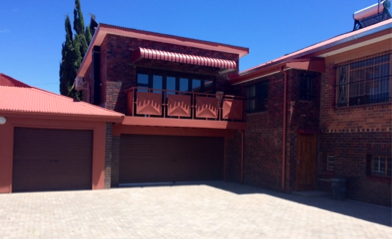
The bishop's residence and offices in De Aar, South Africa.

The bishop’s residence and offices in De Aar, South Africa.

Blessing of the new Mother House in Poland

As noted previously, Fr. Tom Cassidy, now on sabbatical after completing his second term as provincial superior of the US Province, is writing a journal during his trip to Poland. During his sabbatical Fr. Tom is spending time in many of the locations for which he had responsibility when he was on General Council. Next spring he will spend extended time in Asia, helping in the missions of India and the Philippines. Here, writes about the dedication of the SCJs new conference center which the US Province helped to fund:

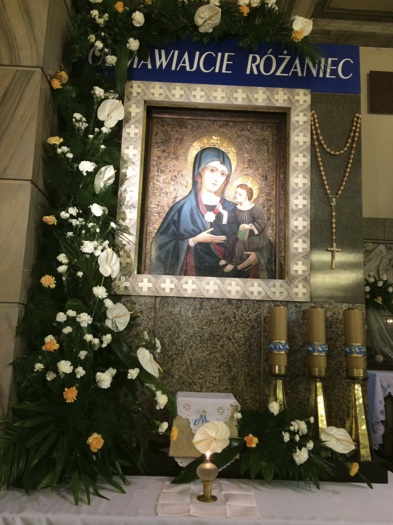
The church next to the newly remodeled conference center has a shrine to Mary:  "Blogostawionego Macieraynstwa" according to Fr. Tom.

The church next to the newly remodeled conference center has a shrine to Mary: “Blogostawionego Macieraynstwa” according to Fr. Tom.

Today the Domus Mater (Mother House) was dedicated and blessed by one of the auxiliary bishops of Krakow. Originally the cardinal had agreed to be the main celebrant but at the last minute had to cancel and promised to send one of his three auxiliary bishops to fill in for him. In addition to me representing the United States both the German and Franco-European provincials were present as each had contributed to the renovation of Domus Mater as a conference center.

The building is done in what I’d call a “Modern European” style. For anyone who has been to Italy and seen our Villa Aurelia (small hotel adjacent to the general curia) the style would be similar, but with new technological innovations such as electronic keys. There are 33 guest rooms that can accommodate up to 66 people. Of course there are several rooms for meetings and one large hall as well. Part of the building also houses the SCJ community. I believe it numbers 11. In addition there are 10 rooms for elderly SCJs, and in this case I’m thinking more along the lines of nursing care. These rooms are not quite finished.

The morning began with breakfast served from 07:30 to 08:30 and at 09:00 a conference was held in the church. This was necessitated by the size of the crowd attending today’s blessing. The hour-long talk was by a medical doctor and with my all but non-existent Polish went over my head, though I could at last figure out it had to do with the bioethics of human reproduction.

After the conference there was a half hour break to prepare for Mass. Artur, our Polish Provincial, gave an introduction and the Mass then proceeded as usual with the bishop as main celebrant and homilist. Following the Mass, the bishop accompanied by Artur and several others, went about the building blessing it with holy water. After the blessing an excellent meal was served. By the way, I’ve noticed that at big celebrations like this only tea, coffee and juice is served. The laws on drunk driving are very strict with the alcohol level at .02%. As such the slogan: “Don’t drink and drive” takes on a whole new meaning.

After the meal I agreed to meet Fr. Christopher at 2:00 PM for the drive back to Warsaw. There were four of us in the car, but this was a bigger Fiat, more like a wagon then a car so the ride was quite comfortable. Christopher knows a little English but the other two did not. On the walk to the car Christopher apologized for his English saying: I have to translate from Polish into German and then into English. As we began the trip I told him I would listen to a book on my iPhone and they could talk all they wanted in Polish. Actually it turned out to be a quiet trip as the two other passengers spent much of the trip napping.

We arrived back at the provincial house in Warsaw just about at 6:00 PM. The traffic was lighter than I expected. This being the weekend there were fewer trucks on the road, which helped especially along the sections that are still single lanes in each direction.

Unfortunately, in one sense I did not have anytime to tour Krakow, a very beautiful old European city. However, I spent a few days here on my first trip to Poland and have a good feel for the city and its rich history. Tomorrow will be my last trip as Michal Ciemiega and I will travel to visit the famous shrine of Our Lady of Czestochowa.

Formation communities and visit to Auschwitz

Fr. Tom Cassidy, now on sabbatical after completing his second term as provincial superior of the US Province, is writing a journal during his trip to Poland in October. During his sabbatical Fr. Tom is spending time in many of the locations for which he had responsibility when he was on General Council. Next spring he will spend extended time in Asia, helping in the missions of India and the Philippines. Here, writes from Poland:

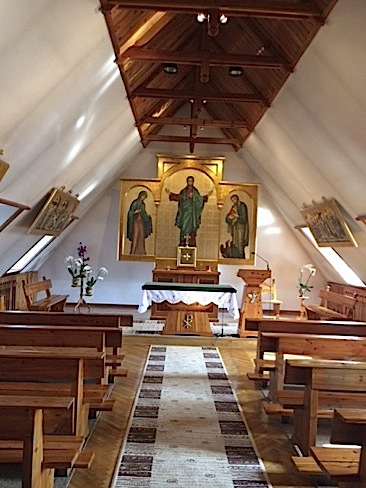
Chapel at the SCJs' novitiate in Poland

Chapel at the SCJs’ novitiate in Poland

Fr. Micheal Ciemiçega and I drove from Warsaw to Stadniki with a stop for lunch at the SCJ novitiate located at Stopnica. The building has a long and storied history that goes back several centuries. It was purchased from the Franciscans after World War II and as with many buildings in Poland, it suffered extensive damage during the war.

There are currently three novices who began their novitiate year last month. I was told there are eight postulants though their house is about 100 kilometers from Stopnica.

In addition to stopping to see the place it also afforded us the opportunity to join the community for lunch.

Upon our arrival at Stadniki, where SCJ students study philosophy and theology, I had the opportunity to get in my daily walk. Stadniki itself is not very big but happily there was a sidewalk that kept me out of the road, though traffic was light to say the least.

At present there are 19 students. The majority are Polish but several other Eastern European countries are represented, i.e., Croatia, Byelorussia and, if my memory serves me, Moldavia. I had the chance to spend a half hour with the students this evening talking about SCJ life in the United States. All the students are studying English but their grasp of the language varied greatly so two of the students translated from time to time.

The school year here began last week. They follow the European tradition of an October start. In addition they follow the Jesuit model of Thursday off and classes on Saturday. All of their studies are done here at Stadniki. The deacons travel to Krakow for a course and practicum at a hospital a bit akin to CPE (Clinical Pastoral Education) in the US.

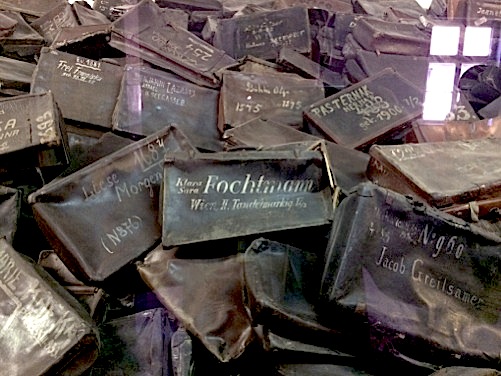
Suitcases left behind by those who were sent to Auschwitz-Birkenau

Suitcases left behind by those who were sent to Auschwitz-Birkenau

Auschwitz-Birkenau

On my first visit to Poland I did not have time to visit the Auschwitz-Birkenau concentration camps and wanted to make sure I could find the time to see first-hand this sad chapter in history. Words in many ways fail to convey what took place and how sinister human beings can become in their treatment of their fellow human beings.

It is good that much of what took place here has been preserved and that so many come to see for themselves how the “final solution” was carried out with such precision.

Stadnike is about an hour and a half drive to Auschwitz, but here in Poland it is called Oswiecim. When the Nazis defeated the Poles and took over they changed the names of places so that they would be easier to pronounce in German. The reason Auschwitz was chosen as a concentration camp was both its location that provided excellent rail transportation as well as the fact that it was the site of a Polish military camp — that’s why most of the buildings in Auschwitz are made of brick.

AushwFr. Michael and I left the house about 8:30 so that we could be there in time for the first English tour at 10:30. For most of the day there are English tours every hour while other language groups may be less often or perhaps have their own guide with them, as is often the case for Jewish groups I was told.

I certainly spotted a number of groups of young Israelis during our 3 1/2 hour tour. The tour takes you through Auschwitz (1) and then the groups are bused over to Birkenau — it’s about a five-minute ride. Auschwitz was actually a series of camps that began with the military barracks (Auschwitz 1) and over time grew to encompass Birkenau where most of the mass killing occurred as well as labor camps where prisoners worked, actually worked to death might be a better way to put it.

As I said in the first paragraph words cannot really describe what took place and what is felt by visitors today. Only what is left behind can give a voice to those who died here.

Celebrating “name day” and getting a sense of life in Poland

Fr. Tom Cassidy, now on sabbatical after completing his second term as provincial superior of the US Province, is writing a journal during his trip to Poland in October. During his sabbatical Fr. Tom is spending time in many of the locations for which he had responsibility when he was on General Council. Next spring he will spend extended time in Asia, helping in the missions of India and the Philippines. Here, writes from Warsaw:

Fr. Artur, receives well-wishes on his name day

Fr. Artur, receives well-wishes on his name day

A number of SCJs from the Warsaw area and beyond came to the provincial house to celebrate Fr. Artur Sanecki’s name day. [Fr. Arthur is the Polish provincial superior and in Poland, “name days” or saint days upon which a person shares the same name, are celebrated much like birthdays are celebrated in the United States.] We had Mass at 11:30 AM followed by a short gathering to toast Artur and wish him well. After the presentation of the toast each person would clink his glass with Arthur’s, shake his hands and in the style common in this part of the world, brush their cheeks three times.

We then had our meal consisting of soup, about four different kinds of salads and vegetables, potatoes and rice and a selection of meats (chicken, beef and pork). Following the meal we returned to the hall to have coffee and dessert — a very delicious four-layer cake.

Since Mass was not until 11:30 I took the opportunity to take a walk before. Not far from here is a Jesuit church it was impressive to see the number of people arriving on foot for Mass and, I might add, it was young and old. During the afternoon I passed by several other Churches that were filled to capacity for the evening Mass.  That’s not to say there are no problems facing the Church here in Poland.

Our own SCJ community has experienced a decline in Polish vocations. Now many of the students come from the missions in Eastern Europe, such as the Ukraine, Croatia and Moldavia, to name just a few. The sex abuse scandals that we have become familiar with back in the States has finally been felt here as well. In addition, if you look around the globe as a country becomes more prosperous, interest and participation in religion tends to decline. That, to some degree at least, is felt here as well.

In the afternoon Artur took me via the subway to Old Warsaw. The style of architecture is certainly old but you have to remind yourself that much of it was reconstructed following World War II. Much of Warsaw was destroyed first in 1939 at the beginning of the war and then the Polish uprising and the final liberation of the city added to its destruction.

I should note that as in any major city in Europe the public transportation system is excellent. We could have gotten to the central city by bus, tram (street car) or subway. This being Sunday the subway was crowded with folks out for a Sunday stroll. The old city was packed with people, again young and old, enjoying the sunny crisp weather (the temperature was around 60° F). Our tour of the old city ended with the stop at a famous deli and bakery where, according to Artur, one could enjoy the best doughnuts (Paczki) in the city. Naturally we had to try.

I’ll close today with a few photos taken on our walk around the old city. Tomorrow we are headed to Stadniki, the theologate of the Polish Province that, by the way, has just celebrated its 50th anniversary.

Cassidy Poland pic

Poland-bound

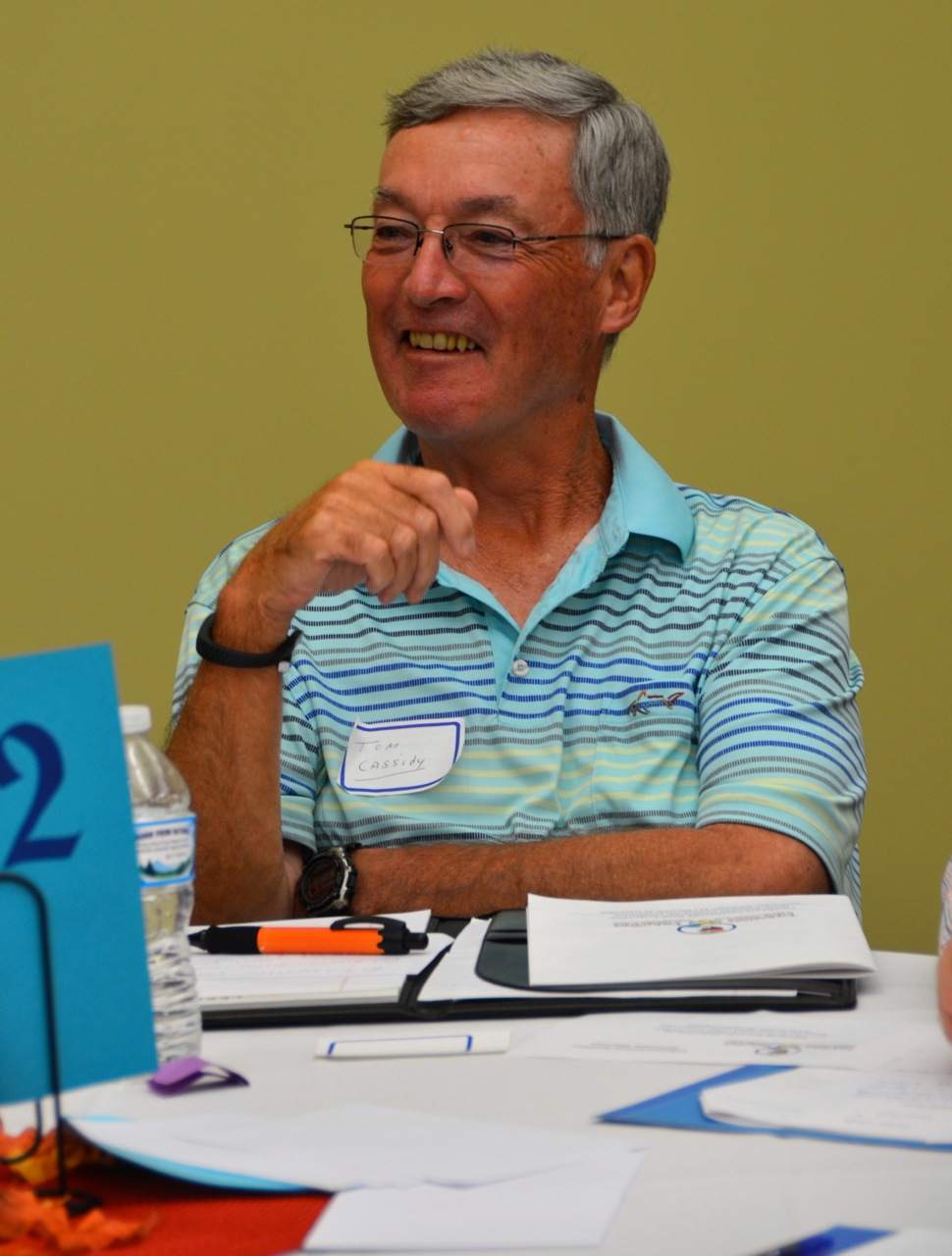
Fr. Tom speaking during a recent gathering. After completing his second term as provincial superior he began a sabbatical that is taking him to several of the places for which he had responsibility when he was on General Council.

Fr. Tom speaking during a recent gathering. After completing his second term as provincial superior he began a sabbatical that is taking him to several of the places for which he had responsibility when he was on General Council.

Fr. Tom Cassidy, now on sabbatical after completing his second term as provincial superior of the US Province, is writing a journal during his trip to Poland in October. We will post excerpts from it on our province blog. Here is the first entry, written on October 3:

I’m off for Poland! At the moment I’m sitting in Chicago’s O’Hare Airport waiting my flight to Frankfurt and then on to Warsaw. I leave Chicago at 6:25pm and will land tomorrow in Warsaw at 1:50pm. It’s a long trip but I have some much longer than this one. I managed to bring everything I needed with the exception of my Magnificat Daily Missal. It’s not a great loss as both my iPad and iPhone have the iBreviary app that also includes both the daily readings and Mass prayers in English. It would be hard for me to follow it all in Polish.

The chief purpose of this trip is to attend the dedication of a conference center in Kracow that our United Sates Province help to fund. It is actually the renovation of a large building owned by the Polish Province. I saw the building several years ago on my first visit to Poland following the meeting of the European SCJ Major Superiors that the major superiors of Canada and the US were invited to attend. Secularity was the theme, and although there are differences on what that means and how it is applied in Europe and the US as well as Canada.

Fr. Artur Sanecki is the current Polish Provincial. He has just started his second three-year mandate. I know Artur from his days as a student in Rome where he obtained his doctorate in scripture. Artur is no stranger to the US as he spent several months living at Villa Maria (our old retirement community).

Artur invited me to attend the dedication/blessing of the new conference center since the US Province helped fund the project. I reminded Artur that my time as provincial has come to an end, but he said to come anyway and since Fr. Stephen Huffstetter, our new provincial, is just settling into office I got the chance to represent the US. It also fits into what I am going during this transition year (sabbatical). I am taking time to visit the various provinces and regions I worked with while on our General Council, as well as doing some work for the congregation by spending several months in India early next year as well as assisting with English in the Philippines in April and May.

I’ll bring this to a close as it is about time to board the flight from Chicago to Frankfurt.

Reflecting on the loss of a seminarian

Two Dandelion Seed Heads

The living reality given to us by God

The following reflection was written by Fr. Bernie Rosinski, SCJ, a frequent contributor to our province blog:

Yesterday at Sacred Heart School of Theology, the first day of the fall semester, I witnessed something that is hard to describe. It was like a “sobriety dance.” A sensible pall seemed to fall over everyone, staff, faculty, student alike. I knew it. I recognized it. I did not know what was causing it. Everyone walked as they usually walked, moved between room and class, office and conference room, in and out of the dining room. The usual bubbliness and hubbub were gone and a sensible reduction in sound and noise was evident. I noticed, too, that the usual laughter and loud bursts of conversation were lacking. Why the pall? Why the shroud over normal conduct? It was like some invisible weight was pressing down on flesh, causing it to flex and depress.

Then, at the lunch table, as I was seated with some Vietnamese nationals attending the ESL [English as a Second Language] program here – actually, two priests, a brother, and a religious sister – I was asked: “Why does God take some people when they are young?” I found the question strangely timed but valiantly tried to give the stock answer in an acceptable way. My hearers did not seem to buy it and the problem was not due to language. Shortly thereafter, Msgr. Ross Shecterle, the president-rector of the Sacred Heart School of Theology, came over our table to announce the death of one of the seminarians in case we hadn’t heard the news yet. He choked up a little as he spoke. I hadn’t known, but others at our table were aware of the death.  Now I knew the cause of the pall I had witnessed. I finally learned the answer to my wonderment. His name was Javier and he was from Mexico.

We humans ascribe to God a lot of things that happen, even dying. Earlier I had read a very intelligent and intelligible phrase in a brief essay by Douglas Bushman that said: “…the ultimate explanation of all that God does is that he is faithful to himself.” He has created the physical world of time and space that operates so very consistently that we can draw our “science” from it: the laws of physics, chemistry, zoology, biology, etc. In that same world of time and space, God allows living organisms to grow in evolutionary ways according to their own laws.

While we all have to die, God has meant us for life and that is why he sent his Son, Jesus, to show us the way to life – through death and resurrection. This same God once in time sent his Son, Jesus, to heal us and our world. In Jesus’ resurrected absence from our world, the healing art of medicine developed and made use of science. Unfortunately, the art of medicine, for all its science, is unable to keep up with evolving organisms. Where it does, there are cures; where it doesn’t the laws of nature follow their natural course and we die. Once again, the ultimate explanation of all that God does is that he is faithful to himself, to his work, his creation, the laws of science and the evolution of living organisms.

There is no blame. There is no fault. There is only living reality given to us by the God who is faithful to himself.

Let us remember Javier in our prayers.

Screen Shot 2013-08-27 at 2.10.56 PM

NOTE: Javier Ibarra Hernandez was a seminarian at Sacred Heart School of Theology for the Diocese of Salina, Kansas. The diocese posted the following on its website:

Javier Ibarra Hernandez, a seminarian for the Diocese of Salina, died Monday, Aug. 26, at Via Christi-St. Francis Hospital in Wichita.

Ibarra, 35, had been hospitalized several weeks and was being treated for an unusual strain of pneumonia.

“It is with a mix of human sadness and Christian trust that I share with you that our dear friend and seminarian, Javier Ibarra, died earlier today,” Bishop Edward Weisenburger said in a statement Monday. 

“As most of you know, Javier became sick several weeks ago. His condition quickly showed signs of being catastrophic, and for that reason we brought his elderly parents and his sister here from Mexico. We believe Javier received exceptional care from committed doctors and a very devoted nursing staff,” the bishop said. 

The day his family arrived, Ibarra was alert and able to communicate, Bishop Weisenburger said. 

“That day proved to be the last day that he was able to be alert for any lengthy period of time. It was an immense blessing that his family members were able to have that special day with him,” he said. 

“A great many of you have prayed for Javier throughout this sudden illness. Your concern for him was always apparent, and he knew of your affection. He treasured the new home he had found in the Diocese of Salina, his rapport with his brother seminarians and the good people of north-central and western Kansas. I know that he will be remembered by us with great kindness,” Bishop Weisenburger said in the statement.

Click here to visit the diocesan website.

Learning TWO new languages

Fr. Juan Carlos (“Juancho”) Castañeda Rojas is just about at the end of his novitiate year. He is scheduled to profess his first vows on August 15. As he prepares to do so, he shares the following reflection:

Juan Carlos Castañeda Rojas during the June Election Assembly, where he served as a teller.

Juan Carlos Castañeda Rojas collecting ballots during the June Election Assembly.

When I came to the United States, the first thing I had to do was study English. That is why I was part of the ESL program (English as a Second Language) at Sacred Heart School of Theology. It was a really good and challenging time for me. Learning a new language and a new culture was not easy, but here I am with my education in philosophy at Xavier University (Chicago) and getting ready to continue with my studies in theology at Catholic Theological Union (also in Chicago).

Well, my novitiate is almost over and I have had many great and powerful experiences. I will keep them always in my heart. It has been an amazing journey exploring the history and constitutions of the congregation, growing in faith, and strengthening my vocation and my desire to become an SCJ. As I told Fr. John Czyzynski, our novice master, after our trip through the different missions and ministries in Mississippi, Houston, South Dakota, Florida, and Milwaukee, I recognize the importance of studying our constitution and history. But I also learned a lot by listening to all the members of the SCJ community in our visits.

Today, because of one of those people who shared his experience as an SCJ, I realized that I was not only learning English but was and am learning another language, one that I now call DLH (Dehonian Language of the Heart). Thank you Fr. Byron [Haaland], you made me realize that in your sharing. ¨I speak Dehonian¨ were the words Fr. Byron spoke that had a huge impact on me. While ESL taught me how to speak English and communicate, DLH taught me to indentify myself as a Dehonian. And I will complement Fr. Byron’s words with Fr. PJ’s [McGuire] message in his homily in which he made reference to one of the sections from Fr. Dehon’s ¨The Retreat with the Sacred Heart.¨ It was  there that I found another new word for my vocabulary, which is “gauge.”  Meditation 34: Generosity is the gauge of love (by the way, thank you Fr. PJ for a wonderful translation) tells the story of a young man who received the gift of a vocation but lost it because of his lack of generosity.

English, as any other language, has many rules; grammar and correct pronunciation make it a hard language to learn. But I learned that the Dehonian Language of the Heart has only one ¨rule,¨ which is called “Generosity.” You may ask, “That’s it?” Well, DLH is taught from one heart to another; it is a language that is translated through actions as well. It is fairly easy and there is always a place for everyone. We are all called to this learning adventure.

In the same way that the young man from the meditation received the gift of his vocation, I have received mine. And I am very happy to realize that I have many teachers who can teach me every day not just new a word in English but also a new word in the language of Fr. Dehon, the Language of the Heart through their experiences and their examples of how they live.

On August 15, with the profession of my first vows, I will be saying yes to God. I will also be saying yes to the legacy of Fr. Dehon, and I will be able to say it in a Dehonian way by the way I conduct myself as an SCJ.