Category Archives: Uncategorized

Second week, and death of a confrere

As we noted previously, Fr. Johnny Klingler, SCJ, is in the Philippines teaching English April through May. He writes from the formation community in Cagayan de Oro.

It is Sunday morning and I will soon prepare to travel to Palembang, Indonesia, for the funeral of Fr. Tom Fix, SCJ. He died last night after a battle with cancer. Now at peace, he surely will be missed by the people he served for so many years. I was able to visit him in Indonesia on two occasions through the years.
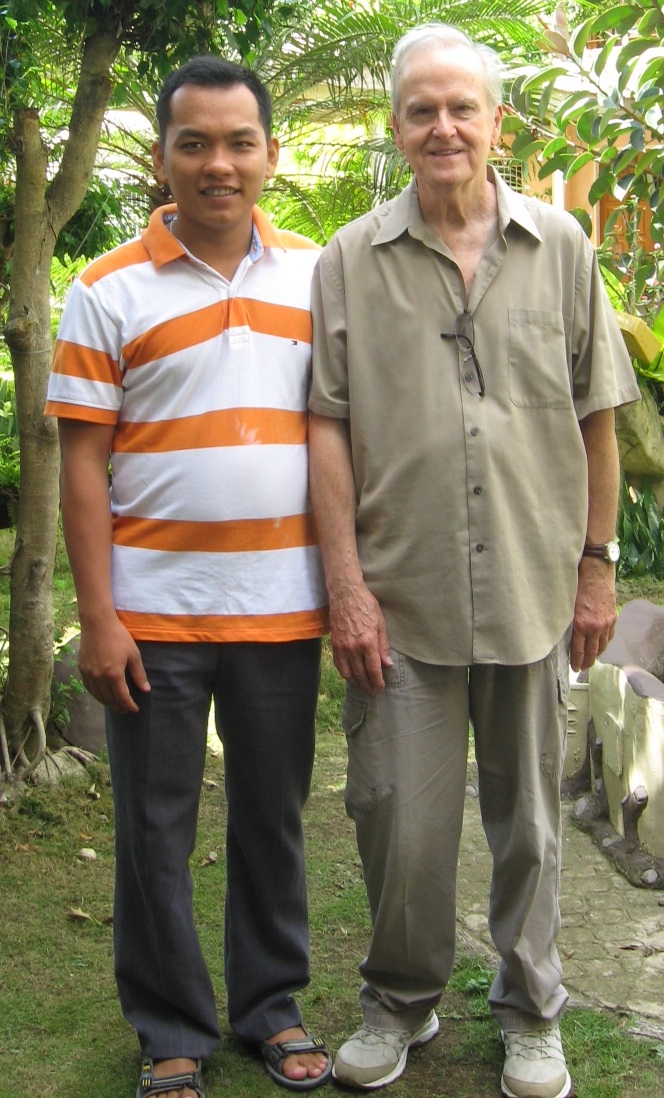
Fr. Johnny with one of his students.

The  second week of school went well and I continue to feel very positive about what I am doing. Besides being in the classroom the students call on me to help them in their punctuation and writing assignments.They are eager to learn and all need individual  help. I have already used film and popular songs  to help them. I recall my days at the seminary in Kilroe teaching writing and multimedia.

Aside from school I went out one evening to an Italian restaurant and enjoyed some pizza and wine. It was a pleasant respite from rice, fish, and water. Saying that though I should add that the fish at our meals is good and a we are served a large variety as we live close to the ocean. We also at times enjoy a pasta and tuna dish which is delicious.

Yesterday morning I went with one of the postulants to see something of the city. We visited the cathedral and Xavier University where the SCJ  students study philosophy. It is very large and quite impressive. The city was crowded with Saturday shoppers and, of course, traffic and more traffic. I am happy that I do not  have to drive. However, driving here would be easier than Rome. I hope in the coming weeks to visit some of our SCJ parishes and our novitiate, which is about six hours away by car. This past Tuesday there was a final profession at the novitiate.

The intense hot summer continues. I sweat most of the time even after a nice cold shower!

–Fr. Johnny Klingler, SCJ

“How old are you?”

Two of Fr. Johnny Klingler's students working in the formation house garden.

As we noted previously, Fr. Johnny Klingler, SCJ, is in the Philippines teaching English April through May. What follows is his first blog post from the formation community in Cagayan de Oro.

On my first day at our seminary and community house in Cagayan de Oro, I was awoken at 4:30 a.m. by a symphony of cock-a-doodle-doos, the barking of dogs, the songs of birds and the tape-recorded call to prayer of our Muslin neighbors.

The formation house library is Fr. Johnny's air-conditioned refuge. The librarian is pictured here.

It was Wednesday morning and I went around introducing myself to the librarian, the secretary, two cooks and the lady who does the washing. They are all so lovely. I took my writing pad with me in order to write down their names, which helps me to remember. The class of Vietnamese aspirants that I will teach are all so friendly. They range in age from 21 to 29. They all look much younger. The first question that they ask me is, “How old are you”? It appears it is the way to get the conversation going. I start out with 42 years and work myself up to 76! They ask many questions and want so much to learn English. I got to know them better the following day when we went on an outing to the beach. It was a beautiful place. The water was warm, clean and had a good surf. I got a slight sunburn despite the protection. Our picnic lunch consisted of rice, chicken, shrimp chips, peanuts, bananas and watermelon. The watermelon is the best I ever tasted.

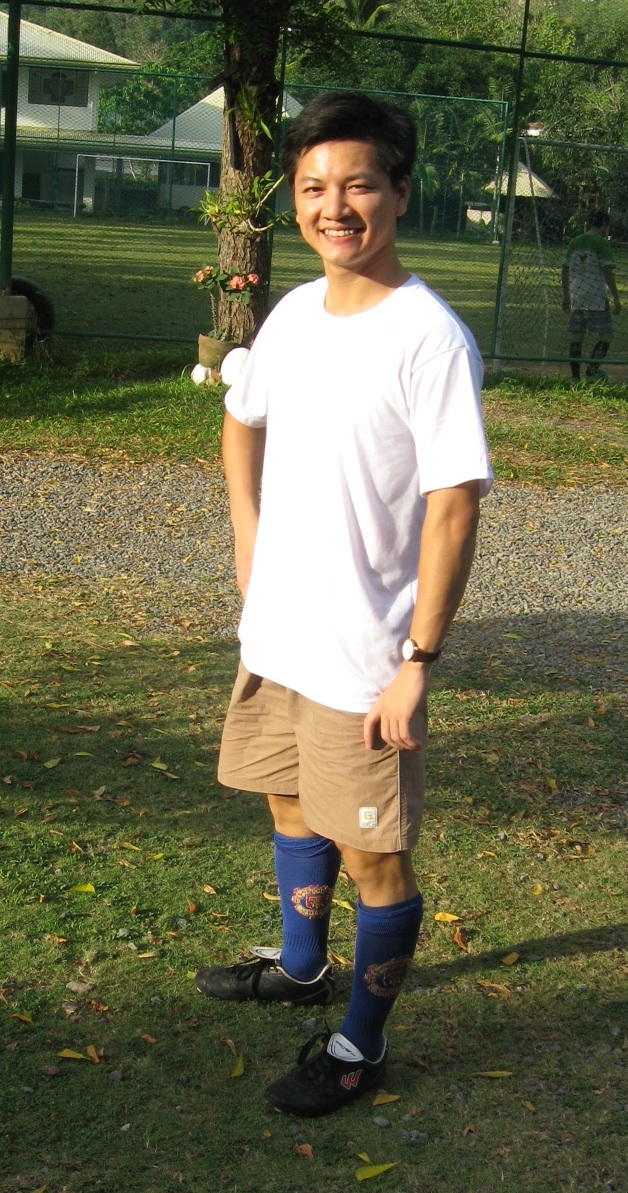
Fr. Johnny said that the students and SCJs in the formation community are all "mad about soccer."

Lunch and dinner usually consists of rice, chicken, fish, tomatoes, cucumbers and onions, and for dessert, bananas and mangoes. There is always rice (white and sticky), even at times for breakfast. I make my own breakfast of toast covered with peanut butter. I love the strong instant coffee and I drink plenty of water. I have to as I am usually sweating. It is a little cooler than Manila in the early morning and late evening. The days are so hot and humid. My room is usually about 83 degrees or more and I am happy to have a fan. There is no air conditioning. However, I discovered that the small library is air conditioned so I go there as much as I can. One thing is sure, I will not gain a pound and more than likely lose a few. There is beer and coke in the recreation room and even though I don’t care for beer, I find it refreshing when the temperature is so high.

Friday, the teacher who set up the six-week English course came over to see me and we went over the program. She has a doctorate in communications and has taught at the formation house for a number of years. The classes begin on Monday.

This Sunday morning, I woke up at 4:30 a.m. and began my day. The liturgies are prayerful and simple; the singing of the students, so beautiful. This afternoon I will take a siesta. Perhaps we will watch a movie this evening. I brought some DVDs for the community,

Fr. Wayne Jenkins, who has finished his archival work for the new district, will leave this afternoon for Indonesia to visit Fr. Tom Fix and then return to the States on Wednesday.

-Fr. Johnny Klingler, SCJ

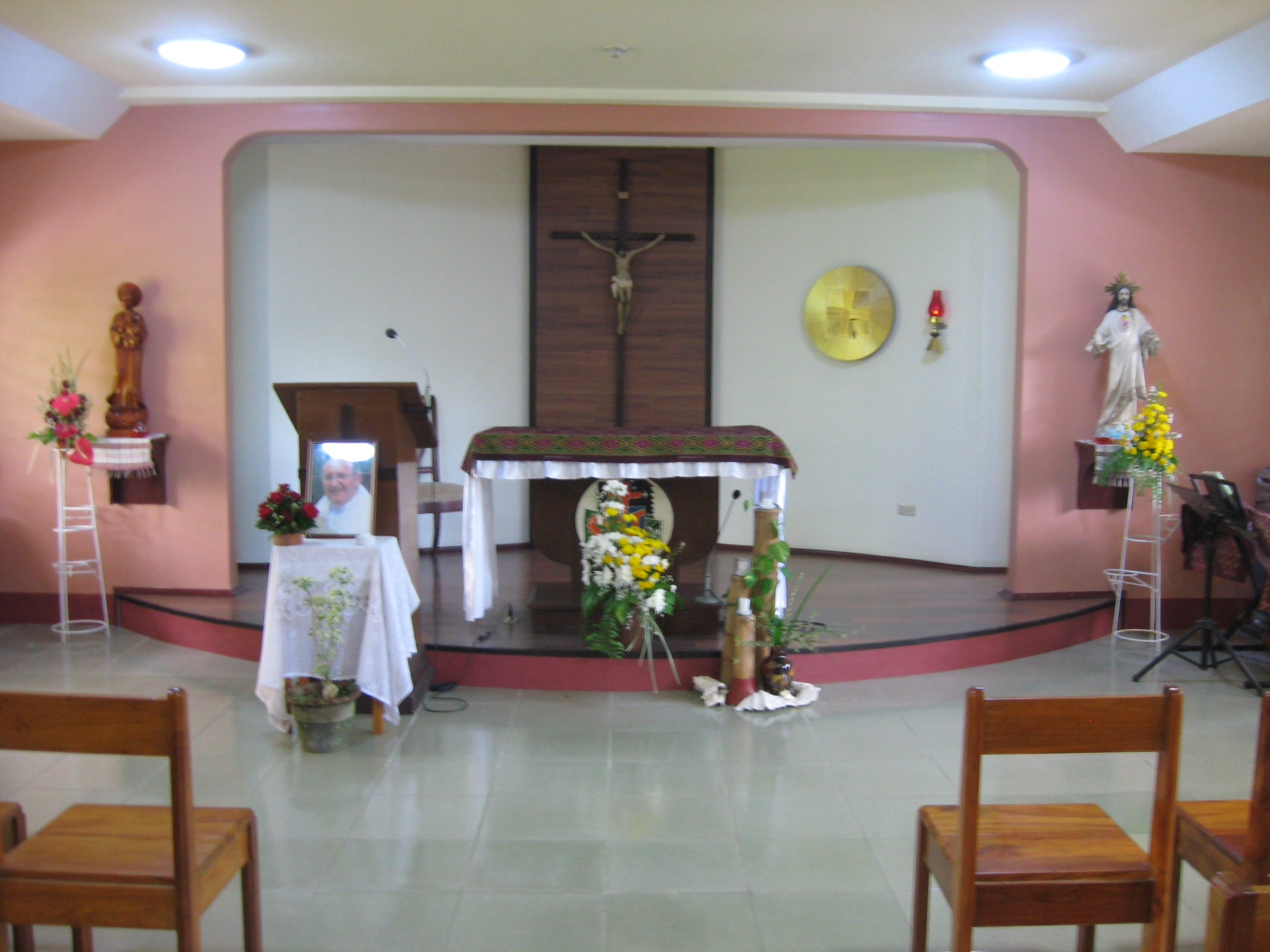
The formation house chapel

Holy Week in the Philippines

Fr. Johnny writes: "This is painting done by Joey Velasco, of slum children. Notice on your right the child sitting on a garbage can and the lad to the side. Joe Velasco is a Filipino artist who lives close to our house.

Fr. Johnny Klingler writes from the Philippines. He will be there for the next two months teaching English:

“Just a little news… I arrived in Manila on Wednesday at 11:30 p.m. Fr. Vincent Sri Herinati, superior of the community, was there to welcome me. It was a very long journey. I finally got to bed at 2:00 a.m., Holy Thursday. I left Chicago on Tuesday at 3:30 p.m! I could only sleep about three hours due to jet lag and it being  so hot . I was happy to have a fan in my room as the temp was 83 degrees.

“I went  to the ‘Church of the Revolution’ for the Holy Thursday liturgy. It is so called because after the peaceful change of government the new president, Corazon Aquino, had it built in Thanksgiving. I went with Fr. Al  Back, Formation Director  and Fra. Jonathan Schneriders from Brazil who is studying  the native language, Tagalog.  It was a beautiful Mass, lovely singing and procession. We stood for 2 1/2 hours not knowing that you had to be there at least 45 minutes before it began to get a seat. I was grateful that the church was air conditioned. The temperature during the day is in the 90s and humid  I am usually sweating here!

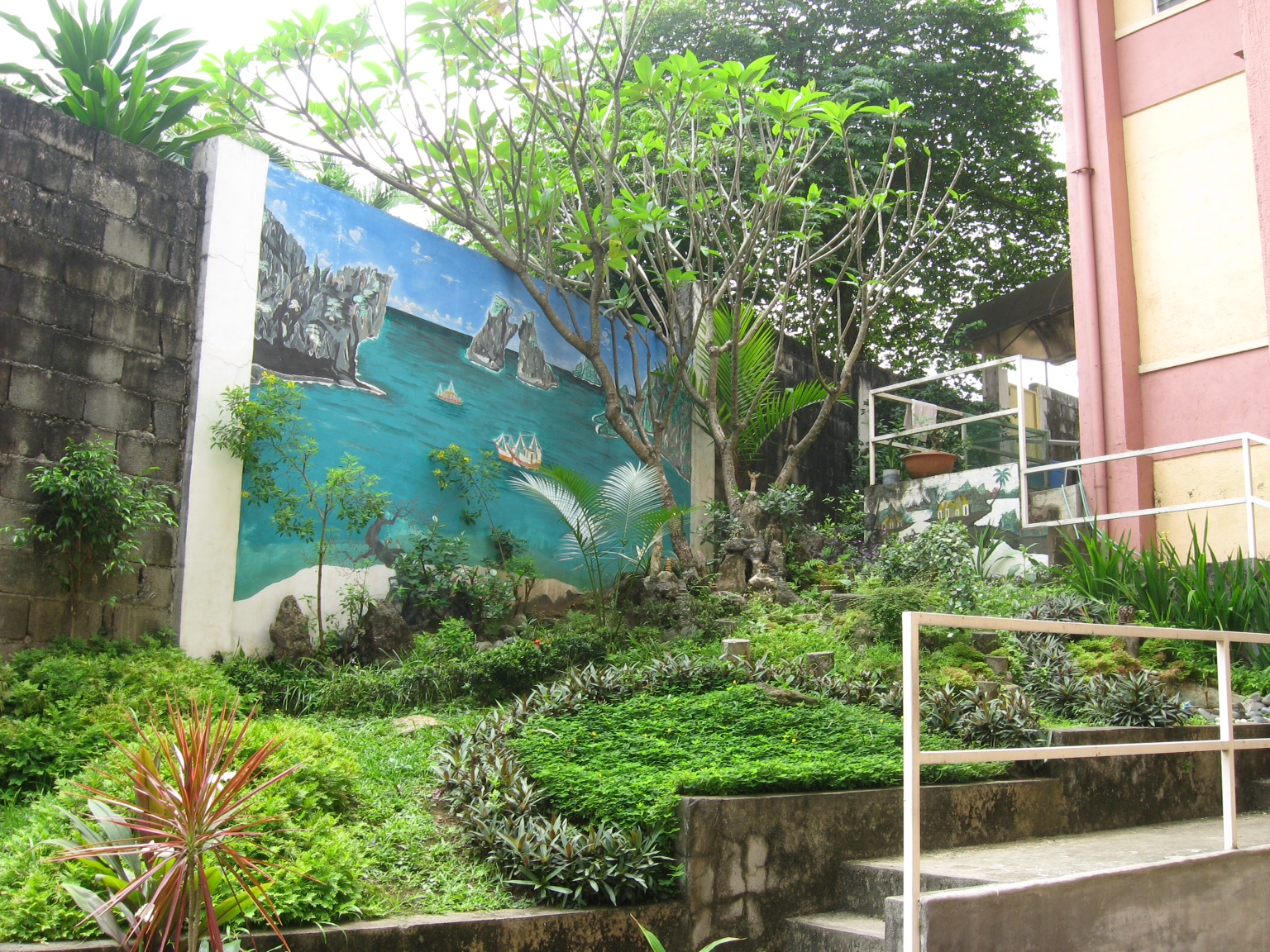
"This garden on our grounds of the community house was done by an SCJ from Vietnam while he was a student," writes Fr. Johnny. "His name is Br. Thai D Tran and will soon be ordained a priest."

“Good Friday services took place at one of our  SCJ parishes which is located close to the large garbage dump in a very poor area. Many of the people scratch a living from it by looking for recycle material that  they can sell. I read that 45% of the people of the Philippines live on $2.00 a day. I went with Fr. Vincent Sri, who is  pastor of the parish, and a visiting Holy Cross brother. I sat on a bench in the very small church. It was simply celebrated with a children’s choir. The entire service was said and sung in Tagalog. The people were so friendly and welcomed you with a blessing: taking your hand and putting it on their forehead with a bow. I in turn placed my hand of their head or shoulder.

“Fr. Heiner Wilmer, the provincial of the German Province, arrived on Holy Saturday afternoon from Cagayan de Oro after visiting one of his priests. We are friends from my days in Rome. He had to get up at 3:00 a.m. Easter morning to catch a plane for Vietnam where he will give a retreat to our community. We celebrated Easter Mass with Fr. Al  and then went out pizza.

“Today, Easter Sunday morning, most of the community is out for Easter Sunday Mass. I look forward to our Easter meal. I am happy that I can enjoy the food. I especially like their coffee and fruit, and thank God I like rice!

“I will leave for Cagayan de Oro on the island of Mindanao on Tuesday. It is a 1 1/2 hour flight. The summer school will begin on Monday, April 16th.”

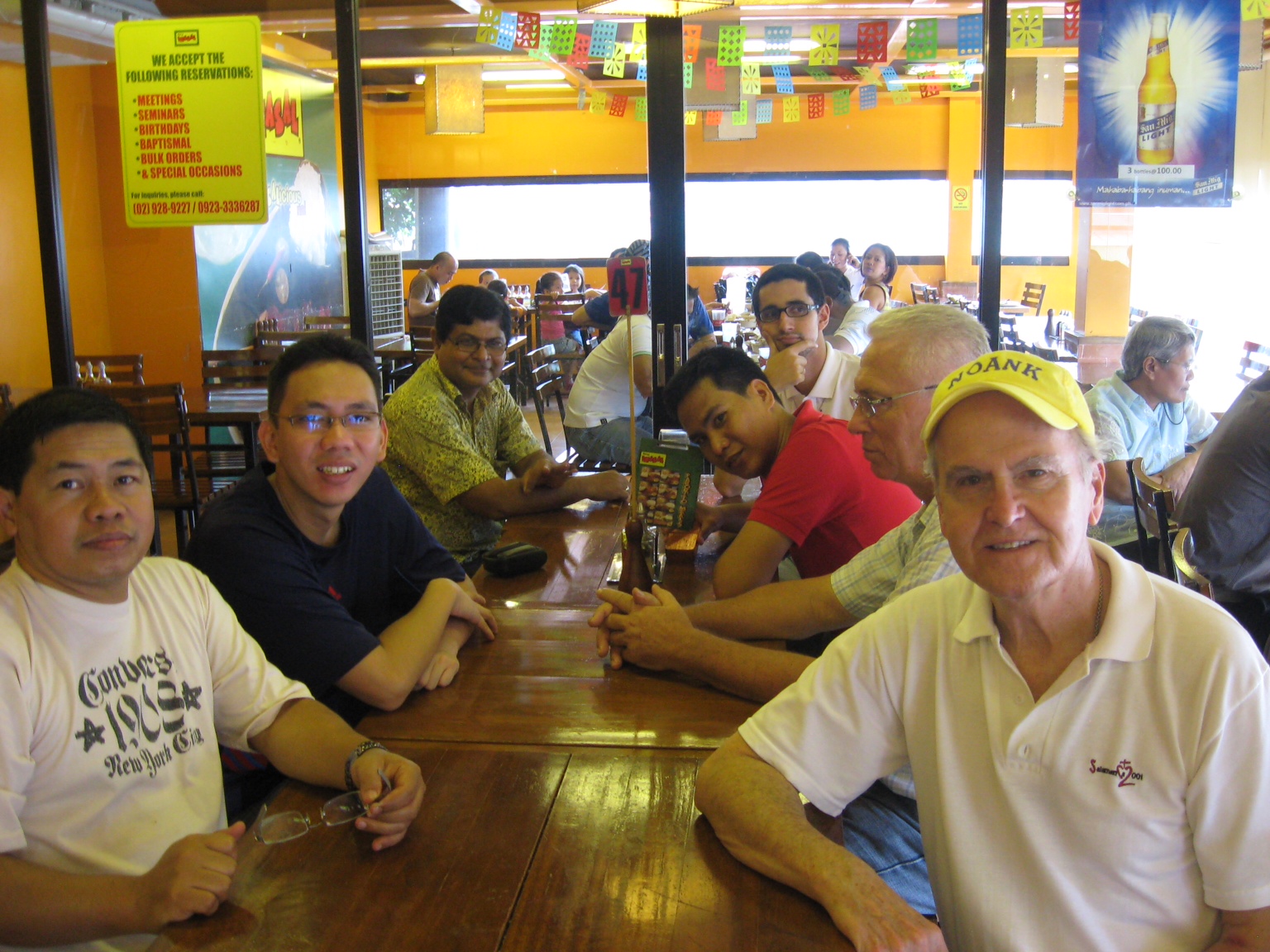
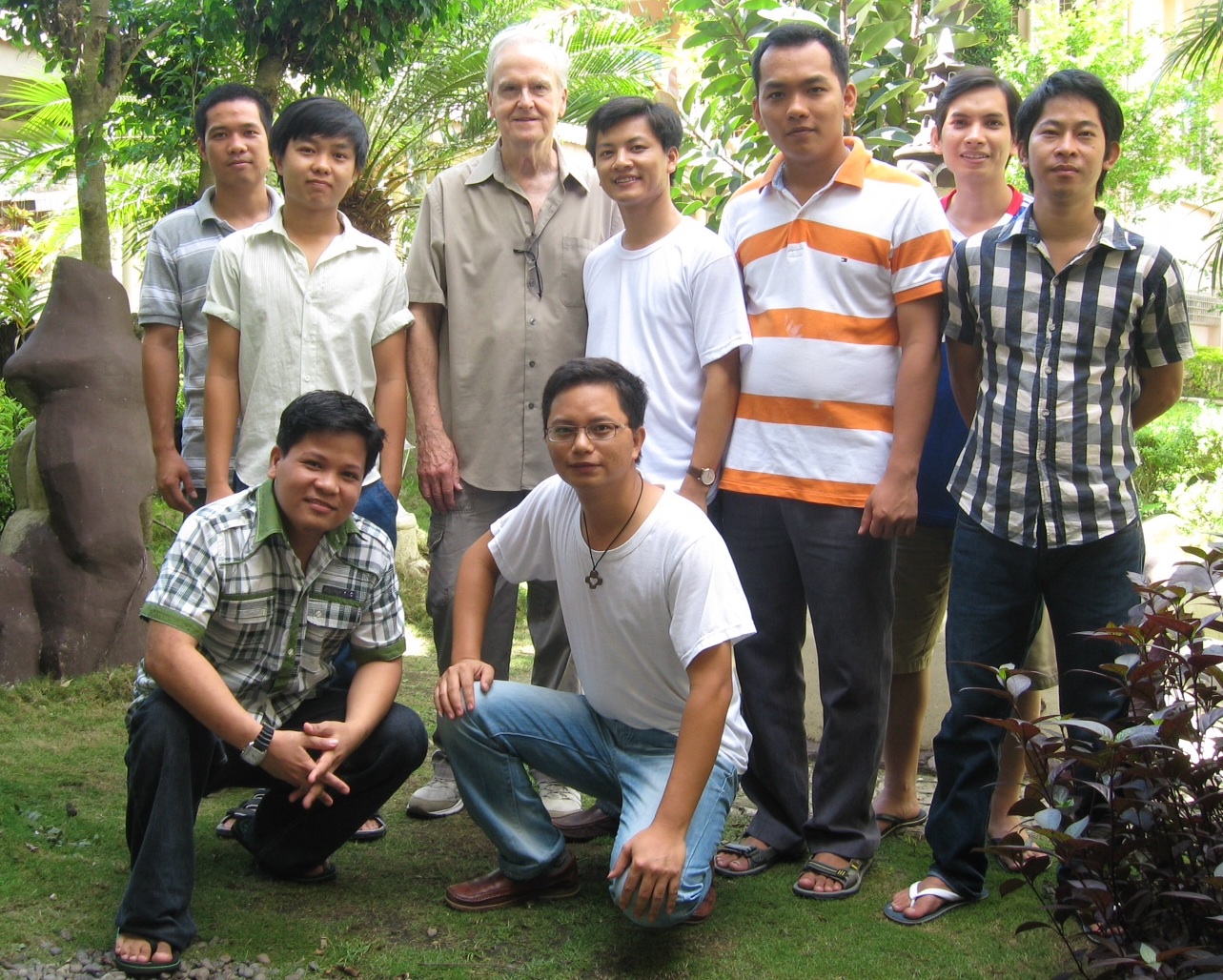
Fr. Johnny (front with yellow cap) with students and SCJs at a Philippine restaurant.

God’s Presence in the Prairie

Originally from Indonesia, Fr. Vincent Suparman, SCJ, volunteered to be a missionary and was soon assigned to Papua New Guinea. In August, he began his new assignment: serving in rural South Dakota with the Lower Brule Pastoral Team.  When people think “mission” they often think of lands far beyond the shores of the United States.  Yet there are many home missions throughout North America.  Much of the ministry of the Lower Brule Pastoral Team is on the Lower Brule and Crow Creek Indian reservations.  

This is Fr. Vincent’s second blog post:

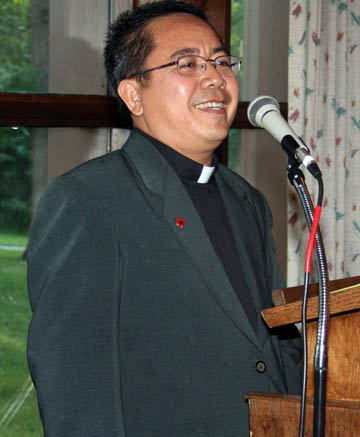
Fr. Vincent Suparman during the province jubilee celebration in July; Fr. Vincent celebrated his 25th anniversary of vows.

On one Sunday before noon I reached St. Catherine Church at Big Bend for a mass. I got there about 40 minutes before mass began. Shortly after parking my car I went into the reconciliation room hoping that there would be a few parishioners coming for confession. Nobody showed up. As I gave my Sunday homily, I saw four people sitting far back on the pews. I felt like I was in a strange place facing a vast meadow. Then I recalled what my spiritual director said, “We don’t pray to make God present to us. God is always present everywhere. No matter how many people there are in the prairie here in Big Bend and its surroundings, the Holy Spirit is always there. God does not depend on how many people there are to be present among us. We pray to make ourselves present to God.” I continued my own reflection after communion.

In my opinion, also true for us SCJs. Sadly, we too often are not present to appreciate the beauty of nature, grace, and the love that overflows within the ordinary moment of our lives. Bounty is there, but sometimes we do not see it. We easily find excuses: fatigue, haste, and so on. These excuses prevent us from reflecting on our spiritual lives more deeply to appreciate what the moments of our ministry, spirituality, and lives hold. Our mission goal is not to try to make God present, but rather to make ourselves and the people present to God. Nonetheless, in order to be prophets of love or God’s instruments, we ought to equip ourselves with knowledge, skills, and wisdom by which we proclaim the Good News.

The commissioning of the disciples (Matt 28:19-20) –– that is interpreted as mission task –– is not meant to be lived in black and white, nor is it meant simply to be going off to work, coming home, having supper, preparing for the next day, and going to bed. We have much to share and say to help our community and the people grow in faith, hope, and love in this challenging world. No matter how busy we are, we must be careful not to let ourselves get burnt out. We can think of the days after having a retreat, pilgrimage, or workshop. We regain our health and energy after having been out of our normal routines. On the way home we think that nothing is as sweet as returning to the ordinary, our work, and being in the everyday life.

Life is given freely. All our needs are provided for. Water, grass, and land in which we raise our cattle are signs of God’s presence. There are more signs of God’s presence than we can think of. Plants and animals are there for our nourishment. We have flowers for beauty, trees to shade and shelter us. Do we possess them? We possess none of them. It is ours to use as we are passing through and walking by as we continue to walk the path to manifest God’s love and mercy to the people we serve.

Fr. Vincent Suparman, SCJ

Brought by the hand of God to the prairie

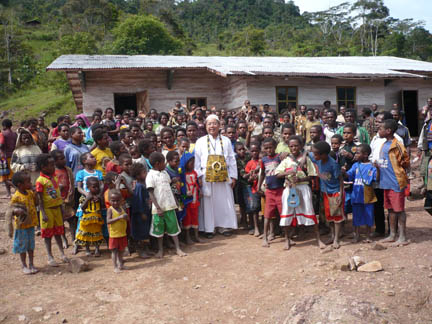
Fr. Vincent at his prior missionary assignment in Papua New Guinea

Originally from Indonesia, Fr. Vincent Suparman, SCJ, volunteered to be a missionary and was soon assigned to Papua New Guinea. In August, he began his new assignment: serving in rural South Dakota with the Lower Brule Pastoral Team.  When people think “mission” they often think of lands far beyond the shores of the United States.  Yet there are many home missions throughout North America.  Much of the ministry of the Lower Brule Pastoral Team is on the Lower Brule and Crow Creek Indian reservations.  

Fr. Vincent wrote the following shortly after beginning his new assignment:

It is impossible to see all of South Dakota in a few days. South Dakota is a very large state, and it has many natural wonders. There  is much to see and to do. Most visitors only choose three or four places to visit, namely Mount Rushmore, the Badlands, the Black Hills, and the Crazy Horse monument. One must choose to see South Dakota, it isn’t on the way to many places.

It takes approximately 12 hours to get to Lower Brule by car from Sacred Heart Monastery in Hales Corners, Wis. Or, you can fly to the state’s largest city, Sioux Falls, from which you can rent a car and drive the 170 miles to Lower Brule. After getting off I-90 at Exit 248 to Lower Brule, if it is a clear day, you will see the highest hill called Medicine Butte situated just eight miles from Lower Brule.

When I drive in South Dakota, I immerse myself in the vast, sweeping prairies of The Great Places and the Great Faces. I am warmly welcomed by a place of endless educational opportunities and unforgettable experiences. Anytime I drive to visit one of our six parishes on the west and east banks of the Missouri I can feel prairie winds through the valley breaks and broad river terrace of the Native American reservations. The great Missouri runs through the vast grasslands which extend west over east to the horizon. In my opinion, the Brule Reservation is rich in natural life. Antelope, mule, deer, and buffalo roam freely. There are also prairie dogs scattered across the uplands and valleys. Pheasants, wild turkeys, and many kinds of birds are abundant.

What can I say about pastoral ministry in Lower Brule? As with any place, pastoral ministries are done with a local flavor:  the sacrament of reconciliation, the Eucharist, the liturgy of the Word, etc. Also as in many places, fewer people go to Mass and confession these days. This is an unfortunate development because private confession is one of the pillars of the spiritual life. It is said that God is not tied to one vehicle as a highway for the forgiveness of sins. However, the sacrament of confession is still important for adult Christians as they grow spiritually.

Sometimes I listen to the stories of villagers after Mass. At times they have struggled to integrate their Native American culture with their Catholic faith.  In many instances, both traditions have been passed down by their families.

When the Native Americans come to powwow, they talk about Native American culture which is expressed in many symbols, songs, and dances. They hold it firmly and closely as a jewel.

Whenever I reflect on my own inner journey I realize what a gift it is to be a Dehonian missionary, to learn first-hand about other people by being with them. In reflecting on my pastoral ministry in Lower Brule, many questions fill my mind because I am a new person in this area.  I have much to learn.

If I truly live in the mission spirit and in the spirit of Sacred Heart, I will let myself be used by God to bring hope, love, and mercy to the people with whom I am ministering.

Summer update

Br. Clay Diaz during the July province assembly.

Br. Clay Diaz, SCJ, is a theology student doing summer ministry in northern Mississippi.  He writes here with a quick hello and update:

Hello and many blessings to all! I am having a good summer so far. During the first part of the summer I have been working at Christ the King parish in Southaven, Miss. During the month of July I had a good summer and I truly enjoyed our province assembly. Now for August I will be working with Sacred Heart Southern Missions.

As of August 31 I will be back in Chicago, getting ready for my second semester at Catholic Theological Union.  My first semester at CTU provided me with a good learning experience and I am looking forward to my next semester. I am in the Master of Arts in Pastoral Studies program.

This week I will be renewing my vows at Christ the King on Thursday August 4 at 9:00 a.m. Fr. Bob Tucker is going to be the presider.

I hope to continue writing blog entries for our province site and encourage other young members to do so as well to keep others informed as to what is going on in our lives and ministries.  Actually, I wrote “young members” but I encourage all members of our community to contribute to our blog.

Peace to all,
Br. Clay Diaz, SCJ

Final week in the Philippines

As we’ve noted previously, Fr. Bernie Rosinski, SCJ, is spending several weeks in the Philippines assisting the SCJ district with administrative duties as well as helping students in the international formation program with their English. Time is going quickly; he writes with just one week left to his stay.  

Fr. Bernie Rosinski, SCJ

I leave for the States a week from tonight and this Saturday will fly from Cagayan de Oro for Manila. I will stay in Manila at our Theologate (one-and-a-half hours away by plane) until Monday. Return will be through Seoul/Inchon and almost over the North Pole.

To confess the truth, I have enjoyed my stay in the Philippines though I will be processing all the things that have happened to me along with all the things I have seen. I have taken as many photos as I could to remind me of what I have seen.

Here in Aluba (Cagayan de Oro suburb), I shower every morning in unheated water.  Which is ok because at 5:30 AM when I shower, it’s already about 85F. I sleep without any blanket. Only two rooms here have “aircon,” which is the Filipino word for air-conditioning. One is the office of the fund-raiser and his secretary and the other is the library.

It would be unfair to leave the impression that showering with cold water is the norm. There are hot showers at the Novitiate in Dumalinao and in Manila. But since I spent most of my time here, I pretend to myself that I am a cold-water hero. We have one other vexation: sometimes there is no water, or else the faucet has a mere trickle. That’s why every shower has a large plastic bucket so that it can fill by catching water from the shower head when things are normal. If necessary, a small pot can be used to dip into the bucket and splash enough water to rinse off the soap or shampoo. It works; I know from first-hand experience.

I am here in the dry season. Yet I have witnessed a couple of monsoon-like rains (which the people say is unusual). It is the dry season that causes leaves to drop from trees, not the frost or cold that we are used to. Despite it being the dry season, the humidity is excessive.

What can I say about the people?  They win your heart so effortlessly you don’t even know they’ve got it.  They are so generous, so helpful, so thoughtful and considerate. I don’t know how many feasts and festivals I have gone to because some parish or organization or family was celebrating something and we were invited.
Rice is the food staple. It appears on the table at breakfast, lunch, and dinner. Always boiled and without any sauce or condiment. Never fried. There are OTC bottles of soy sauce and other sauces that are used to flavor  food according to individual taste. Filipinos like “hot” sauces. There is always a soup (usually highly salted) at lunch and dinner. The favorites are mushroom, egg, chicken, and fish. Fish and chicken appear at almost every midday and evening meal along with a cooked or uncooked vegetable. Recently I have been enjoying cucumber and cherry tomatoes. The table drink is water. It is always cold and filtered.

While the Vietnamese here (six) are rice-eaters, they are also noodle eaters. The understanding cook provides us with soup once or twice a week laden with rice noodles. She has endeared herself to Vietnamese hearts. Another person who is very endearing, to me at least, is Fr. Francis Pupkowski, SCJ, whom I met in Hales Corners in 1988-1989.  He was among the first group of missionaries destined for the Philippines. He was there to learn English along with a German, an Italian, a Brazilian, and a couple of Argentinians. It would be their common language (Oh, the price people have to pay to serve God as missionaries!).  Fr. Francis has a bread-making machine and every morning I would have a couple of slices of homemade bread with margerine and marmelade. Occasionally, the cook would surprise us with an omelet or some fried eggs and Spam (very popular here in the Philippines).

This week remaining I have four masses to celebrate here in community, one talk to give, and four homilies. I also have to go through a formation plan that the Philippine District is revising so that they can work toward becoming a region. It is 46 pages long and I proofed it and made a number of corrections and some editorial suggestions. I have already done as much with their District Directory and Chapter Rules and some correspondence. I knew there was some reason why I came here; it is like I never left my administrative work even though I was here to teach English pronunciation. Even there I think I did pretty well; at least I haven’t left my students angry at me. Yet?  🙂

-Fr. Bernie Rosinski, SCJ

A few nuts and bolts about the Philippine District

This time I’d like to share some nuts and bolts about the Philippine District –– how many SCJs and students are here and a bit about what the district does.

Already the Philippine District has 50 men in vows. They also have two men in Rome attending the year-long formation program for formation directors. Other Filipinos have taken this course in the past.

Their scholasticate (in Manila on the largest island of Luzon, a residence from which the men attend the two seminaries in the city) has a small number of SCJ priests who give specialized Dehonian formation and accompaniment. In residence there are also a few SCJ priests from other provinces who are attending university here to acquire advanced degrees. At the conclusion of their academic year on March 31, there were 19 in theological studies plus an additional five who were making their apostolic year.

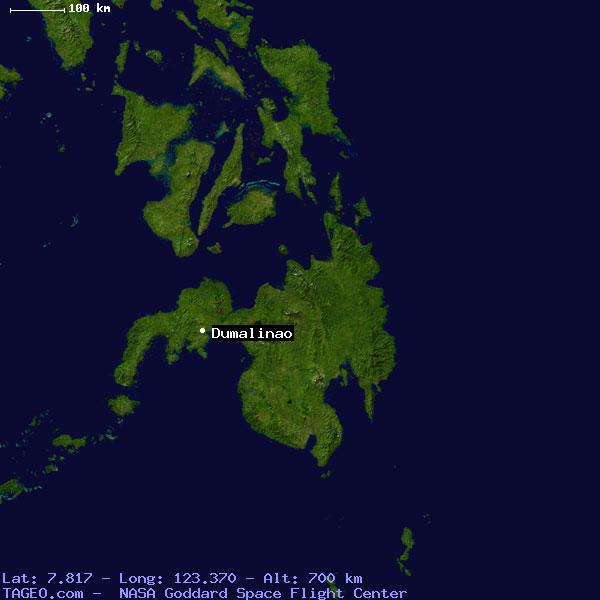
The Philippine novitiate is located in Dumalino on the island of Mindanao.

At the novitiate in Dumalinao (on Mindanao, a large island in the south of the Philippine archipelago), there are five SCJs on staff and 15 novices (eight Filipino and seven Indian).  The SCJs include an Indonesian superior and a Brazilian novice master, as well as the former superior of India, Fr. Martin van Ooij.  The novitiate team also has responsibility for the local parish.

At Cagayan de Oro (on the northern edge of Mindanao), the SCJs have a college level seminary whose students must qualify for (as a condition for admission to the seminary) and then attend the nearby Jesuit-run Xavier University.

The local superior, who also serves as district superior, is Fr. Bene Machado. He is assisted by two formation directors. There are two other priests in residence who have responsibilities connected with parishes and other ministries, including the shelter for abused women which was begun by Fr. Eduardo Agüero). Finally, there is Fr. Francis Pupkowski who runs the district fund-raising effort. The lay staff consists of the English teacher, the librarian, and the assistant in the fund-raising work.

The SCJs here have many responsibilities – not just a single ministry or job. I was the only priest present here today at Sunday Mass for the English and university summer school students. All the other priests, including Fr. Bene, were out helping in the parishes by celebrating masses at various chapels or missions.

It boggles my American mind to learn that a “parish” may consist of a primary church and up to 90 mission out-stations. These mission churches are visited on occasion by one of the priests who always notifies the mission president in advance, usually by sending a text message (Filipinos are said to send more text messages in one day than most countries do in a year — it is less expensive than calling). When the priest comes, he celebrates mass, baptizes, hears confessions, aids and assists the people with the help of a catechist, and conducts business with a mission “president” who is responsible for the upkeep of the mission.

When the priest is not there, the mission president leads the people in prayer and the rosary, the catechist gives a lesson, and the choir practices hymns. No matter how poor and simple a mission chapel may be, it always seems to have an amplifier that can either play religious music or serve with a microphone as a loudspeaker. The people are extremely devout and respectful. Children and young people come up to the priest, grab his hand, and touch it to their foreheads in blessing, an expression of supreme trust.

These are just a few of my observations so far during my weeks here in the Philippines.

–Fr. Bernie Rosinski, SCJ

Filipino field trip

Fr. Bernie Rosinski, SCJ, is spending several weeks in the Philippines assisting the SCJ district with administrative duties as well as helping students in the international formation program with their English.  He continues to share his experiences in the province blog:

Cagayan de Oro

Instead of class this morning, my Filipina teacher counterpart (grammar) and I (pronunciation) went with our students to Xavier University (Jesuit) in downtown Cagayan de Oro to visit a museum on campus. The museum is hosting an exhibit on the culture of Mindanao island.  It was the equivalent of a “field trip” and I felt very much like a little boy.

Don’t misunderstand that last statement. I was not patronized or treated like a little boy. It was simply that every part of this experience was entirely new to me, as if I were a little boy. I had, for example, my first trip in one of those contraptions I wrote about earlier: the motorbike sidecar vehicle (except that the sidecar was not at the side but in the rear);  it took about half our crowd of 15 or so people so we went in two “motorella” (yep, that’s its name). It operates like a taxi and takes you where you want to go. It took us 15 minutes to get to the university.

There I learned a number of interesting facts: that the “George Washington” of Philippine indepence was born on Mindanao, that early on there were conflicts between “Moros” and Filipinos, that there were also serious and lasting conflicts between the Catholic religious orders that helped colonize the Philippines originally (and I haven’t been able to learn if they have ceased. . .), that weaving was an island industry and the colors, fabrics, and designs were very original. Beadwork was imployed in making clothing and I saw a woman’s blouse that took two years to make. I was reminded of the psalm that speaks of the wedding of Ahaz and Jezebel, noting the “pearls embroidered” into her wedding gown.

Then we visited the beautiful chapel on campus. A large painting of Christ leaving his tomb was featured on the wall behind the altar. The roof was high, the sides were totally open to the breeze, the pews had some people scattered about, praying I can only assume — though they might have simply been resting. From the chapel, where I took some photos, we left to have a “snack” — something the students had asked for in their evaluations which we got the day before: (1) outing; (2) snack; — both of which made me feel again like a little boy. The snack consisted of a sugared donut and a coke.

While walking to the donut shop the students walked around me like a bodyguard and even when I finished my snack and wanted to go outside and take pictures, two of them accompanied me. This was something else that contributed to my feeling like a little boy (I haven’t felt this good in years).

Finally, we were ready to return to the SCJ house. “Ma’am Jo,” (all Filipinos seem to have a single name by which they are called) and I were steered to a jipney (pronounced “jeep knee”) and we were home in about 10 minutes. What it cost and who paid for this venture I never learned. Still one more factor that left me feeling like a little boy.

-Fr. Bernie Rosinski, SCJ

The problem with English…

As noted previously, Fr. Bernie Rosinski, SCJ, is spending several weeks in the Philippines assisting the SCJ district with administrative duties as well as helping students in the international formation program with their English.  After a few days of teaching English he shares the following observations:

With my degree in applied linguistics in hand, I have felt for a number of years that teaching English as a second language faces a huge obstacle. That obstacle comes in the form of the Latin alphabet writing system.

It’s not the writing system itself; rather it is the fact that most languages that make use of it find an almost perfect one-to-one correspondence between the written Latin alphabet system symbols and their language sounds. Languages with written accents like French and Portuguese are able to modify that one-to-one correspondence to accommodate their additional sounds. When the following vowel sounds are written in the Latin alphabet, i.e., A, E, I, O, U, virtually all Western languages, except English, pronounce them identically.

Let me state as a given that English does a very, very poor job in making the Latin alphabet correspond with their spoken sounds. George Bernard Shaw recognized that and offered a monetary prize, still unclaimed, for anyone to come up with a system that would equate one English sound with one written symbol. Instead, all kinds of esoteric phonetic spelling systems exist that are too complex for anyone to learn properly.

To get to the point, because other languages are so successful in making their written symbol correspond to their spoken sound symbol, early on their speakers acquire a facility, a disposition, a tendency, a psychology (?) that leads them into thinking and acting that the way to learning a language, any language, is through reading, through the written Latin alphabet symbol. They actually believe that they can learn English in this way. What they don’t realize is that English is notoriously poor at making writing correspond to the spoken sound. Let me illustrate with an example. One sound (which I will not attempt to “write” here) has 12 different ways of appearing in written English (and I urge you to consider the contradictory patterns of writing): people vs amoeba; either vs niece; suite and sweet; key and sea; chamois and chassis; marry and she. Non-English people go nuts trying to learn to speak English from way it’s written. The problem is:  from their prior experience with their native language their very bones scream out to them that this is the only way to go.

The answer: repeating English sounds; learning English like babies do — by hearing, by using analogy for similar sounding words, by making mistakes in analogy application; by being corrected, either by oneself or by others. And after the sound system and sound patterns are learned, attempting to join the spoken word to the written word.

That’s the way I am working in the Philippines. We use the breviary with its cycle of morning and evening prayer psalms. I ask the students not to look at the book but to listen to what I am saying. I repeat several times and then I ask the students collectively to repeat what I said by picking up their psalm books. Then I will ask individuals to repeat the verse. Where pronunciation mistakes are made, I correct them. Oftentimes, the mistakes that are made result from applying native language reading patterns to the English sound; e.g. seeing “will” in writing, they will pronounce it “wee-l” because that’s the way the “i” is pronounced in their language: one letter, one sound.

With Vietnamese and Filipino speakers, I have two different groups because each comes from a different linguistic background. In attempting to speak English, they do so differently and thus reveal different problems. Here, I bless God for my linguistics training at Georgetown. In fact, I was able to discern two different dialects among the Vietnamese. When I asked them whether two individuals who were making the same English pronunciation mistakes came from the same area, they were able to say “yes” and I think my professionalism impressed them.  Hopefully, that will translate into greater cooperation.

I have learned that both Vietnamese and Filipinos have already studied English for a minimum of 10 years and some as many as 12 years. English is not one of their favorite subjects; there are other more important subjects in their curriculums and they devote limited time to these. Why squander precious time on English? Yet, they have to pass an English language exam to get into Xavier University here in Cagayan de Oro. They realize that and are extremely cooperative during this summer program.

-Fr. Bernie Rosinski, SCJ