Category Archives: Uncategorized

Celebrations in India

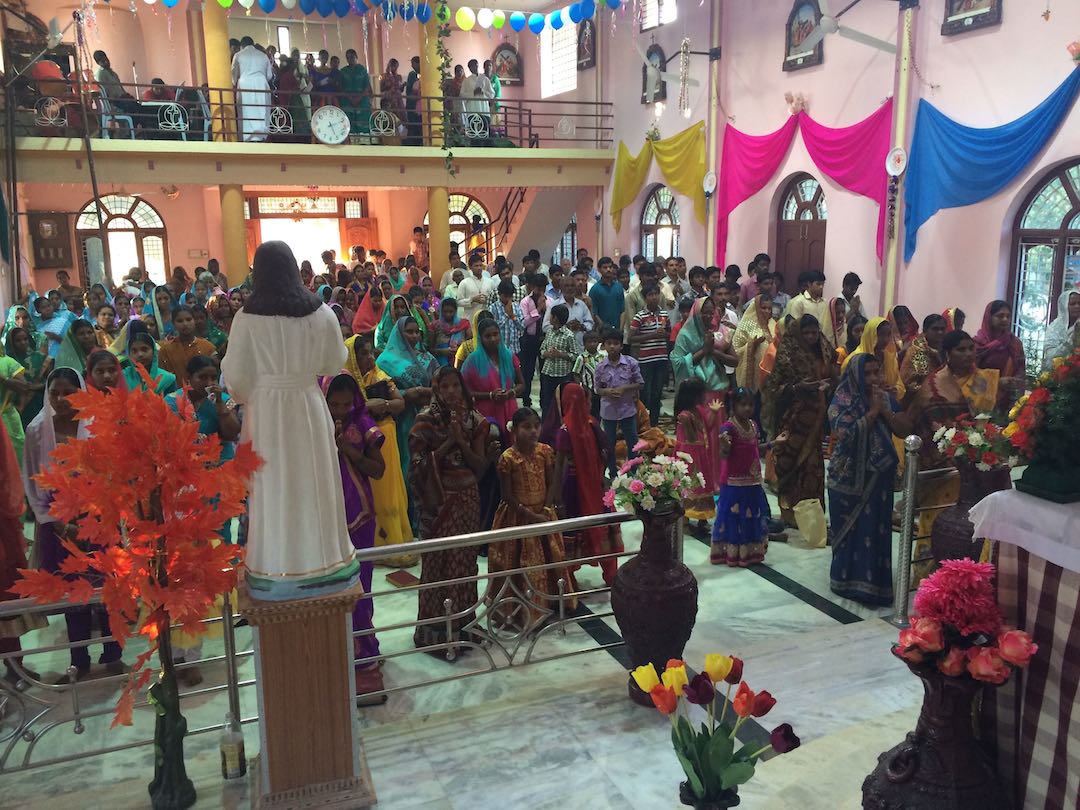
Parishioners celebrate the one-year anniversary of Sacred Heart Church in Nambur.

Parishioners celebrate the one-year anniversary of Sacred Heart Church in Nambur.

Fr. Tom Cassidy writes from Nambur, India:

First, I want to share a photo from the one-year anniversary celebration of the dedication of Sacred Heart Church in Nambur (January 26). To mark the occasion the parish held a Mass and procession beginning at 4 p.m. and running all the way until midnight! I hear that sometimes such celebrations can easily go until dawn.

With the SCJ community we celebrated the second annual “Novitiate day.” Last year it was held in March, but this year it was pushed forward to the end of January. I’m not sure why the change but from my point of view this time makes better sense, especially with Easter being early this year. The weather is also a bit cooler, but that can be seen as a minus by many Indians who find temperatures in the 60s to be downright cold!

There are 10 in the present novice class along with six postulants. While the show belongs to the novices, the postulants were heavily involved as well, carrying on many of the behind-the-scenes tasks and from time to time becoming part of one or the other of the 17 acts.

I’d divide the show into five categories: (1) dance routines, (2) morality plays, (3) audience participation, (4) PowerPoints on the SCJs and the Nambur community, and (5) songs.

Students perform during "Novitiate Day" celebrations

Students perform during “Novitiate Day” celebrations

For me, the dance routines and morality plays were the best part of the cultural show. Indian men like to dance and our SCJs are no exception. Some, of course, are better at it then others but all seem to be enjoying themselves. The most serious dance is the one pictured here called the “fire dance.” It was a stately dance using hand and arm motions along with body movements to place the fire pots into differing locations and formations. As for the morality plays I enjoyed the one about corruption the best. It showed how corruption begins at an early age and is pervasive. Sadly, it is a real issue for Indian society.

The two PowerPoints were well done though the writing was difficult to read at times.

The show lasted just over two hours. One of the novices told me that in their rehearsal they did it in 1 hour and 39 minutes. While it may have gone on a bit long I think that everyone had a good time.

Of course, we were all well-paid for our attentiveness with a wonderful meal to end the evening.

Appreciating a good clothes dryer!

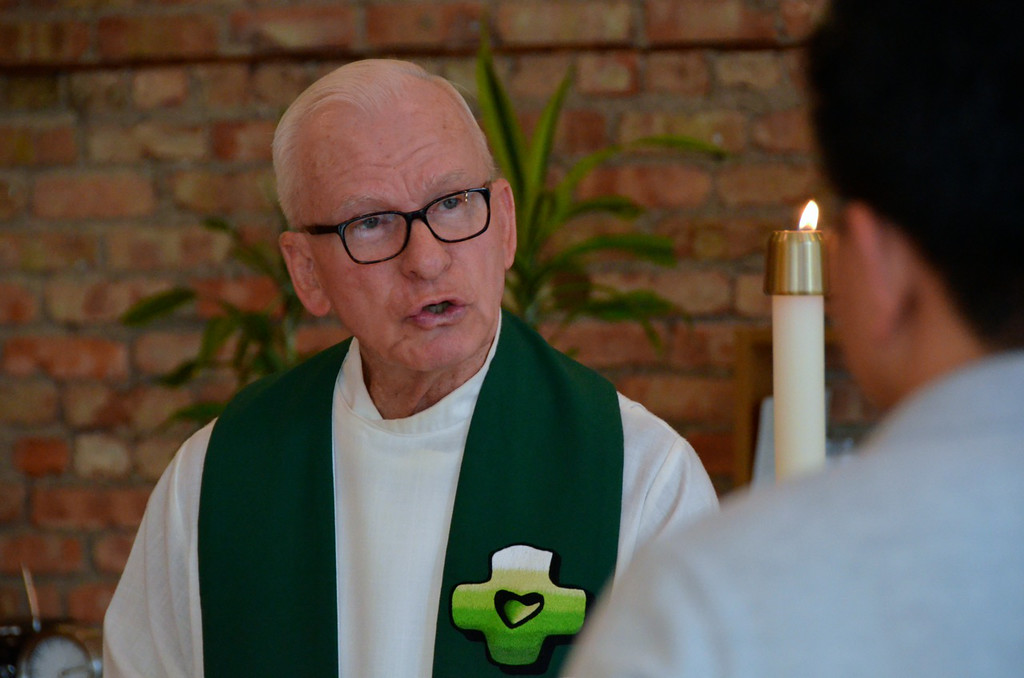
Fr. John (left) smiling during  a community meeting with the Dehon Formation Community in Chicago last fall. The retired novice master has served in formation during most of his 51 years of priesthood.

Fr. John (left) smiling during a community meeting with the Dehon Formation Community in Chicago last fall. The retired novice master has served in formation during most of his 51 years of priesthood.

Fr. John Czyzynski writes from the Philippines:

This week I have classes with the postulants (seven young men).  We meet in the morning for what is scheduled as a two-hour session, but is usually a bit less. I am doing some things on Fr. Dehon, SCJ spirituality, self esteem, and Marian devotion. When we talked about Fr. Dehon and I asked them to tell the group what appealed to them about the founder. It was interesting to hear how they came at that from all different points of view.

It started to rain during the sessions and one of the guys charged out of the room. I asked what was going on and was told that it is his job to get the laundry off the lines so it does not get soaked by the rains.  Thank God for dryers in the United States!

The rain has not been severe but steady for about five or six hours.  They have a interesting system of canals to drain off the water and get it to flow into the river the town is named after:  Cagayan d’ Oro (“River of Gold” — though it looks more like mud than gold). The ground is so moist it can’t absorb any more.

Several guys have asked me to help them with pronunciation of English.  One of them was pronouncing some words with a British pronunciation and I said that is not incorrect so I was not correcting him, but we say those words differently in the United States.  He said: “correct me.  I want to speak English the way the Americans do.”  It reminded me of St. Albert speaking of St. Thomas and saying the student would surpass the teacher.

There are about 45 seminarians here, four novices and 15 in the post-novitiate program in Manila (Quezon City). They are pretty evenly divided: Vietnamese and Filipinos.

I will be going to the novitiate on Sunday (Feb. 1) to have some time with the novices; Feb. 10 I return to Manila to have some time with the post-novitiate group before returning to the United States.

Back in India

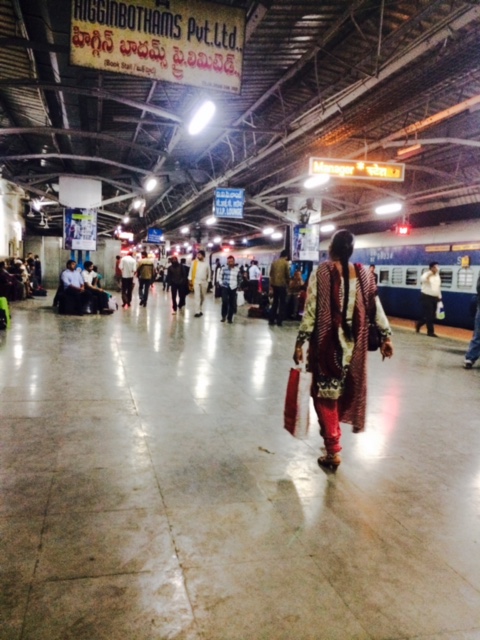
Planes, trains and automobiles. Fr. Cassidy was back on an Indian train less than a day after his arrival in Mumbai

Planes, trains and automobiles. Fr. Cassidy was back on an Indian train less than a day after his arrival in Mumbai

Fr. Tom Cassidy is back in India, where he will be assisting until early May. As he did previously, he will periodically share his journal entries on the province blog. The following is from his first:

Well, I made it to Mumbai on time and without any airline snafu or Mother Nature getting in the way. Going halfway around the world takes time no matter how you choose to go. I landed in Mumbai right on schedule and even though it was 10:30 pm there were lots of customs officials on hand so that everyone passed through passport control quickly.

Fr. Aji, the pastor of our parish here (Divine Mercy) and Fr. Thomas Vinod, district superior, were there to meet me, along with a good soul from the parish who offered to drive us. Since both passport and customs were quick we were on the road in almost no time.

I asked what the plan was for today and was told that we’d leave the house at 6:15 am to catch a train for Neural, about an hour’s ride on a local commuter train. That did not give me many hours of sleep! Fr. Abraham was kind enough to make us all a good breakfast to give us a jump start and get us on the way.

The SCJ community in India may take over ministry at this church in Neural

Fr. Thomas and Fr. Aji pray during their visit to a church in Neural (about an hour by train from Mumbai). The SCJs are in dialogue with the cardinal of Mumbai about taking over pastoral care of the church.

The purpose of our trip was to look at a small parish the cardinal of Mumbai suggested that the SCJs take. There is also the possibility of a school along with the parish. The school is currently operated by an order of religious sisters who plan to soon withdraw from it. It has almost 300 students and is in a tourist area up in the mountains about nine kilometers from the Neural train stop. As the district looks for land to build its future district/provincial house [headquarters] this is one area under consideration. It is at the moment still more rural than urban but you can see development is quickly taking place. This is in part spurred by the future international airport that will be located nearby.

The church was constructed in 1858 but is well taken care of. I am not sure how many Catholics are in the area or how many tourists take advantage of the Sunday parish Mass. If I understand correctly, this church would be considered the mission church of the parish that, I think, will be based in Neural.

Retired novice master heads to the Philippines

Czy preach

Fr. John Czyzynski during Mass with the Dehon Formation Community.

Fr. John Czyzynski is in the Philippines for the next month. “Really,” he joked, “rumors that Pope Francis timed his trip with my own are exaggerated!” The Holy Father recently concluded a five-day visit to the country, arriving just before Fr. John.

Writing from Cagayan d’Oro, the recently retired novice master shared a bit about his visit:

“I came here to meet with the formators and to share my years of experience doing formation ministry. [Most of Fr. John’s ministry as an SCJ priest has been in formation, the preparation of men for religious life and priesthood.] Our time together has been good.  At least it feels like some good stuff is happening.

“These formators are so young that I have a hard time distinguishing them from the students. I keep saying that I am speaking from an American’s point of view and I need to hear how what I say matches their experience of doing formation in a different culture.

“I got here Saturday and rested a bit and then had two Masses at a parish in ‘greater Manila’ (a parish close to our house there). It was a feast day. The Philippine people have a great devotion to ‘Santo Niño.’ They honor the child Jesus dressed in something similar to the Infant of Prague.  After communion all the children come up to the front of the Church and are blessed.  I started to choke up as I looked at all those little kids waiting to be blessed.  The folks here have great respect for the clergy.  People of all ages come up to priests and take the priest’s hand and touch it to their foreheads. It is a sign that they are asking to be blessed.

“I will be meeting with the students who are at different levels of formation and talking to them about our community and charism. I am amazed at how well they speak English.

“So far I have been able to eat everything that everyone else is eating. That’s it for now; I’m going to rest a bit before my next session with the formators.”

Last days in Congo

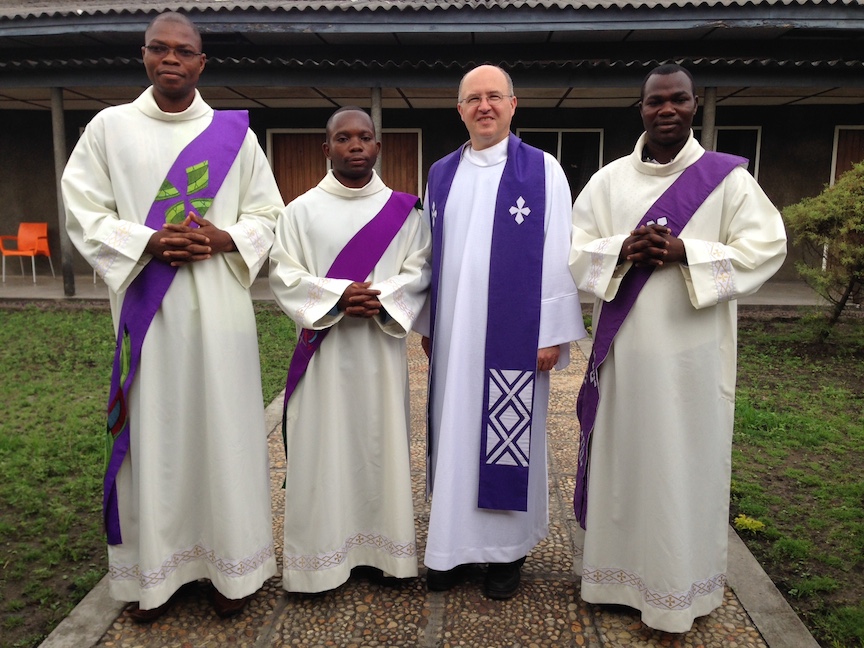
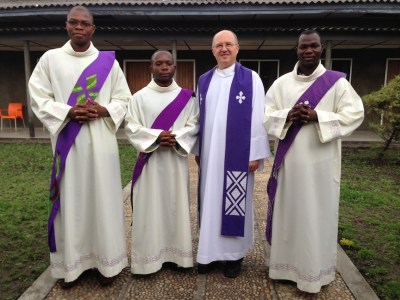
Fr. Steve with SCJ deacons in Kinshasa.

Fr. Steve with SCJ deacons in Kinshasa.

Fr. Stephen Huffstetter shares his final journal entries from the Democratic Republic of Congo where he and Frs. Charles Brown and Leonard Elder have been traveling for the past three weeks. They took part in several remembrance ceremonies for SCJ missionaries killed in Congo during the 1964 Simba rebellion. 

DECEMBER 3 – Yesterday was a long travel day, with more waiting than actual time on board the two-hour flight from Kisangani to Kinshasa. When we went through customs and security I was surprised that nothing was computerized. The agent asked a few questions about where we were staying, then entered our passport numbers with pen in a ledger book. I wonder if there is any check or follow through.

The overhead bins were full, not so much with suitcases containing clothes but with tubs and boxes of foods being transported from the country to the capital. Overcast skies prevented much of a view from above except for the period close to take off and landing. Coming into Kinshasa you certainly see what a huge and sprawling urban center of the world it truly is.

Today we had some time to explore part of the city. We visited the artists market and so a wide variety of many lovely things, mostly carved of wood, but a good selection of canvas paintings as well. Fr. Marek [provincial superior of South Africa] was most interested in some local weavings that he purchased for use decorating the altar and other prayer spaces. There are no posted prices, and the art of bartering is alive and well as prices are argued, haggled, then finally agreed to.

One stall had many old statues, masks and sticks. We tried to learn something about the cultural and religious significance of them.

As we drove around town the air was choked with smog. All the vehicles run on diesel fuel, and my eyes were itching and burning after a while. Power is cleaner, most coming from hydroelectric dams. But there are substantially long brown-outs throughout the city. Out house had electricity for only a few hours these past two days. Fr. Gabriel can use a generator when needed, as in the evening when students need light to study by. But their budget is strained every time they must buy more fuel for power most of us take for granted.

Notre Dame is the Cathedral church of Kinshasa. Midday the doors were locked, but a worker at the parish offices was happy to let us in for a tour. Built in 1955 it is a soaring brick building, made of local materials. The statues, ambo and tabernacle were lovely wood carvings. The rest of the space was simple, though prayerful, fitting for a poor church in a developing country.

The SCJ house in Kinshasa has a small chapel for daily mass that seats about 50. At 6 am today it was full to overflowing, with people spilling over to plastic chairs set on the lawn outside. Songs were in Lingala, and the mass in French. The music was quite spirited with drum, rattles, keyboard and tambourine . The crowd was an even mix between men and women from a variety of ages and walks of life. The SCJs incorporate the prayers of the Divine Office into the mass, and people pray along with them before going off to start their day.

DECEMBER 6 – Our time in Congo has come to an end, and we will soon board the plane for the long trip home. Our entourage of visitors has dwindled to the three Americans now. Fr. Claude returned to Canada on Thursday, and Fr. Marek to South Africa on Friday. Fr. Zenon left for Lumumbashi where the SCJs are exploring setting up a new community house in the southeast part of the country near Zambia.

The past two days have been on the quiet side. Part of me is impatient wanting to go and do things. Instead I’ve entered into these Advent days with an attitude of patient waiting and prayer. First Friday was much like a day of reconciliation , and I asked one of the priests here to hear my confession in preparation for the great feast of Christmas just around the corner.

I’ve used some of the time to write up reports and reflections about our collaborative efforts with the Congolese Province that I will share with the Provincial Council upon my return. And in my limited French and in our confreres’ limited English we’ve tried to learn as much about each other as we can.

Fr. Simplice was ordained a priest last February and is continuing his studies for a liscenciate in New Testament Biblical Studies. We walked about a mile to the Augustinian University where he studies.

Every country has its contrasts and things that don’t make sense to outsiders. The main boulevard through the city is actually quite nice, well paved with four lanes in each direction. I noticed street sweepers all along the route picking up dust and dirt with brooms and shovels to keep it looking tidy. Yet the side streets leading up to the main thoroughfare were not paved at all. The dirt was uneven with large holes and dips, and a lot of trash from daily use of the people clogging the drainage ditches. It reminded me of similar misplaced priorities we have back in the States where areas with wealth get more services and attention than poor neighborhoods.

Augustinian University is a consortium of 23 men’s religious orders and 17 sisters’ communities. About 10% of the students are laity committed to improving the quality of life and ministry in the church . The school formerly only offered a degree in philosophy, but in the last few years has expanded to include degrees in theology and psychology.

Since Charlie is a professor of New Testament studies, he and Simplice had a lively discussion about Luke’s Gospel. Simplice is writing his thesis on the story of the rich young man who turned away sad when Jesus asked him to give everything to the poor and follow him. We went to the university library to check out what academic resources were available . The good news is that books here are quite treasured and well used. The not so good news was that the collection was very old and dated. One problem is financial, purchasing new works. Another is availability. One of Charlie’s hopes as mission director is to help developing provinces get the theological books and resources they need for their libraries.

In the afternoon I noticed several students gathered around a plastic chair next to the garden. It was time for haircuts. A barber comes to the house every two weeks and gives everyone a good cut. Instead of scissors or clippers he used a double-edged razor blade attached to the side of a comb. Just as in a typical barber shop the crew sat around gabbing ands telling stories as each awaited his turn.

Every Friday evening the community opens up the chapel for Eucharistic adoration, and a good number of people from the neighborhood join. Today was First Friday, with a special emphasis on Sacred Heart devotion.

Over breakfast Fr. Simon and Fr. Gabrielle remembered an American SCJ who had a huge impact on their families and their vocation. Fr. Dave Maher devoted many years to serving in the Congo before he took ill and died. They are two of four SCJ priests from his parish, inspired by his hard work, dedication and deep spirituality. From that same cluster of parishes he served there are many vocations to the diocese and to women’s religious communities as well. One person’s witness can inspire many to follow.

My quarters here are quite comfortable (though with no AC a little on the warm side). I have a two-room suite, with an office in front and bed in back. I realized that it was Fr.  Gabrielle’s office, but discovered today that when I leave, he will get his bedroom back as well. “When guests visit us, we want them to feel at home and share our best with them.” This whole journey has been one of generous and gracious hospitality, and much to inspire as we wrap up and head home.

I was in prison and you visited me…

Light in prison

Fr. Stephen Huffstetter writes from Kisangani where he and other SCJs spent the first Sunday of Advent in a Kisangani prison, sharing the Eucharist with prisoners. 

Sunday, Dec. 30
1st Sunday of Advent

We celebrated mass this morning in the Kisangani prison. A thousand inmates are crowded into a facility meant for 300. Most were young men, whose crimes I never actually learned about. We were here to pray with them as our brothers in need. We tried to bring hope and light in a difficult place where it is needed the most.

The brick walls and barracks enclosed a dirt courtyard. Those attending mass crammed into a picnic  pavilion type structure in the middle of the yard. Parts of it were covered with patches of corrugated iron for shade from the merciless sun. One man sat on the roof looking down. I thought of the paralyzed man who watched Jesus from the roof and had to be lowered down, and that gospel passage came alive for me in a new way.

I scanned the crowd to see faces with scars and bruises from a rough life. Despite the bleak surroundings, once the drum beat began, and inmates started singing in soaring harmonies, I felt a tangible sense of God’s spirit. The opening song was in the Lingala language, but one repeated word stood out among the rest – Emmanuel! Advent has begun, and in this time and place we yearn and pray for a Savior, go to be with us. Advent counsels patience when we want instant solutions, hope when we are ready to give up or give in. O come o come Emmanuel.

prayer prisonJohn Pierre, one of our young Congolese confreres, presided and preached. I didn’t understand the words, but watched the faces and nonverbal interaction of the prisoners. They nodded. They laughed. They looked inside and reflected as he connected with the realities of their struggles. We all hope to hear the Word of God in that way.

From that crowded and hectic setting we moved to a more peaceful one: the convent of the Franciscan Missionary Sisters. The four members of their house were a mini League of Nations from Congo, India, Peru and Poland. They serve 1,300 girls who attend school next door. Besides academics the school offers courses in commerce and tailoring. If the girls can learn trades they can earn some money doing them even before they finish school.

As we talked over lunch, Fr. Marek asked them where they would hope to see their community in 15 years. They hope not only to serve local needs but to raise up local vocations who themselves have the needs of the larger world in mind. Perhaps the younger generation here might themselves be willing to one day be sent in mission.

In the evening another group of sisters invited us to their table. Jamaa Tatikufu, Sisters of the Holy Family, are a diocesan order, founded here in Kisangani. Sitting in chairs circled around the lawn we shared what kind of ministry each of us is involved in. We spoke of religious life, vocations, and the pastoral challenges each of our countries face. I admire the faith, charity and hard work of those serving the church through both evangelization and development.

Last evening, with the start of Advent, the church began celebrating the Year of Consecrated Life. Between the table fellowship and sharing with these two groups of Religious Women, what a wonderful way to kick off the year.


Monday, December 1 

I changed my domicile last night to the Monsignor Grison Center. Fr. Kiki, the director, wanted me to experience life here for a few days. Still in Kisangani, it lies more on the outskirts, on the banks of the Congo River. The setting is more peaceful, and as I look onto the river I can see ancient tree trunk pirogues taking villagers floating past downriver. Rather than the hustle and bustle of urban life around us, last night I drifted off to sleep to the chorus of frogs.

Part of the year the center is dedicated to retreats, as spiritual development is essential in renewing and revitalizing any church. When the war destroyed so much infrastructure there were really no other centers that could host spiritual searchers. It’s a needed and appreciated service to God’s people.

Other times of the year the center rents out rooms to civic groups for conferences and meetings. Again, there are few other places in the city that can offer such space. The rental income helps make the center pay its bills as it goes. Two SCJ priests and two interning seminarians oversee the operation. Another two priests serve the needs of St. Gabriel parish next door. It is the first and oldest parish established in the area.

Fr. Zenon, provincial superior of Congo

Fr. Zenon, provincial superior of Congo

Fr. Zenon invited his provincial council and staff to have a wrap-up meeting with us. They laid out their overall vision for programs and building projects they dream about developing. Boldest is to build a new school to serve the needs of the abandoned children who come through the St. Laurent Center that would also serve the needs of that area of the city as it grows in that direction. Fr. Jonas, the provincial treasurer, was able to clearly break down the costs of each project. The small amounts they are able to raise locally , coupled with the amount of grants that might come in from other provinces, will determine whether these projects can happen sooner or remain but a distant dream. But the young and growing province is not afraid to dream big as its members try to meet the many social and spiritual needs of the areas entrusted to them.

The afternoon brought some free time. Fr. Apollinaire Mutima, SCJ, is the associate at st. Gabriel Mission. He is also studying in a field not usually associated with theology: forestry and agronomics. His last “field” placement was in the forests downriver where he learned about sustainability and trees. The jungle/forest has incredibly rich biodiversity, but the ecosystem is fragile and subject to abuse. We are stewards of the earth we inherit, and want to pass it on to the next generation in better shape than we found it. But that will take much work and conscious effort.

In the evening 27 area SCJs gathered for a farewell supper. We’ve been hosted and shown around by many of them individually, but it was nice to have everyone together at the provincial house. Tomorrow we travel back to the capitol, Kinshasa, so tonight was a time to exchange laughter, stories and email addresses, and wonder when we might next meet again.

Education about education in Congo

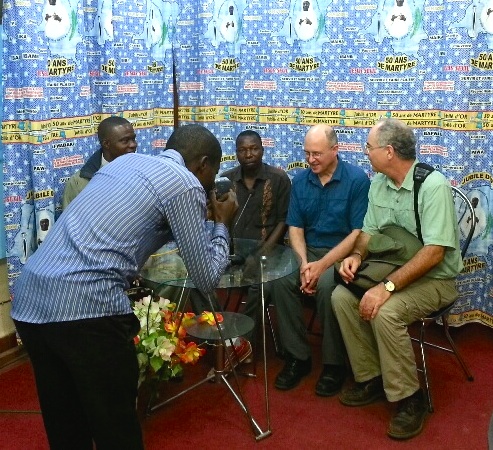
Fr. Charles Brown shared the photo above of SCJs with diocesan radio and television personnel in Congo. The US Province helps to financially support the broadcast center whose task is "evangelization and social development." Fr. Steve was interviewed on television during his visit.

Fr. Charles Brown shared the photo above of SCJs with diocesan radio and television personnel in Kisangani. The US Province helps to financially support the broadcast center whose task is “evangelization and social development.” Fr. Steve was interviewed on television during his visit.

Fr. Stephen Huffstetter continues to share his journal entries from the Congolese Province:

Friday, November 28 – The SCJ visitors from Poland and Cameroon returned home  yesterday and we welcomed two new members from the North Italian Province, Frs. Nerio and Daniele to our tour group. They flew into Uganda and took part in the events of the eastern part of the Congo before working their way to Kisangani to meet up with us here.

Visiting the minor seminary for the archdiocese brought back many memories for Fr. Nerio, who had lived there himself when it was an SCJ institution. We saw workers harvesting clusters of walnut-sized pods from palm trees to  press and boil and make palm oil. Rather than a kitchen, the cooking area was outside in the courtyard. Blankets spread in the sun held drying manioc.

The dormitory was one long room with beds covered in mosquito netting lined up one after another. Many of the buildings were in need of repair. The oldest original structure actually lay in ruins, destroyed in  the 1964 rebellion and never rebuilt.

But inside the classrooms where we met the students I encountered life and hope and energy. Their system of six years of secondary school would be the equivalent of our junior and senior high school together under one roof, so when we visited the first classroom I was struck by how young that group was. Just as in the States, when boys begin that young, only a small percentage will end up becoming priests. In their time of studies they will get a good education. Hopefully those who go one to other careers will become faithful Christians who will bring to those values to their families and society as a whole.

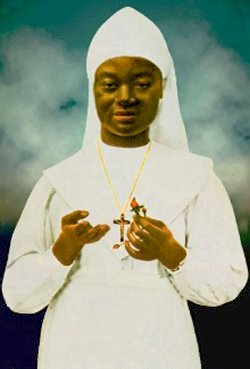
Sr. Anuarite

Sr. Anuarite

Every church we’ve seen has a prominently displayed a picture of Sr. Anuarite, a Congolese nun who was martyred in the 1964 rebellion. She has incredible respect and admiration from the people and many societies of prayer and good works have been organized in her memory. Fr. Claude, who worked for the diocese during his mission years here, was one of the interviewers when the Vatican investigated her cause. He actually interviewed the rebel officer who killed her when she refused to submit to him sexually. How would I have felt and acted to come face to face with one who killed someone I so admired?

We visited a high school.  One of the or English students asked me to explain why we have two different ways to pronounce the word “the” but I was no help there. Neither could I help when I noticed that instead of textbooks the students had just copybooks. The teacher asked if there was any way we could help with books and materials.

A complex problem we discussed on the way home is that illiteracy is very high in this part of the world. Books are both expensive and in short supply. Any items shipped into the interior take a long time to travel upriver, and without being guarded have a good chance of being stolen along the way. I asked about printing locally, but while there is a vast amount of wood, their are no paper mills. In this city of 1 million there is not even a daily newspaper.

The problem is similar in most any poor area of the world, and even my experience in the States. How can you gradually and effectively help a struggling local economy build the resources and infrastructure to meet its real needs?

Responding to health care needs the SCJs helped built a hospital some years ago. The surgery room looked like the set of a 1940 movie: six hospital beds to a room with no curtains or partitions. Families cooked meals on open fires at the property edge to feed their sick relatives. An ambulance with one missing tire rested on a concrete block. Bed sheets dried on the lawn. Nurses entered patient data by pen into a ledger book. Dedicated staff struggled with limited resources. The need is great and as the sick come to the door, they do what they can.

After the Six Day War in 2000, Fr. Zenon and other professionals of good will collaborated to develop an organization to give youth hope for a better future: GRADI Juenes (Group Reflection Action Development Integral for Youth). They volunteer their time to present programs, retreats, activities and even radio programs to help the youth in character and moral development. A starting point is a strong message of anti-corruption. They steer the youth away from getting caught up in the downward spiral of prostitution. Counseling is offered at the drop-in center. They reach hundreds of youth each month, and do it on a shoestring budget of about $1,250 per month. They expressed gratitude for our financial help. Again I was edified by the collaboration, commitment and hope.

Across the alley is a kindergarten that  the SCJs sponsor. School was closed for the day. I reflected on the brightly colored mural of Jesus looking over a crowd of Congolese children. Many of the buildings in the city could use a touch up. Paint seems like a luxury when there are more basic needs. Yet beauty and inspiration ARE a basic need.

Saturday, November 29 – RTA is the Radio and Television network for the Archdiocese of Kisangani. They invited us to tour the facilities and see how they use the media for both evangelization and development of the people. One of the technicians showed us the rough edit of last Sunday’s commemorative mass for the martyrs.

Frs. Steve and Charlie were interviewed in Kisangani.

Frs. Steve and Charlie were interviewed in Kisangani.

The main purpose of the visit was a “press conference”. A while back the SCJs gave a mission grant that helped keep them going through a critical time. I felt awkward when I found myself the center of attention and appreciation being thanked for something set in motion before I was provincial and the details of which I knew so little about. I mentioned that it is really our donors who deserve the thanks. We are only stewards of what they give us. They tell us to spread God’s love and use their donation where the need is great and it will do the most good. I thanked the staff for their dedication and hard work and told them I have seen good results and can assure our donors they have brought about great good.

We went to the production room and sat down for a short interview. Fr. Charles Brown graciously served as my interpreter. I spoke of what being here at the commemoration of the martyrs has meant to me, and offered some words of encouragement to the youth of the diocese. Fr. Claude Bédard then took his turn at the mike and had them laughing as he recounted some of his adventures from coming home after 30 years.

As a gift I received a lovely statue of Mary holding Jesus, carved in local ebony. Mary is the patron of the diocese, and they spoke of how the gift symbolized the connections between our peoples.

Our house for initial formation was rather quiet when we arrived. The new group of a dozen seminarians won’t start their program until February, but vocations are strong for us right now in Congo.

This part of the world has very limited banking and financial infrastructure. To try to establish some long-term financial viability the religious congregations try to invest what they have in land or buildings they can rent. Next to the house was some land the community wants to develop, and we saw the beginnings of a series of brick stalls where locals will be able to sell produce and wares. They joked that it was a local version of a strip mall!

We toured the Sotexki fabric plant to get an idea of the state of area industry. It is one of the multinationals still operating here, but in a much smaller capacity than in its heyday. Where once thousands of workers spun cotton into fabric, now the work is carried on by 200 or less. There are very few of these kinds of jobs for youth looking for employment.

Pizza for supper! 
I was grateful to a return to the good old fashioned comfort food I love so much. Fr. Giovanni is a missionary from Italy who knows how to make it right. He talked to a friend who owns a restaurant, borrowed his kitchen and ovens, donned a chef’s cap and baked us a feast as we sat in the (relative) cool of the evening and leisurely gabbed.

-Fr. Steve

US provincial continues to learn more about Congo and its people

SCJs pray at the tomb of the martyrs in Kisangani.

SCJs pray at the tomb of the martyrs in Kisangani.

Fr. Stephen Hufstetter continues to share his journal entries from his visit to the Democratic Republic of Congo for the commemoration of two 50th anniversaries: that of the deaths of 28 SCJ martyrs in Congo, and the 50th anniversary of the establishment of the Congolese Province. 

Monday 24

We’ve heard reports that back in the States heavy snows have snarled traffic and changed travel plans for many people this week. Ice and snow are the last thing on my mind as temperatures climb into the 90s most days in Congo. The issue here is rain and its effect on roads. Outside of the city, none of the roads are paved. We were supposed to travel east to the area of Wamba, where a  ceremony will commemorate the large group of SCJ martyrs who lost their lives there on the 26th. But roads are a muddy mess, and cars and jeeps that have attempted the trip have gotten bogged down or had to turn back.

After many days on the go, a slower day to read and take a long nap was greatly appreciated. The sidewalks outside our rooms were busy with visitors who took the opportunity to see Fr. Claude and Fr. Francois after their homecoming of many years.

Fr. Zenon (right) helping in the fields

Fr. Zenon (right) helping in the fields

Fr. Zenon, the Congolese provincial and I sat down to discuss ways we can collaborate with one another. His province is quite pleased that we offer an English as a Second Language program in Hales Corners. He wants to continue to send men there in summers because English is becoming more and more useful as the international language, especially in the congregation. The U.S. Province is also sponsoring one Congolese member for continuing theological education. While studies in a different country are a difficult undertaking they see it as a way to help their province train experts in fields they need to support their works.

We also talked of finances. Monies from our  donors in the States go much further in a developing nation such as Congo. In schools that struggle mightily to teach the basics, $50 a month is the salary for an average teacher. Besides social projects, a lot of our financial help keeps the formation programs for our seminarians going.

Tuesday 25

With our travel plans east still canceled with impassable roads we were able to make a trip of 120 kilometers to the north on red dirt roads to the village of Banalia. This was one of the early SCJ missions staffed by the Dutch Province;  Fr. Hermann Bisshops, SCJ, was killed there on this day in 1964.

Along the way we saw many homes made of mud brick and leaf roofs. Pigs, goats and chickens constantly crossed the road, and far more traffic was on foot. Villagers carried large baskets with goods on their heads. Wood fires burned as people prepared food for their families. Bicycles laden with cassava leaves and bananas carried the goods to market.

Fr. Leonard takes a break

Fr. Leonard takes a break

We had a few stretches with only trees and plants, but I was surprised by the constant patches of homes even as we got further and further from the city. Most people live along the roads, with far fewer in the interior. We saw many children in uniform walking to school. We also saw many children working or playing, obviously not in school. when asking about this, I was told that education is mandatory but many of the children cannot afford the $5 per month school fees, and don’t attend.

We crossed over a couple of narrow bridges. Only one car could pass over at a time. Through broken wooden planks you could glimpse the rushing river below, and crossing over was an act of faith. At one river crossing we saw a hydroelectric dam which supplies most of the power for the region.

St. Elizabeth of Hungary church in Banalia stands tall and proud, though weathered and aged.  The mission has been turned over to diocesan priests and the three of them hosted us for lunch and a tour.  Also passing through the area was Bishop Joseph Banga Bsne of the Buta diocese. He serves as vice president on the Congo bishops conference and as we sat in a circle of chairs around the courtyard, he discussed church and political issues with us.

Congo has vast resources and potential. But it is a country where the rule of law is hard to enforce. Taxes and fees that should go to the common good end up enriching individuals instead. Those with wealth and power seem far distant from the needs of the villagers.

Because of poor roads it is a great undertaking for a parish priest, let alone a bishop, to maintain good contact with his flock.

After lunch we went into the village and visited the only hospital for many miles. It was brightly painted and well kept. The waiting room was an open brick building with spaces to build fires. Families will cook food there to take to their sick relatives. Staff say the most common problems are malaria, typhoid, TB and pneumonia. They are able to perform c-sections here. Since most women prefer to work with midwives, the hospital may not get the patient until the delivery has already begun and complications have set in. They try to do a good deal of education and preventative health care.

Thursday 27

Yesterday we toured the scientific and educational institute which is a center of natural sciences, with a focus on agricultural and botanical studies. They took over a former tobacco factory and created a place of great significance to the local and national economy. Their current pet project is developing strains of bananas that are resistant to the blight that has stuck some areas. We toured both the test plots and the laboratories where different plant strains are tested.

A beautiful walking trail with a wide range of native plants and trees was most like “the jungle” I had pictured in my imagination. The only wild animals though we’re in the small museum nearby.

We also toured the schools run by the Marist community. They educate 1,400 grade and high school students , and staff a small college with about 700 enrolled. I saw bright read and blue patches on the school lawn, and wondered what that could be. Gym clothes were drying out after PE class — much better than the smell of wet towels I remember from Jr. High days!

Students also help the school by doing manual labor. Some were cutting wide swaths of grass by hand with machetes and scythes.

I’m aware that today in the States is Thanksgiving Day. I’m  thankful to family, friends and community members back home, and pray their celebrations are joyful.

– Fr. Steve

Remembering those who gave their lives

SCJs join members of the local community to pray at the site where the first group of SCJ missionaries were killed during the Simba rebellion. Fr. Steve is pictured in the hat on the right.

SCJs join the local community to pray at the site where the first group of missionaries were killed during the Simba rebellion. Fr. Steve is pictured in the hat on the right.

Fr. Stephen Huffstetter writes from the Congolese Province where he is taking part in the memorials for SCJ missionaries who lost their lives in the Simba rebellion of 1964. Frs. Charles Brown, Leonard Elder and Claude Bédard (Canada) are also representing North America. 

NOVEMBER 22 – We walked to Bishop Marcel Utemi’s house to pay our respects. He warmly received us and thanked the Priests of the Sacred Heart for their rich history in this diocese. Monsignor Grison, SCJ, was the first bishop when this became a diocese. He is remembered with a statue in a small park nearby.

Next was a trip to the Procure. The high walled complex covering about a city block reminded me of some medieval fortress. It was here during the 1964 rebellion that many people took refuge. When rebels came Msgr. Fataki, a well loved native Congolese who later became a bishop, was in front of the doors. He stood up to the rebels who wanted to attack the Europeans inside. “If you are going to kill them you will have to shed my blood first.” They backed down and many lives were saved. In addition to the 1964 fighting, the procure and cathedral were shelled as recently as 2000. Bishop Fataki is now buried in the Cathedral, which stands next door, overlooking the wide Congo River.

In front of the cathedral stands a statue of the Sacred Heart. At one point revolutionaries were ordered to tear down external signs of the faith. They didn’t know the statue was constructed around steel railroad ties and when their wires snapped trying to topple Jesus, they took it as a sign to cease, and the statue still guards the church entrance.

More than an administrative office for religious activity, the procure was a supply center for the entire region. At a time when civil unrest brought all normal commerce to a standstill, SCJs arranged flights from Belgium directly into Kisangani filled with medicine and needed supplies. We saw the well worn printing presses, still in use today, that distribute news and books to the area.

Nearby in a small park stands a memorial to those slain in years of unrest. Sadly, it was later used as a killing site and is marked with bullet holes in the tiles.

3,000 come together 

NOVEMBER 23 – Today was the day of our big memorial celebration. It was 50 years ago today  the first group of SCJs were killed in a home a few blocks away from St. Martha Church.

The Congo River is perhaps a mile wide here, and there are no bridges to cross over. People walked onto a ferry boat that could take several hundred people at a time. As the mass of humanity crowded on board I got a better sense of how overcrowded ferries occasionally have trouble and sink. Yet the chaos quickly dispelled when the religious sisters on board intoned a hymn honoring Mary, and most of the boat started singing along with harmonies that stirred my soul.

Fr. Steve during the memorial service at St. Martha's Church in Kisangani.

Fr. Steve during the memorial service at St. Martha’s in Kisangani; an estimated 3,000 people took part.

We gathered at the spot where our martyrs were slain, for prayer and reflection and the laying of wreaths. The mood was disturbed by intense yelling nearby, which I I thought was a domestic fight. I later learned it was a preacher who denounced us Catholics for disturbing the souls of the dead.

The crowd for the Mass was huge, perhaps 3,000 faithful from across the city. An altar was set on the front steps of the church, with a tarp providing welcome shade as the temperatures climbed into the 90s. Six tents provided shade for parishioners, yet the people still spilled out onto the roadway and surrounding the church.

The opening song and procession into church took a long time as the column of servers, priests and other liturgical minsters shuffled and danced to the rhythm of the drum. While so much of Congolese culture is so totally new and different, the prominence of the drum reminds me so much of my days working with Lakota people.

My favorite group of liturgical ministers were a dozen elementary school parishioners. They wore yellow dresses, white stocking feet, long white gloves and a star shaped white headband and they sang and danced to all the songs and liturgical music. I really smiled when they broke out white pom pons too!

I’ve never been at a Mass where the collection took a half hour! Initially ushers placed three foot high wicker baskets in the middle of the dirt road leading into church and people streamed from all sides to make their offering. The choir sang two or three uplifting songs during the time. When I thought we were finished, another group of parishioners lined up to present their offerings in kind – live goats and chickens, bushels of beans and vegetables, and bamboo poles heavily laden with bananas and other fruits from the forest. The need for the priest to wash his hands at that part of the Mass makes a lot more sense after handling livestock!

Distributing communion to the faithful is always meaningful to me, and today it was even more of a special honor and prayerful experience. I don’t know nor understand the lives of these people and what they’ve been through. Yet they believe, and it strengthens my own faith.

After communion came the remarks by the visiting dignitaries. I was warned that I’d be expected to give a few remarks. The Mass was in Swahili, but French is also widely spoken here. I dusted off my high school French from 40 years ago and with the help of Fr. Claude from Montréal told the people and the SCJ community of our prayers and support.

All in all we were at the altar almost four hours. While I didn’t understand the language, I paid more attention to the ritual, and the people gathered to pray and remember.

We shared a festive meal afterward. The new local food I tried today was a type of fried caterpillar. While it did take me a while to work up the nerve to taste, It reminded me of  smoked oyster, only crunchy.

The ferry was finished running for the day, so to get back to the other side we loaded into a pirogue. The boat was perhaps 40 feet long and carved out from the trunk of a single tree. About two dozen pilgrims sat on the edges as we motored across the vast river and reflected on an unforgettable day.

-Fr. Stephen Huffstetter, SCJ

Visiting today’s Congo while remembering the past

Fr. Leonard writes that by the time Mass was done their group missed the last ferry so "we traveled in a "piroug," a boat made from a hallowed out tree. Fr. Claude Bédard (Canadian Region) is front, left; Fr. Stephen Huffstetter is in the hat in the middle; Fr. Charles Brown is next to Fr. Steve.

Fr. Leonard writes that by the time Mass was done their group missed the last ferry so “we traveled in a “piroug,” a boat made from a hallowed out tree. Fr. Claude Bédard (Canadian Region) is front, left; Fr. Stephen Huffstetter is in the hat in the middle; Fr. Charles Brown is next to Fr. Steve.

Fr. Stephen Huffstetter writes from Kisangani, Congo, where he and Frs. Leonard Elder and Charles Brown are taking part in memorial services in remembrance of SCJ missionaries who were killed during the country’s Simba rebellion in 1964.

Kinshasa, the nation’s capital

Yesterday we toured the capital city of Kinshasa, one of the world’s sprawling urban areas with population estimates ranging from 8 – 12 million. There is a small downtown business district but much of the city is made of smaller buildings extending many miles in every direction. I was amazed to see so many people on foot. With the average worker earning about $2 per day there isn’t a lot left for transportation. Many from rural areas have come to the city in the hopes of work and a better life. Like other large scale migrations throughout history, the ruggedness of city life often overpowers the dream.

Fr. Gabriel needed some paperwork at the central government offices. Many people had been lined up since dawn and weren’t even sure if they would get in to do their business. Here one must be patient and persistent.

We walked to the president’s house (which is white here too) and to the memorial mausoleum where Laurent Kabila [president of the Democratic Republic of Congo from 1997-2001] was buried after a bodyguard shot him down. The corners of the edifice were strong hands holding ivory tusks, with broken chains and the hope for freedom. In preparing for this trip I read up on the history of the Congo, and the suffering and tragedies from the time of colonialism until today.

When we prayed adoration back at the community house I reflected that the problems I face are small compared to the major challenges of the Congolese people. Yet our SCJs here press forward with hope and faith. We have the chance to work together and make a difference.

Today we flew into Kisangani, formerly called Stanleyville. Our group of 10 seemed a bit lost amid the noise and chaos of the airport, but our hosts had a contact who helped us navigate our way through the system. By the time I went through the security questions the only thing I was asked was if I was part of the same pilgrimage. Unlike my usual travels, there were no assigned seats. I got a window so as to look out at the vast forests and wide and majestic Congo River.

On Saturday a memorial was held at the site where many of the SCJ missionaries were killed in 1964. The house has been demolished;  the SCJs were killed in the basement

On Saturday a memorial was held at the site where many of the SCJ missionaries were killed in 1964. The house has been demolished.

The first event in the commemoration of our 28 SCJ martyrs from the 1964 rebellion was an evening prayer and rosary at the site of 12 of the graves. Several sisters working in the area also died, and leadership From their communities honored them as well. Fr. Claude Bédard, a former missionary from from Montreal, also made the pilgrimage. He hasn’t been back to Congo for almost 30 years. When two of the sisters he used to work with recognized him we witnessed a joyful, tearful reunion. Prayer was in French, which I haven’t spoken since high school, but by the fourth decade or so I had the last part of the Hail Mary down.

We visited the Monsignor Grison center, which the U.S. Province helped renovate. In an area where many hotels and accommodations haven’t recovered from war and civil unrest, this complex serves not only as a center for retreats and spiritual development, but as a conference center as well. It is connected to St. Gabriel parish, on the shores of the vast Congo River. We first gathered for adoration, the adjourned to a reception area for an evening social. One room is dedicated to the 28 martyrs, and also had pictures of all the foreign missionaries who have served here. Fr. Charlie Brown and Fr. Leonard Elder laughed to see how they looked in their youth. Charlie remarked, “this is where I grew up and became a priest. We also prayerfully remembered people like Fr. Dave Maher, Br. Jerry Selenke, Br. Frank Miller and Fr. Frank Hudson. A table held ordination and profession pictures of our native Congolese vocations. This province is young and growing and the sixth largest in the congregation.