Fish day

little-india-singapore-fish

Everyone pitches in on fish day

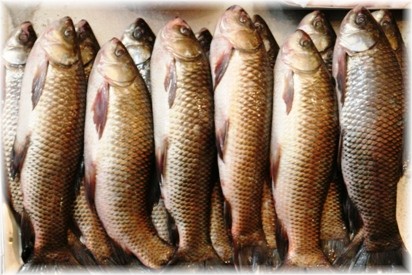
It is a very popular dish around here. More fish is served than chicken or any other kind of meat. A fair number of our SCJs come from fishing villages in Kerala and naturally have a taste for fish. Here in Eluru we are about 2 1/2 hours from the coast so I can’t say the villages around here hold many seafaring men. However, I suspect fish may be the least costly source of protein in the local diet.

When Frs. Mariano and Jojoppa returned yesterday afternoon I asked them what time they left as the night before I was told the trip was planned for a 2:00 AM departure. I thought my watch said 4:00 AM when the old diesel jeep cranked up outside my window. Even if I had been in a deep sleep the racket would have pulled me back to a conscious state. At any rate, the answer I got was 3:30 AM. The discrepancy in time may be my watch as I have a setting for Milwaukee time and local time. MKE time is 11 1/2 hour behind India’s one time zone.

I asked Fr. Mariano about their trip. The road to the coast is not very good right now as a lot of it is under construction (don’t we know about that back home!). Although the traffic was light there was a lot of mist and fog along the way. At times, he said, they could hardly see 10 meters ahead (30 feet). The two of them managed to arrive in plenty of time to catch the boats. Although people plan on the boats coming in around 6:00 AM more often not they’ll be at least a half hour later. A lot depends on how good the fishing was, and I’m sure both the weather and currents and tides may have something to say about arrival time as well.
Fish day at the theology house

Fish day at the theology house

About 2:00 PM the jeep came rumbling up our driveway with its horn a-blaring. The signal for: “All hands on deck.” The jeep was packed with three or four large styrofoam boxes containing the iced fish. When asked how many kilos he brought back, Fr. Mariano replied: Oh about 200 or maybe 250 kilos. That should last  the community of 20 around two months. With their summer vacation coming in mid-March and the postulants leaving here around March 1st for a couple of weeks vacation before they have to report to the novitiate at Nambur I think this load may last a bit longer.

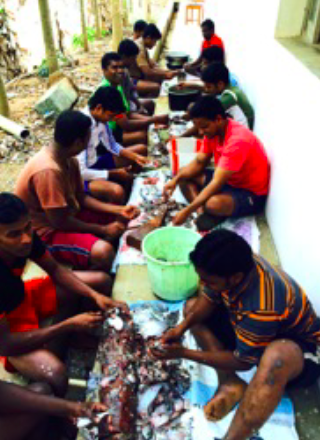
Both the theologians and postulants were all gathering to begin the process of cleaning the fish and getting them ready for the freezer. Fr. Sebastian asked: “How can you keep the fish frozen with the frequent electrical outages?”

Most of the outages are of a short duration of no more then 15 to 30 minutes. Freezers will keep stuff frozen for that duration. For longer times the house has a generator that seems to me can run the entire electrical needs of the community. We’ve used it a couple of time since I’ve been here. I haven’t figured out how, when or why the generator kicks in as most of the time it does not. My working theory is some outages are planned and our generator is fired up during these. I’ll have to ask for a better explanation.

Three kinds of fish were brought back: A red fish, a black fish, and one large fish. The latter I missed as it was cleaned near the end of the afternoon and I missed seeing it. In any case, none of the students could tell me what it was other than: “It was a big fish.”

The fish cleaning party took place behind the kitchen. It took a little while to round up all the students but before too long music was a blaring and laughter and chatter could be heard even from the roof when I was up there to send my afternoon e-mails and journal/blog to the provincial office. As the fish cleaning party is a regular occurrence (about every two months) everyone had an idea of what he was supposed to be doing. Since some of the students do come from fishing villages they probably have done similar work, perhaps not on this scale, within their families.

Keeping in mind that the 440 pounds of fish would be reduced in volume/weight as scaling and cleaning took place for a community of 20 at the full weight of 440 it amounts to 22 pounds of fish per person and about 1/3 of a pound per day. As I’ve said, it is the probably the chief source of protein.

We were talking about the local diet at breakfast and comparing it to what we eat back home. I said: Americans would want more vegetables, especially green vegetables, than what is served in the house. Obviously lots of rice form a major source of calories in the diet. A cup of short-grain white rice has 242 calories that include 53 grams of carbohydrate and four grams of protein. Believe me, the students plates are piled with a lot more then a cup of rice as it is the mainstay of most meals.

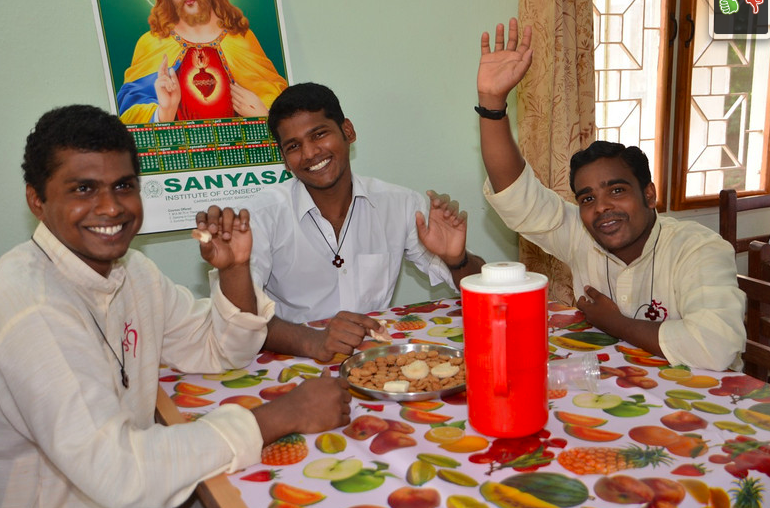
The students worked all afternoon before they could call it a day and put the 200-plus kilos of cleaned fish in the deep freezer for future use. They enjoyed the fruits of their labors at our evening meal. A small token of thanks showed up at the end of the meal in a dish of vanilla ice cream for all.

That reminded both Fr. Mariano and Sebastian of Fr. Tom Garvey, SCJ, who holds a special place in the development of our Indian SCJ presence. I spoke about him earlier. His name came up because Tom was well known for his love of ice cream. He did not develop that taste here in India but brought it with him from the States for there too his love of ice cream, especially vanilla, was well known.
The many languages of India

Screen Shot 2014-02-13 at 9.18.24 AM

As noted previously, Fr. Tom Cassidy, SCJ, is spending February with the theology community in India. Here he reflects on the many languages of the country:

Language! 

Most of the postulants, and for that matter, members of the Indian District, come from the states of Kerala and Andhra Pradesh. There are a few from Goa where Fr. Mariano, the superior of the theologate, hails from, and in recent times a few come from north India. Each state has its own language and, I suspect, a number of dialects and local languages as well, especially where migration has taken place. For example, here in Andhra Pradesh the state language is Telugu while in Kerala it is Malayalam.

Hindi is considered the national language and is the lingua franca. English is also an important national language. It is the language used in education, especially as one moves up the ladder from primary to secondary to university level. Because our students come from different states English is also the lingua franca of our SCJ community.

India langauge map

The many languages of India

Because of the language issue, it is not so simple for the district superior and council to assign men to ministry. Especially since, with the exception of Mumbai, the parishes we have are in rural areas where the local language must be used. So someone from Kerala can’t be assigned to Andhra Pradesh for parish ministry unless he knows the local language. In Mumbai at Divine Mercy Parish, Mass rotates between English, Hindi and, I believe Telugu, as the community consists of migrants who have moved into the area looking for work.

For the majority of Americans, speaking a second or third language is rare. Certainly in the past 20 years or so Spanish has become an important second language in the States given our large Hispanic population.

Most of our students in India know two or more languages besides their command of English. For a Westerner learning any of the local languages of India is compounded by the fact the script is so different from our own. It’s like studying Hebrew or Greek where the first thing you need to do is learn the alphabet. Telugu has 54 characters in its alphabet as opposed to our 26.

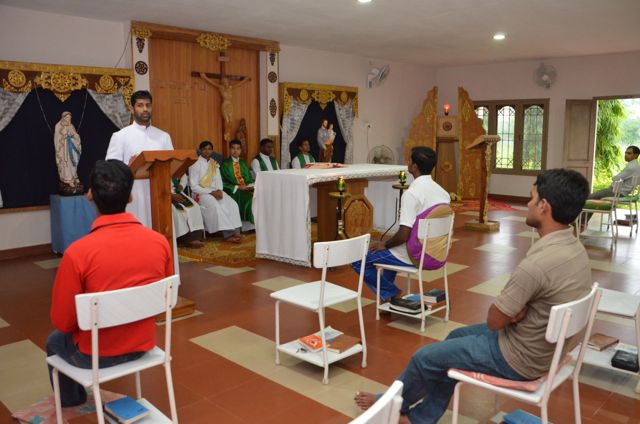
Our liturgies are in English, though some of the songs are done in other languages. These local songs are ones the students know by heart. Liturgical music is a part of both Mass and Adoration. We often will chant the psalms as well during morning and/or evening prayer. While in the States we often will sing two or maybe three verses of a song; so far every one we have done here has been sung from beginning to end.

Leave your shoes behind

shoes_at_door


Fr. Tom Cassidy will be with the theology community in Eluru, India, through the end of February. Today he writes about some of the customs of his temporary home:

One of the joys of visiting a foreign country, especially one out of your comfort zone, is learning about local customs that are often so different from your own personal experience. I’d like to explain several that are a daily part of Indian life.

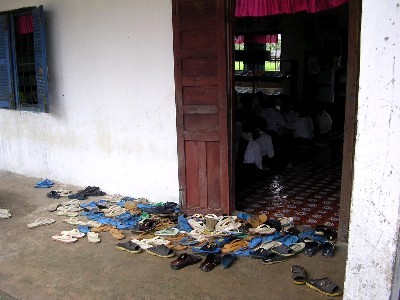
One custom that is part of daily life, at least in rural India, is shoe removal. As you walk down the hallway to the chapel you see both walls lined with sandals left by the students and priests.

This is not the only place where one removes his/her shoes. You’ll know a student is in his room because his shoes will be outside the door. It’s perfectly fine to wear shoes in the hallway, but not in your room. I can’t begin to fathom where this custom began or its significance, but I have found one very practical use for it. Our floors are tiled and cool and one way to feel cooler in a hot climate is to have cool feet. It works right now, but when the 100 degree temps arrive I’m not sure how cold the floor will be.

Students prayer India

Students at prayer

Since we are taking our shoes off and putting them on so often during the day what kind of shoes are worn is also important. Most in the house where flip-flops or thongs. It makes for easy on and off. I have a pair of Tevas that I have had for years (served me well on all my Asian trips since 1991). I don’t like anything between my toes so this uses straps. Obviously I do a lot more bending over then those who can simply slip on and slip off at will.

A second cultural custom, or perhaps better put –– practice –– takes a bit of getting used to coming from the west. Where I come from when giving a no answer it can often be accompanied, especially for emphasis, by turning your head left and right. Here what we take for a no means yes – the way the head bobs. Not only does it mean “yes” but I don’t think even with lots of practice could reproduce the movement of an Indian’s head when he says “yes” There is an elegance to it that I find hard to describe.

I have also discovered the head movement sometimes accompanies a conversation as if the yes movement is confirming that the point has been understood and well taken. I must also confess Indian English is not always easy for me to understand. The students here are soft spoken and each has his own accent. Some of these accents are easy for the ear to catch but others are more difficult.

An example: In chapel when we are going to sing there are three books a song may be taken from. The one most frequently used is divided into sections starting with a letter and followed by a number. I find it extremely difficult to pick up many of the letters. My ear can’t often distinguish between a D,E,T or P, when the student announces the song.

In all fairness I should point out MY OWN accent and speed can be a problem for our students to pick up and understand. I do try my best to slow down, especially when preaching in chapel, but at times I find myself falling back into my usual speech patterns. It will be interesting to see if by the end of my visit our mutual understanding will improve. I’ll have to ask Br. Hari about that since he’s the one who pointed out to me how difficult it can be to understand a non-Indian’s English.

It all depends on what your ear is used to!

Chasing down the buffalo

water-buffalo

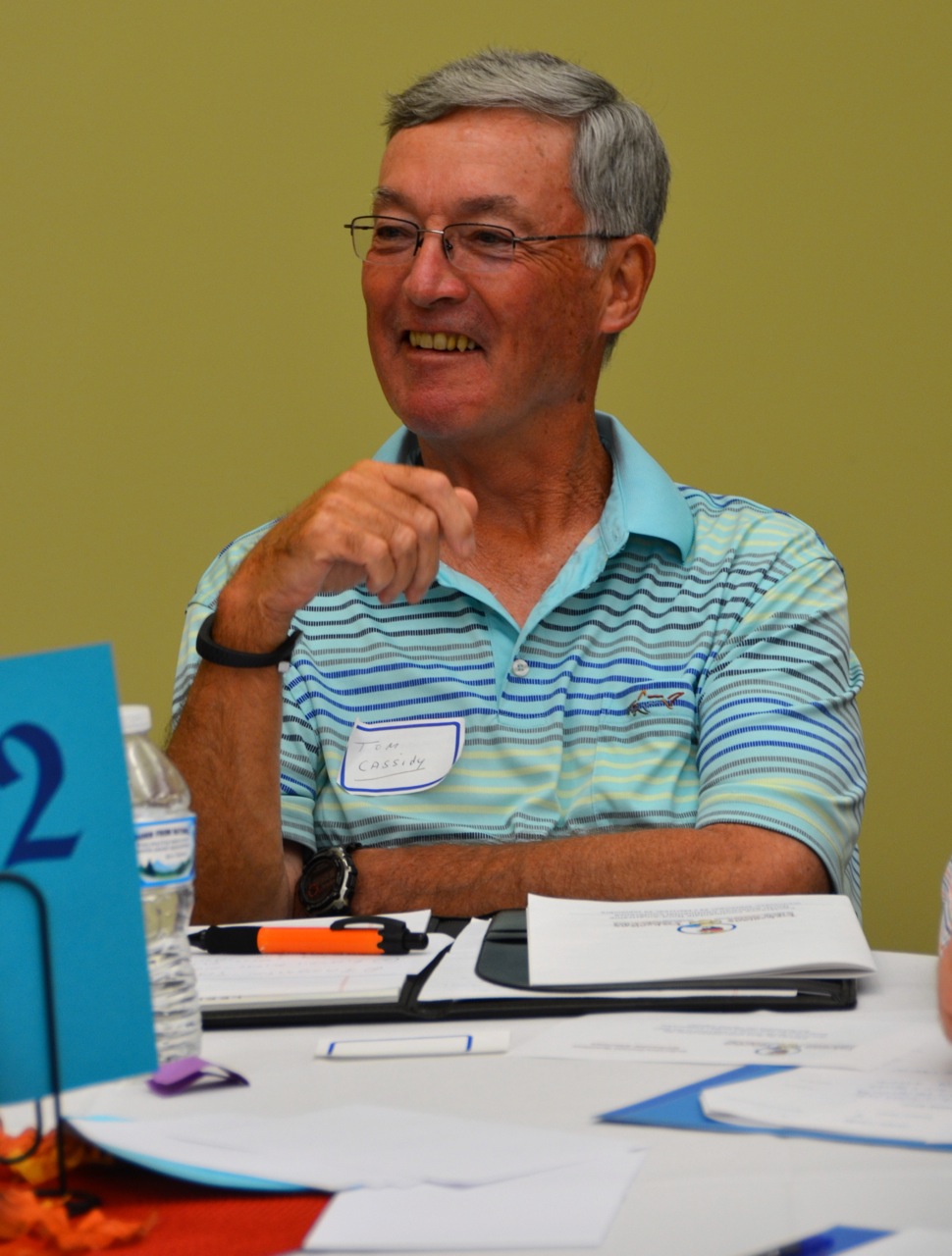
Fr. Tom Cassidy will be with the theology community in Eluru through the end of February. Here, he writes about a recent morning that started on the roof, chasing down a WI-FI connection and continued on to the hunt for the community’s escaped water buffalos:

It turned out to be a rather interesting morning. As usual, after breakfast I got Fr. Mariano’s computer and marched up to the roof to connect to the internet and download any important e-mails and trash the rest.  I also upload any e-mails I may have written from the day before.

Speaking of the internet, a number of the students are following what I am writing on the province blog. So far all the local reviews are positive. However, keep in mind these are my own reflections, and as much as I try to be accurate, impressions are sometimes in error. I do try as best I can to correct any mistakes I make along the way.

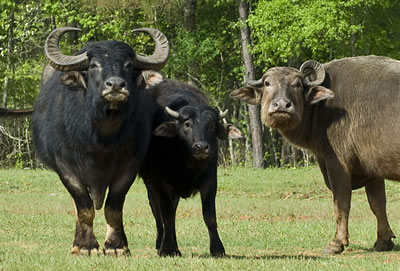
About the time I finished posting my journal and a few other emails  there was a knock at my door. Mahesh, one of the postulants, reported that our three buffalos had gotten out as someone left the front gate open and he and some of the other postulants (theologians were in school) would go looking for them. I’m guessing this was about 10:15  AM when the roundup began.

The postulants have lunch at 12:30 PM during the week and when I arrived only Jesu was there as he had just returned from town shopping with Fr. Jojoppa. I had a good conversation and learned a lot. We first talked about the missing buffalo. We have one adult female who supplies the house with milk; a lot of which is turned into yogurt that I think they call curd.  It is on the sour side but everyone takes it at lunch and supper as it helps cool the stomach after a diet of rice and spices — I take water to cool my innards. Our other two buffalo are young males destined at some later date for the table.

Fr. Tom Cassidy

Fr. Tom Cassidy

Finding our three wayward beasts is not as simple as it sounds. They are not marked (branded) so trying to find them, say if they are in a field with other buffalo, well you can imagine as the saying goes they all look alike might very well apply here. I imagine the best clue is the three might well stick together. Another problem arrises if the buffalo are eating grass in some farmer’s field. He’ll want some form of compensation for lost grass. I am happy to report sometime in the early afternoon postulants and buffalo came marching down our road.

Jesu did say that if the buffalo were village animals they would be used to moving about and would know their own way home. Our beasts are kept inside our property, unless they manage to find the front gate open, and have no idea where they go once out.

Jesu and I also spoke about the morning shopping experience. It turns out Jesu is a good bargainer and jawing with merchants is an important part of getting things at the best price. I was impressed with Jesu saying: “We depend on many poor people who are our benefactors and it is important to value each and every rupee.” From his minor seminary days Jesu has been bargaining on behalf of the community.

He also told me some about his family. He was surprised that I was a priest since I was the only son in my family and would not carry on the name. It is important in the Indian context to continue the family line. Male children inherit while females do not as their dowry when they marry is in a sense their inheritance. Of course, if there are no male heirs it is a different story. In Jesu’s case he has several brothers and sisters. Families in India are getting smaller especially as more and more move into urban centers.

I read this morning saying summer is about to arrive. The temperatures are rising now, and averaging around 90°F during the day, though the nights are sill very comfortable. Perhaps I’ll have to crank up the air conditioner one of these days but so far I have been quite comfortable.

Sunday in rural India

Fr. Tom Cassidy will be with the theology community in Eluru through the end of February. Here, he writes about traveling to celebrate Mass at a nearby parish:

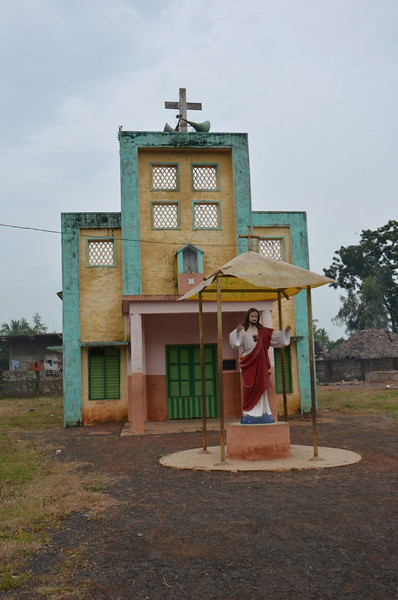
Sacred Heart Church in Eluru

Sacred Heart Church in Eluru

Yesterday Fr. Jojoppa, scj, invited me to accompany him and three theologians to celebrate the 9:30 am. Mass in our parish of the Sacred Heart. We would first pick up four Dominican Sisters who help with the music. Their convent is located in Eluru not too far from the bishop’s residence, which was pointed out to me as we drove to the convent.

Br. Bernarji played the key board and led the singing this morning. He also had a group of girls perform two dances for me after Mass. He taught them these dances as past of a Christmas celebration. I am not a dancer but appreciated it and thought the girls did an excellent job. They certainly knew their routines and kept in time together.

All of us were out and on the road at the appointed time of 6:45 a.m.. About five minutes down the road Fr. Jojoppa asked if Harish had remembered to bring the flowers for our blessing of the two statues. Oops! We turned back and the cook was waiting at the front gate with flowers in hand, and after a quick turn around we headed back to Eluru to pick up the sisters.

Our parish (Sacred Heart) is normally about a half hour drive from the theologate. Our detour to Eluru did add a few minutes to the drive. In addition to the main church it has three sub-stations. The stations average around 40 families each while the parish church has about 190 families. Shades of the American South before segregation were evident –– there are two substations in the same village as they are two different caste.

Screen Shot 2014-02-03 at 8.26.09 AMAs is common in mission areas, in addition to the pastor the church employs catechists as assistants. Mr. Somaiah was preparing to hold Sunday’s worship service in Saints Peter & Paul sub-station when we drove up.

After making the rounds of the three sub-stations to give me the big picture we arrived at Sacred Heart. The Sunday routine begins with rosary at 8:30 a.m. followed by a half hour of Eucharistic Adoration at 9:00 a.m. then followed by Mass. The times are a bit elastic as Mass itself began closer to 9:50 a.m. The parishioners don’t all arrive at the same time. It took until about the time of the homily for the church to fill up. As I’ve previously noted men and women sit on separate sides of the church and with few exceptions (mainly for age) sit on the floor.

Following communion and before the final prayer I was asked to bless the statues of the Blessed Mother and St. Joseph. They are not new statues, but were recently refurbished. Using the ritual for the blessing of sacred objects with Fr. Jojoppa’s assistance I blessed them both and then placed the traditional garland of flowers over each statue.

We finished Mass sometime after 11:00 a.m. and it was then that I was treated to the dance performance by Benarji’s dance troop.

On our way home Fr. Jojoppa drove pass the piece of land he hopes to buy for a parish house. Bishop Jaya Rao Polimera wants the SCJs to live close to the people. This plot of land will put them somewhere in the middle of the parish and not too far from the main road.

Screen Shot 2014-02-03 at 8.26.00 AMAccording to Fr. Jojoppa, because Eluru is a poor mission diocese the bishop does not pay religious as they are expected to fend for themselves. When I asked: Is this common in India? Yes, was the answer I received.

This photo also shows the type of roads found all around Sacred Heart parish once you get off the main highway. In the villages, at least the main street is often paved. Travel during the rainy season can get a bit dicey when these roads turn to mud but Fr. Jojoppa assured me that rarely did he need to use the 4 wheel drive jeep. He usually travels around the parish by motorbike.

Last day in Kumbalanghy

This may be the last of Fr. Tom Cassidy’s blog posts for awhile. He is moving from a regular internet connection in Kumbalanghy, India, to a less predictable one in Eluru. The former provincial superior will be with the formation program in Eluru through the end of February.

Today is my last day in Kumbalanghy. I’ll have to get up at 3:00 a.m. to be packed and ready to go to the airport when the taxi arrives at 4:00 a.m. Fr. Thomas and I will be traveling to Andhra Pradesh and as I understand it we will be taking a “puddle jumper,” which means we’ll depart Cochin at around 7:00 a.m. and arrive at our final destination around 1:00 p.m. I think there are three or four stops along the way — shades of the old North Central Airline flying Wisconsin, Minnesota and the Dakotas. I thought I would be going to the novitiate as tomorrow is the dedication of the new church the U.S. Province  helped build through our financial contributions to the project. Fr. Thomas told me at dinner this noon that I would be met and driven to Eluru (my final destination for my stay in India) and that on Sunday we (meaning a number of SCJs) would drive to Guntur for the dedication.

One of the things I forgot to bring with me was a hat so until yesterday I was doing my walks on the roof since it is covered and keeps the sun out. While in Cochin I managed to pick up a baseball cap not in the style I would prefer but it does the job. With hat on my head yesterday and today I walked the road that passes in front of our house.

Screen Shot 2014-01-27 at 8.38.08 AMThere wasn’t much traffic when I took this photo but during much of the day there is a steady stream of traffic, and since all the busses end their route just beyond our property there is a steady stream of bus traffic in both directions. Perhaps next would be the number of motorcycles, followed by cars and then trucks and a cyclist or two (especially young kids). If my memory is not playing tricks on me there is a lot less traffic in this local area compared to Andhra Pradesh and it seems to flow better as well. Finally, remember due to India being under British influence for so long traffic drives on the left, just opposite of what we do in the States.

When we speak of a small rural town we think of a Main Street with a number of side streets jutting off to residential and perhaps some other commercial properties. In Kumbalanghy, as I suspect in much of rural India, Main Street is the only street and most buildings — either small shops or homes — are built right along the roadway. Instead of side streets you’ll find a path or two that leads to homes built off road. Obviously if you have a car you’ll need to be on the main road while a motor bike can easily maneuver most side paths.

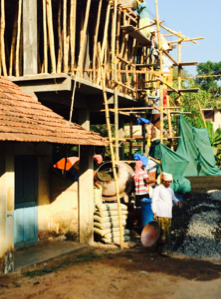
Screen Shot 2014-01-27 at 8.38.17 AMA few minutes’ walk toward the parish of St. George I spotted this construction site. It would be typical of what you’ll see in much of India outside the large cities. Most structures are made of steel and concrete. You’ll note the extensive supports holding up the roof above the second story. Note too the cement is mixed on site and though the photo only hints at it much of the work is labor intensive. With a population of over a billion people labor is not in short supply.

All the homes I spotted along the road were made of cement with tile roofs. Some of the homes were large and quite attractive. As is the case all over the globe Mother Nature is construction’s worst enemy. Here the two elements that can wreck havoc are sun and rain. The sun tends to wash out colors over time and the raining season can be torrential. Even one drop of water constantly dripping in one spot can over time carve stone. Just think of our own Grand Canyon that water carved out of rock ions ago.

I suspect home interiors are not all that different from what we have in our seminary here in Kumbalanghy. High ceilings to help dissipate the heat and tile or marble floors which also help cool the building. I’m sure in wealthier homes one would find area rugs to accent the flooring. I am grateful our house has screens as insects, especially mosquitoes, are a problem. They have not, thankfully, been a great bother so far, especially in my room with the ceiling fan creating a good breeze. I read somewhere that mosquitoes can’t fly in any kind of wind to speak of. I suspect that’s why they seem most pesky at down and dusk when winds tend to be their calmest.

A growing history in India

Mass in India

As noted earlier, Fr. Tom Cassidy helping with the formation program in India until early March. In the following post he reflects on the history of the SCJ presence in the country:

I think it was in 1994 that the invitation came to the SCJs from the Bishop of Cochin to establish our presence in India. It was not an easy process. Foreign Missionaries are not granted access to the country and as a result, SCJs from around the congregation would move in and out of the country. India does grant a six-month visa for foreign visitors. As a consequence many SCJs have come to India on a short-term basis to help build our presence, and that has included a number of Americans.

I don’t think I can recall all those who have been here but a few stand out in part because they are remembered so well here by the Indian SCJs. I believe the first American who came to India was Fr. Rick Dileo. Rick was on sabbatical when Fr. Virignio Bressanelli, SCJ, our superior general at the time, encouraged Rick to spend six months of his sabbatical in Cochin. Maybe it helped that Rick’s family came from Argentina, Fr. Virgnio’s native land, but in any case Rick agreed and became one of the first SCJ vocation recruiters.

Without a doubt the American SCJ who has had the biggest impact and is best remembered is Fr. Tom Garvey, SCJ. Just as in the case of Rick Dileo, Tom was on sabbatical. Once again Fr. Virginio worked his charm and asked Tom to spend part, if not all, of his sabbatical helping develop our SCJ presence in India. It did not take too much convincing as Tom’s sense of SCJ availability was always strong.

There was another advantage for him as an American: he could apply for a five-year visa making it easier to come in and out of India. Once Tom arrived to spend his sabbatical year I think he fell in love with India and the challenge of forming a new SCJ entity. His sabbatical turned into his ministry as he spent the rest of his life working to develop a native SCJ community. Sadly, he died following minor surgery and has become revered among those Indian SCJs who knew him and a legend to those who entered after his passing.

Another SCJ who is truly held in high honor for his simplicity and holiness is Fr. Tom Fix, who actually went through the US formation program at the same time as Tom Garvey. Following his ordination and a few years working in the United States, Tom volunteered to go to Indonesia as a missionary. He became a member of their province and when the government demanded missionaries either leave the country or apply for citizenship he became an Indonesian citizen.

In many ways our expansion in Asia came about through the request by our Indonesian  Province that we expand in Asia beyond our Indonesian presence. That expansion began in 1988 when we opened our Philippine mission on Mindanao. Indonesia has sent its members to each of the new missions in Asia and Tom was asked to work in the formation program here in India which he did until 2011. He was slated to return to India following his home leave in the US. However, upon returning to Indonesia in order to apply for a new Indian visa it was discovered that he had cancer which could not be treated and so he spent his remaining days among the Indonesian people he served so well. Tom is especially remembered by Indian SCJs as a wonderful spiritual director and a man with a smile on his face.

Finally there is Fr. Charles Bisgrove, SCJ, who came to India on a number of occasions to help in one formation house or the other. He’s remembered for his hearty laugh, his love of peanut butter and for his wonderful singing voice. Many of the SCJs just finishing their formation hold Charlie in high regard as he worked with them at the novitiate as well as after they entered theology at Eluru. Charlie was supposed to come with me in 2011 when the region was set to ordain a large group of SCJs to the priesthood. About a month before we were to travel to India he suffered a massive stroke and died several days later.

There are other American SCJs who came for a time to lend a hand and although I don’t think I can recall them all several do come to mind. Frs. Jan de Jong and Mike van der Piet, two Dutch American SCJs, both gave some time to India. Fr. Dominic Peluse, SCJ, often talks about his sabbatical when he ask asked to come to India to work for Tom Garvey as his “secretary.”

I would certainly be remiss if I forgot Fr. Wayne Jenkins, SCJ, who worked very hard to establish the SCJ Indian archives and guidelines on how to keep it up-to-date. Even our US director of communications, Mary Gorski, came to India to assist in establishing good communication policies to better inform the congregation of what is happening in India as well as for their internal district communications and for SCJ promotion in India.

I’m sure there are others but without the means to recall or verify who they are I can simply say that though the US no longer has a mission it can call its own (South Africa) and though we have not sent permanent missionaries anywhere for many years, India has helped keep our mission spirit alive. In closing I certainly would be remiss if I did not point out our financial support for India and our other Asian entities has been vital to their development.

EDITOR’S NOTE: Fr. Tom noted several SCJs from the US Province who have gone to India over the years. However, as he indicated, there were certainly others. One of them was Br. Leonard Zaworski, an SCJ from the United States who spent 10 years in India. He is now retired and living at Sacred Heart at Monastery Lake in Franklin, Wis. Always the risk in naming a few people is the possibility of missing others — even someone like Br. Lenny who devoted so many years to the Indian District. 

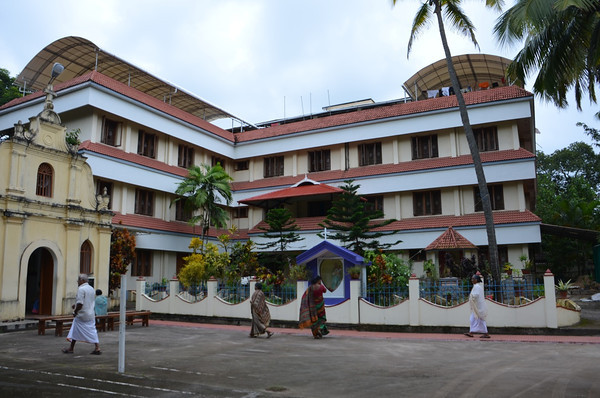
Dehon Bhavan, India

Dehon Bhavan

Dehon Bhavan

Building an academic foundation

As noted previously, Fr. Tom Cassidy is assisting with the formation program in the Indian District until early March. Today, he writes about the SCJs’ seminary in Kumbalanghy:

I thought today I would spend a little time describing the life of a seminarian here at Kumbalanghy.  The name of our seminary is Dehon Bhavan. This is one of three minor seminaries the SCJ Indian District operates. Due to the amount of land the SCJs were able to purchase when they were looking to open up a seminary in this part of Kerala, facilities for physical activities are somewhat restricted.

Minor seminaries use to be very common in the United States; we had two in the US Province: one in Lenox, Mass., and the other at Donaldson, Ind. I taught at Divine Heart Seminary in Donaldson for two years as a scholastic (1966 to 1968) and then again as a priest I served as principal from 1973-1977. After Vatican II the minor seminary system in the States slowly began to disappear, though there are still some around, including St. Lawrence run by the Capuchins in Wisconsin.

I can understand why here in India the minor seminary continues to make sense as a lot has to do with the quality of education available to students. By using good schools, the foundation is laid for future academics in both philosophy and theology. In addition, English language skills are necessary for theological studies, and since English is the common language of all our Asian entities it is important for Indians to know it so they do not become isolated from the rest of the congregation.

Here at Kumbalanghy there are two education tracts going on at the same time. First there is English. There are about five students who are currently here spending at least a year learning English. One of them is a bit older then the typical minor seminarian as he completed a bachelor’s degree prior to his joining the SCJs. The others are more typical teenagers of high school age.

The second tract is high school. These students travel by bus each day to a Catholic high school for their studies. When they have completed the required program of studies they will move to Cochin where we have our house of philosophical studies (Dehon Vidya Sadhan).

Here is the official outline of the purpose of Dehon Bhavan as described in the SCJ Indian District Directory of 2010.

‘The SCJ Candidate students come from all parts of the state of Kerala, although at times there are students from other parts of India. The SCJ formation program is designed to introduce the candidates to the fundamentals of SCJ Spirituality and Religious Life, and to experience different kinds of ministry. During this time they also attend outside classes to receive their High School diploma at the end of the two year program at Dehon Bhavan.”

The House Language is English. As noted in their directory, while most students come from Kerala, not all do. India is a country of many languages and cultures and someone coming from the state of Andhra Pradesh would not know Malayalam. Since the SCJs are drawing students from several areas of the country they need a common language and since English is important for studies and communication with SCJs in other parts of the congregation it is also the common language of the district. In India the official common language is Hindi.

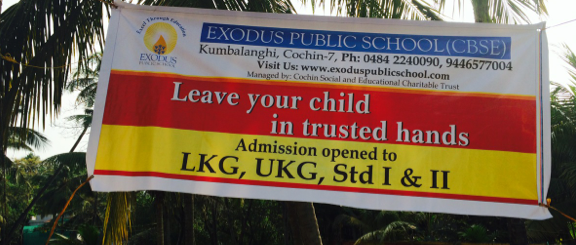
English is still a very important language in the country, especially for commercial reasons. Often you see advertisements for schools that specialize in English  language and instruction. I’ll close with a picture of one such advertisement right in front of our house.

Screen Shot 2014-01-21 at 10.57.56 AM

Eating Indian style

Indian Curry Meal Banquet

More than curry found on the table

As noted previously, Fr. Tom Cassidy is assisting with the formation program in India until the beginning of March. Here he writes a bit about Indian food.

I thought I would spend a few moments talking about food, at least as I have experienced it so far. Most Americans think of curry when they think of Indian cooking, but that’s only partly true. India is a country of 1.2 billion people and like the US, it is a large geographic area. From the warm south as we are here in Kumbalanghy, about 9° north of the equator, to the highest mountains in the world — the Himalayas at 28° north — you can begin to get an idea of its size. Along with its size is the vast linguistic and cultural diversity of the country and with that comes diverse cooking styles as well.

The ocean is only a short distance away, perhaps a mile or two, and since the state of Kerala boarders the sea it’s not at all surprising that fish is an important part of the diet along with chicken. Rice is a staple and is served at the noon and evening meals without fail. I suspect, but have no way of knowing for sure, that rice appears in all the diverse ethnic and cultural groups in the country. Certainly that was the case on my last trip to both Kerala and Andhra Pradesh.

In the few days I have been here there has been a bit more variety at breakfast. A rice and coconut mixture (almost like a powder) frequently appears, serving the purpose of rice at the other two meals. However, we have also had a flat bread resembling a Mexican tortilla in its place and on Sunday a small thick white bread. For this meal there is usually a dish of some time of vegetable based soup or broth that is mixed with the bread or rice. Water and tea are served with these dishes.

The noon and evening meals consist of rice and several side dishes. Fish or chicken are the protein dishes and are accompanied with several other vegetable side dishes. I have particularly enjoyed how the okra and green beans are prepared. Water is the liquid of choice and we have frequently had small bananas to top off the meal. On Sunday we also enjoyed a small cup of ice cream. That, you must eat quickly as it tends to melt rapidly.

Screen Shot 2014-01-20 at 3.06.59 PMI took this photo last evening at St. George’s rectory as we attended the final celebration for the 175th anniversary. As the photo shows, rice is the central dish with, in this case, four side dishes and a tad of sauce on the rice. Two side dishes were vegetables: one much like a coleslaw and the other a mixed vegetable including red onions, carrots, etc. The other side dishes were beef (at the top of the photo) and SHARK at the bottom.

When the dish was first put before me I thought the shark might be a type of bacon — it had both the color and texture of bacon and certainly was fried much as we would fry bacon. After tasting it I asked the pastor what it was and to my amazement he said shark! It was delicious and I graciously accepted a second helping when offered.

As for spices, yes, Indian cooking tends to be on the spicy side. It is not as hot as some Mexican or even Italian dishes I’ve had (at least so far!) but on the other hand practically everything has a tinge of heat to it. And while I may have had curry I can’t say I have found it overpowering or for that matter, bring it to mind as I think of the dishes I’ve enjoyed to date.

As for my eating habits I eat the food put before me. If it’s a fish dish I usually take little as the fish comes with bones included and I’ve not mastered the art of deboning the fish before putting it into my mouth and as a consequence have to be a bit careful when chewing it.

Eating with your hands is a common method here and according to all, the preferred method at home. However as this is a seminary and which is preparing the students for a future life that will encounter other cultures and worlds in one form or another utensils are used at the noon and evening meals. It makes for a noisy table much more so than in the States. The plates are made of metal (hard to break) and with the pushing of rice and side dishes together unto a fork or spoon makes for a racket when 20-plus are doing it all at the same time.

Let me close with one word about last evening’s closing celebration at St. George’s. We arrived as the speech making was coming to an end. That was fine by me as I would be at a loss for what was being said. I do know the bishop of Cochin and local politicians were among those scheduled to speak.

Screen Shot 2014-01-20 at 3.07.19 PMThe highlight for everyone was the two acts which brought the evening to a close. Both were in a sense morality plays. The first was about the relationship between a father and his son and how important respecting your parents is as the tables can turn and the child one day may take care of the parent.

The second was harder for me to grasp but I was told it had to do with doing your part to make your parish a better place. This one had a lot more dialogue and that made it difficult to comprehend. I will say that the acting (all members of the parish) was quite good and though I did not understand the lines they were delivered with professional skill.

By George!

Celebrating 175 years!

As indicated previously, Fr. Tom Cassidy is in India until early March, assisting with the formation program. The following was writing from Kumbalanghy.

Screen Shot 2014-01-18 at 10.00.37 AMI can summarize the day in two words: “By George!” I arrived last evening around 10:00 p.m. and was informed by Fr. Thomas Vinod (the SCJ district superior) that the parish our minor seminary is located in would be finishing a year-long celebration in honor of the 175th anniversary of their foundation. Not too many parishes in this area bear the name St. George. I wonder given the date of their foundation if any British influence went into this given the fact that St. George is the patron saint of England and the British were fully entrenched in India during this time period. By the way, this is a very Catholic area, which makes it an exception to the rule in this vast country.

Before speaking about the day’s activities, a few words about this SCJ house. It is the smallest minor seminary we have in India. At present their are 18 students who are nearing the end of their school year (March). There are four SCJs on the staff: two priests, one deacon and one SCJ student who is doing his regency year. Each SCJ student has a year out to work in one of our ministries either formation or, as in Mumbai in one of our parishes. Having spent two years myself between college and theology teaching at Donaldson I can appreciate the value of a regency experience.

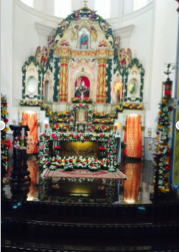
Our day at St. George, about one mile from the seminary, began with Mass. The sanctuary was festooned with flowers and reminded me of Our Lady of Guadalupe celebrations at our parish in Houston. Even though Friday is a work day in India the church was packed and spilled out the doors into the courtyard. I have no idea how many the church can hold as the church had no pews save for a very small section in one of the alcoves. Here the people stand, kneel and sit on the floor. Men and women are separated from one another as well.

Screen Shot 2014-01-18 at 10.00.28 AMThe Mass began at 10:00 a.m. and went on for about two hours. It was celebrated in the local language of Malayalam so I was out of the loop when it came to the homily or other extemporaneous parts. The retired pastor was the main celebrant and his introduction went on longer than the homily given by another priest. The singing was well done, and even though I did not understand the words the melodies were pleasing to hear. I’m guessing some were modern tunes while others more traditional given their intonation.

Both before and after Mass people gathered in front of the Church where the statue of St. George, as well as those of the Blessed Virgin and Jesus were on display for their veneration. Given this is St. George’s feast his was in the middle and festooned with an abundance of flower garlands as I think you can make out here.

Before we all returned to our house for a rest we were invited to stay for lunch. We are very near the ocean and so seafood is the specialty of the area. I was served a fish with a tomato base. The only down side for me was my need to debone the fish myself, but I seemed to manage it. After the fish course we were served rice with three or four side dishes. We ended with ice cream. The drink of choice was water as alcohol is not a part of the culture.

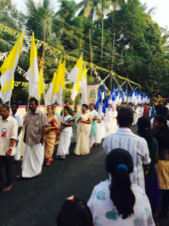
Screen Shot 2014-01-18 at 10.00.15 AMI think I managed about an hour’s rest before it was time to head back to the parish for the procession. The estimates of how many marched along was a low of 2,000 to a high of 3,000. Since I only have an alb with me I chose not to be with the priests who marched behind the Statue of St. George and the Blessed Sacrament in their habits and cassocks. Instead I joined a couple of our students on the march. I think all we had to cover was a mile or perhaps two since it was a circular route but it took 2 hours to complete. I think I was the only non-Indian to participate.

At the head of the procession was a group of drummers followed by this section of various parish organizations (Legion of Mary for example) carrying their flags denoting who they were. Following the flags and umbrellas the people walked along in two lines — young and old, men and women, boys and girls and even a dog or two came along. Just before the men carrying the flag of St. George and the three statues of Mary, Jesus and St. George another group of drummers and musicians made way for the important part of the procession. I thought to myself we could never get away with this in the States but it made absolute sense in this context. I also thought Italians could fully participate in a procession like this. If you have ever been to the Sunday Mass at Festa Italiana and took part in the procession after Mass you’ll understand what was going on here in Kumbalanghy.