Four in Philippines profess final vows, ordained to diaconate

The diaconate ordination

The diaconate ordination

As noted previously, Fr. Bernie Rosinski is in the Philippines teaching English until the end of May. He has been a dedicated blogger during his time there, this time writing about the recent final vows and diaconate ordination ceremonies. “As I sit writing this, I hear neighborhood children on the seminary grounds laughing and enjoying themselves as they play games with balls and tag,” he put in an email with the following blog attached.  “When the seminarians are recreating the neighborhood kids seem to sense it immediately and they gather quickly.”

With the sound of children and seminarians playing in the background Fr. Bernie writes:

Four members of the Philippines Region took major steps toward their ultimate goal of being ordained priests for service to the Church in Immaculate Conception Parish church in Aluba, Cagayan de Oro city, which was committed to the charge of the Priests of the Sacred Heart less than two years ago.
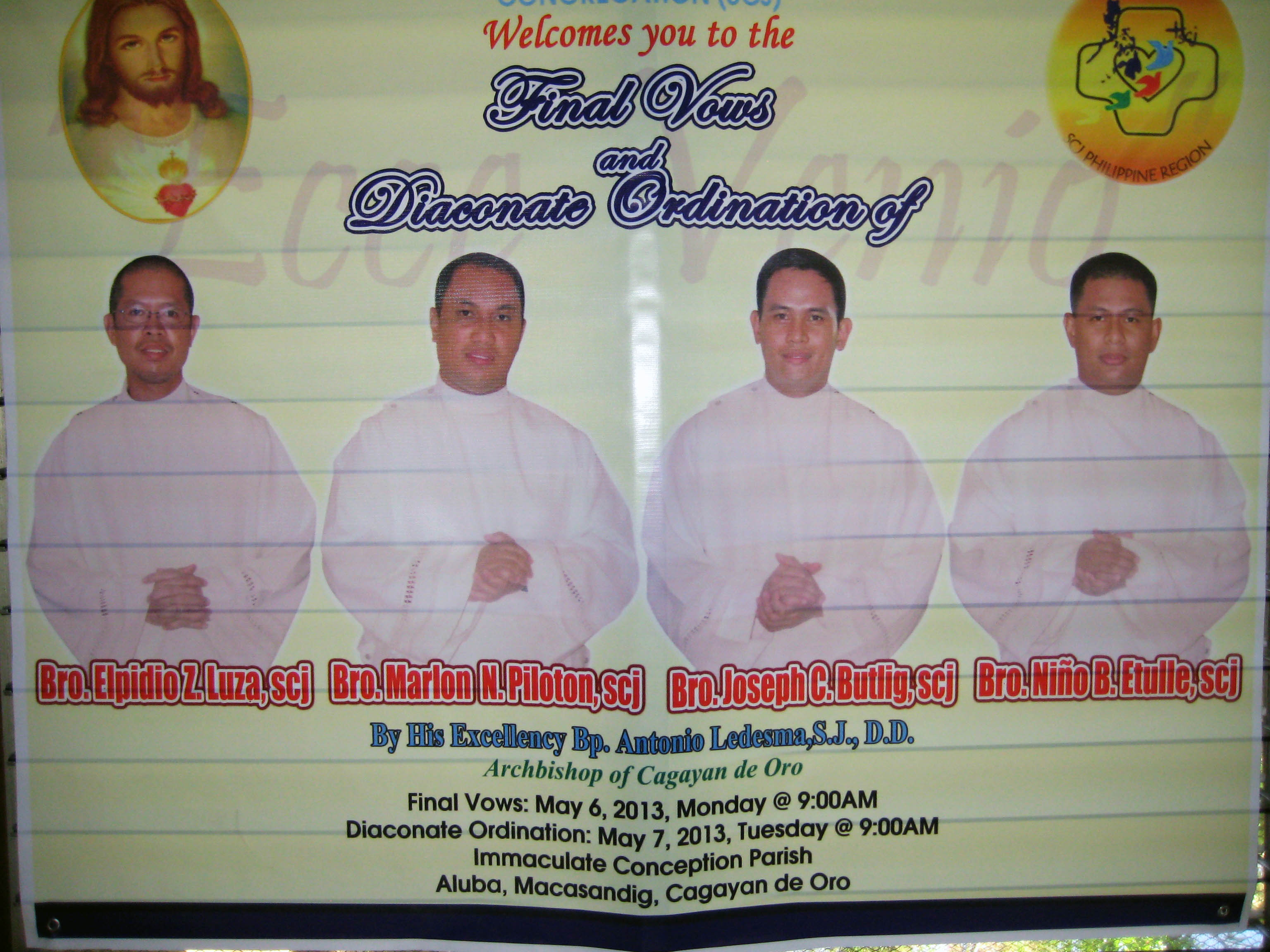
A banner outside the church celebrates the SCJs ordained to the diaconate

A banner outside the church celebrates the SCJs ordained to the diaconate

On May 6, Bros. Elpidio, Niño, Joseph, and Marlon pronounced their final vows before Fr. Francis Pupkowski scj, regional superior, and their fellow religious, family, friends, parishioners and seminarians. This step was a necessary one as a prelude to what took place next day since no one can receive sacred orders unless he has first been incardinated into a diocese or has become a permanent member of a religious order. The profession of final vows is that permanent commitment to the Priests of the Sacred Heart

The vow ceremony took place during Mass and was followed by a banquet on the nearby seminary grounds of the Priests of the Sacred. Under outdoor tents, the banquet for about 200 was catered by ‘Ma’am Tess’, formerly a hostess with Cathay Pacific Airlines, and her staff. One dessert treat was good ol’ popcorn but, for the rest, the meal menu was entirely Filipino, abundant, and delicious. It was a treat that would be repeated for an even larger number of guests the next day.

May 7, in the same venue, Archbishop Antonio, Ledesma, S.J. ordained these same four men to service of the church as deacons. In his homily, the archbishop of Cagayan de Oro city stressed three qualities he urged these men to strive for in their lives: humility, obedience, and service to the poor. He proceeded to ordain them deacons right after his homily.

As an eager and interested visiting spectator from the United States, I saw a small army of well-disciplined, cassocked and surpliced boys and girls carry out the various duties of altar servers: incense and thurible bearers, candle and cross bearers, portable microphone carriers, procession escorts, sacred vessel bearers, wine and water presenters, and for Holy Communion Eucharistic paten bearers. The parish also had a small complement of male and female voices which sang the responses and sacred hymns with great distinction and beauty to the accompaniment of a guitar and a small electronic organ. These services were repeated on both days. And since the drills and hymns required by the two liturgies differed in some respects, this meant much practice time.

Did this parochial paradise have any serpents in it? Yes, there was an occasional feedback squeal from a loudspeaker. But this blogger observed how swiftly these technologically sophisticate people remedied the situation. If I were a pastor, I’d like to have them on my team. 

Family and friends quickly try to get photos of their loved ones after the ordination
Family and friends quickly try to get photos of their loved ones after the ordination

“You are invited…”

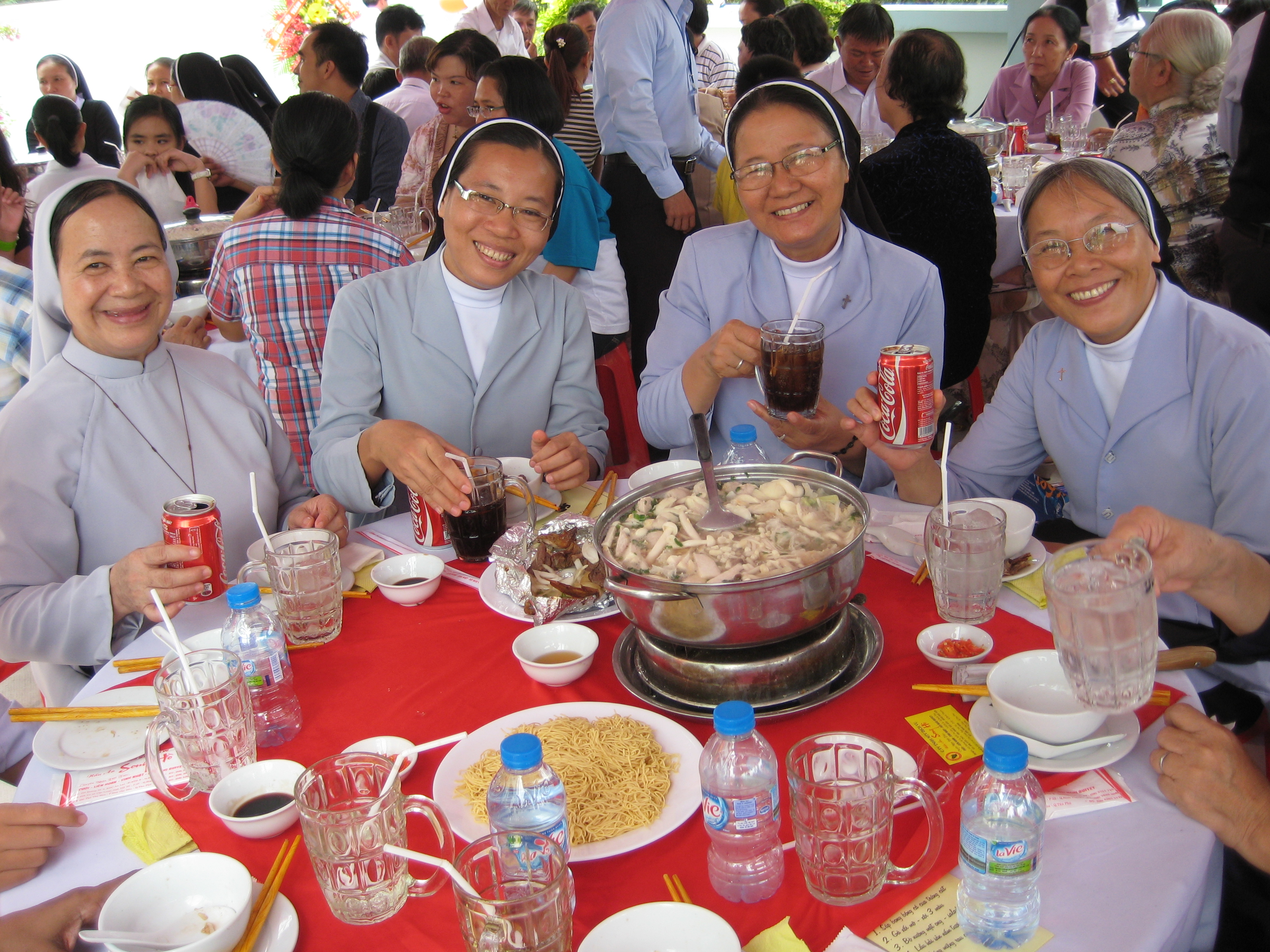
Members of a local sisters community joined SCJs and others at the celebration of the first SCJ house in the country.

Members of a local sisters community joined SCJs and others at the celebration of the first SCJ house in the country.

Blessing, prayers and celebration

As noted earlier, Fr. Bernie Rosinski attended the dedication of the first SCJ house in Vietnam. Previously, he wrote about his initial impressions of Vietnam. Here, he reflects more specifically on the house and the dedication. 

“You are invited to attend the dedication. . .” The dedication took place in Ho Chi Minh City, formerly known as Saigon, Vietnam. It is the first SCJ building in the country. So, of course, I planned to attend and was glad of the invitation. [Fr. Bernie was nearby in the Philippines teaching English.]

After seeing the skyscrapers of modern downtown Ho Chi Minh, the use of the word “building” is rather pretentious here. We are speaking about a rather modest edifice. However, its construction was a boon to the city economy, even if only a small one. It took over a year to build and thus gave steady employment to many workers. It required materials and thus furnished purveyors the opportunity to sell goods. It needed equipping and thus helped local merchants provide household furniture and equipment. In other words, its existence benefitted the country, the local economy, and the SCJs who were pleased to invest funds in this fashion and in their own future.

We visiting SCJ dignitaries (as I use it here, “dignitaries” is a pretentious word) were taxied from their hotel at a reasonable morning hour to the site of the building. While awaiting the arrival of the bishop to bless the structure, these and invited guests had ample opportunity to climb the stairs and walk the floors to see the new construction. It was simple and functional: rooms to sleep in, eat in, study in, and pray in.

With the bishop’s arrival to conduct the blessing and dedication all the guests moved to the ground floor to witness the proceedings. It began with an outdoor ceremony at which Bishop Peter Kham and Fr. Tom Cassidy gathered to cut a red ribbon at the building entrance, a ribbon ceremoniously held by several Vietnamese religious women. After reading some prayers, the bishop proceeded to walk through the building and sprinkle holy water as is normally done at a house blessing. Fr. Tom Cassidy was one of the scissor-wielders because the US Province helped finance the new construction.

His work done, Bishop Peter departed and the remaining guests attended a liturgy that featured beautiful Vietnamese music and singing that was very reverential. In his homily, Fr. Tom made the point that every culture reveals a face to God that is unique in the world and that, if lost, is lost forever. When the celebration was complete, the group dispersed to the ground floor to await a very fine, catered banquet that again gave employment to the local economy. Guests were seated under tents and at round tables. I estimate the number of guests approached 300 or so. They included clergy and religious men and women. The laity were present in great numbers, many of them family and relatives of students. The celebration was also honored by the presence of local civic and military authorities who graciously shook hands with the foreigners visiting their country and made several toasts during the banquet. “Yo!”

While some people had actual cameras, everyone had a cell phone with its included camera function and so photos were made by everyone who could do so. People were asked to pose in a variety of settings and circumstances, grouped by table, or by garb, or by family, or by function, or by anything else that caught the photographer’s fancy.

In the early afternoon the party broke up with the arrival of the caterer’s truck.  His employees needed to take their equipment and themselves to another setting somewhere else in the city. People began to disperse. The building will slowly become inhabited in the weeks ahead.


Beauty, warmth and hospitality found in Vietnam

An illuminated restaurant boat on the Saigon River

An illuminated restaurant boat on the Saigon River

Fr. Bernie Rosinski took a break from his teaching duties in the Philippines to attend the inauguration of the first SCJ house in Vietnam. In this post he writes with his reflections on the former city of Saigon and the people of Vietnam:

Impressions of Ho Chi Minh 

My provincial superior made it possible for me to visit Vietnam the last week in April. As I was already nearby (teaching English in the Philippines), he suggested that I might be invited to attend the dedication of a new construction built for SCJ use. I was duly invited and there I passed one very enjoyable week.

So, what did I enjoy? What are my impressions?  What delightful memories do I retain?

Fr. Tom and Fr. Bernie share a meal in Vietnam

Fr. Tom and Fr. Bernie share a meal in Vietnam

Jumbled and massed together, I would distinguish the civic, external memories from the ones I have of my SCJ colleagues. Together they form an overall pattern of hospitality and warmth that I was totally unprepared for, since I had lived in the era of conflict between Vietnam and the US. Never a soldier, I nevertheless witnessed TV coverage of the events that took place there on a daily basis (thanks to Walter Cronkite and CBS) and surmised that bad feelings existed between our two countries as much for the general Vietnamese population as for the Vietnamese SCJs. I was wrong, absolutely and inexcusably wrong.

Ho Chi Minh City (formerly Saigon) is a beautiful, modern city with many wide avenues and boulevards sided with parks. There are also narrower streets and alleys. Automobiles tend to be mostly taxis, though some people possess their own vehicles. And of course Ho Chi Minh has a system of city buses that works very well and on time. The most commonly used transportation, however, is the motorbike and motorcycle. Entire lanes are given over to them and they reminded me of Brazilian army ants on the move (witnessed on Animal Planet or NatGeo) because they moved together, five or six alongside each other, almost as if they were choreographed. They do not travel at very high speeds. And I once witnessed an entire family of husband, wife, and three children on one motorbike. However, that is not common.

While there are international businesses and banks located in large buildings on the downtown boulevards, there are many smaller businesses and restaurants located on connecting streets. Our SCJ hosts took us to visit some eateries and the menus (with photos and in Vietnamese, Japanese, and English) were overwhelming with the number of choices offered. The food quality and preparation was excellent. One evening, our entire visitor group was hosted on board a restaurant boat that sailed the Saigon River. From there we could see the city skyline and the lighting effects shown on various skyscraper buildings.

Fr. Tom, my provincial, and I toured the Presidential Palace with an English language guide and learned that, on occasion, rooms in this building are rented out to host corporate and civic meetings. I thought it was a good way to reduce the costs of maintaining it and wondered why the White House could not do the same. We also visited Notre Dame Cathedral and other places. While we were seated in the park to rest a bit, two shoeshine boys sought to polish my sneakers.

The same general feeling of benevolence and well-being was present when we visited our SCJ brothers. They fed us, conversed with us, guided us, and accompanied us in taxis to all the places we wished to go. They were eager to practice their English on us; it was a small price to pay to reciprocate their hospitable spirit. Fr. Tom and I resided in a small, nearby hotel. We could walk every day to meet our SCJ brothers.

Documents, documents, documents!

Fr. Bernie (in hat) with other SCJs in Vietnam

Fr. Bernie (in hat) with other SCJs in Vietnam

Fr. Bernie Rosinski took a break from teaching in the Philippines to attend the inauguration of the first SCJ community house in Vietnam. Here, he writes about a few stumbles in his travels. Click here to read about the dedication itself, and click here to view an online photo album.

What not to throw away

Panic City. Stressville. Have you ever been in a foreign country and learned that you are missing a document that will allow you to return to where you came from? That happened to this blogger. And my visa for Vietnam was good only for one month. Visions of being jailed for non-compliance with Vietnamese law arose unbidden and I didn’t even know a good local lawyer. Panic City. Stressville.

After traveling to Saigon for the dedication of our first SCJ community house, I was preparing to return to the Philippines to continue teaching English as a Second Language (ESL). Along with Fr. Rino, SCJ, my traveling companion, I presented my passport and Cebu Pacific Airlines return ticket to the desk attendant. She asked for one additional document: a copy of a ticket or airline reservation OUT of the Philippines before she would allow me to enter it by issuing me a boarding pass. This is the standard practice in a number of countries, I guess.

Wouldn’t you know that my reservation copy of that ticket out of the Philippines was the last piece of paper I dumped before I left the Philippines for Vietnam! I was perilously close to the weight limit and forgot the legal practice. To make the weight limit I got rid of what I thought I didn’t need, including paper.

What to do? The desk attendant asked if I had a copy of the e-ticket on my computer. I didn’t even have my computer. Well, did I have it on my cell phone? I didn’t even bring my cell phone. Did I have a copy in my camera? I didn’t even know that people did those things. Talk about being technologically challenged!

However, Fr. Rino had his computer with him and we ran around the airport seeking a Wi-Fi area (that much I understood. . . ) where we could go online and retrieve my confirmation email from my webmail files. Finding such an area, we needed the password. At midnight, finding the people who know passwords is another exercise that can stress one out. But we did succeed. After lots of false starts we managed to make a photo of the required document and show the photo to the attendant. And my boarding pass was duly issued.

Arriving in the Philippines, I presented myself to an immigration official. A pleasant, matronly woman took my passport while I fumbled with my camera to make sure my photo document was ready to show her. She asked if I was Russian and I told her I was of Polish descent. She said I needed an entry visa and she was prepared to issue one good for 21 days. I responded by saying that I had a multiple-entry visa. “Sure enough”, she said after checking my passport. She then smiled and stamped my passport and never asked for the documentary proof that I had a ticket out of the Philippines.

When I had calmed down and had time to reflect, I felt she probably acted in this way because she knew that I would never have been allowed into the country the first time without that ticket. Home. Safe. Secure.

Rhythm of the Philippines

Sunrise

As noted previously, Fr. Bernie Rosinski is in the Philippines teaching English. We are grateful that while he is there he continues to write reflections for our province blog:

A phenomenon takes place virtually every day on this Island of Mindanao that in the United States occurs only twice a year. I am referring to the fact that here the sun rises at about 6:00 AM and sets each day at about 6:00 PM. Where this blogger comes from, the phenomenon happens only on the vernal and autumnal equinoxes: March 21/22 and September 21/22. Mindanao is merely 6° N latitude from the Equator.

Imagine, if you will, never having to use a jarring alarm clock to wake you from sleep up because the sun does that for you. Imagine, if you are a farmer, never having to change cow milking time due to a change to “daylight savings time’. Imagine, if you will, always having the kids traveling to and from school during daylight hours. Imagine. Once the sun goes down in the evening the body can relax, the family gathers together around the table and each one has time for each other.  Imagine, having a constant electrical power bill that barely fluctuates due to seasonal variation. Now you begin to have some idea of the daily rhythm of the Philippines.

Other rhythms exist here in the islands but need to be discovered and entered into. Some are local and some are zonal. There are rainy and dry seasons, for example, though I have yet to experience them. There are growing seasons and resting seasons. Then there is the typhoon season.

Finally, the Philippines form part of the “ring of fire” of volcanoes and earthquake prone areas that swing down from the Aleutian Islands in Alaska around Japan, China, Malaysia, Indonesia, the Philippines eastward to Chile, Peru, Central America, Mexico, and California in the Western hemisphere. Such disturbances are not rhythmical but occasional. And yet, over time, they too become part of the life here in the islands.

Hospitality a priority right down to the peanut butter!

Peanut butter

As noted previously, Fr. Bernie Rosinski is in the Philippines teaching English. We are grateful that while he is there he continues to write reflections for our province blog:

Hospitality comes in various forms. This blogger wrote earlier in these pages about his treatment by the SCJs of the Manila community and their kindness in showing him the beauties of Tagaytay and the mountain lake of Taal. His hosts, this time, were the SCJs of the Aluba community on the island of Mindanao, about 600 miles distant as the crow files. Their hospitality, too, was greatly appreciated but it took a more subtle form.

Imagine, if you can, a climate which is very humid and the daily temperature unvaryingly ranges between 85° and 95°, particularly if you come from a geographic area in which the four seasons prevail. Electric fans are always operating here in an attempt to moderate conditions and they work well so long as there are no power ‘brown-outs’ and the community can afford the electric bills. Airy building construction with many windows and doors open to the outdoors allow ocean breezes free access to baking bodies. I am sure that with time one can become accommodated and comfortable. Visitors to the Philippines, however, often do not have the time to acclimatize.

Then think what your feelings might be when you are led to a room which is to be your residence for the next six weeks and it turns out to be equipped with a Konin room ‘aircon’ (Filipino for air conditioner). You can just ‘taste’ the relief you will experience when you shut the door and turn the unit on.

What will your feelings be when, additionally, you discover that there are only three rooms in the entire seminary complex equipped with aircon and that your room is the only air-conditioned one for personal use? Is that not real hospitality and consideration? And I have experienced it.

Hospitality here extends itself even further in adding certain foods to the common table. Americans especially should know that a simple thing like peanut butter is hard to come by in a foreign land. I found it on our table!  And it can sometimes be a welcome substitute for a fish meal with the fish’s eyes staring at the consumer. This blogger’s preferred daily whisky ration is Scotch; it too can considerately be found in the liquor larder.

Now anyone that dislikes moralizing can skip these final words.  The Filipino SCJ community is very considerate of visitors from other lands and strives to ameliorate the elements that foreigners might find most troublesome: climate, food, drink. It is this consideration that speaks very loudly of their desire to be hospitable.  For our part as visitors, it is one great reason for repeating visits to this country, especially for service to the region: retreats, conferences, instruction and teaching. When the helper is made to feel welcome, help is immediately forthcoming.


Travel in the Philippines always an adventure!

Fr. Bernie and his fellow travelers

Fr. Bernie and his fellow travelers

As noted previously, Fr. Bernie Rosinski is in the Philippines assisting with English language instruction. In this post he writes about the adventure of travel in a nation made up of thousands of islands.

Travel in the Philippines is an adventure. The Philippines archipelago in Southeast Asia consists of more than 7,000 islands, of which, 800 or more are large enough to be inhabited.  Travel among the islands and within an island is extremely important for this nation.

Frs. Francis, Jacek, and I recently traveled from the largest island at the northernmost end of the archipelago, Luzon, to the largest island at the southernmost end, Mindanao, where the SCJs have a college level seminary and a novitiate. Fr. Francis is the regional superior of the Philippines and conducts business from his office there. Fr. Jacek, a psychologist, gave the first week’s series of presentations to the men from the four entities of Asia who are preparing to make their final vows in May and went to visit his SCJ friends. I went to offer instruction in the English language to college-level seminarians.

To avoid interminable traffic jams on the streets leading from Dehon House in Quezon City to the inter-island airport in Manila and catch our flight, we had to leave the residence at 1:30 a.m. to catch a 5:20 a.m. flight to Mindanao.

What makes travel among the islands such an adventure? Inter-island travel is conducted necessarily by plane or boat, both of which ferry people between the various islands. Such traffic permits commerce, government administration, and the continuance of strong family ties. The mere frequency with which ferry boats conduct their operations and the high level of fishing and marine traffic in the surrounding seas almost invariably leads to boating accidents, of which there have been a number in recent years. Plane travel permits safer, more rapid service and even daily commuting.

What makes travel within single islands such an adventure? Within-island travel is conducted by bus, car, light rail, jeepneys, motorcycles, motorbikes, bicycles. Sometimes these smaller units have attachments with seating arrangements to carry passengers. The result is that the units serve much like public transportation to move people about.  When all are traveling the same road (no matter how wide), these motorized devices travel at very uneven rates of speed. Furthermore, those units equipped for carrying passengers frequently halt rapidly and unexpectedly, putting great strain on their own safety from inattentive or speeding drivers. The possibility for tragedy increases greatly when, along with large trucks, pedestrians and draft animals are added to the traffic mix.

There are several expressways and toll roads that exclude all but trucks, buses, and autos. There are avenues and boulevards in Manila and its suburbs that permit six, even eight lanes of traffic. However, even these suffer from the constant threat of quick stops and starts by weaving buses, jeepneys, and passenger carriers. It seems to this foreigner and rank outsider that the only ingredient lacking to Filipino travel management is DISCIPLINE.

Preparing for final vows

A banner celebrates the members of the 2013 final vows program in the Philippines

A banner celebrates the members of the 2013 final vows program in the Philippines

As noted previously, Fr. Bernie Rosinski is in the Philippines assisting with English language studies. In this post he writes about the Asian final vows program which brings together students from the Philippines, Indonesia, Vietnam and India:

In the SCJ scheme of things, juridical districts and regions are entities that are not yet self-sustainable and independent. The SCJ Rule of Life establishes criteria which juridical entities, such as provinces, regions, and districts, all have to meet.

So how do some districts and regions manage? They pool their meager resources. This is what is taking place over the next four weeks in the Philippines. All SCJ Asian entities are sending their final vow candidates to Dehon House at Quezon City, a suburb of Manila.

The Asian zone comprises the province of Indonesia, the region of the Philippines, the district of India, and a community in Vietnam. These have sent their final vow candidates to profit by the wisdom and instruction of valued SCJ teachers and directors in the matter of how to live the vows of religious life.  India has sent two men, Indonesia five, Vietnam two, and the Philippines has sent four. One Brazilian seminarian seeking to serve in the Philippines has also joined this group, for a total of 14 final vow candidates this year in Southeast Asia. As a matter of practice, this program has been rotated among the participating entities over the years; last year it was held in India.

On Sunday, April 7, Fr. Francis Pupkowski, the regional superior of the Philippines, officially welcomed these men who seek to make their permanent commitment to the Congregation of the Priests of the Sacred Heart of Jesus (SCJs). His words of introduction included presenting the five men who are engaged in the program: these include the following SCJs: Fr. Jacek Lukasiewicz (Polish province), Fr. P. J. McGuire (US province), Fr. Rino Venturin (Vietnamese community), and Fr. Delio Ruiz (Philippines Region). Fr. Percy Bacani will also assist; he is a member of the Missionaries of Jesus.

Each presenter will have approximately one week to cover these major topics: (1) Psychological Growth: Personal Assessment of the Vows (Fr. Jacek) ; (2) Dehonian Spirituality:  Foundation of Availability, Community, Mission (Fr. P. J.); (3) Vatican II: Challenges of Enculturation and New Evangelization (Fr. Bacani). At the conclusion, Fr Venturin will preach the final vow retreat; and Fr. Delio will take care of processing and evaluating the four week experience.

Most men arrived at Dehon House in Quezon City during the course of Easter week, though some were already on hand. From an outsider’s perspective, they appear eager to begin the program. Evidence can be found in the number of candidates spending extra quiet time in chapel.  They already know each other by name and have played tennis and basketball together. It seems like every single one of the final vow candidates is a computer sophisticate, a great eater, and very, very friendly. I watched these men work together preparing meals and food and debating the best way to clean chickens for the hired cooks.


Always a welcoming spirit

San Roque in the Diocese of Novaliches, Philippines

San Roque in the Diocese of Novaliches, Philippines

“The people are so grateful to have their own parish church and two resident priests that their joy spills over into gracious hospitality.”

-Fr. Bernie Rosinski

Fr. Bernie Rosinski, SCJ, is back in the Philippines, teaching ESL as he did two years ago. He is periodically posting reflections during his time there; this was written on April 7:

Hospitality is frequently touted as a virtue that Christians should exercise. After all, the letters of Sts. Paul and Peter emphatically recommend it to their early Christian readers. However, those who are actually recipients of such hospitality know just how welcome it is, particularly when one is a stranger in a strange land and subject to all kinds of stresses and anxieties.

I was once again just such a hospitality recipient. This time the hospitality was not exercised by a large community of SCJ religious in a formation house where emphasis is placed on this virtue as part of the seminary training. Instead, it was exercised by a small, poor parish community run by two SCJ religious: San Roque Parish in the Diocese of Novaliches (a suburb of Manila) and found in Caloocan City. The parish was newly carved out two years ago in the midst of a squatters’ quarter. The people, however, are so grateful to have their own parish church and two resident priests that their joy spills over into gracious hospitality.

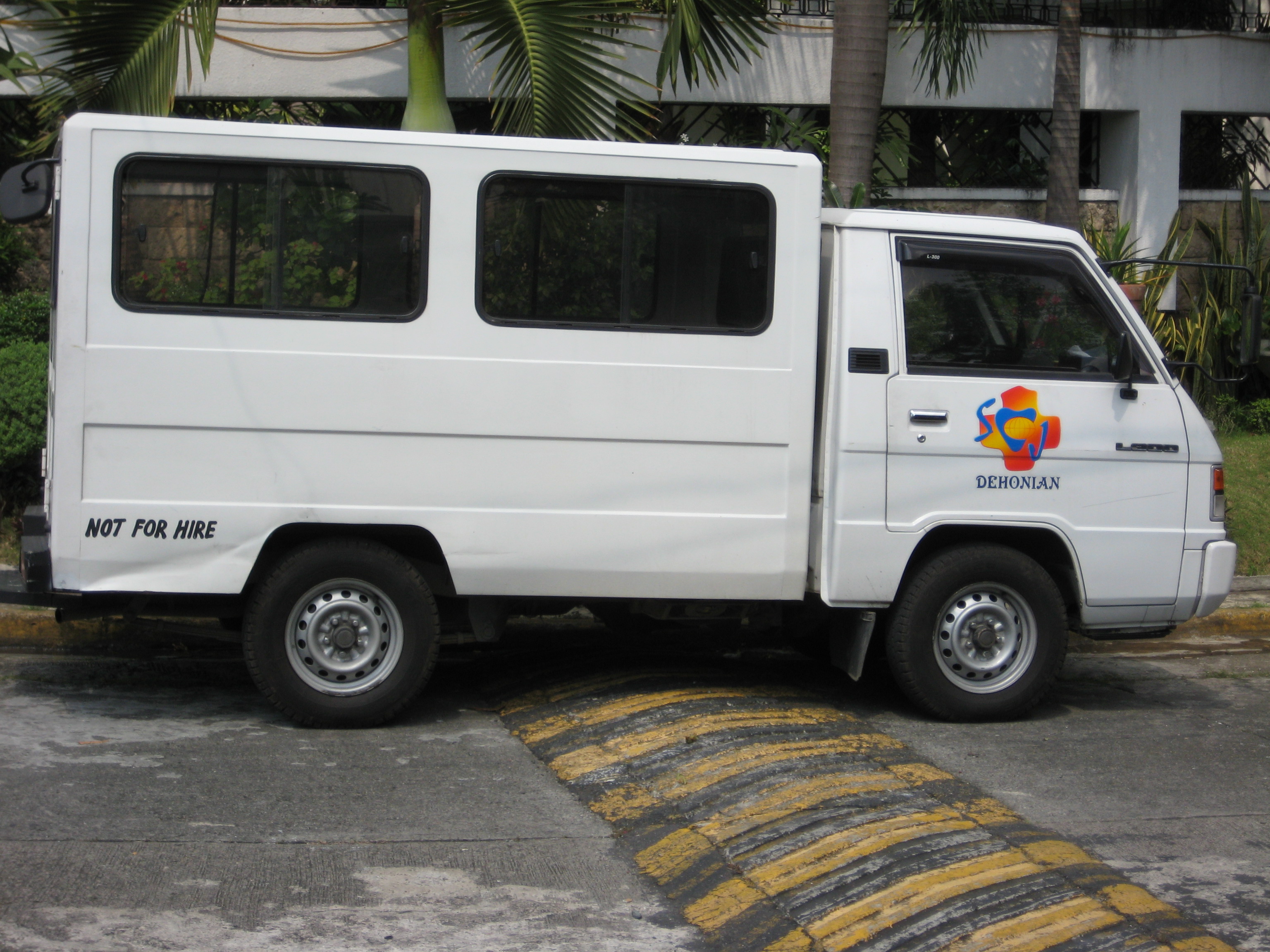
Note the logo on the van door

Official seminary transportation

The entire seminary community and staff were invited over from Quezon City, about an hour’s drive through metropolitan traffic congestion, to Caloocan City. We traveled in two conveyances, an SUV and a minibus nicely decorated with an SCJ logo. We were greeted by Frs. Nonong and Patrick, pastor and associate respectively, who made us feel very welcome as did the parishioners and neighbors who filled the narrow roadway onto the property upon our arrival.

Fr. Nonong invited us to his small office where he turned on a window air-conditioner (“aircon” as the Filipinos call it). The unit had been purchased only the day before and was not yet properly installed in the office window. It took the parishioners two years to save up enough money to make the purchase. The cool air was intended to make us feel comfortable and welcome, all part of hospitality.

The invitees spent about an hour visiting the parish church and its features, which included ‘Year of Faith’ banners proudly displayed and a statue of the Risen Christ triumphant. While we meandered about as some parishioners prepared two tables for our repast: pork, chicken, fish and an assortment of fruits and vegetables. Sprite, Coke, San Miguel beer, and water were there to quench our thirst. Like their American counterparts in summer, Filipinos make year round use of outdoor charcoal broilers. Here it is a matter of necessity as natural gas for cooking is unavailable in this area and electricity is at a premium.

Departing, we encountered some difficulty in leaving because a motorized tricycle was parked across from the narrow entrance to the parish grounds. Neither SUV nor minibus had space enough to exit. To make matters worse, the owner was not present and the unit was locked. It was siesta time. Some attentive neighbors assisted in moving the conveyance out of the way by brute force and all the invited guests managed to get home safely.

The streets of Caloocan

The streets of Caloocan

Enjoying SCJ hospitality

IMG_2326

Fr. Bernie (right) with a few of his SCJ hosts in the Philippines

Fr. Bernie Rosinski, SCJ, is back in the Philippines, teaching ESL as he did two years ago. Yesterday he posted a story about celebrating the Easter Vigil near Manila. Today he reflects on being the recipient of SCJ hospitality:

SCJ hospitality has some recognizable forms. Particularly when a guest comes from a foreign land, its usual form is to take that person to see some visual delight, or historical place, or some politically significant setting.  On Tuesday, Fr. Al Back, SCJ, took me, along with some SCJ students from Dehon House in Quezon City, to Tagaytay, a resort area about 30 miles from greater Manila.  I was the guest and brothers Bhat, Phu, Ngoc (Vietnamese), Patro (Filipino), and Jonathan (Brazilian) acted as my hosts.

Tagaytay is a long, long city stretched out along the eastern rim of an extinct volcano.  Taal is the name of the volcano. There is a fresh water lake in the middle of the volcano crater and a number of islands protrude from the crater into the lake. The distance from the rim of the volcano to the lake down below is anywhere from 500-1000 feet, sometimes of sheer cliff and at others of sharply descending hills. After our visit when I got back I checked a large map of the Philippines in the seminary library and according to the scale on the map, the diameter of the lake is about 20-25 miles across. Before it blew its stack, this volcano must have been immense.

The People's Park near Tagaytay

The People’s Park near Tagaytay

Filipino hucksters on the rim carry signs offering boat rides on the lake below. The winding roads down to the lake along the face of the volcano rim are daunting enough to test one’s courage.

We chickened out, of course, and instead had breakfast at the only restaurant in Tagaytay that was open at 6:30am: a McDonalds.  I had hotcakes and sausage to go with my coffee and the others had eggs and rice with their coffee. I baulked at the notion of rice for breakfast.  Now, purist Americans might protest at our choice of restaurant but we were all glad to see it. Its very presence is an indicator of the tourist clientele at Tagaytay

Hotels and golf courses dot the perspective, especially in the plains near the lake and crater basin and I am told that it is a great favorite with European and Australian tourists because of the great security it offers along with spectacular views and tropical warmth. It is open year round and the lets and leases are rather inexpensive.

On the south end of the rim is a Peoples’ Park built by President Ferdinand Marcos. His construction resembles a World War II bunker made of concrete that is slowly deteriorating. When I saw the bunker construction all I could think of was that he must have known that his day was coming.  Jipneys take people from a parking lot to the top of a steep climb where the bunker restaurant, outdoor theatre, chapel, and tourist shop are located on a promontory.  A twelve foot bronze pineapple outside the bunker is a favorite setting for family photographs.

Prior to our departure our group stopped for the “pause that refreshes” at a small restaurant where most enjoyed coconuts, sipping its liquid through straws and then spooning out its nut-like meat to eat. During this break I saw some wild monkeys on the side of the cliff directly below the restaurant, a mother with its infant.  We evoked their curiosity but they kept their distance. The monkeys have a lot to learn about SCJ hospitality.