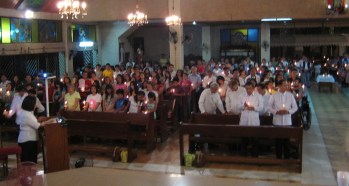
Easter vigil in the Philippines

Easter vigil Mass near Manilla

Easter vigil Mass near Manilla

“The faithful sought the blessing of priests by taking the priest’s hand and touching it to their forehead”

-Fr. Bernie Rosinski, SCJ

Fr. Bernie Rosinski is back in the Philippines, teaching ESL as he did two years ago. A veteran of general and provincial administration, he has also been tapped as a resource to the young region as it gets its own administration in order. The following is a reflection he wrote about Holy Saturday near Manila: 

“Cast down fire from heaven!”  This biblical image was realized before our eyes at San Lorenzo Ruiz parish church in Quezon City, one among the many towns which constitute the great metropolis of Manila in the Philippines.  Several SCJs, including myself, were present for the Holy Saturday Vigil services in this parish. They began promptly at 8:00pm, long after dark which occurs promptly at 6:00pm in this equatorial region.
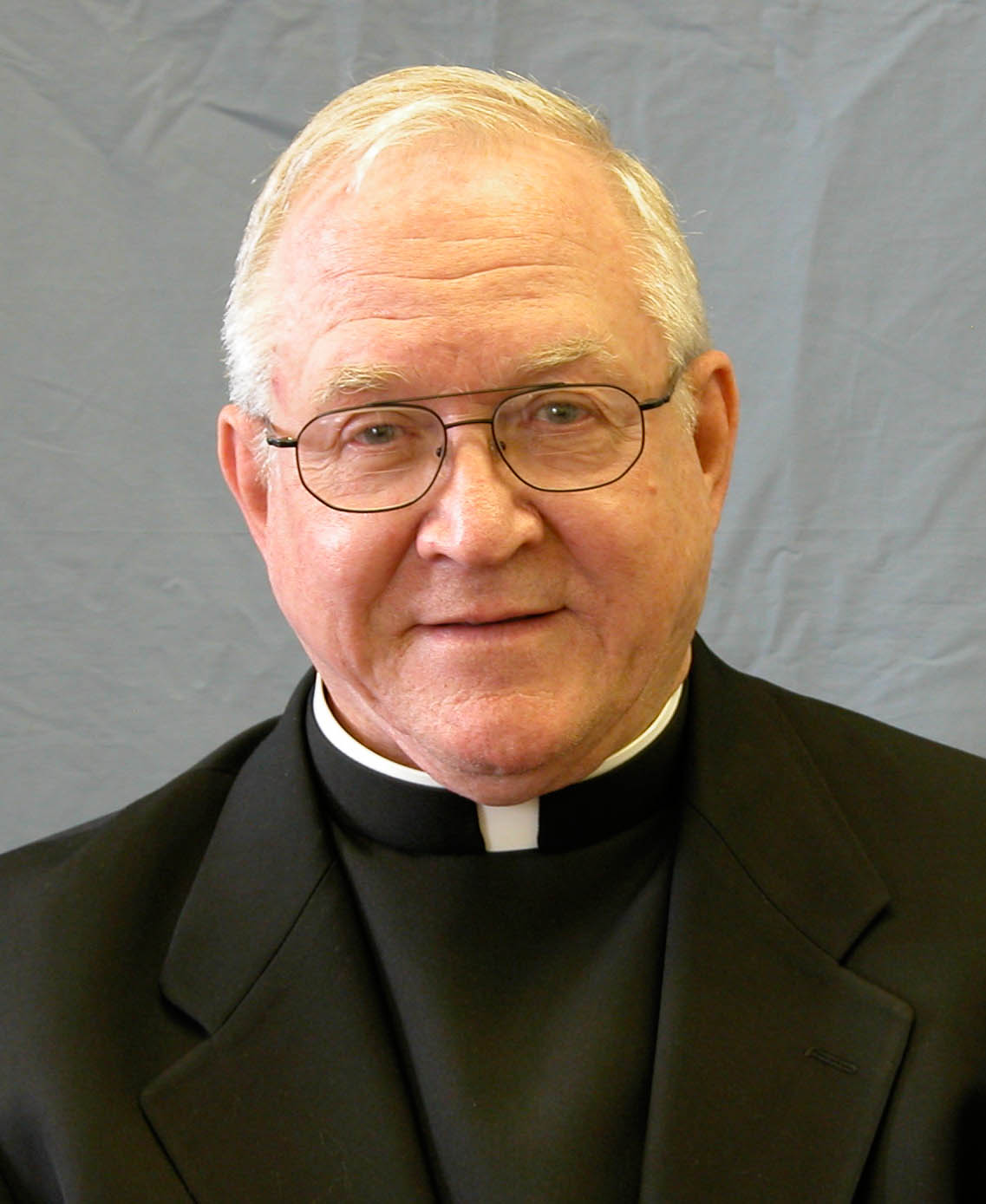
Fr. Bernie Rosinski

Fr. Bernie Rosinski

The local parish priest and we three SCJ priests assisting him proceeded to the place where the firewood for the “blessing of fire” had been prepared in a large public square about 200 feet from the entrance to the church. The church service attendants, about 400 in number, were gathered in the square and surrounded the fire pit.

At the precise hour, I heard a kind of explosion and witnessed a burning fire brand or fire pot rapidly descend laterally from a nearby roof and drop a vertical distance of about 50 feet and a horizontal distance of about 100 feet directly onto the firewood immediately causing it to begin burning (I think the wood had been soaked in kerosene). As the fire descended, I could see that it was confined to a device that had an eyehook and dropped along a wire leading from the rooftop to the fire pit. The arrangement was ingenious and evoked the mystery of fire as an Old Testament image of God. After this dramatic beginning, the ritual of blessing the fire and the Easter candle and procession into the parish church took its normal course. Each parishioner carried a small lit candle.

Inside the church, the pastor sang the Exultet (the hymn which celebrates the Risen Lord as the Light of the world) in Tagalog using modern music in place of the traditional Latin chant. After each portion the choir would sing a refrain. All was done in the dark; only the Easter candle itself was lit.  Two flashlights were used to assist the pastor.

The same two led flashlights were then used for the Liturgy of the Word in the Tagalog language which followed. One parishioner vested in a white robe would read; the reading would be followed by a psalm sung by another vested parishioner until the five selected readings had been completed, each by different persons. The verses of each psalm were modern musical compositions and the individual parishioners chosen to sing all had marvelous voices. The refrain was enthusiastically sung by the parishioners, men and women alike.

As the last reading was taking place, I was warned by a whispering SCJ priest to get ready for some dramatic moments and to be prepared to move away from the chairs reserved for the celebrating clergy. After witnessing the descending fire pot, I wondered “What next?”

As we dutifully moved to the lateral walls of the sanctuary in time, the Glory to God was intoned in Tagalog. At that moment, all the church lights came on, a huge purple cloth covering the image of the crucified came fluttering down to the ground right over where the clergy would have been standing and two huge banners with the words “Aleluya” on them were unveiled and remained suspended on the wall behind the altar.  A cluster of altar servers then helped furnish the altar with coverings, candles, and the articles need for the celebration of mass. But the dramatics were not over yet.

The New Testament reading was proclaimed, the Alleluias were sung, the gospel account of the women at the tomb not finding the body of Jesus was read. As the gospel was concluded, from a door that opened onto the sanctuary, two robust men, vested in white, rapidly and hurriedly, carried a statue of the Risen Savior to a display setting at the side of the main altar. Four pairs of girls quickly followed in procession directly behind. They closely resembled children who had just made their First Communion with white, flowered coronets on their heads. They carried baskets of rose petals and scattered them on the ground on which they walked and then upon the display of the Risen Savior.  This statue will remain on display during the entire course of the Easter season for the veneration of the people.

The Easter liturgy at San Lorenzo Ruiz church continued in the normal manner: baptismal water was blessed and used to baptize an adult woman convert and her kindergarten-aged son; she was confirmed and later received the Holy Eucharist. The people made their profession of faith and later swarmed to receive the Holy Eucharist.  Mass ended. The clergy had a hard time making their way out of   church because the faithful sought the blessing of priests by taking the priest’s hand and touching it to their forehead.

This display of faith by the Filipino parishioners of the parish of San Lorenzo Ruiz, himself a Filipino martyr missionary, executed at Nagasaki, Japan in the 1600s, impressed me greatly during this “Year of Faith.”  Theirs is a faith that is sustained by visual displays of the kind I witnessed. Filipino saints  like Lorenzo Ruiz and Pedro Calungsod have, in turn, witnessed to their faith by enduring martyrdom. Perhaps disparagingly I call such visual displays “dramatic.” But, hey, whatever works; It certainly moved me.
Bringing the Gospel to a secularized world

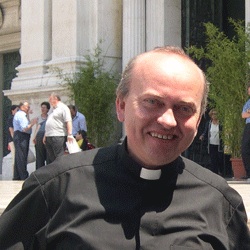
Fr. Wladysalw Mach

Fr. Wladysalw Mach

Fr. Wladyslaw Mach, an alumnus of our ESL program, is one of five SCJs who are a part of a new project in Berlin, Germany. He and another Pole join two Brazilian SCJs and a German who, as a community, offer a Dehonian presence in an increasingly secularized society. Fr. Wladyslaw’s primary ministry is as a chaplain in the emergency room of a nearby hospital. The following is from a reflection that he recently wrote about the new project: 

“How do we reach people?” is the question we ask of ourselves in all the areas where we serve. Young people of today go to the big city to take part in all that it offers. Life moves incredibly quick for them; trends and fashions are just a part of it.

Somehow, we have to find a way to insert ourselves into that life so that we can share the Gospel message. I must be open to new forms of preaching. Nowadays, that includes using all the technical possibilities, such as media.

But we must also must remember – most especially – the effect and role of grace.

I must at the same time be a good “manager” but act as a believer. It is not a way of ministry that necessarily shows its good effects very quickly.

It is challenging, but I believe that we have many opportunities in a big city, in the midst of a very secularized society, to be present. As a congregation we have the task of bringing the message of God’s love to the people, even in such a difficult and opaque environment.

Most young people in this city are moving here because they are looking for something and/or because they desire freedom. Although this “searching” or desire for “freedom” is understood differently than perhaps in a strictly religious context, it is a good precondition.

The Good News was and is for people who are searching. And that gives us hope that our mission here in Berlin has meaning, that it can grow and bear abundant fruit.

Our work in Berlin cannot be summed up so simply in numbers, facts, successes and visible effects. We meet no crowds. But such is the nature and character of preaching. We do not reach out to a group, we reach out to individuals just as God reaches out to each of us.

Preparing for deployment

Fr. Mark Mastin

Fr. Mark Mastin

Fr. Mark Mastin is a chaplain with the US Army stationed at Schoefield Barracks in Hawaii.  He and his fellow soldiers are preparing for an extended deployment overseas later this year. Fr. Mark writes the following:

I have been well, though since the moment I got back from my visit to Milwaukee, the intensity of pre-deployment training has increased, as well as our emotional levels. We have been in the field several times and in the classroom as well putting in long days from 4:30 a.m. to sometimes 10 p.m. In addition, I have been vaccinated for anthrax, small pox, and typhoid, etc. We have had other medical examinations as well.  I’ve been poked and prodded more than cattle!! We drew our special gear and uniforms recently.

It has rained nearly every day up here in the mountains since October.  Last week we had severe lightning and thunderstorms that brought severe flooding.  This has not stopped us from being in the field.  Training in mud is not fun.  It takes days to soak and get one’s uniform semi-clean from the deep red soil. 

I have become more appreciative of our young soldiers who have to spend long hours outside, particularly when they have to lay flat on the wet muddy ground with their weapons poised in defensive positions while the rain is pouring down on top of them.  It’s for that reason that I will walk around the parameters in the late nights and early mornings to talk with them to see how they are holding up; I try to sneak them some snacks too.  I have concluded that if they can make that sacrifice, so can I by staying up with them.

Sleep is at a premium. Just when you think you can grab 30 minutes of shut eye, gun fire or explosions go off.  Then, you have to think quickly about what action to take.  It is a good thing we practice these events often and that we have standard operating procedures in place that guide us on what task each of us are to perform.  It can be chaotic and perhaps confusing when engaged in these exercises, but we get use to it.  Every action we take becomes second nature.

Even though the chaplaincy has its own battle operational procedures, I have had to be creative in writing adaptive procedures

I was awarded the Army Achievement Medal for recent exercises that included teaching on the subjects of suicide prevention and intervention and my development of a presentation on sexual harassment and assault.

I likewise was privileged become an ethics advisor to one of our senior two star generals on the island, particularly in the area of being a Conscientious Objector.  He felt that we Catholics have quite a background and education in ethical and moral issues that would aid him in making decisions about our soldiers.

Aside from my primary duties and the battalion, I continue to teach RCIA.  We have quite a large group this year coming into the Church.  They are all so enthusiastic.  One of our elect had one of those rare conversion moments at a Mass she attended out of curiosity for the first time in her life.  This person, a well educated individual who had not been raised in the Christian faith, felt this flood of warmth and joy pour over her when the priest elevated the consecrated host; she said she had no idea what he was doing. 

 After this mystical experience, she was afraid to speak about it to her husband but became convinced that the Catholic Church was the church she needed to be part of. She asked me; “does this happen to other Catholics during the Mass?” I musingly said I wish all of us could experience these mystical feelings.  I told her that what she encountered was a special gift from God that should be cherished.  She and her entire family will receive all of the sacraments on Easter Vigil.

Going into harm’s way

Like all of us here, I have mixed emotions about our upcoming deployment. There is excitement and fear.  

I look at this deployment with the Dehonian mindset of oblation.  I have come to appreciate and redefine this attitude.  Scripture says that there is no greater love for another person than to lay down one’s life for a friend or another person.  I do not have a martyr’s complex.  I do enjoy living.

Oblation to me means availability and sacrifice.  As a religious, life should not always be comfortable or convenient.  It means being present with people in their sufferings, compassionate if you will.  It’s being a bridge of hope (GOD)to people, especially young people, who cannot make sense or find meaning in life.  As instruments of God’s mission, simple words of encouragement go a long way without ever having to mention anything spiritual or religious.  Saying that someone is doing a good job has the same effect.

I will be in harm’s way.   But Oblation, availability and presence can make a big difference to our soldiers, particularly in how they cope and manage their resiliency and emotions.  And so, I need to make the effort to meet them wherever they may be.  

However, I too need others to comfort me.  And so I ask all of my brothers and sisters to pray for me and our soldiers while I am gone.


Reflecting on ministry on the Great Plains

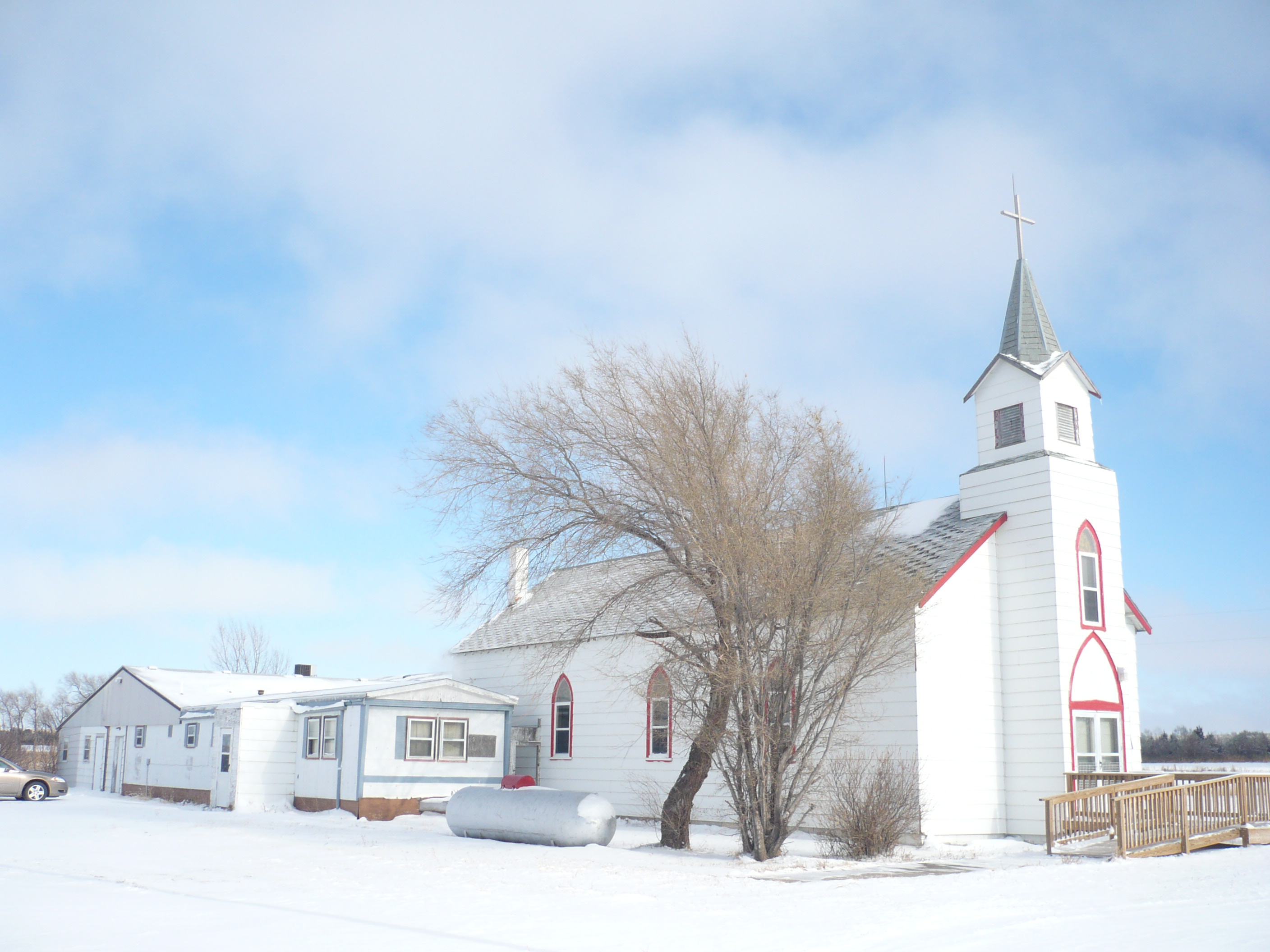
St. Catherine's Church in Big Bend, SD

St. Catherine’s Church in Big Bend, SD

The following reflection was written by Fr. Vincent Suparman, an Indonesian SCJ who serves on the Lower Brule Pastoral Team in South Dakota:

One Sunday I was sitting behind the steering wheel on my way home from Big Bend, SD. The wind blew up to beat the band causing my car to sway. In no time at all, I underwent a “Great Plains” weather change. The confidence, pride, and affirmation of being an SCJ missionary were disturbed by unpredictable weather.  Yet, I often find myself in awe of seeing how God’s wonderful works are revealed through my life and ministry. No better word can I say than to be grateful to God for allowing me to grow spiritually here in the prairies and Great Plains. As I am living in the frontier, I have taken for granted listening to what is going on around me. I may be concerned about some issues but I don’t have to swallow whatever I am told. Instead, I need to be more attentive and listen to what information helps me work better.

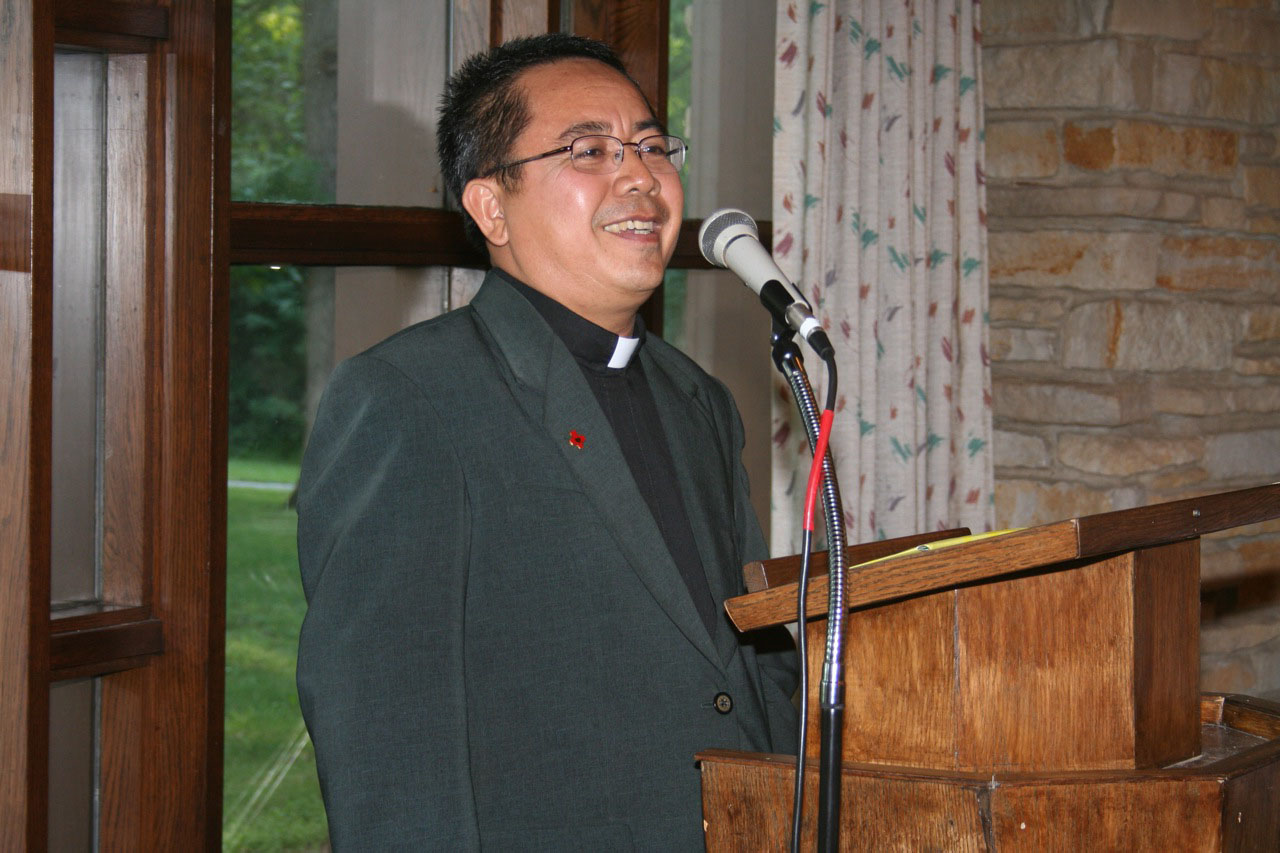
Fr. Vincent

Fr. Vincent

In terms of spiritual growth, which is the goal of every human being and of those who are being reshaped by the Holy Spirit, I am often inspired by the farmers, especially here in South Dakota. If the crop doesn’t grow, the farmer is concerned about what goes wrong. Experts study the crops in the fields.  Tests are run. When a Christian stops growing, spiritual help is needed.  One of the missionary activities is – I am told – to preach and grow spiritually in order to meet the spiritual needs of the people I serve.

Having been in religious life for 26 years, I still have to constantly learn about spiritual and pastoral aspects that in turn will broaden my perspective of thinking and developing my pastoral ministry in the future. Instead of letting my energy be absorbed by any activity around me, I let myself be enlightened by the Holy Spirit so that I will be able to see clearly what I have been doing in the mission field. Reflecting on mission activities in the prairie, I come to realize that I am called to serve people with an open heart and mind. At the same time, I need to strengthen my inner spirit and keep my life on track. Once I was told by my spiritual director to start my daily activity with a good habit that perhaps I may have taken for granted: the habit of prayer. When trials come, there is no better way to endure them but by praying patiently and attentively in the presence of God. A simple prayer helps us not only to deepen our spiritual life, but also to stay connected with God, other people, and other creatures around us even though it is not necessary to get to know each one of them on a personal level.

Such a good habit – I describe above – needs to be accompanied by the personal habit of learning about particular subjects to improve our pastoral skills. Just think about eating at a restaurant. We may see people selecting their food from a salad bar.  They pick up their salad, but then they choose carefully their favorite vegetable. They seem to be very picky. No, they are not picky. But the point is that they select carefully the food they are about to eat. This is what actually happens in the process of spiritual growth. Finally, “to be aware of God’s presence” is one of the  few valuable efforts that cannot be neglected regarding spiritual growth. In my opinion, no one can stray from God and remain healthy. Let me borrow a term that sometimes is used when we talk about the Sacred Heart Spirituality. Through the Eucharist and adoration our life is nourished and transformed into a better quality of life. In turn, the community life becomes stronger and healthier. As a result, the community life bears fruits abundantly that is revealed through our life and ministry.

This is one of many ways to help the mission activities and the church come to life. Doing mission work is much broader than just re-evangelizing people and helping them take responsibility. In term of leadership, it is important to think about how to train them to be good fathers and mothers in their families. Everyone in the church should be invited to be part of the church activities until they feel comfortable being in the church while filtering the Word of God into their culture and family values. There is no need to use a controlling figure to bring the people back to the church. Instead, there is a need to bring them closer to one another so that they may be able to share the gifts of the Spirit. Talking about their talents will probably discourage them; this should be avoided. Encouragement would be appreciated if we talked about the human person and how valuable each person is in the community-building process.

Encouragement is a very important thing we can do to bring the people back to the church. Otherwise, they will stay away. The key is how to give them a chance to have a better future for their family, for the church, and for the pastoral ministry of the SCJs.

The people whom I serve do not need someone who runs the church as the manager runs a company. They need someone who keeps them moving to reach their better future.

Fr. Vincent Suparman, SCJ


Reflecting on the novitiate

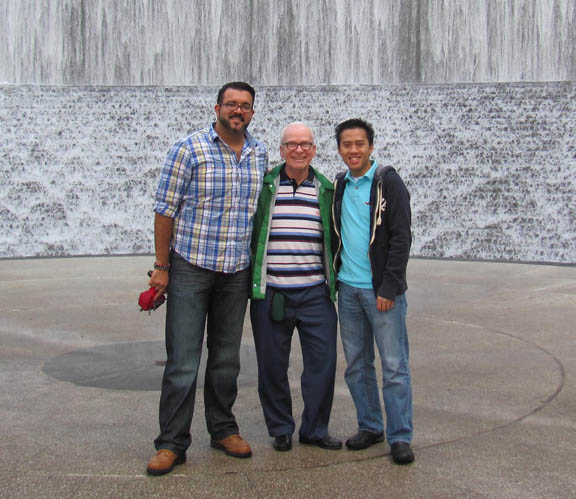
Novice Juan Carlos Castaneda Rojas, Fr. John Czyzynski (novice master) and James Nguyen at the Gerald D. Hines Waterwall Park in Houston

Novice Juan Carlos Castaneda Rojas, Fr. John Czyzynski (novice master) and James Nguyen at the Gerald D. Hines Waterwall Park in Houston

“God wrecked my life”

Novice James Nguyen is about halfway through his novitiate year. The following is his reflection on it:

God wrecked my life.  That may sound as shocking to you as it did for me.  But as I reflect back to the roots of my vocation this year, I have never been so convinced that God did wreck my life.  For the majority of my life, my dream was to climb that ladder of success to reach the top rung of security in wealth and happiness.  That meant getting through college, getting a job as a chemist, getting married, and having a loving family.  I was doing fine until God came and wrecked my life a little over halfway through college.  I have never been the same since.

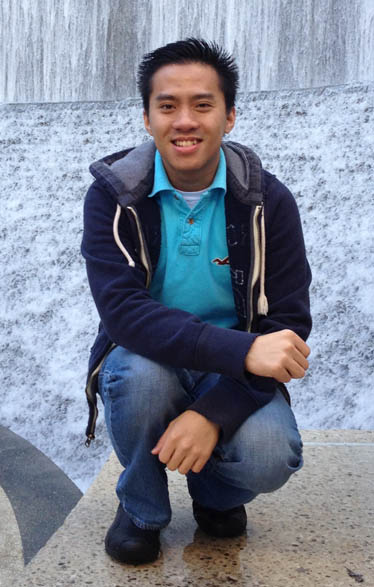
Novice James Nguyen

Novice James Nguyen

I have not been the same since the first day of novitiate as well.  That great excitement during the Reception of Novices has settled into something that’s more manageable, that thrill of not having to go to school for a year has surprisingly disappeared, and the expectations I had in the beginning have yet to have gone my way.  Nonetheless, I am very grateful that things did not go as I planned or else I wouldn’t have the opportunity for self-discovery, growth and spiritual development that this experience has given me.  I have to admit that I was a bit nervous and anxious embracing the new transition.  Novitiate is an intense change and I was reluctant to let a part of my life go.  But overall, this year has given me the chance to look deeper and discover things I had never known about myself.  Although it wasn’t easy, I was able to open up and encounter my vulnerabilities, flaws and true-self through tools like the Myers-Briggs and Enneagram Personality Tests that we learned at the Intercommunity Novitiate in Techny.  That felt like being in a laboratory again doing experiments.  In a way, novitiate does feels like a lab where my vocation is being tested, tried and lived out on a daily basis.

There were times where I felt uncertainty, wondering “what have I got myself into?” as I was constantly wrestling with the “what if” scenarios.  But that in turn has challenged and stretched me in doing things I would not have considered before.  I have also had the privilege of visiting  places where SCJs minister and have meet struggling people with their incredible stories.  This and various other experiences have helped me listen and discern the movements of God in my life.

The silence and slow rhythm of novitiate has provided me an atmosphere to be more attentive to God’s love.  My journey began with the choice of love.  The origin of that choice is reminiscent of the faith conviction of Fr. Dehon, that Christ loved him first.  Love, I believe, will lead me to the place where God is calling me to be as I approach the last half of novitiate.

God indeed wrecked my life, and shattered it into pieces.  It will take a lot of time, effort and persistence to be able to put it all back together again, but I have learned not to do it myself.  I have been picking up the shattered pieces and handing them over to God one by one, day by day.  This is because I know that only God can change something so broken into something so beautiful.  That knowledge has brought me great joy, a joy that I am unable to explain, but what I simply call, “Rambunctious Joy.”

You never know what topics will come up at the dinner table

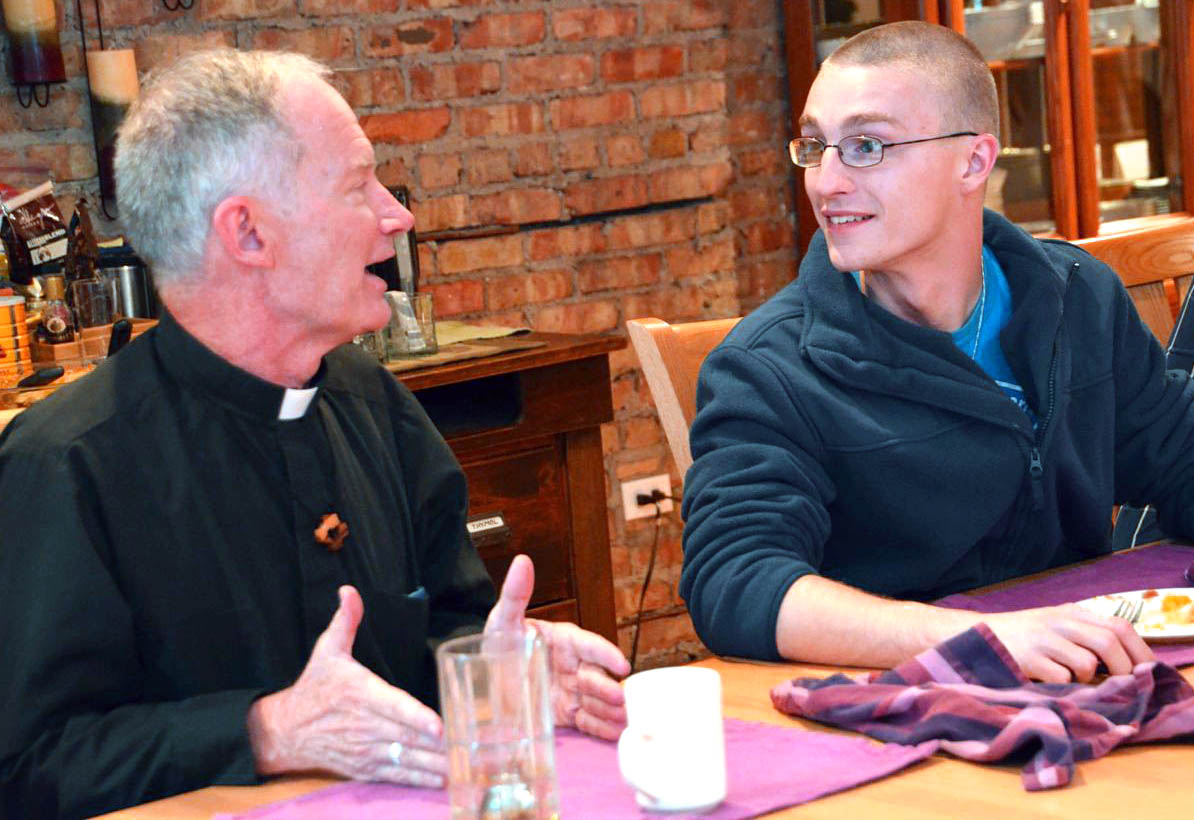
Fr. Tim Gray and candidate Justin Krenke

Fr. Tim Gray and candidate Justin Krenke

The end of January saw more erratic Chicago weather as the rest of the community reassembled. Fr. John Czyzynski and the novices, Juan Carlos Castañeda and James Nguyen, spent most of January touring province ministries (in the South, of course!). Frater Fernando Orozco spent January at Our Lady of Guadalupe in Houston, and Br. Clay Diaz returned from his program to begin the spring semester at Catholic Theological Union.

Everyone returned just in time for the First Friday reflection, given this month by Fr. Joseph Dinh. It was to be followed by a Come and See weekend. Br.  Ray and Br. Long were to bring three prospective candidates to visit the house and see the program.

Our community meals, of course, are an essential element in community life, and most of them are quite entertaining. Although texting and calling during the meal is verboten, most people have their phones at the ready to Google the answers to questions that arise. And questions arise!

I took some notes during two evening meals, and these were some of the topics that came up:

Everyone shared his favorite horror movies, and we also compared trips that we had taken. There was a discussion about different styles of chewing, and its effect on teeth. We also discussed  different types of relics.

People demonstrated tricks and stunts that they could perform, and we had quite a heated discussion of the various qualities of dogs and cats.

On the scientific side, we discussed the merits of different theories of evolution, and talked about the man in England who has dedicated his life to challenging Einstein’s theory of relativity.

We discussed the danger of coyotes; I showed pictures of my brother-in-law shooting coyotes out of his bathroom window in Maine.  We wondered what is used to fill tractor tires and Br. Duane called his brother, who assured us they were filled with salt water.

On the theological front, we had a debate about what the “sensus plenior” of Scripture referred to, and in response to a question about the grammar of “Sursum corda”, Fr. John Czyzynski did some research and assured us that “sursum” was an adverb.

On another front, we were informed about the details of Mexican superstitions — la llorona, (a ghost which wails at night) and the infamous chupacabra (a vampire which attacks goats).

There were other topics which were discussed, but this is a relative sample of the wisdom and entertainment you will enjoy during a visit to the Chicago formation community.  We have plenty of room and good food and always appreciate visitors.

-Fr. Tim Gray, SCJ

Holiday season with the student community

Fr. Tim Gray, SCJ, a member of our formation team at Dehon House in Chicago, writes the following:

The Dehon Formation Community Christmas tree

The Dehon Formation Community Christmas tree

The formation community began the holiday season by visiting the retirement community in Hales Corners for Thanksgiving. The next three weeks saw a flurry of activity as the tasks of decorating the house and making other Christmas preparations were competed alongside the students’ pressure of final exams and papers due for school.

However, on December 7 we maintained our normal First Friday prayer schedule; we welcomed back Fr. Greg Schill, not so long ago a member of our formation community, to lead us in an evening of reflection. We were joined by Br. Ray Kozuch and Br. Long Nguyen, who brought three potential candidates for a “Come and See” weekend.

The community gathered on Wednesday, December 12, for an outing to see “Potted Potter,” a comical re-visiting of the Harry Potter series, and again on Thursday for a party (complete with charades), and gift opening.

After that, the community began to disperse; the candidates and the professed students headed home for vacation, and the novices began to steel themselves for their first experience of Christmas away from home. Fr. Bob Bossie and Br. Duane Lemke will also remain in the house over the holidays, while Fr. Antonny Warjito and I will take the chance to visit family.

As a community, we receive so many visitors and guests that “guest-master” is a regular work assignment, on a par with washing dishes and vacuuming. We are pleased and honored to be considered a home away from home by SCJs, their families, and friends — and other religious communities.

God’s blessings at Christmas and throughout the new year.

Last days in Rome

As noted previously, Fr. Bernie Rosinski, SCJ, is among those on a pilgrimage to Rome organized by the province development office. What follows is his final blog post from the trip:

This is the last pilgrimage blog from this reporter. It has been a delight to sit down and recall the highlights of the pilgrim’s day. Perhaps, we can learn that every day has its highlights from God, though we often don’t recognize them as such.

Saturday, the group traveled to Monte Cassino to visit the famous Benedictine Abbey founded by St. Benedict at the juncture of a high promontory overlooking several deep valleys. The imposing position of the abbey can be seen from everywhere below and it is no wonder that its strategic importance was recognized by the warring factions in World War II. The present abbey was rebuilt after extensive damage caused by Allied bombing. Br. Steve Cyr, a deceased SCJ of the U.S. Province, was wounded at Monte Cassino.

From there the group went to Pompey to see the excavated remains of a city destroyed by a natural, rather than a military, force: an erupting volcano in 79 AD. The power of Vesuvius and its destructive force is unimaginble.

Though the trip took several hours, the group arrived back home in Rome only 10 minutes later than planned and was in plenty of time to participate in a Roman style banquet — one that takes several hours to complete. It begins with wines, red and white from the local vintners, and water from the local bottlers.

After a bit, an antipasto is served. The amount of food is not too great but it certainly whets the appetite of hungry people who desparately fear that this is all they will get to eat. So, they wolf it down: bruschetta and sauteed egg plant and  zuchini strips, with garlic oil and a light sausage. Once the plate is clean, the pilgrims stare at their empty plates (if they have never experienced a Roman banquet before) and a note of desperation filters through the rising level of conversation.

Twenty or so minutes later, the waiter or waitress (there is only one no matter how large the group may be), returns to pick up the empty plates and a sense of hope is restored. This raises the volume even more.

Shortly thereafter, the pasta plate appears. American pilgrims know pasta. They often make their main meal of spaghetti. In Italy, things differ slightly: pasta is intended to line the stomach for the  delicacies that are to follow. But first, it takes another half hour to finish the pasta, then to have the waiter or waitress return to collect the empty plates. In the meantime, between courses, people feel like they are starving.

At last the main course is delivered on a plate to each guest. We had patatine, with chicken strips, and salad. Having nibbled on tasty Italian bread throughout all the previous courses and dipped it into olive oil, some patrons end having leftover chicken on their plates. I guess this is used to feed the cats of Rome of which there are many.

The desert course was a fresh fruit cocktail in a semi-sweet sauce. It was the perfect end to a marvelous banquet that took nearly three hours. However, by this means the pilgrim group had another experience of a different culture than their own and talked about it all the way back to the hotel.

Fr. Bernie Rosinski

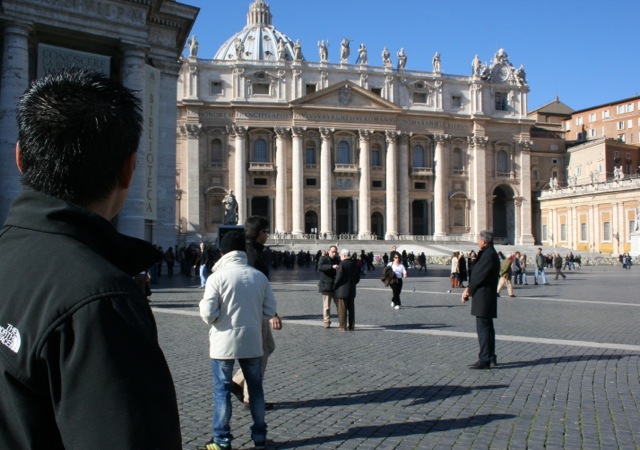
That was Saturday. Sunday was entirely different. It began on a very high note: the bus was on time and took us to St. Peter’s Square where with a minumum of delay the pilgrims easily passed through security to get into St. Peter’s (a reminder of the assassination attempt on Blessed Pope John Paul II). We were guided into St. Peter’s Basilica where Fr. Dominic and I concelebrated an 8:00 a.m. Mass at the “Polish” chapel, i.e., the chapel of our Lady of Czestochowa.

Having concluded our Mass and gone to our agreed upon meeting place, we met our guide a little after 9 a.m. From that point, things began to “go south” as we Americans say. The sky began to cloud up. By the time we had bussed to our closest point to the Piazza Navona where we were to begin the day’s tours, drops of rain began to fall. Actually, once in Piazza Navona, the wind blew water from the fountain on us so that we were inundated from the top and from the side.
Sunday morning is church day. And even though the Roman churches and basilicas tolerate visitors to see the wonderful artwork, Sunday morning is Mass time and visitors and pilgrims may not visit and move about. It is sacred time. Though our tour guide tried to compensate for the schedule conflict by giving us time for shopping and gelato (delicious Italian ice cream), we still were a bit too early. However, we managed successfully to visit the Pantheon, the church of St. Ignatius with its ceiling fescoes by Fr. Luigi Pozzo, and the Church of Santa Maria Sopra Minerva. The entire circuit entailed a great deal of walking on cobblestones which are not kind to tired feet. The group did manage to make its way to the Fountain of Trevi and a 45 minute pause for food and/or shopping. At that point, a decision was made to end our tourist day, and not a moment too soon. As we made our way to where the bus was located, we were drowned by a downpour that saw rivulets of water course down the streets where we were walking. All in all, when we consider the great weather we had on all our other days, this day was an exception.

Monday is a day on which no program is scheduled. The pilgrims will be free to choose to do what they want: visit a favoritve place, shop, eat, pray, pack. Tuesday, we return to the United States.

The sites of Rome and Mass at the Generalate

Fr. Bernie said that “Blessed Pope John Paul II is a favorite of our pilgrimage group. Here his image is found on the door to the Basilica of St. Mary Major.”

As noted previously, Fr. Bernie Rosinski, SCJ, is among those on a pilgrimage to Rome organized by the province development office. Today he writes about several visits of the group in  the city, as well as Mass celebrated at the Generalate:

The group visited a number of places and saw a variety of masterpieces or historical artifacts: St. Peter in Chains (the Moses of Michelangelo and the chains that bound St. Peter in the Mamertine prison before his execution on Vatican Hill); the Coliseum, erected by Emperors Vespasian and Titus to wipe out all traces of the Emperor Nero’s highly unpopular and cruel domination of Rome; the Roman Forum down through the centuries before Roman civilization really took hold under the emperors and after; St. Mary Major, the last of the four major basilicas of Rome visited by our group (cradle of Jesus and historical mosaics dating back to 6th century and later).

Francesco, our guide, was very capable in English and spoke with an American accent. He was extremely knowledgeable and told us he “loved to talk.” It was for this reason we obtained truly extensive explanations of the many places we visited and their features. He may be our tour guide again on Sunday; at least the group hopes so.

The group was treated to a talk by Fr. John van den Hengel,  the Vicar-General of the Priests of the Sacred Heart, on the international scope of the congregation.  After, was a Mass concelebrated in English by the superior general of the congregation, Fr. José Ornelas Carvahlo.

Fr. General also gave our pilgrimage group a talk with slide illustrations that described the status of the Congregation of the Priests of the Sacred Heart worldwide. It was fascinating in its presentation of how the congregation and the church is moving toward the southern hemisphere, the aging patterns of the northern hemisphere. We who have been present at general chapters and conferences are familiar with the statistics but it was an eye-opener for the pilgrim group.

We citizens of any particular place have a tendency to localize our interests and neglect what is happening elsewhere. Our media has a tendency to note particular events; trends and directions are less concrete and therefore not part of what we hear on TV or read about in our newspapers and magazines. That was remedied by Fr. General’s presentation. Several members of the group asked pointed and intelligent questions afterwards. They seemed very interested in what was happening in the church. At the end of the presentation Fr. General thanked the people for their support of the SCJs in the United States and noted that much of what we are able to do worldwide comes from the support of the U.S. Province.

The end of the day saw a dinner hosted by the Priests of the Sacred Heart for the pilgrim group in the community dinning room. Along with visible evidence of the internationalization of the congregation seated at table (students and curia staff from 17 of the 41 nations in which the Priests of the Sacred Heart are found worldwide), the pilgrim group enjoyed a meal of lasagna, peas, string beans, potato fries, and chicken along with an Italian tort and aperitifs of several kinds for dessert. What many pilgrims found amazing was the fact that the food was served by the Superior General, general councilors, curia staff and students. And the same cleared the dishes away afterwards.

In their turn, many SCJs present were fascinated by S. Natividad, the group’s 92-year-old pilgrim. They spoke to her, teased her, and were teased in turn. This gracious lady was a great source of pride to her three daughters who accompanied her on the pilgrimage. Fr. General chose to sit at her side.


Visiting the “City of Peace,” Assisi

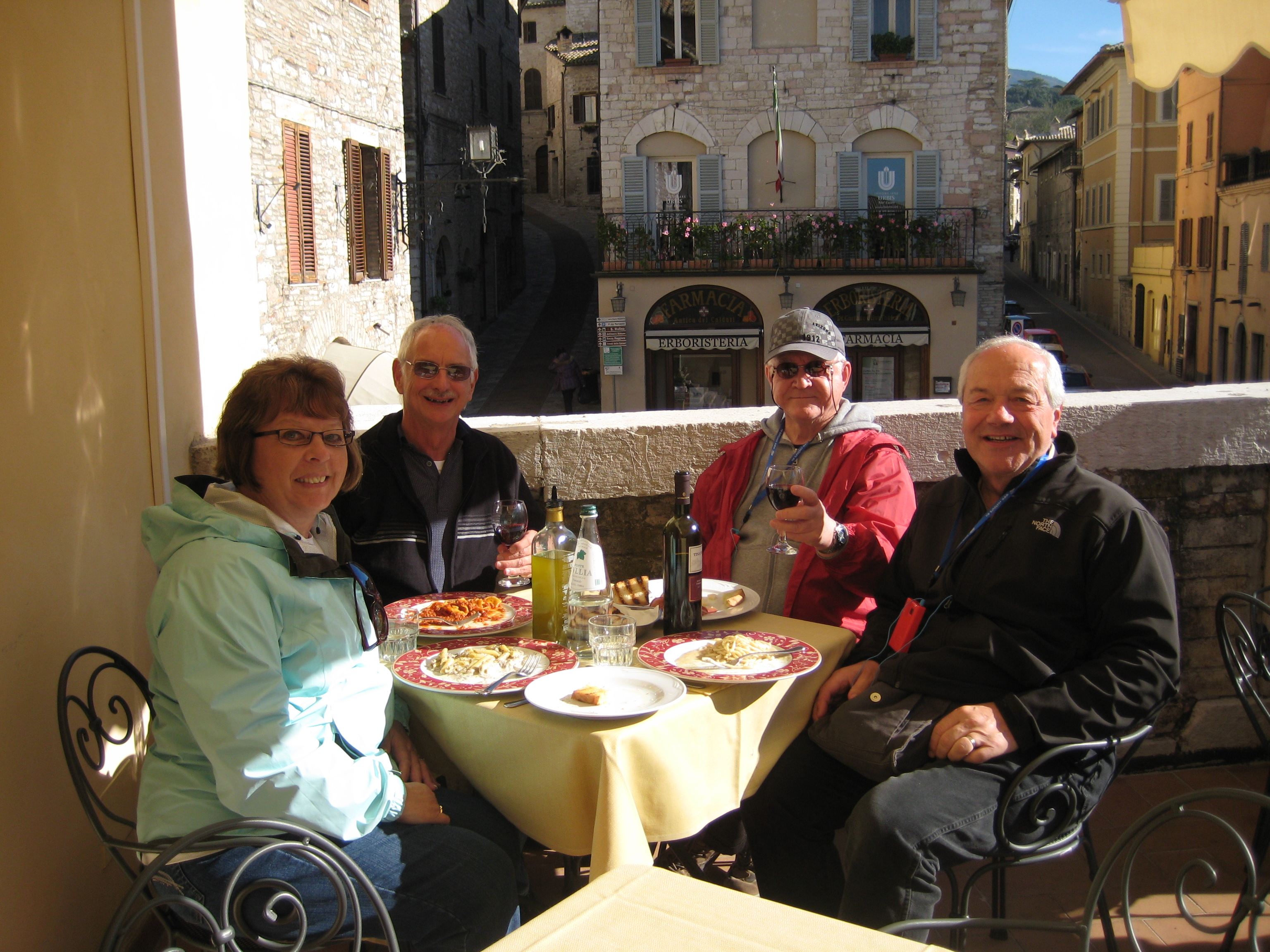
Fr. Dominic Peluse (back left) and Fr. Bernie Rosinski (back right) enjoy a meal in Assisi with members of the tour group.

As noted previously, Fr. Bernie Rosinski, SCJ, is among those on a pilgrimage to Rome organized by the province development office. Today he writes about the group’s visit to Assisi:

The pilgrim group visited the city of peace, Assisi in Umbria. St. Francis would have been proud of our group. We supported all the merchant class of which his father was a member. Yes, it was a time for shopping as well as visiting sacred shrines.

Our bus driver endeared himself to many members of the group by arriving at the escalator which took us to the level where the church of St. Clare was located. It saved us innumerable steps and a great deal of energy which would be needed later in the day.

The church of St. Clare fronts the chapel of St. George in which the famous crucifix from which Francis heard the words: “repair my church” were heard. After some months of literal interpretation, Francis finally understood Christ to mean “the” Church, not “a” church. Clare’s tomb is contained in the crypt and other famous memorabilia are found there as well.

We proceeded to the main square where the group broke up into small, manageable luncheon groups — all the better to get served quickly and thus allow time for shopping. Some of us pilgrims are learning that shopping is not just an artform but a vocation.

After, the entire group followed the guide to the house where Francis was born and lived his early life. His mother was French and his father a converted Jew from Lucca. Both parents are honored with bronze statues and his early home is now a chapel.

Walking down the street toward the Basilica of St. Francis was like walking the halls of history. The tour guide would point to the left and right as we proceeded and name a date, an event, an occurrence that took place anywhere from the 12th century to the 20th. Though we pilgrims were outfitted with “whispers” or wireless radio receivers, we still had to pay attention to her remarks because her English needed some polish — maybe a summer in the Sacred Heart School of Theology ESL program! She consistently would place an adjective after a noun, observing Italian grammar rather than English grammar. If one person were “poor,” then two persons were “poors.”  These words are not written to mock her courageous efforts, but to indicate how hard we pilgrims had to listen. She was extremely knowledgeable.

The tour guide showed us just how an illiterate people could be served by the images and frescoes in the basilica. Beginning at one end, she made her way around the entire upper church and narrated the life of St. Francis in frescoes by Giotto. It was a much appreciated tour de force.

There was a brief shopping interlude in the souvenir store found just between the upper and lower parts of the basilica. Once shopping was concluded, we were shown the lower church with frescoes by Cimabue, including what is believed to be a very accurate portrait of St. Francis. This portion of our visit concluded with a trip to his tomb where the pilgrims prayed for peace and many other things.

While it was a very tiring day, with all the walking and climbing, there were no complaints. Our bus driver, Nicola, got us home in plenty of time to enjoy risotto, patatine, and bistecca at the Villa Aurelia.