An audience with the Pope

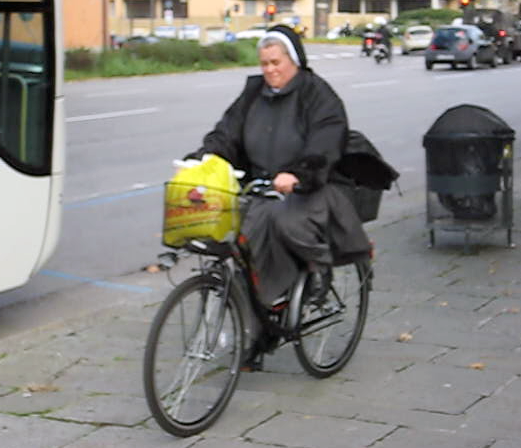
Fr. Bernie sent this photo, writing “You never know who or what you will see on the streets of Rome!”

As noted yesterday, Fr. Bernie Rosinski, SCJ, is among those on a pilgrimage to Rome organized by the province development office. Fr. Bernie wrote the following at the end of a day that included attendance at the papal audience in St. Peter’s Square:

The group of pilgrims awoke Wednesday morning to learn the latest news of the presidential election. When the polls were closing on the West Coast, Romans were waking up to the morning sun.

Today was spent at a pontifical audience with Pope Benedict XVI in St. Peter’s square. Fr. Dominic and I explained the “liturgy” of the audience, what languages were used, the order of precedence, the formality approach. Fortunately, after some terrifying dark clouds, only a few sprinkles of rain fell and the sun came out to welcome the Pope.

Pope Benedict gave a fine talk about how, from his very creation, man is meant for God. When s/he is unhappy, the cause for the distress usually lies in the choice man has made to put some created thing or value in place of God.

While the full papal discourse was given in Italian, brief summaries followed in French, Spanish, English, German, Polish, Portuguese, Croatian (there were approximately 7,000 Croatians present), Indonesian and what seemed to be Arabic. I was stumped by that last language.

Right after the audience a member of the group and I went to verify a meeting location for the tour bus. In the meantime, the pilgrims twiddled their thumbs awaiting our return. However, after we got our information, the Italian police wouldn’t let us return into the area where the rest of the pilgrims were waiting. About 20 minutes later, someone in the group began looking for us and saw our frantically waving arms. Eventually, everyone got together and waited at the proper place for the proper bus to arrive at the proper time. And even the proper tour guide was there.

In the interim, to make use of toilet facilities (which are not all that conveniently common in the city of Rome) the group members entered a large tourist gift shop and bought some objects: this practice appears to be an acceptable “quid pro quo” with Roman merchants.

The remainder of the afternoon consisted of a bus trip through interesting parts of the city out to the Basilica of St. Paul’s Outside the Walls and to the catacombs of St. Domitilla.

Tomorrow the pilgrims take a bus to Assisi, the city of peace, the new Jerusalem. It will be an all-day affair with lots of walking and step climbing. This is a state of affairs that creates problems for some among the group. However, all look up to the example offered by Natividad, a 92-year-old resident of McAllen, TX, who has “walked the walk” and is a remarkable model for the rest of us pilgrims.

Finally, all are mindful of the three pilgrims who did not join the trip at the very last moment because of an 18-year old relative who suffered a brain aneurism just as they were preparing to leave. All have offered prayers for the victim at the sacred sites they have visited as well as for those who did not join them.
A prayer for the students, and the school

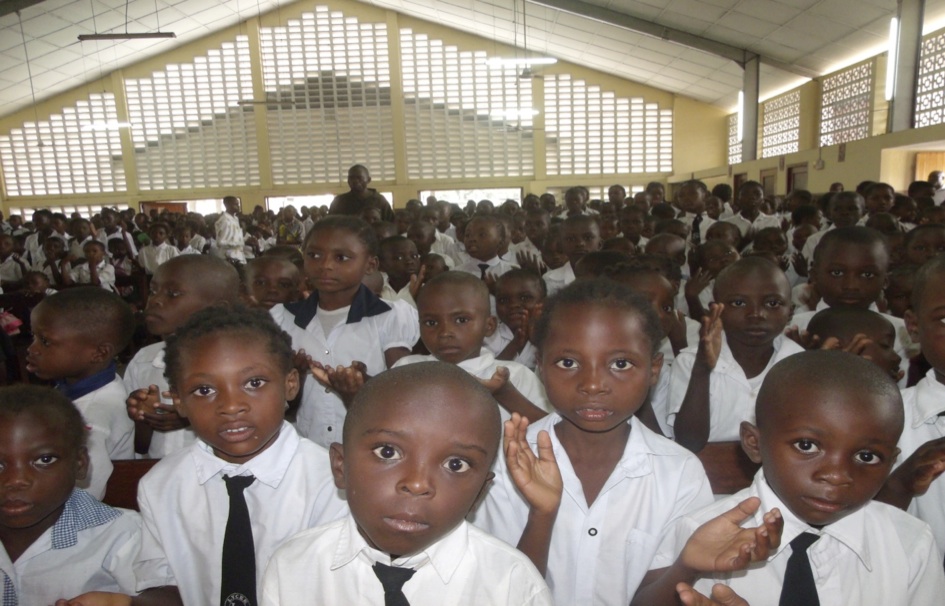
Children at St. Clement’s in Kinshasa, Congo

Fr. Egide Safari, SCJ, a member of the Congolese Province, recently wrote about the start of the new school year at one of the province’s schools, St. Clement.

The following is paraphrased from the original French:

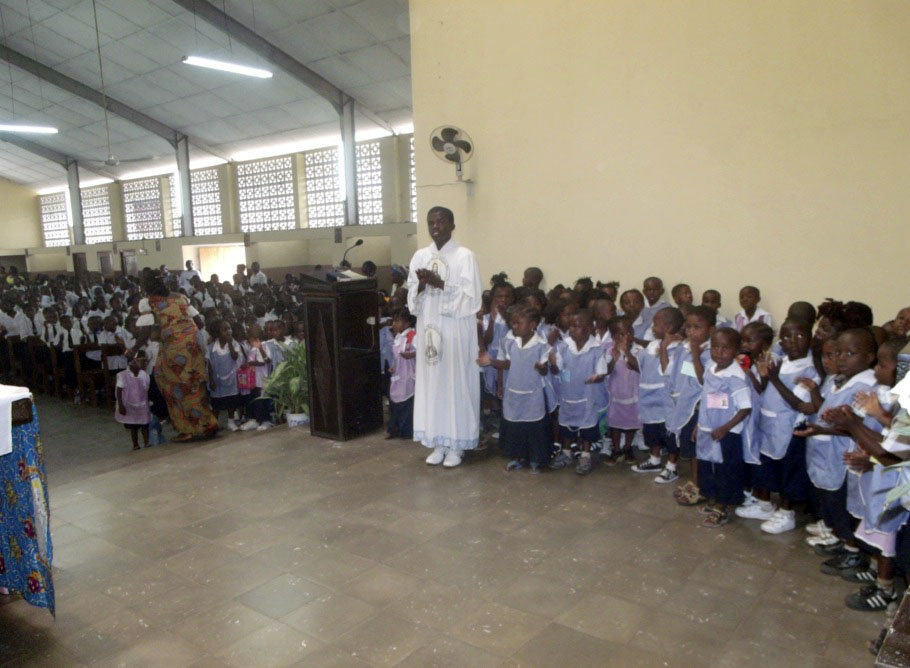
St. Clement in Kinshasa recently held an opening Mass, seeking the grace and support of God, for the 2012-13 school year. The principal celebrant was Fr. Élie Muzungu, SCJ, out-going director of the school. [Originally from the Democratic Republic of Congo, Fr. Élie is a member of the Canadian Region; he did his novitiate in Chicago with members of the U.S. Province.]

Fr. Élie urged students to love God, their parents and school, and reminded them of the sacrifice needed to do well in school.

St. Clement School includes three kindergarten classes, nine primary school classes and 14 secondary school classes. Unlike last year, there has been a decline in enrollment, especially in kindergarten. This is because of the difficult social conditions of the country. Parents have to pay the cost of their children’s education. Throughout the school year, students are forced to abandon school because of a lack of funds.

This is hard for the students, of course, but also for the school because it depends upon tuition to pay for much of its costs, including staff payroll and supplies.

And so, we pray and wish for a successful school year for our students, but also for the school itself.

Opening Mass for the new school year at St. Clement’s


The beauty of Rome

Pam Milczarski and Fr. Dominic Peluse of the Province Development Office are leading a pilgrimage this week in and around Rome.

Fr. Bernie Rosinski, SCJ, is among those on a pilgrimage to Rome organized by the province development office. The city is a place he knows well after years of both study and work in Italy. Fr. Bernie wrote the following at the end of the group’s second full day in the Eternal City:

The Office of Vespers/Evening Prayer for today, Tuesday November 6, has the following prayer: ‘The talents of artists reflect your splendor, may their work give the world hope and joy.” This prayer of the church is recited by priests, monks and cloistered nuns worldwide every day on behalf of the members of the Church.

Brought to Rome through the offices of the Priests of the Sacred Heart, this pilgrimage group  — 30 strong — witnessed how the talents of artists reflected God’s splendour both yesterday and today and their sentiments run in perfect accord with the prayer. Monday, it was the Sistine Chapel and the Vatican Museums. Today it was the remarkable Renaissance city of Florence.

Never mind that all the pilgrims are still suffering degrees of jet-lag; their hearts are resonating and soaring with the beauty they have seen from the artists they revere: Rafael, Michelangelo, Caravaggio. They have been in the city that housed Dante and Boccaccio, and the scientists Galileo and Vespucci.

Under the direction of Fr. Dominic Peluse, SCJ, and Ms. Pam Milczarski, the group, so far, meshes well together. We are staying at a Villa Aurelia, a modest hotel run by the Priests of the Sacred Heart conveniently found in the heart of the city of Rome. All movement is by a comfortable bus. Though lunch is often on the run at bistros and unknown and untested restaurants, these have not disappointed. And the evening meals are always fantastic.

Tomorrow, we look forward to the audience with Pope Benedict XVI in St. Peter’s square.

Ciao from Roma!

Sharing gifts and talents with those we are called to serve

Fr. David works with a member of the SHSM staff

Fr. David is a part of the SCJ community that serves the Catholic Church in the nine northern counties of Mississippi. Recently he wrote about his experience joining members of the Sacred Heart Southern Missions’ staff in rehabilitating a home for a local resident.

I believe that at Sacred Heart Southern Missions we are keenly aware that the mission of the Priests of the Sacred Heart and the mission of the Southern Missions is to be active agents of the love of Christ. We all know that many people support us in this effort: donors, co-workers, volunteers, prayer partners, and many others. But, just as importantly, we too are part of that active love of Christ.

I believe it is important to have an active experience of what we do to truly experience the impact our actions can have on the lives of the people we serve and their communities. The concrete experience of sharing the lives of those we work among gives us a window into the ways we can transform and change our communities and ourselves. In working with other employees of Southern Missions I had the experience of putting the love of Christ into action. I also experienced sharing that love of Christ.

I had this experience in the Wooten house. It was a fun experience working alongside others I do not see daily. During the day of labor I saw first-hand that we are able to make the lives of others better in a profound way. The work that our team did –– preparing a house to be rewired and re-dry walled –– was a sharing of Christ’s love from our hearts and lives and was felt by the family whose house is now safer and warmer. I believe that the witness we offered, the willingness to share what we have to make the lives of others better, is the reason we are here together. It does not matter what our task, it only matters that we want to share our gifts and talents with the people we are called to serve.

 -Fr. David

A new school year

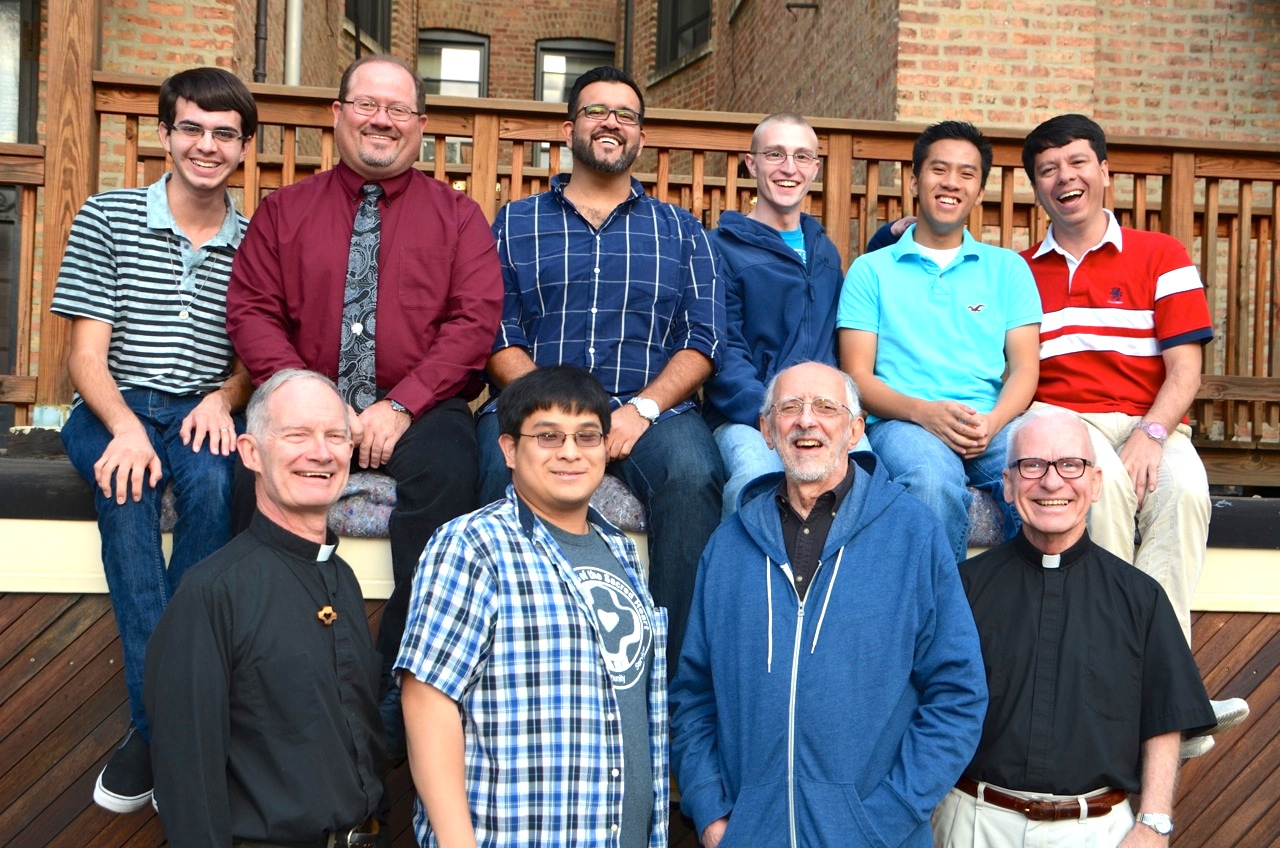
The Dehon Formation Community. Top row: Gabriel Gutierrez, Br. Duane Lemke, Juan Carlos Castañeda Rojas, Justin Krenke, Anthony Nguyen and Fra. Luis Fernando Orozco Cardona. Bottom: Fr. Tim Gray, Fra. Joseph Vu, Fr. Bob Bossie and Fr. John Czyzynski. Not pictured: Br. Clay Diaz.

Fr. Tim Gray, SCJ, who was a frequent contributor to the blog during his recent sabbatical, is a member of the Dehon Formation Community in Chicago. He writes about the community at the start of a new academic year:

Community members arrived in late August from all over the province, the country, and the world to begin the new school year. Once again, this year we have 12: six students in formation, three SCJs on the formation team, and three more in residence. Here is a brief introduction to the residents:

Joseph Vu, SCJ, from Chicago, has already drawn  comparisons with another Joseph: Joe Haselbauer. He is a whiz at math and computers, and can always be counted on to find the solution to almost any problem. Joseph is doing very well in his studies at Catholic Theological Union, but his heart is in his ministry to the youth at St. Henry’s parish on the north side.

Every community has “a quiet one” and for us that is “Jimmy” Nguyen, from Seattle, who usually lets his smile do the talking, but who is consistently expected to inspire us with his creative prayers. James loves the quiet and the opportunity to reflect that he finds in the novitiate program.

“Juancho”, (Juan Carlos) Casteneda, from Colombia, on the other hand, is constantly at the center of whatever social activity is going on, often in the kitchen , with joyful music at full volume. He also enjoys the novitiate as a break from the grind of studies and an opportunity to know Fr. Dehon better.

Fernando Orozco Cordona, SCJ, also from Colombia, like Juancho, misses his family and native land. He has been called “Juan Valdez” for his love of coffee and is always one of the first up in the morning to enjoy his cupful. He enjoyed his summer at Our Lady of Guadalupe in Houston and hopes to return there upon his graduation from CTU next spring.

Justin Krenke, from the Milwaukee area, is in his third year of candidacy, and attending St. Xavier college. As a convert, he is intensely interested in Catholic rituals and traditions and always keeps us on our toes with his comments and questions, not only about church matters, but also current events and pop culture. He was extremely impressed by the ministry done by Sacred Heart Southern Missions during his experience in Mississippi this summer. [Note: Justin wrote about that experience in a previous post on the this blog.]

Gabriel Gutierrez, from central California, is the “new kid” of the program, and is still getting adjusted during his first month in Chicago. He is very serious about his studies at St. Xavier, and keeps in touch with the news, especially church news.

Br. Clay Diaz, SCJ, from both Massachusetts and Puerto Rico, is in his last year of theology studies and looking forward to final vows. We are awaiting his return from his program in January, when he will return to studies and his ministry of tutoring children at The Port.

Br. Duane Lemke, SCJ, our home-grown SCJ from South Dakota, is the local superior and head of the formation team, and is already preparing for Halloween. He puts his creative talents to work in decorating the house, preparing social events, and leading community projects, such as canning fruits and vegetables under the “Sons of  Dehon” label. His latest interest is taking a course in mosaics. In addition to all this, he manages to supervise the house and the formation programs.

Fr. John Czyzynski, SCJ, from the great metropolis of Cleveland, is the novice master and continues to enjoy his ministry of formation, living in the house, and also his ministries outside the house. He spends a lot of time and  energy working with several homeless people in our area, with the goal of helping them live a more settled and secure life.

Fr. Bob Bossie, SCJ, thinks he has lost his “Bahston” accent, but we know better. Bob  officially retired from his ministry at Eighth Day Center for Justice and now stays closer to home. He still spends a great deal of time and energy caring for his brother, Paul, who suffers from a multitude of health problems.

Fr. Antonny  Wijaya, SCJ, from the Indonesian province, is studying for a degree in sociology, in preparation for teaching when he returns. Despite the fact that his evening classes make it difficult for him to participate in a lot of community activities, he has been a valued and well-liked member of the house.

Mr. Brian Fitzpatrick is a layman, a former seminarian with the Redemptorists, and a former classmate to several of our students, who has lived with us for most of the past year while studying for a degree in social justice.

As for me, Fr. Tim Gray, SCJ, I was born in Detroit but considered Houston “home” after 20 years there. Now I am back in Chicago as the newest member of the formation team, and have not yet tired of talking about my travels and exploits in Brazil during my sabbatical. I am working with the professed students in their last years of  theology and have located several Hispanic communities with which I will help out with weekend liturgies. I also hope to become involved in immigrant ministry.

Our house is at “the crossroads of America”, and hospitality is a major theme. Fortunately, we have several guest rooms, and they are often used. The weekend of October 5-7 was a “come and see” experience. Br. Ray and Br. Long accompanied two prospective candidates, Amir Fahrai and James Bartley, who got a flavor of the formation community. Keep them in your prayers as they discern their call.

Student “learns what ministry is” in Mississippi

Justin Krenke

I first heard about the things the SCJs are doing in Mississippi when Lois Harrison, the Volunteer Coordinator for Sacred Heart Southern Missions, came to Chicago to give a First Friday reflection. She talked about Dehon Village, the HIV/AIDs ministry, the food pantry, and of course, the number of parishes that they run. After listening to all of this I asked Br. Duane, my formation director, if I could go to Mississippi and experience some of these things for myself. I knew this would be a place where I would be able to look back and say that I truly learned something from my time there.

Most of my time working at Sacred Heart Southern Missions was spent with Sr. Betteann helping with the HIV/AIDs ministry. We spent a lot of time traveling in Sr. Betteann’s car. We were either going to Memphis to pick up food from the food pantry run by Friends for Life, or we were running to someone’s house to drop something off for them and seeing if they needed anything. We would stay for a little and they would talk with Sr. Betteann about their kids or their job and all the things going on in their lives. I was amazed at how Sr. Betteann was able to talk to each person and you would think they were the only person she works with, she knew each of these people and cared for them. But even more so I was amazed by her energy. Here was this 78-year-old nun who was constantly on the move, and when she wasn’t out of the office she was getting paperwork ready for people to fill out when they came to see her, she was putting food in bags for people, she was always answering her phone or writing an email. It was constant movement but it didn’t seem to faze her at all.

When I wasn’t with Sr. Betteann I was sent by Lois to work on a few projects. The one that sticks out the most in my mind was working at the home of Mr. and Mrs. Riley. The Riley’s had no flooring in their entire house, it was just the concrete from the foundation, and their walls were just drywall. I assisted one of the other volunteers in laying down wood flooring in the kitchen. Unfortunately they had tried to put in a floor before I got there but ran out of flooring and couldn’t find any that matched what was already down. So we had to rip up what was already there, and then try and put down the new stuff. It was hard at first because the boards refused to snap into place, but eventually things got easier as we got more of it laid down.

But we didn’t just lay down flooring while we were there. We talked to the Rileys during lunch and they would come in and see if we needed anything to drink, and during those few days we got to know a little bit about them and their struggles. When we finished the kitchen floor Mrs. Riley said that the kitchen “was now their favorite room in the house” and that just having a floor in that one small part of the house made it feel more like a home than house. Unfortunately I had to leave Mississippi before the rest of the floors in the  house were put in; however I did email Lois and she told me that the Rileys now have flooring in every room in the house as well as baseboards around the entire house.

While most of my days were spent working at Sacred Heart Southern Missions, the rest of the time I spent getting to know the SCJ community down there. What amazed me about the SCJ community in Mississippi wasn’t that they took care of six parishes, although that was impressive, it was that they were able to connect with the people in each parish and form relationships with them even though they weren’t the “permanent pastor.” Each of them was able to go and say Mass at any one of the different parishes and at the end of Mass talk to the people as if they were the permanent pastor and didn’t have another Mass at another parish where they would do the exact same thing. They knew people’s names and were able to joke with them and really connect with them.

I truly did learn something from my time in Mississippi; I learned what ministry really is. Ministry isn’t just about going and helping people and then when you’re done, moving on the next project. Ministry is about making connections with people, talking with them, and learning about and from them. It’s about showing people that you truly do care about their situation and you want to be able to help as much as you can, even if it’s just listening. I truly am thankful to all the SCJs, and all the people at Sacred Heart Southern Missions who really made my time down in Mississippi so enjoyable, and I can’t wait until I’m able to go back.

-Justin Krenke, SCJ candidate

Final reflection on Brazil

The small statue of Mary, Nossa Senhora de Aparecida, to which Fr. Tim refers in his reflection

The enormous impact of a tiny statue

As noted previously, Fr. Tim Gray, SCJ, spent the summer in South America, living and ministering with our SCJ communities there. This is his last blog entry from Brazil.

I want to conclude my reflections on my visit to Brazil by describing a fascinating symbol which, to me, says a lot about the church in Brazil. It is a statue of Mary, Nossa Senhora de Aparecida. The actual terra cotta statue is tiny — just over 12 inches tall. The statue was found in 1717, tangled in the nets of fishermen in the river Paraiba, stained dark by being submerged in the water.  It was recovered in pieces — first the body, then the head. The fisherman brought it home, and soon it became an object of devotion because of the many healings which took place. A sanctuary was built, and then enlarged, as devotion spread.

In 1930, Nossa Senhora de Aparecida was declared the principal patroness of Brazil and in 1955 construction began on a new sanctuary building which, according to reports, is second in size to St. Peter’s in Rome and the fourth most visited Marian shrine in the world. And in its place of honor, a 12 inch tall statue.

What continues to amaze me is the hold that this tiny, dark brown image exerts over the Brazilian church. Almost everyone is familiar with the gigantic white statue of Christ the Redeemer that watches over the city of Rio de Janeiro. Most churches I visited in Brazil have large, sometimes life-sized, gleaming white statues of Our Lady of Fatima, or Our Lady of the Rosary, or so many others, gazing longingly up to heaven; but none of these were chosen to be the principal patroness of Brazil. That honor goes to this small, dark statue, staring straight ahead, as if to say: I am one of you. I did not descend from heaven, supported by clouds of angels — I was brought up from the water, stained dark from the earth. I was not even whole; I was broken and healed.

This statue sums up for me the character of the Brazilian people and the Church in Brazil: multicultural, always concerned about the poor and oppressed, the little ones. As other memories and impressions from my travels fade and jumble together, this one symbol remains strong in my memory: we will not forget you, the little ones.

Personal note: as I return from my travels and settle in with the formation community in Chicago, I have decided to continue writing, and I have started my personal blog at thebodaciousword.blogspot.com I hope to see you there!

Fr. Tim Gray, SCJ

Latin American model of Church

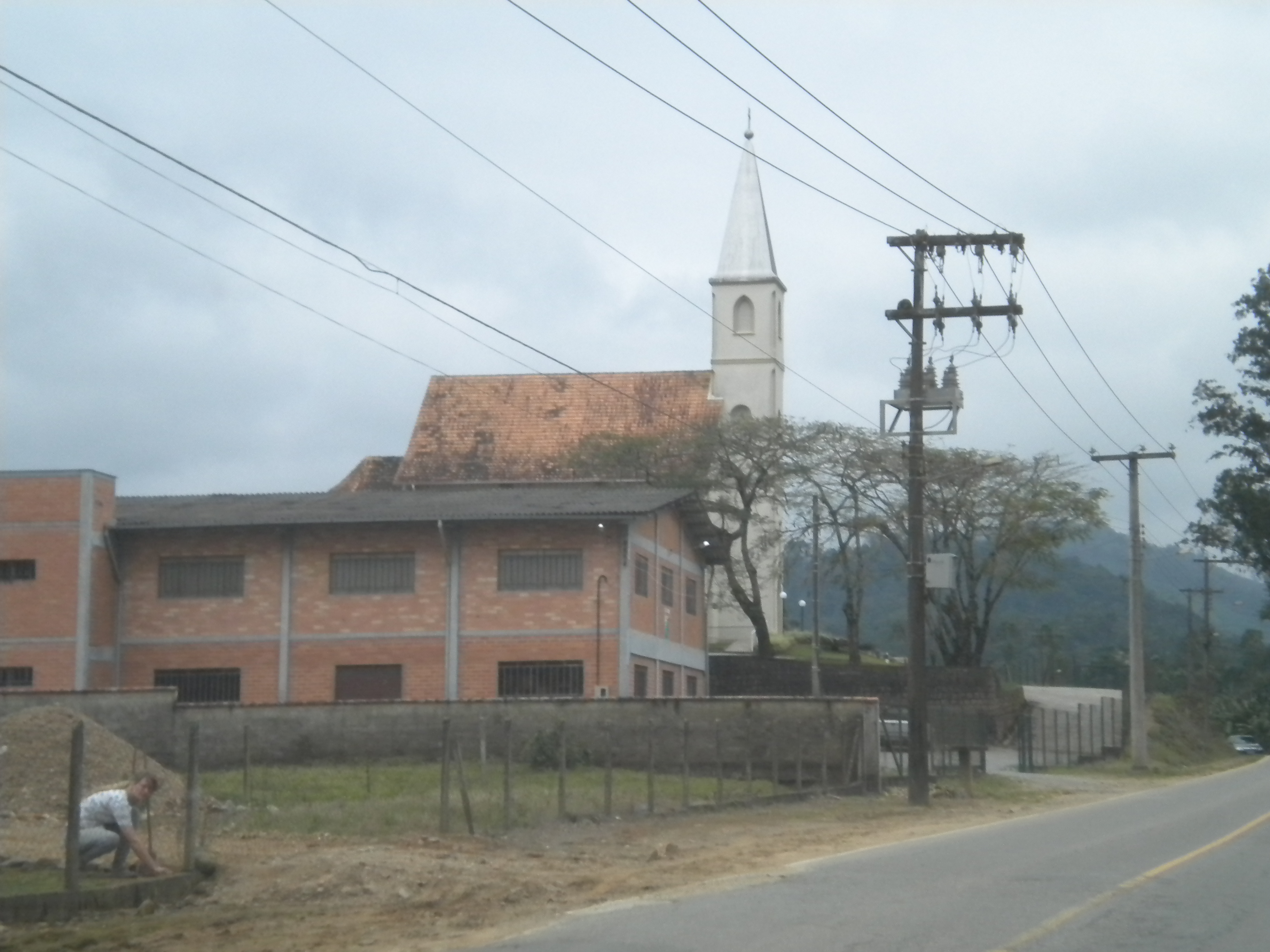
A parish community served by Nossa Senhora de Graca in the South Brazilian Province.

As noted previously, Fr. Tim Gray, SCJ, is spending the last part of his sabbatical in South America, living and ministering with our SCJ communities there. In early August he wrote the following:

On August 1 I headed to the South Brazilian Province, in the cooler part of Brazil that still has very strong European traditions (quite a few SCJs grew up speaking German at home and only learned Portuguese when they began school.)

However, while there may be European traditions, the church here is definitely run along the Latin American model — large parishes are composed of smaller communities, from half a dozen to 20 or 30, each community with its own chapel and facilities for religious education, meetings, and social activities. They are similar to what we would call “missions” in the United States. They range in size from tiny one-room buildings to large complexes.

I tried to explain to some of the SCJs how parishes work in the United States, and they were scratching their heads trying to understand how one large parish could only have one community. (Ironically, many US dioceses are now closing and merging parishes, and since we don’t have any other model of parish to work with, many people see a pastor’ being responsible for several different communities as a bad thing).

I also saw something else which was different from my own experience: all of the seminaries I visited — three in South Brazil, two in Central Brazil, and one in Maranhao — had SCJ parishes and other SCJ ministries in the same city, so that the seminarians were able to do ministry in an SCJ context, the other SCJs in parish ministry had “a home away from home” at the seminary, and the seminary would also serve as an additional resource to the parishes, for retreats and other gatherings. Lay Dehonians and other leaders would often be included in SCJ social gatherings.

Another surprise for me was the fact that nearly all the parishes I visited in Brazil published their own full-color, high quality monthly or bimonthly magazine, which contained not only the news which a weekly bulletin would carry, but also magazine-quality articles written by SCJ or other columnists — another indication of the SCJ commitment to education and training.

More than academics found in Spanish study program

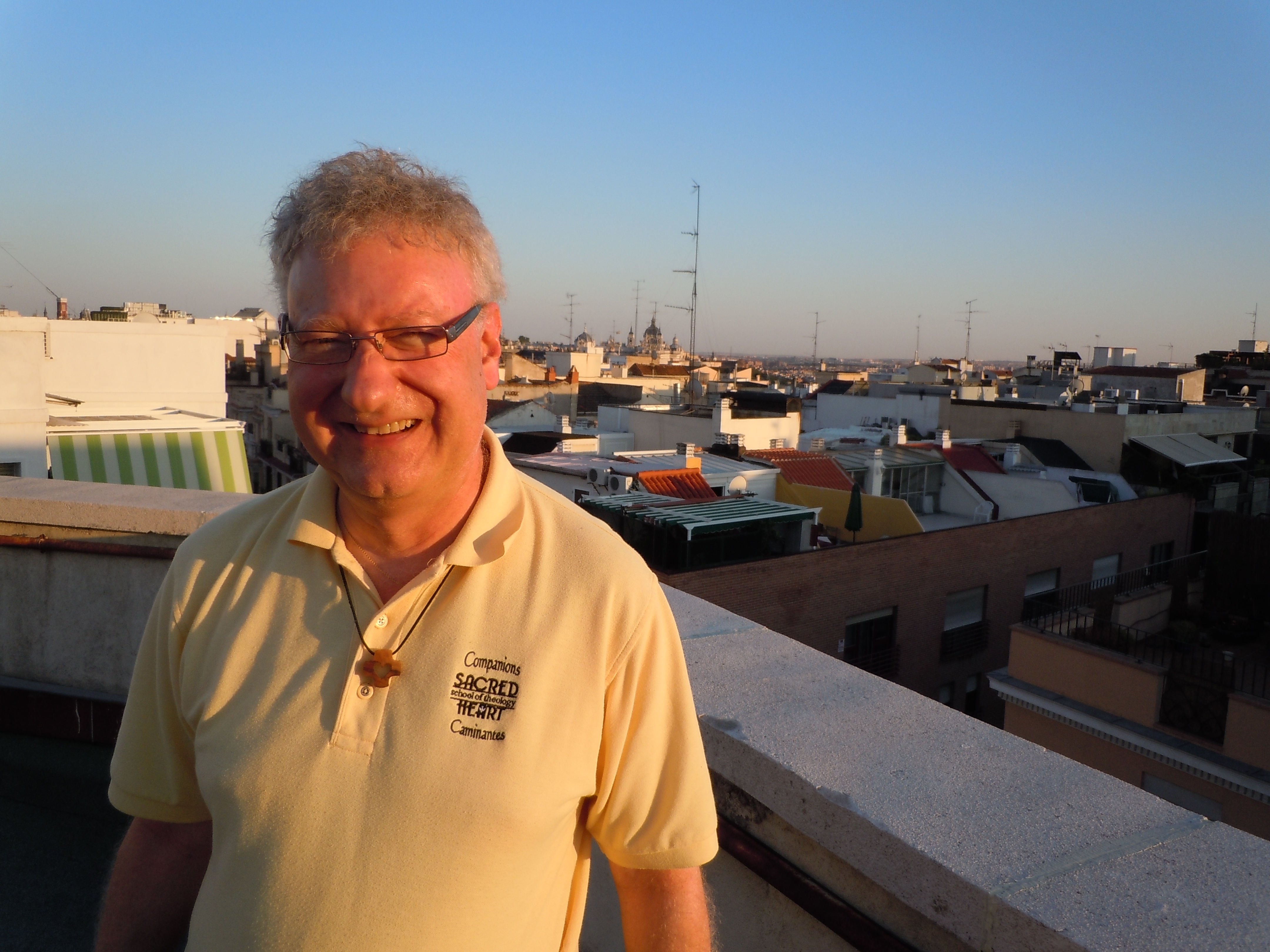
Fr. Jim Walters during his recent visit to Spain.

Fr. Jim Walters, SCJ, is director of the Hispanic Studies Program at Sacred Heart School of Theology. Through the fall semester he is on a sabbatical that began in Avila, Spain this year. He writes:

For years I had hoped to study the works of Sts. John of the Cross and Teresa of Jesus.  A year ago I became aware of a course offered through the Catholic University of Avila (UCAV), Spain.  The course is taught in Spanish and offers study from the original texts.

During my time in Avila, I chose to live with a community of Discalced Carmelites, three of whom were my instructors for the duration of the course.

What I had anticipated as an academic experience proved to be much more.  Our classroom sessions (Monday – Friday) were scheduled for three hours daily.  We were encouraged to spend four to five hours of study and praying with the major works of both saints in preparation for each day.  Saturdays were spent on visits to the historic sites relevant to the lives of John of the Cross and Teresa.  These included: Salamanca, Fontiveros, Alba de Tormes, Segovia, and Toledo, in addition to frequent visits throughout the city of Avila to monasteries, convents, and hermitages.

The challenge of working with 16th Century Spanish, at first seemed somewhat daunting, but an extensive research library was available with lexicons and contemporary Spanish translations and commentaries on the major works of both saints.  Our liturgies together focused our study on how each of us is called to live the vocation to contemplative prayer in the midst of daily ministry.  I was reminded often of Fr. Dehon’s hope that his sons would be contemplatives immersed in the struggles of the world.  I came to appreciate the spirituality of John of the Cross and Teresa of Jesus as one that very much calls us to appreciate and affirm the beauty and dignity in all of humanity and to empty ourselves of all that keeps us from living in union with God and one another.

The highlight of my time in Spain was a weekend pilgrimage to Santiago de Compostela.

Although time constraints prevented me from walking the Camino, I was able to make the trip by train.  I arrived at 7:00 AM and literally had the Cathedral to myself.  I concelebrated the traditional Pilgrim Mass with an international gathering of priests and the archbishop of Santiago, Mon. Julián Barrio.  Fortunately, I was able to witness the preparation and swinging of the “botafumeiro,” a four-foot thurible, used at special events including the novena of masses in preparation for the celebration of the feast day.

Although I was not able to connect with many SCJs from the Spanish Province due to summer vacations and other commitments, I was able to spend a day with the community at Colegio Fray Luís de León in Madrid.  They were very hospitable and gave me some great insights into our ministry in education throughout Spain.

I am truly grateful for the opportunity to have studied in Spain and have been enriched by the deep spiritual life very much present throughout the country.  Wherever I went, people recognized our congregational cross and the “padres reparadores.”

-Fr. Jim Walters, SCJ


The favelas of Brazil

As noted previously, Fr. Tim Gray, SCJ, is spending the last part of his sabbatical in South America, living and ministering with our SCJ communities there. On July 31 he wrote the following:

Fr. Tim Gray

On Friday, during my last week in Rio de Janeiro, I was taken on a visit to the favela (slum) served by the SCJs at the other parish, Bom Jesus de Penha. Unfortunately, there was not room for me to stay at the rectory there, so my visit was limited to a day trip.

Even if I had more time and space to describe a favela, it would be difficult. You can Google it to get a rough idea. Try to imagine a small city, broken into many pieces, and jammed back together chaotically. Many of the pieces of a city are there, but not as you expect. Almost everything looks temporary, or under construction, which it probably is.

The favelas, while they started quite randomly, are also like a laboratory in which many types of social experiments have been tried, both by governments as well as NGOs and others. What would be safe to say is that whenever the powerful act, whether it is the government, or business, or drug lords who normally control the favelas, the poor pay the consequences.

Fr. Renivaldo, who had worked in this parish as a seminarian and had visited many houses here, drove me up the steep alley leading into the favela, waving at people he recognized. We saw one of the six chapels in the favela itself; they serve the same purpose as parish chapels anywhere else in Latin America — a place where Mass is celebrated on certain days, and a community center for many types of meetings and classes during the week. The chapels were the one part of the favela that seemed most “normal” — and I think that sums up the presence of the SCJs there: to give people an opportunity to live at least a part of their lives in a way that gives them respect and hope.

The parish church at Bom Jesus is huge, since it serves a wide area, including the favela. It offers seven weekend Masses, confession and Mass every day, and serves as the meeting place for larger gatherings, such as the novena of Masses, talks, and celebrations to prepare for the parish feast on August 5. I noticed that the local committees from each of the chapels were represented in the parish activities, so that it is not just ministry TO the favela residents, but BY them as well.

As I found in all of our Dehonian parishes in Brazil, there is a very great commitment to education and formation of adults for ministry and community.

Although the Brazilian Catholic Bishops consistently stress their concern for the poor and oppressed, resources are always limited. Not all favelas receive attention from the local parish. It is small wonder that evangelical churches are multiplying across Brazil, to fill a gap the Catholic Church cannot. Despite the fact that the faith came to Brazil nearly 500 years ago, many parts of it still remain mission territory.

-Fr. Tim Gray, SCJ