Category Archives: Uncategorized

Easter in the Philippines

Fr. Bernie Rosinski, SCJ, is spending several weeks in the Philippines assisting the SCJ district there with administrative duties as well as helping students in the multi-national formation program with their English.  He recently shared the following:
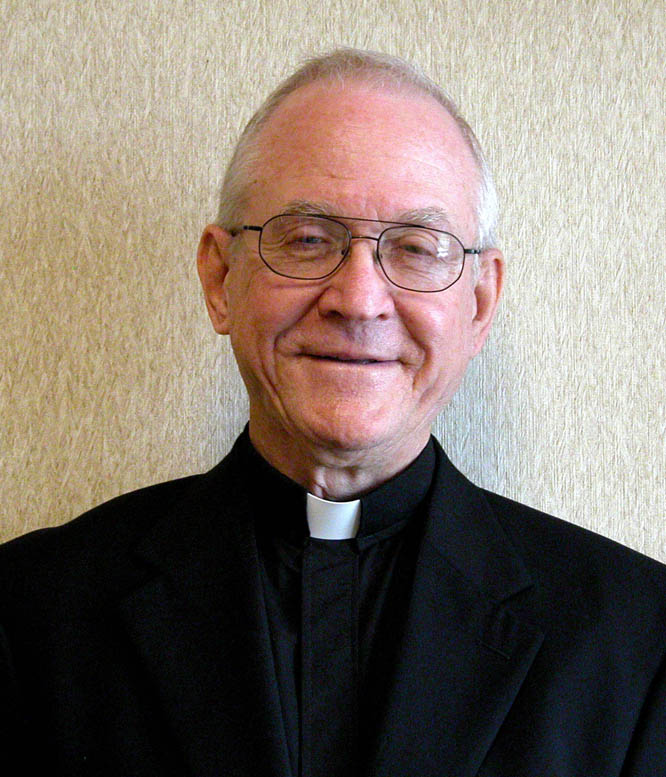
Fr. Bernie Rosinski, SCJ

On Easter Sunday, I went by car from Cagayan de Oro to our novitiate in Dumalinao, about 200 miles away; a five hour trip that took closer to eight. We traveled west along the northern coast of Mindanao. We stopped at a hospital, privately owned (this is possible in the Philippines), where the owner — a doctor — hosted us, together with his wife. I actually ate whole roast pig and a number of other delicacies. So this stop was part of the delay.

The Philippines sunrise is about 6:10 a.m. and sunset is about 6:30 p.m. daily. The islands are so close to the equator so day and night are almost equal. Part of our travel took place after dark. Fr. Bene Machado, SCJ, was the driver. He is Brazilian and Brazilians are great racing car drivers.

The entire highway was concrete. Except for one large industrial city, it was two lane. Let me describe the highway a little more. It has no shoulder. The highway is used by: (1) people who walk (usually in their “floppies” or flip-flop sandals) on either side of the highway, whether with or against traffic, and sometimes people sit on the side of the highway which, with a shoulder, resembles a seat or step on which to sit; (2) people with simple bicycles; (3) cyclists with racing bikes; (4) small motorbikes; (5) small motorbikes with side cars for transporting goods or passengers (usually without lights); (6) motorcycles; (7) motorcycles with sidecars for transporting goods or passengers; (8) “jipneys,” which are elongated Jeeps used for transporting people and goods [in this category are also SUV’s which are converted to the same purpose] and which make frequent “bus” stops along the highway; (9) large buses, which also make frequent stops along the highway; (10) big Kawasaki and Honda motorcycles, which can speedily weave in and out of traffic; (11) big trucks carrying cement, goods, gas and oil, and grain; and (12) cars, like the one we were in.

The faster vehicles overtake and pass the slower vehicles as you may well imagine. I am sure that if a helicopter were above us, the pilot would think the entire state of Mindanao was inebriated because there was so much weaving in and out of traffic. Nighttime made it worse. I couldn’t even see the pedestrians and bikes that we were passing. How Fr. Bene managed to drive without killing people, I’ll never know.  We did see two accidents. In both cases, a car struck a motorcycle.

The entire trip reminded me greatly of an event from my past when Fr. Bourgeois [former superior general of the Priests of the Sacred Heart], having just recently learned to drive, drove down the middle lane of a three lane highway. I saw cars pulling into that passing lane and then, just as quickly, returning to their regular lane. Fr. Bourgeois had the center track and he (we!) weren’t going to give it up. When we got to where we were going, I remembered that I lost my stomach.

After an equally crazy drive in the Philippines, I wondered if I would do the same. This time, I didn’t.

The novitiate was quite nice, quite scenic, and the people were exceptionally hospitable.

In the time I have been here I traveled to see Kumalarang and Margosatubig places where the SCJs have ministered, and witnessed a final vow ceremony. All in all, my stay was very pleasant.

Our return trip was no less chaotic, but at least it was in the daylight and took about two-and-a-half fewer hours.

Upon my return, I finally began teaching English. I have two groups: one is made up entirely of Filipinos and one is primarily Vietnamese.

So much for week one in the Philippines!

-Fr. Bernie Rosinski, SCJ

Ash Wednesday, a time to be sensitive to words

Reflecting on Ash Wednesday, Fr. Cassidy writes the following:

Today marks the start of the great season of Lent as Christians throughout the world seek to purify their hearts in preparation for the drama of Holy Week culminating in the celebration of the Resurrection. Lent is traditionally a time of prayer, fasting and penance. Vatican Council II changed our sense of fasting and penance. Wisely, I think, the emphasis has been placed on our personal responsibility to practice prayer, fasting and penance as suits our personal circumstances, rather than on a mandated set of practices. It has not eliminated them, and I would argue that today, more then ever, there is a great need for Christians to practice even more fervently prayer, fasting and penance during this Lenten season.

I would like to spend a moment with you meditating on the first aspect of these pillars of Christian Lenten spiritually. A few days ago Inward/Outward, an e-mail service providing brief meditations from the Church of the Saviour, sent this meditation by Abraham Joshua Heschel out to its subscribers:

“One of the major symptoms of the general crisis existent in our world today is our lack of sensitivity to words. We use words as tools. We forget that words are a repository of the spirit. The tragedy of our times is that the vessels of the spirit are broken. We cannot approach the spirit unless we repair the vessels.

“Reverence for words — an awareness of the wonder of words, of the mystery of words —  is an essential prerequisite for prayer. By the word of God the world was created.”

Wordsmiths we are well aware of the power of words. Frequently at our council meetings I am reminded that “words do matter.” Words can heal as well as hurt. Words can forgive or condemn. Words can uplift or tear down. Words can be tender or harsh. Words are at the very heart of human communication.

I was struck with Herschel’s phrase “words are a repository of the spirit.” Words, of course, come in as many languages as human beings speak. I have no idea how many there are, but I do recall reading a number of years ago that on any given day over 600 languages and dialects are spoken in California.  The Bible’s story of the tower of Babel blames man’s hubris as the source of the multiplicity of languages. I like to think that if words are indeed a repository of the spirit then perhaps we need all of humanity’s languages and dialects to come to a fuller understanding and reverence of the WORD. For John tell’s us: “In the beginning was the Word, and the Word was with God, and the Word was God.”

Spiritual writers tell us that as we progress up the ladder of prayer our need for words lessens and our ability to abide in the presence of the WORD increases. Most of us never reach that level of prayer where words are unnecessary. But if we are ever to achieve that level of contemplation then we better take to heart what Herschel has to say that words are wonder, words are mystery and if we can reverence words then we can begin to reverence the WORD.

Maybe this Lent, when around us we see so many examples in our society of men and women using words to preach hate, prejudice, selfishness and countless other attitudes that tear down individuals and our society, we can, as our president has called us to be, more civil in our personal, political and societal discourse. Perhaps our use of words can be for us an act of penance as we take the time to think before we speak and reverence our neighbors by reverencing the words we use when we speak to them or about them.

Perhaps our use of words can be for us acts of prayer, penance and fasting. I suppose it’s a stretch to say our use of words can be an act of fasting. But doesn’t fasting mean to refrain from something, most often food? Refraining from ill speech that hurts another seems to me to be a great way to honor the season of Lent.

This Lenten season I hope we all will find ways to prepare ourselves for the great drama of Holy Week and the joy of Easter. Using those tried and true pillars of spiritual growth, prayer, fasting and penance, certainly bear the test of history as a worthwhile means of moving forward in our spiritual life. Recognizing the power of words come Easter morning may we all have on our lips these words: Christ has risen.

Fr. Tom Cassidy, SCJ
Provincial Superior, U.S. Province

20 Minutes at the Rec Center

Note:  Mike Tyrell is executive director of Child Services at St. Joseph’s Indian School in Chamberlain, SD.  Periodically he sends reflections to the St. Joe’s staff with  “a note of thanksgiving, because we are all very lucky to be working with our mission here at St. Joseph’s Indian School,” he said.

The Rec Center at St. Joseph’s Indian School provides recreation, athletics, and other activities for students and staff.  The facility houses a gymnasium, exercise room, student game room and an indoor pool.  Three Rec Center staff and a custodian oversee programming and facility upkeep.

Mike Tyrell

On Saturday morning I happened to find myself in one of those unique but fun 20 minutes in our Rec Center.  As I was winding down my workout, a houseparent came into the workout room with one of the boys from his home.  He was working with the student teaching him to properly lift weights.  It was nice to see the mentoring going on and the student following the houseparent’s lead.

As I left the workout room, I found the Ambrose Home students waiting rambunctiously to go to wresting practice.  We have not had a wrestling program in a few years and it was their first practice.  As we do not have a wrestling mat, the kids and houseparents were waiting for the mini-buses to take them to the public school’s wrestling room.  The boys looked as if they were on tender hooks as they waited to get going.

I then wandered into the Rec Center gym where two houseparents were setting up an Archery Course for the students.  Today was the first day of training our students on how to safely shoot a bow and arrow.  The staff, who were recently certified in archery training, were eagerly awaiting the students’ arrival.  In talking with the staff, you could tell they were excited by their enthusiasm for the activity.

As I left the gym, I noticed two students reading books.  Apparently these students were in trouble and reading was part of their discipline.  One boy showed me that he was reading The Prince of Egypt and I wondered if I could get an oral book report down the road.  Both boys were also watching the archery range being set up with great interest.  If this was discipline, they appeared to be having a good time.

As I was leaving the facility, the second of two Rec Center staff showed up.  They were looking forward to a busy morning followed by an afternoon of bowling.  As I left the building, the snow was falling heavily and piling up.  It was surreal as I thought of all that was going on at the Rec Center and across campus on this cold, snowy January day.  It made me thankful for the fact that we are fortunate in what we are able to provide for our students.

Mike Tyrell

Indonesia celebrates ordinations in new chapel

Archbishop Aloysius Sudarso, SCJ, of Palembang, ordains three men to the priesthood and four to the diaconate on January 25.

Today, on the Feast of St.Paul’s Conversion (January 25), the Indonesian Province is celebrating ordinations in the big new chapel of St.Paul Minor Seminary.

First, a bit about the seminary.  It was built in 1947, occupying a corner of a piece of land that was close to 10 acres in size, a marshy area that easily absorbed excessive amounts of rain.  Over the years, more landfill has been brought in to keep the buildings and their inhabitants dry.  It is now a quite elegant and suitable place, able to accommodate the more than 100 seminarians who regularly occupy it, plus the staff, which presently includes four SCJ priests, two Franciscan sisters and three full-time lay teachers.

The chapel easily seats 400 people, but tents have been set up on one side and in front of the entrance so that up to 2,000 people can be seated for the occasion.  I have been here for about a week and have seen the progress of the preparation committee as they go about their business; I am truly impressed.

Archbishop Al Sudarso will be in his glory when officiating at today’s afternoon service surrounded by more than 100 priests in the sanctuary with him, the majority of whom will be SCJs but a significant number priests of this diocese as well.

Those to be ordained to the priesthood will include two SCJs and one diocesan man.  Receiving diaconate ordination will be two SCJs and two diocesan men.  The two new SCJ deacons, by the way, hail from the Indian District.  Rinu and Hrudayaraj have been learning the Indonesian way of doing ministry for almost  two years now.  The two new Indonesian priests are Indri Irianto and Tri Mardhani.

There was a grand rehearsal last evening conducted by our learned and dedicated liturgist-in-residence, Fr. Agus Setyoaji, an SCJ graduate from a Manila university with a master’s degree in liturgy.  He has composed several booklets and many hymns for divine worship.  For the choir we have Miss Lena, who for the last 20 years has been praised for the perfectionist way she trains groups of singers for polyphonic music.  We already have heard what she and her high school singers will be rendering for us this evening since their practice sessions were carried our in the Xaverius school next door to our seminary.

I will try to send a little follow-up after the event, which most appropriately would be accompanied with some photos.  Who knows what might develop.  Even with the tents in place, we are still praying that it won’t rain.  Yours truly,

Fr. Tom Fix

School days in India

Originally from the U.S. Province, Fr. Tom Fix, SCJ, has been a missionary in Asia for most of his priesthood.  Now a member of the Indonesian Province, he often works for extended periods of time with the formation program in India.  He wrote the following from Aluva, India:

Fr. Tom Fix, SCJ

It’s a bright sunny morning here in Aluva, just like it was yesterday. But yesterday afternoon and evening turned up something else: an electrical storm with lots of rain.  The monsoon is taking leave of us with more than a whimper.  However, our students have a different kind of storm occupying their minds –– exam time has arrived.

At table the students ask me if I had much “symbolic logic” in my day, or what I thought of “aristotelian metaphysics.”  I can wiggle out of these two, but not when they ask how much Indian Philosophy we had.  No fair!  But we have a nice library, so I can catch up if I so wish (just like I can learn the Malayalam language, yes, “if I so wish!”  but I think I’ll go back to reading what the Packers did last Sunday…).

All of which points to the things that keep one young while residing in a place monopolized by “yoot” (the way those from my hometown of Milwaukee often pronounce “youth”). We have 40  here this year.  After these first semester exams there will be a break of only six days, during which the two upper classes will go on retreat while the the youngest will take a course on the psychology of personalities (or what we used to call ‘temperaments’).

The larger picture — what the Indian District is up to — has us preparing for the final vows ceremony on December 8 and ordination to diaconate on January 2.  The former will be here in our philosophy house in Aluva, while the latter will move to the theologate in Eluru.  Between the two houses is a train ride of a day-and-a-night.  Already we are booking tickets both ways.  Unfortunately, I’ll have to miss both, since it will be my time to return to Indonesia, where I must wait a two-month interval before applying for my next six-month visa back here.

We are grateful that the young Indian priests are now stepping into roles of leadership and formation, easing the pressure on the missionaries.  Fr. Sunil Roman, for example, just came back from Ireland after finishing coarses in spirituality, coupled with assistance in one of our parishes in Scotland.

That’s all that comes to mind at the moment.  Every best wish and regards to everyone nearby.

Fr. Tom Fix, SCJ

A year at St. Joe’s Indian School

Br. Clay Diaz, SCJ

My name is Br. Clay P. Diaz Vlaida, SCJ; I am currently working at St. Joseph Indian School in Chamberlain, South Dakota. I have been at St. Joe’s since December, 2009, and continue through mid December. This is a part of my pastoral ministry year before starting my studies at Chicago Theological Union in Chicago.

I was working with the high school level students and with the house parents in a support role. My role with the high school students was to tutor them in English, science, history and other courses –– except for math, which is not my specialty. With the house parents I helped them with transportation and in other areas as they arose.  I also observed and helped with the Native American class and the computer class at the elementary school.

I have truly enjoyed working with the high school students. Starting in August I will move to the elementary and middle schools, once again tutoring tutoring students.

I enjoy working at St. Joe’s because of the great people both at the homes and in the different academic departments. The atmosphere on the campus is such a unique experience. I have learned a lot about the Native American culture and continue to learn because each day is a new learning experience. I have participated in different events throughout the campus, such as bowling and a 7th grade cultural trip.

I’d be happy to share my experience with others who are interested in learning about the Native American culture.  Of course, my experience is that of someone who is new to the culture and to South Dakota, having been in this ministry for only six months.

God Bless!

Br. Clay Diaz, SCJ

EDITOR’S NOTE:  Br. Clay will be renewing his vows on July 23 (8 a.m.)  at St. James Church in Chamberlain, S.D.  Fr. Bill Pitcavage, newly elected provincial councilor and pastor of St. James, will receive his renewal. “I am looking forward to renewing my vows with our community,” said Br. Clay.  “For me it is a true blessing being a member of the Priests of the Sacred Heart.”

People really do say “eh?” in Canada; awesome!

The following is written by Novice Joseph Vu who, along with Novice Fernando Orozco and Novice Master Fr. John Czyzynski, are visiting SCJ ministries in the Canadian Region.

Look out Canada, here comes the good ‘ole US of A!

Still cool from winning the Stanley Cup, a handful of Chicagoans head to the land that gave birth to the sport of Hockey!

Us heading to Canada…and wouldn’t you know it…EVERYONE ELSE is too!

The SCJ novices have skidded their way to the doorsteps of the SCJs of the Canadian province. We left the house at 7:00 AM (that’s right, AM!!!) and made our way to the chilling north. Unfortunately, “chilly” doesn’t fit the bill. I’m not much of a meteorologist, but I think I am quite accurate in saying that the temperature in the city of Toronto, Ontario, is “egg-cook-able-sidewalks” HOT.

Actually, in all seriousness, Canada is not as different as one would imagine. Well, except that the official national languages are English AND French… and that means that my Spanish dictionary is totally useless! (I threw it out the window at the Ambassador Bridge)

The bridge!

A cool difference about Canada is that you can drive really fast on the freeways, where the limit is 100… kilometers, that is.  Ha, ha!

Anyways… the novitiate has landed unto Canadian soil, and of course we paid homage to the Queen as we made our way on the Q.E.W. (there was an old lady with really regal clothing standing at the split directing us to the Q.E.W., but I didn’t catch her picture in time). Although we were in a ‘foreign’ country, I still felt a little bit at home. The “Queen” was a little backed up today — a little slice of Chicago traffic just for little ‘ole me.

The SCJ house in Toronto

After long hours of being in the car (I slept most of it, so it felt really quick), we finally made our way to the SCJ community house in Toronto. The house is on a street that is called Hyde Park, which is amazingly the name of the neighborhood where the SCJ Chicago Formation house is located. (What happened to originality!?)

More to come soon!

JJ, aka: Joseph Vu

“Seize for God the Energies of Love”

I returned this weekend from the Canadian Religious Conference Assembly held in Montreal from May 27-31, 2010. This year’s theme: “Seize for God the Energies of Love: choose to live the vowed life.” While here in the States we have separate conferences for men and women religious, Canada, like many other countries, has one conference representing both men and women religious. And as in most countries the women outnumber the men by a considerable number. Thus the vast majority of attendees to this year’s conference were women religious. It would be interesting to know what the ratio of women to men is but from my observations it would be similar to when CMSM and LCWR hold a joint assembly as they did two years ago.

As president of CMSM I was a guest of the conference along with my counterpart from LCWR and CLAR. It was a good opportunity for each of us to rub shoulders with religious in Canada who face many of the same issues we do in the States. One of the major differences that is readily apparent is the bilingual nature of the conference and Canadian life. Everything was conducted in two languages with simultaneous translation provided. French-speaking religious far outnumber their English speaking counterparts. This should not come as as surprise with the historical Catholic presence in Quebec.

There is a real effort made to give due time to each language. A good example of that is the two keynote speakers. The first, Fr. Sidbe Sempore, a Dominican from Africa, spoke in French. While Sister Elaine Prevallet, a Sister of Loretto from Kentucky, spoke in English. Fr. Sempore’s theme was: In a Multidimensional Africa, Giving One’s Life out of Love. My years of service on the general council plus my own trips to South Africa and on one occasion to Mozambique helped me understand the reality Fr. Sempore was trying to describe. So often we think of Africa and in our mind’s eye have equatorial Africa in view. Africa is not a country but a continent filled with many tribes, cultures and languages. It is an area of rapid growth for the Church while at the same time a place where Islam and Christianity often intersect.

Religious life, though born in northern Africa centuries ago, has been shaped by Europe. Now that it has returned to Africa finding the balance between Western understanding and African realities is a challenge and at the same time an opportunity. His talk is available on the CRC’s website.

Sister Prevallet’s presentation was entitled: Religious Vows: Energies of Life for Life. As the introduction to her talk that is also found on the CRC’s website states: On this second day of the assembly, Sister Elaine Prevallet, SL addressed the vows of consecrated life in a totally new perspective. “The whole earth needs to be included in our understanding of our vows,” she said. “Life is one energy and it expresses itself in us and through us. With all of creation we then form a community of life.”  In this way, there are three types of energy at the root of the vows. How, therefore, do we keep these energies free to flow into a life of discipleship?

In addition to these two presentations, one of the real values of attending such a conference is the opportunity to meet fellow religious and the opportunity it provides to exchange ideas. We have much in common but we also need to recognize that the Canadian reality is a story all its own. Their history and experiences are unique to Canadian history and circumstances.

Fr. Tom Cassidy, SCJ

A gathering of north and south

Meeting of the Inter-American Committee

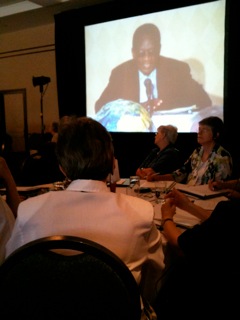
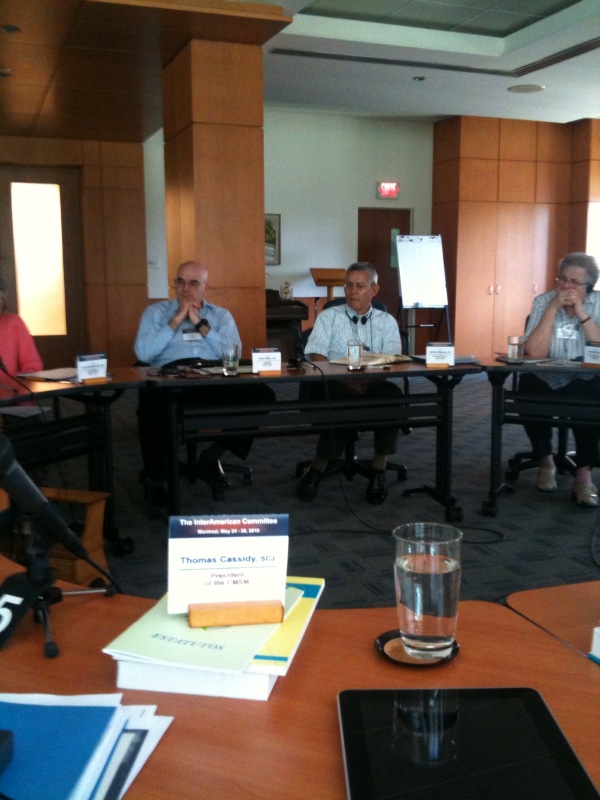
Yesterday we finished our three day meeting of the Inter-American Committee Meeting held at the Providence International Centre in Montréal. CMSM (Conference of Major Superiors of Men) and LCWR (Leadership Conference of Women Religious) met with their counterparts in the CRC (Canadian Religious Conference) and CLAR (Conference of Latin American Religious). CLAR represents the religious conferences of Latin America, Central America, Mexico and the Caribbean. It is an annual gathering with the CRC acting as hosts. Next year it will be the turn of CMSM and LCWR to do the same.

In addition to reporting on events in our respective regions a full day was devoted to the devastation wrought by the terrible Haitian earthquake. First we looked back at how it has affected religious communities and religious life; this set the stage for looking ahead as to how best to assist in the rebuilding that needs to take place, rebuilding not only structures but human life and spirit as well.

From the first word of the disaster both CMSM and LCWR were aware that the media would focus its attention on the devastation but no one would be telling the story of how it affected religious; their institutions and their members. A conscious effort was made to gather information on how religious were affected and to transmit that information to our members.

The Inter-American Committee looked at ways it might offer assistance through the religious conferences of our respective countries. There is no easy answer. However, past experience might prove to be a good teacher. After the devastation of Hurricane Katrina through the auspices of LCWR and CMSM religious partnered with religious communities directly affected by the flooding in New Orleans (and other areas) to assist them in their rebuilding efforts.

Last summer LCWR held its national conference in New Orleans and viewed first-hand how their efforts helped religious and their ministries come back from those dark days.

We were greatly assisted in our discussions about the situation in Haiti by Sister Kesta Occident, CSC, superior general of the Sisters of the Holy Cross and a native of Haiti. In addition to speaking about the current situation in Haiti and what needs to be done, Sister Kesta also spoke about how the earthquake might reshape religious life itself.

Our gathering was not all work, however. We did take an afternoon to visit Notre-Dame Bon Secours Chapel, museum and archeological findings. It date back to 1655 and the founding of Montréal. The museum presents the story of the development of Montréal and the Notre-Dame Bon Secours. It is really the story of Marguerite Bourgeoys who was born in 1620 and came to Montréal in 1653. She founded the Congrégation of Notre Dame and was canonized in October of 1982 by Pope John Paul II.

Next March the Inter-American Committee will meet in the United States hosted by CMSM and LCWR. Though we have not pinned it down, most likely the meeting will take place in the Washington DC area since the two conferences are based in nearby Silver Spring, Maryland.

And now with the close of our international gathering I have moved to the Airport Wyndham Hotel where the Canadian Religious Conference will hold its annual four-day assembly. Due to my own schedule I will only be able to attend the first two days before heading home.

Fr. Tom Cassidy, SCJ

Pentecost in French Canada

It is Sunday morning and we have just concluded celebrating the feast of Pentecost, the Church’s birthday. I am at our SCJ community house on Boulevard Gouin having arrived here late Friday afternoon. The community currently consists of eight SCJs but only seven are in the house at the moment. Fr. Zenon Zendkici, scj, from the Congo is here on a sabbatical year but at the moment is in Ottawa. I’m sorry I missed him as Zenon was studying in Rome while I was a member of the general administration. One of the perks of living in Rome is that over time you come to know many SCJs from around the congregation who pass through the house or live there for a time. It really gives you a sense of the internationally of the SCJs who are now working in 38 countries around the globe.

We added, or are in the process of adding, number 38 this year when a cooperative effort of several of our Latin American Provinces will begin a new mission in Paraguay. Most of our Latin American Provinces are small outside of Brazil where the SCJs, especially in the south, have flourished. Support in the way of personnel from Brazil will be very helpful to this new project. The province of Argentina and the district of Uruguay are also participating in the Paraguay project.

Even here at Boulevard Gouin one immediately senses the internationality of our congregation. Walter van Aas is an 86 year old Dutchmen who came to French Canada a long time ago and worked for many years in parishes about an hour outside of Montréal. Fr. Rein van Leeuwen, scj, as I reported in my last bog, is also from Holland and spent most of his life working in Indonesia. We were reminiscing last evening that he was my guide on my first trip to Indonesia in 1990. Br. Dieudonné Tchouteu, scj, came to French Canada about ten years ago from our province in the Cameroon. Finally Fr. Claude Bédard, scj, a French Canadian, spent many years working in the Congo. In addition to Claude, Br. Luc Coursol, scj, Fr. Roger Phaneuf, scj, and Fr. Maurice Légaré, scj, are also French Canadians.

Fr. Claude Bédard serves as chef of the day in Montréal

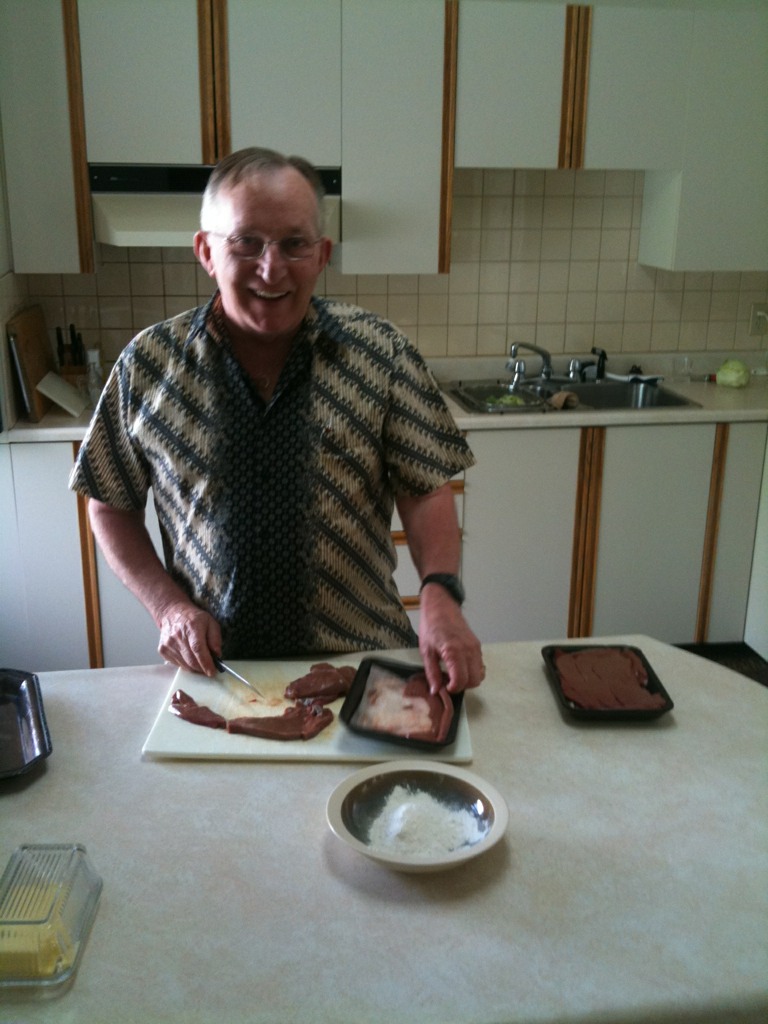
Maurice is an excellent cook and serves as the weekend chef for the community. His back-up is Claude who is in the process of preparing the noon dinner as I write this. Maurice is helping out in a special blessing ceremony at a nearby parish so today’s meal is in Claude’s hands.

Even simple things like meal customs and foods are a reminder of how international we SCJs really are. Here in French Canada, for example, soup is a part of every noon and evening meal. Wine, when it is served, tends to lean very much toward French varieties where as back home we might be a bit more eclectic in our choices. Finally, the language of the house is French though with me around English is freely spoken as well since my French is very limited, to say the least.

Later this afternoon I will head to the Providence International Centre to prepare for our Interamerican Committee Meeting. It will kick off this evening with an informal gathering at 7:30 PM. This year’s theme: Crisis in Haiti: How is it a sign of the times for us? How do we respond? Its stated objective: To share ideas on how today’s religious can be present with the poor following the crises in Haiti and Chile.

The SCJs do not have anyone serving in Haiti, however we do have a small province in Chilie and even though by and large they escaped the havoc caused by the earthquake it will be interesting to learn from our Latin American representatives from CLAR how the earthquake has impacted religious in Chile.

Thomas Cassidy, scj