First stop: Mumbai!

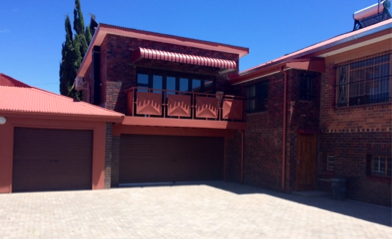
A typical residence near a mission attached to the SCJs' parish in Thane (Mumbai). Fr. Tom Cassidy's first stop in India was with the SCJ community there.

A typical residence near a mission attached to the SCJs’ parish in Thane (Mumbai). Fr. Tom Cassidy’s first stop in India was with the SCJ community there.

A multilingual, multicultural ministry

After completing his term as provincial superior Fr. Tom Cassidy is spending several months visiting the locations for which he had responsibility when he was on General Council. From mid-January until the beginning of March he will be in India, where he will assist in the district’s theology program. The following was written soon after his arrival in Mumbai: 

It is always a bit disconcerting landing in a strange city (though this is actually my second visit to Mumbai) and expecting a ride, hoping nothing goes wrong. Happily, Fr. Aji was there to greet me. When all was said and done it took us about an hour to get to our SCJ house (less than 14 miles from the airport). Even though we left the airport after 10:00 p.m. there was a lot of traffic on the road. Mumbai, like many mega-cities, is one that never sleeps.

On the way to our house Fr. Aji asked if I would be willing to be main celebrant at the 7:00 a.m. parish Mass. It would make for a short night but I would probably be awake anyway so I agreed. I stayed in a house just in front of the parish that belongs to an elderly gentlemen who has been very generous to the Priests of the Sacred Heart. The elderly gentlemen, whom they call “Uncle,” is in the hospital recovering from surgery. I had the chance to meet him this morning as the hospital is only a half a block from our house.
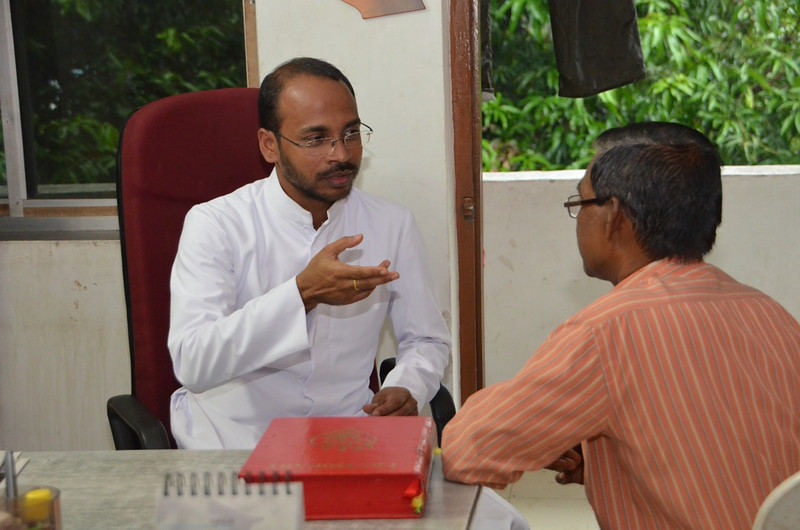
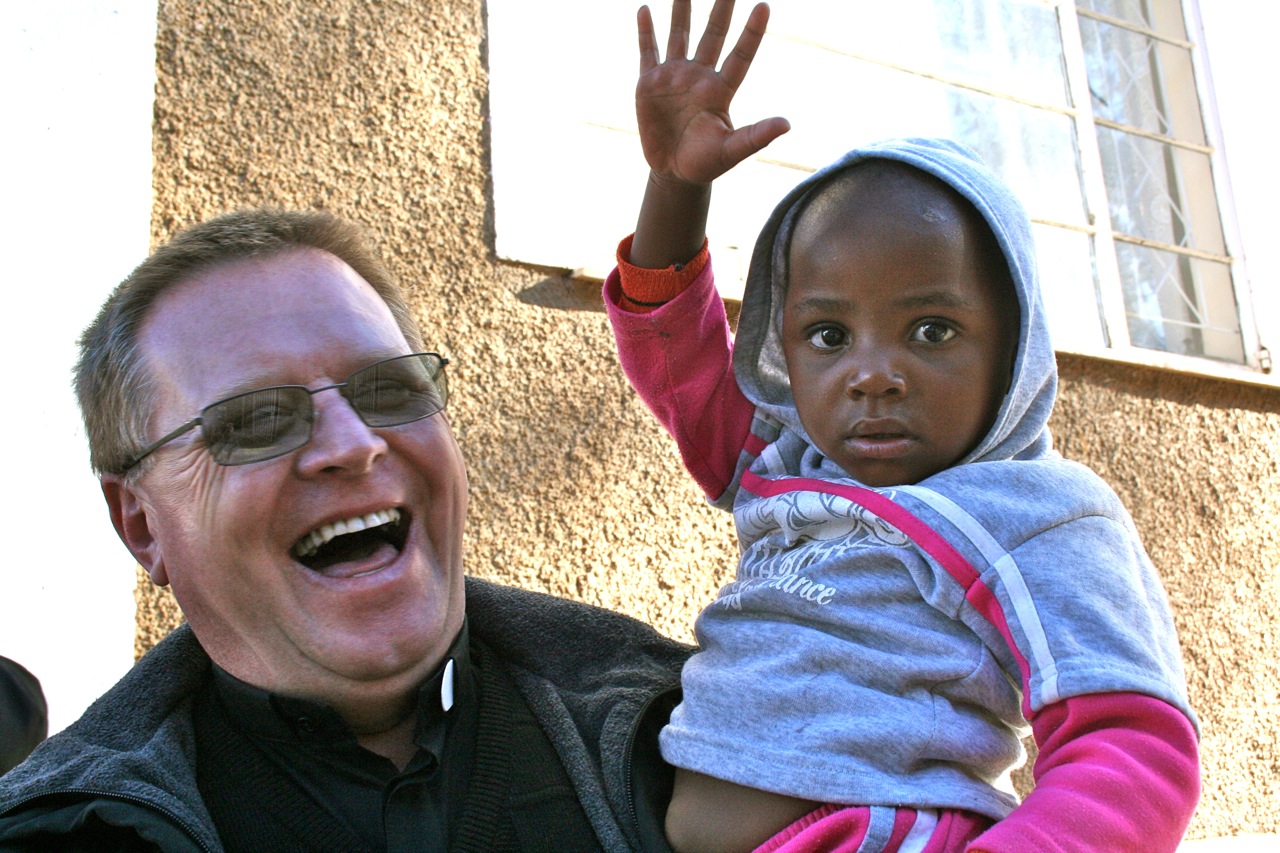
Fr. Agi meets with a parishioner

Fr. Agi meets with a parishioner

The SCJs came to India around 1994 and began in the state of Kerala, the most Catholic area of the country. We came at the invitation of the bishop of Cochin, who knew Bishop Joseph DePalma. I believe they knew each other when the bishop was our superior general. The SCJs have since expanded to other parts of the country. The main work at present is formation given this is one of our newest foundations.

From the very beginning there was the idea to find ministries in the north, or at least north of the states of Kerala and Andhra Pradesh. About two years ago work began on securing a presence in the Mumbai area, and as of 2012 the SCJs were tasked with staffing the parish of Divine Mercy in Thane (next to Mumbai), along with its attached missions. I was told this is the third parish SCJs now staff in India.

Divine Mercy has about 500 families. The vast majority of parishioners are migrants to Mumbai who have come to look for work. As a consequence, the parish is multi-lingual and multi-cultural. Mass is celebrated in Hindi, Malayan, English and I believe sometimes in Tamil.  Many parishioners are poor, though certainly not all.

As Catholics they are a very small group. Hindus are the majority here, followed by Muslims. There is a large Muslim community not far from the parish. Tension between religious factions ebbs and flows. 
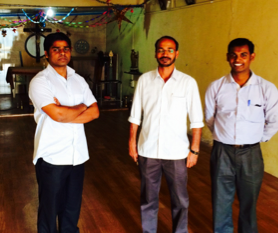
The parish team at Divine Mercy

The parish team at Divine Mercy

I don’t want to make this entry too long so let me close by introducing the three members of the Divine Mercy Parish. In the middle is Fr. Aji, the pastor. He worked in Mumbai as a deacon before we were given the parish and is assisted by Fr. Abraham, standing to the left of Fr. Aji. On Fr. Aji’s right is Alex, who is finishing his regency and will be ordained a deacon on February 1, 2014. 
Christmas travels bring SCJ in touch with province’s past

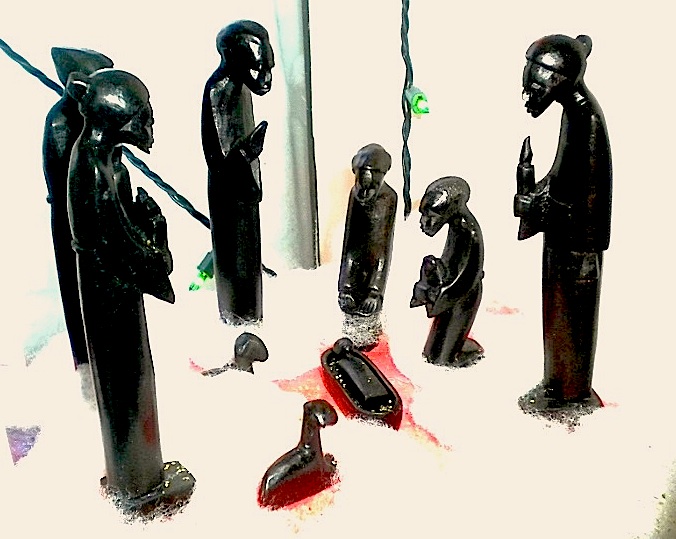
One of the international Nativity sets on display during Fr. Tim's visit to the Montréal community.

One of the international Nativity sets on display during Fr. Tim’s visit to the Montréal community. This crèche is from Africa.

Fr. Tim Gray, SCJ, is a member of the formation team at the Dehon Formation Community in Chicago. Recently he reflected on his holiday travels, travels that took him from a former SCJ seminary in Pennsylvania, to visits with fellow SCJs in Canada, where he once ministered. He writes:

I began a two-week swing through the Northeast this Christmas. I stopped to visit family, friends, and also SCJ confreres. Three visits of note were in Honesdale, Pa., Toronto, and Montréal, Quebec.

While in Honesdale I visited the Hnatko family, who are well known to many SCJs. They lived at the building at Kilroe for over a year as caretakers before it was sold. It was so good to see Marge and much of the family; they send their greeting to all the SCJs. [Editor’s note: the building to which Fr. Tim refers was at one time the location of one of the province’s seminaries.]

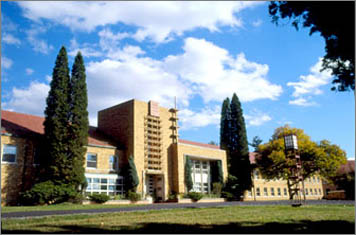
The former Kilroe Seminary now houses the Himalayan Institute

The former Kilroe Seminary now houses the Himalayan Institute

Of interest to even more SCJs is the status of the building at Kilroe. It continues to serve as the headquarters of the Himalayan Institute, a center for growth and healing, which has used the building since 1979. It is absolutely fascinating to me how familiar it still looks! Very little has changed – the person giving me the tour pointed out how durable both the building and the furnishings have been.  Almost all the original equipment in the kitchen and laundries is still in service. There are still chairs from the visiting rooms, in colors that have since come back into style!

Fascinating is that the building continues to be filled with people dedicated to a spiritual life, who spend months or years living in the same conditions as we seminarians did – simple rooms, common baths and toilets, common meals, sharing in housework and other chores. Almost all the work is done by volunteers – there are only a handful of paid employees. The irony, of course, is that they abandoned their center in the Chicago area to move to Honesdale just as we SCJs were doing the opposite. It surely brings a strange mix of feelings to see such familiar surroundings in the service of God, much different than the one we lived in the 1950s and 60s, and yet so perennial.

After spending Christmas with my father and my sister’s family in Maine, I drove to Montréal to enjoy the great hospitality of the SCJs there. Fr. Claude Bédard looks and sounds great [Fr. Claude recently underwent treatment for cancer.]. He expects reconstructive surgery, but it will not prevent him from singing in two operas this spring. All others are fine. I was totally amazed by the collection of Nativity sets from around the world they have collected over the years! I took as pictures of as many of them as I could – I lost track at around 55. It outdoes the Christmas display at the Museum of Science and Industry in Chicago. I’ll share the pictures with anyone who is interested.

Fr. Tim Gray

Fr. Tim Gray

I continued through icy conditions to Toronto, which was devastated by the storms. Our parish lost power for one day; many people were out for a week! The house on High Park feels very different with only three regular residents: Fr. Peter McKenna, Fr. George Coppens, and new arrival Fr. Antonius Purwono, from Indonesia. Fr. Jim Casper, Fr. Willyans Prado Reposo, and Fr. Aegi Warsito are in residence at St. Thomas More parish and return only for the weekly meal. I’m sorry I missed the chance to visit the parish; Fr. Aegi assured me that they would have found a Mass for me to celebrate in Spanish! The parish is massive: 7,000 families, very multicultural. A wonderful SCJ ministry.

So Happy New Year to all, from all, and back to work.

Christmas in Afghanistan

Colored christmas glass balls isolated on white

Fr. Mark Mastin, SCJ, is a chaplain with the US Army, stationed in Afghanistan. Here, he writes with an update on his ministry, as well as Christmas greetings:

Merry Christmas.  I pray all are well.  For over a month I lead a Christmas planning group of several Coalition Catholic and Protestant chaplains.  My counterparts wanted me to head this planning project of religious services and concert events not because they wanted to avoid the work but because they viewed me as the key NATO leader; English is considered to be the main language we are to speak here and therefore I got the short straw, in a nice way of course.  The experience was very good.  It gave me a small taste of what all of our men experience, particularly our SCJ superiors, when they meet in Rome for general assemblies or other international gatherings.

Fr. Mark Mastin

Fr. Mark Mastin

So, we had several ecumenical events with prayer and music.  The Germans and Norwegians supplied the bands and I provided the manpower, sound,  flyers and programs.  It was good to hear songs from different nations and appreciate the lyrics and melodies.  Many of the American Christmas songs were from the 50s and 60s — Big Band style.  This is the music that I grew up with as a child.  Listening to it made me fell a little less  lonely.  Furthermore, I have been able to see how our American culture, particularly in music, has influenced other countries.   As a side note, the Germans know how to do Christmas well here — they actually bring in real trees and lights and ornaments.

It was interesting to listen to and to participate in the sing-a-longs in another language.  I certainly did my share of butchering the pronunciations of a view Croation and German songs.  One of the songs that got people on their feet was Jose Feliciano’s “Feliz Navidad.”  Everyone became Hispanic on that song.

We had a true midnight mass.  Again, I felt like I was back in my childhood when my family and I went to mass at this time. The chapel was packed and soldiers and civilians were standing out in the cold.  There were three priests: a German, Croation and me.  I put a book together of the mass prayers in all three languages, as well as assorted songs.  We each preached for 3 minutes even though I joked with my German friend that he spoke for 5 minutes and therefore I should get six.  Overall, the mass went well and people were very grateful for the experience.  I am a litte worn out from all of the events in the past week.  However, my spirits feel uplifted from the experiences.

Well, take care and tell everyone I said hello and Merry Christmas.  Happy New Year too!

Last stop Johannesburg, SCJs’ newest community in South Africa

Image

As noted previously, Fr. Tom Cassidy, former provincial superior, is spending his first months out of office visiting the countries for which he had responsibility when he was on General Council in Rome.  During his travels he is maintaining a journal; several excerpts from it are being posted on the province blog. The following two entries are from Johannesburg:

November 16: 2 University Road, Auckland Park, Johannesburg, South Africa

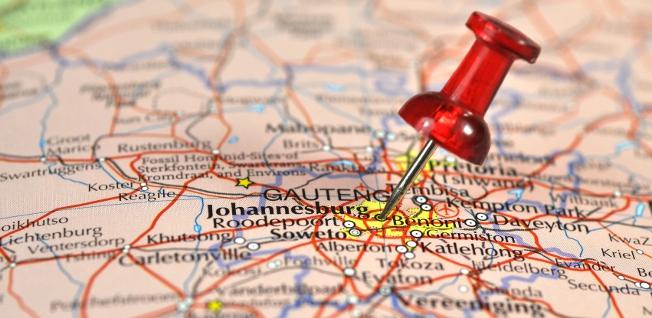
This is my address for the next three days! It is our newest South African SCJ community. The South African Province purchased the property from a community of sisters who retired from their ministry here. It is in a pleasant area in this large metropolitan city of over 8 million inhabitants. The house is located about a four-minute walk from the University of Johannesburg Auckland Park Kingsway Campus.

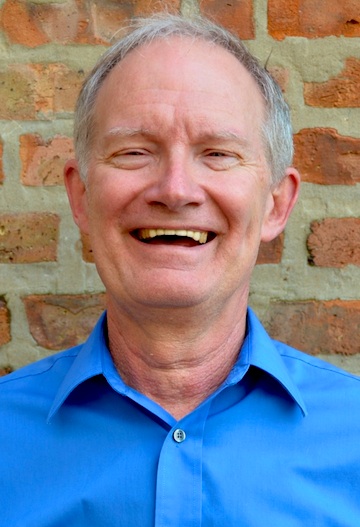
Fr. Peter Surdel, superior of the SCJ community in Johannesburg

Fr. Peter Surdel, superior of the SCJ community in Johannesburg

The Jesuits have their community house a few doors from here. According to Fr. Peter Surdel, the area is also home to a number of actors as the studios for South African Television are very close to here as well. It is also close to the Botanical Gardens, were I took my walk this morning.

My plane was late getting here from Pietermaritzburg but Fr. Peter was there to greet me with his usual smile and we soon were on our way to the house. It’s only about 20 minutes from the airport and traffic was light at the late hour.

This morning we had morning prayer and Mass at 7:30 a.m., followed by breakfast cooked by one of the students. There are five in the house right now. Three are professed (in vows) preparing to study theology in Pietermaritzburg. Two are from Mozambique and one from Angola. The other two are candidates for the South African Province. All five are studying English.

One of the students celebrated his birthday and in his honor, and my arrival, a Braai (South African barbeque) was planned for the evening meal. Two of the students were responsible for the fire and the cooking of the various meats (chicken, beef and sausages) and two others prepared the salads. Earlier in the day Fr. Peter took me to visit the cathedral and the spot of the first gold mine in South Africa. Today it is a casino and theme park.

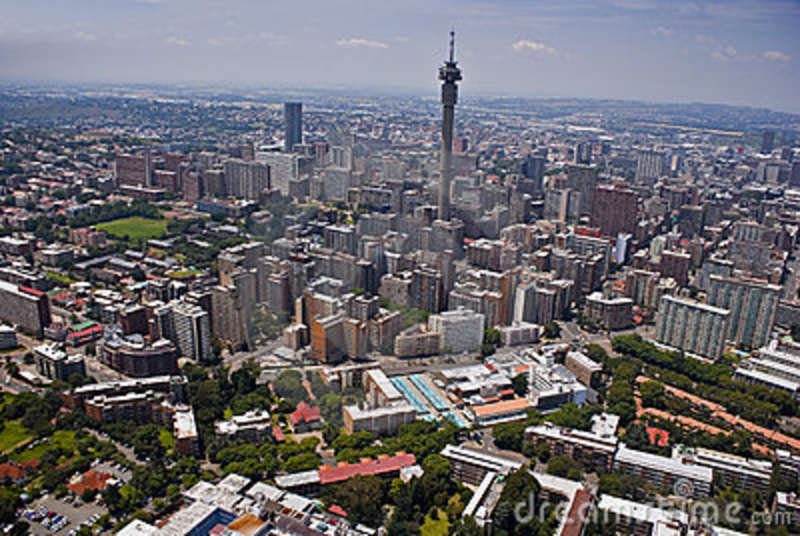
Johannesburg, the site of the SCJs' newest community in South Africa, is the country's largest city with 8 million inhabitants.

Johannesburg, the site of the SCJs’ newest community in South Africa, is the country’s largest city with 8 million inhabitants.

November 17, 2013, Johannesburg

This is my last full day in South Africa; tomorrow evening I will begin the long journey home. There’s not too much on the schedule. This afternoon Fr. Peter showed me St. Augustine College and the Holy Cross Sister’s Convent. The sisters have been connected with the SCJs in Aliwal North since almost the start of our presence there in 1923.

Recently the provincial administration of the Holy Cross Sisters made the decision to close Fatima House, a large nursing facility they run in Aliwal. It is slated to close next June. I learned that the nuns intend to continue a nursing facility but on a much small scale. What will become of Fatima House remains to be seen. The talk of it becoming a private hospital would be welcome by many. [Several SCJs have spent time at Fatima following illness and injury, including Bishop Joe Potocnak and Fr. Peter Surdel.]

Fr. Tom with students in Johannesburg

Fr. Tom with students in Johannesburg

During my stay in South Africa I have not taken many pictures of people, but yesterday Fr. Peter took the picture of me at right with the five students living here.

This is truly an international community.

Fr. Peter, the superior, is a member of the South African Province and comes from Poland

The two students studying for the South African Province come from Zambia and Lesotho.

Two of the three are here to learn English in preparation for their studies at St. Joseph Seminary, Cedara, [near Pietermaritzburg] come from the Portuguese-speaking countries of Mozambique and Angola. Finally, there is one student from Madagascar where French is the national language.

The community does not have a cook so the students take turns cooking. One student is on each week which means once every five weeks they are responsible for preparing breakfast and the evening meal. They also take care of their own laundry and the upkeep and cleaning of the house.

In a certain sense English is a work in progress. The level of English skills varies from person to person. Most seem comfortable with spoken and written English, at least based on the prayers said in common as well as the table conversation at meals.

Variety of religious serving South Africa

As noted previously, Fr. Tom Cassidy, former provincial superior, is spending his first months out of office visiting the countries for which he had responsibility when he was on General Council in Rome.  During his travels he is maintaining a journal; several excerpts from it are being posted on the province blog. The following was written on November 14 in Pietermaritzburg:

Marian Hill & The Sea

This morning I left with Frs. Jean Paul and Innocent to visit Marian Hill and then travel south of Durban to visit the Capuchin Sisters for lunch.

Screen Shot 2013-11-17 at 11.26.46 AMMarian Hill is the birthplace of the Marian Hill religious community as it is the birthplace and mother house of the community, a community of priests and brothers who number over 400 members and serves in a number of African countries, as well as North America, Brazil and Papua New Guinea.

The community traces its roots to the Trappists who came to South Africa and established their monastery at Marian Hill. The story goes that they were looking to build on top of one of the hills in the area but when the ox cart broke down their superior said: “We build here.”

Most people know that Trappists live a monastic life dedicated to work, prayer and (certainly in the 19th century) silence. As Marian Hill began to develop, the monks were asked to send men out to teach such skills as reading and writing to Zulu children in the area. As this did not fit the charism of a Trappist, eventually Rome approved the Rule of Life for a new community called Marian Hill whose mission, as it was described to me yesterday, was to go to the margin of society.

The reason I can report all this is that we had a guided tour by a young Marian Hill postulant (someone getting ready to enter the novitiate). He knew his story well and helped us to understand the history of how Marian Hill came to be what it is today from out of its Trappist roots.

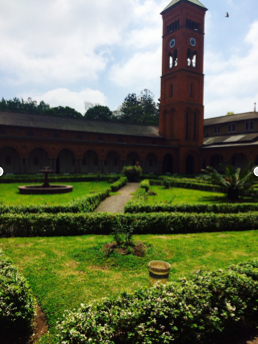
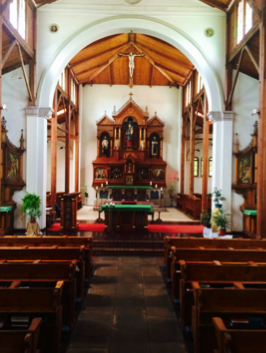
Screen Shot 2013-11-17 at 11.26.57 AMThe Trappists who came to Marian Hill came from Austria and it is easy to see the Germanic influence in the chapel. The use of wood is evident throughout as is the choir stalls common to a monastery chapel.

After our tour was completed and we said our thanks and goodbyes it was off to the Indian Ocean and the convent of Capuchin Sisters. We were expected for lunch and managed to arrive almost on time. The Capuchin Sisters are a cloistered community. They are familiar to our SCJs as from time to time they come here for days of recollection or, as will be the case at the end of January, for several days of planning for the new semester and school year.

The community is international in character as their are five sisters from Mexico, some from other African countries, as well as some from around the area. The mother superior is from Mexico and has been here for nine years. Her English was excellent and if I closed my eyes I would be hard pressed to say where she came from or that English was not her first language.

After our lunch we had the opportunity to spend about half an hour with the Mother Superior and a young African sister who had a wonderful personality, full of humor while at the same time filled with down to earth wisdom.

We finally said our farewells, though Frs. Jean Paul and Innocent would be back with the rest of the SCJ community at the end of January, and headed home. We made it back before the afternoon rains and thunderstorm broke over our heads. The day ended with a community gathering to bid farewell to the deacons leaving on Sunday to prepare for their ordinations next month; as well as my own goodbye, as tomorrow I will fly to Johannesburg for my last stop on this journey through South Africa.

The gathering also gave me a chance to thank and say my goodbyes to Frs. Chris, Adam and Ziggy from Hilton who came down for supper and the farewell celebration. I said a few words to the entire group to thank them for their hospitality. I basically told them that like SCJs around the world they practice hospitality well and I felt right at home and at ease among them and especially appreciated the opportunity to pray with them.

Visiting a friend who is now a bishop; singing hymns in Zulu

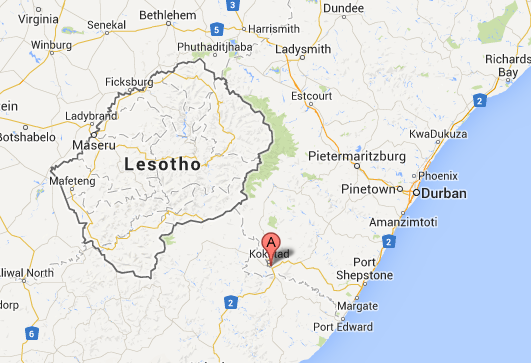
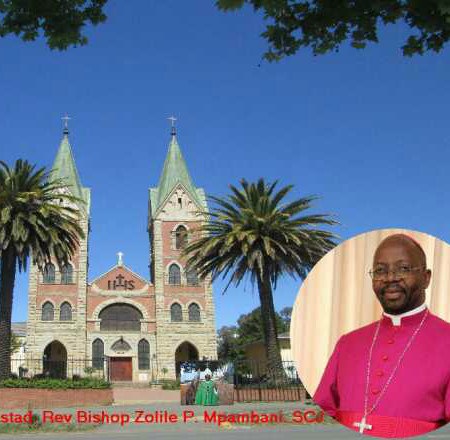
Fr. Tom had the opportunity to visit his former colleague on the General Council, bishop Zolile in the bishop's new diocese of Kokstad

Fr. Tom had the opportunity to visit his former colleague on the General Council, bishop Zolile in the bishop’s new diocese of Kokstad

As noted previously, Fr. Tom Cassidy, former provincial superior, is spending his first months out of office visiting the countries for which he had responsibility when he was on General Council in Rome.  During his travels he is maintaining a journal; several excerpts from it are being posted on the province blog. The following two entries are from Pietermaritzburg:

Today (November 9) was a long day of travel from Aliwal North to Pietermaritzburg where the South African Province hosts an international formation (student) community. We began our travels at 8:30 a.m. and arrived at the scholasticate at 5:00 p.m.

AScreen Shot 2013-11-10 at 8.29.41 PMfter dropping off a religious sister whose community was on the way we stopped for lunch in Kokstad, at the convent next to St. Patrick’s Cathedral. It took me a moment to realize that I was in Bishop Zolile’s diocese. [Bishop Zolile served on the General Council with Fr. Tom before returning to his native South Africa; he was named a bishop earlier this year.]

As I mentioned previously, Bishop Zolile was not there, though I will meet up with him in Pietermaritzburg tomorrow. I did have the opportunity after lunch to visit the cathedral and the bishop’s house where he now lives. It is a new facility having been built by the previous bishop about three years ago.

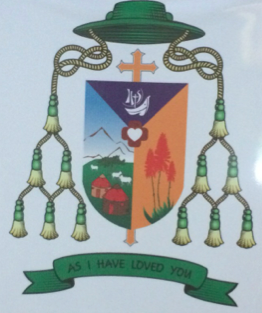
In touring the cathedral I spotted Bishop Zolile’s coat of arms. It is on the back of the bishop’s chair in the sanctuary. His motto is very Dehonian: “As I have loved you.” Another Dehonian symbol is the cross with the heart that has become the unofficial logo for the congregation.

According to Bishop Adam, most of the diocese consists of villages rather than towns or cities though Kokstad itself seems to be a good-sized city. This part of South Africa is called Kwazulu-Natal.

Screen Shot 2013-11-10 at 8.30.32 PM

November 10: Pietermaritzburg

There were two things on today’s agenda. The first was to concelebrate the 8:00 a.m. Mass at St. Francis Assisi Parish, about a 15 minute drive from the SCJ formation community house. This is a parish staffed by SCJs and it is the first parish outside of the De Aar and Aliwal North Dioceses entrusted to the care of the SCJs of South Africa.

In the last two years the SCJs have further expanded by opening a community house in the Johannesburg Archdiocese.  I will visit this community during the last few days of my visit to South Africa. It is hoped that the South African SCJs can expand their presence to urban areas such as Pietermaritzburg and Johannesburg where the large population centers offer the opportunity for more vocations than what is available in rural areas such as De Aar and Aliwal North.

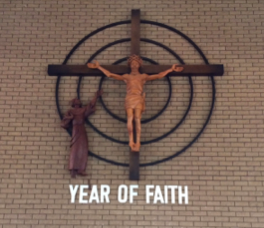
Screen Shot 2013-11-10 at 8.26.50 PMIt may be a little hard to see in this photo but the crucified Christ is an African with St. Francis of Assisi calling all to gaze on the cross and Christ. This parish is in the colored area of Pietermaritzburg. The 08:00 Mass was well attended with the church almost 100% full. The congregation was both young and old as well as a good mixture of men and women. If there were one group underrepresented I would say it was teens. I think, from what I overheard, the reason for this may be connected to the Teen Life Mass this age group had or will have attended this weekend.

The music was wonderful to listen to. Most of the hymns were in English, but because the words were projected on a screen they were impossible for me to see and thus sing along with the congregation. A few of the hymns were done in Zulu and I must confess I enjoyed them above all. What struck me was the stateliness of the tunes as well as the gusto with which the congregation sang them.

Two deacons assisted at this morning’s Mass. Both deacons are SCJs from Mozambique who have spent the last four years at our formation house while studying theology at Cedara. With the end of the semester only two or three weeks away they will head back to Mozambique to prepare for their ordination to the priesthood on December 22, 2013. The deacons thanked the parish for hosting them over the last four years and for assisting them in learning how to function in a parish setting and how to minister to the people of God in their capacity as deacons and as they looked forward to serving God’s people as priests.

Most of us in the States would have found the Mass to be long for our habits. The Mass itself lasted 1 hour and 40 minutes. The homily took 25 minutes. I think if this were a US parish those in the pews would be squirming at a homily of that length, to say nothing of a Mass lasting over an hour on a normal Sunday. From what I could tell young and old took it in stride as though it were (and I think is) par for the course.

ZolileThe second matter of note on my agenda for the day was dinner at our SCJ community called Hilton Farm. Three SCJs (all from Poland) live here. Two teach at St. Joseph’s Theological Institute in Cedara (the school of theology for religious in South Africa) and one is the pastor at St. Francis of Assisi Parish where I celebrated Mass earlier in the day. I’m not 100% sure the pastor lives here full time, but at least he was here for the day and helped prepare the wonderful meal we had.

Bishop Zolile arrived late in the day so I had my chance to meet with him before he headed to Durban to catch his morning flight to Johannesburg and then on to the Southern African Bishops Meeting.


A last look at De Aar

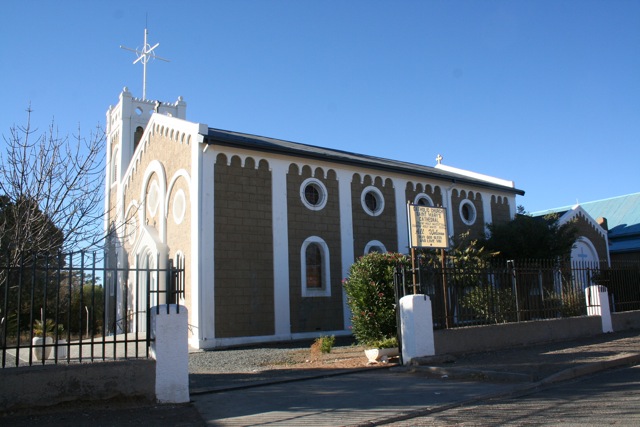
St. Mary's Cathedral in De Aar

St. Mary’s Cathedral in De Aar

As noted previously,  Fr. Tom Cassidy, SCJ, former provincial superior, is in South Africa for much of November.

During his travels Fr. Tom is keeping a journal. Periodically entries from it will be posted on the province blog. Today’s is written from De Aar, where he celebrated the feast of All Saints before continuing on his travels:

Here in South Africa the feast of All Saints is celebrated on Sunday rather then on November 1st. I had the 08:00 Mass at St. Mary’s Cathedral here in De Aar. If you think “cathedral” think small as the Diocese of De Aar is not very big, at least in numbers of people.

According to the 2011-2012 Catholic Directory for the Southern African Catholic Bishop’s Conference the diocese comprised:

An area of 67,248 sq. km. (25,965 sq. mi.)
Total population of 165,000
Catholic population of 5,747
1 bishop, 9 priests and 1 permanent deacon
I could find the addresses for 3 religious sisters working in the diocese as well

With those figures you can get a feel for the size of the cathedral. If I tried to compare it to one of our SCJ parishes in the United States the old Sacred Hearts of Jesus and Mary in Franklin comes to mind or perhaps Our Lady of the Sioux Chapel at St. Joseph Indian School might be a good comparison.

When I first visited St. Mary’s in 1987 it was for all practical purposes a “white” church. Today there is a mixture of blacks, colored (South African terminology) and whites.

One of my sisters asked me if I felt safe walking the streets of De Aar. I walk an average of at least an hour a day. Since I basically walk the Main Street where there is a lot of traffic I really don’t have any worries and have found that the people pretty much ignore me. I’m sure that even in this town of 30,000 I appear to be a stranger among them. Bishop Adam pointed out the many bed & breakfasts in the town which makes me think that strangers on the main drag are not all that uncommon.

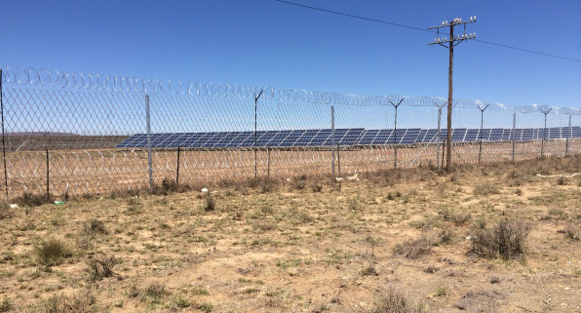
When I came back from my morning walk Bishop Adam was ready to take me to visit the cemetery where Fr. Cecil Wienan, who died on February 8, 2000, is buried. It took a little hunting for us to find the grave as Bishop Adam had the right plot number, but we were mistakenly in the wrong section. After saying prayers over the grave we took to the road so Bishop Adam could show me the solar farm being developed by Siemens. When finished it will produce 95 megawatts of electricity. The farm is 2.5 kilometers long (1.5 miles).

Screen Shot 2013-11-06 at 8.47.08 AMThis is one of two solar farms under construction. According to the bishop they are employing up to 600 people during the two-year construction phase. There are also plans to construct a wind farm in the area as well. The Karoo has plenty of sun and plenty of wind so the region is a good candidate for projects such as these.

Tomorrow is the meeting of the Diocesan Senate. In addition to running the meeting Bishop Adam is putting on his chef hat to  prepare the meal as the person who does the cleaning and some of the cooking has been gone while Msgr. Alcaster has been away. 

The charm of an old English settlement in South Africa

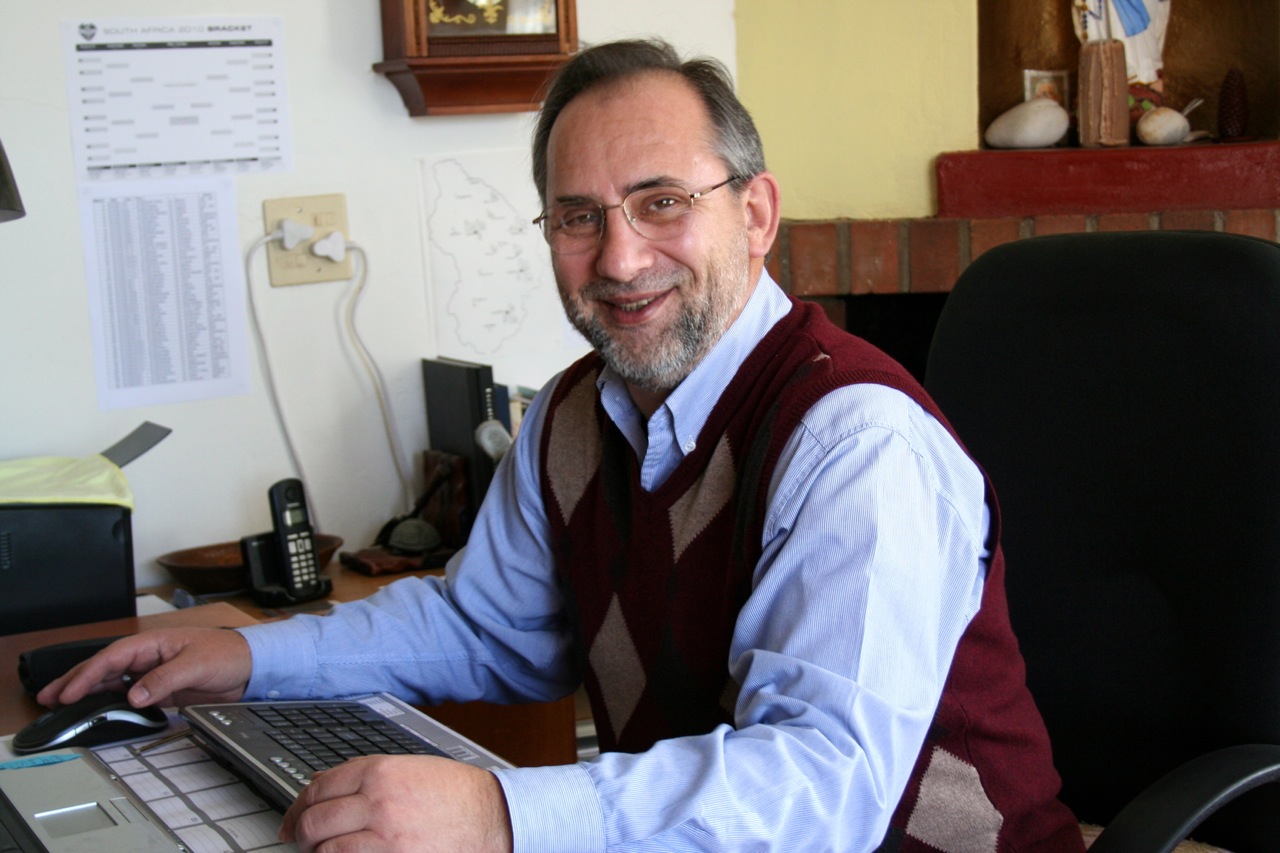
Bishop Adam Musialek at his desk in De Aar. He has been hosting Fr. Tom Cassidy during the former provincial superior's visit to the Diocese of De Aar.

Bishop Adam Musialek at his desk in De Aar. He has been hosting Fr. Tom Cassidy during the former provincial superior’s visit to the Diocese of De Aar.

As a part of his sabbatical Fr. Tom Cassidy, SCJ, is visiting the countries for which he had responsibility when he was on General Council. For most of November the former US provincial superior will be in South Africa. 

During his travels Fr. Tom is keeping a journal. Periodically entries from it will be posted on the province blog. Today’s is written after a visit to Graaff-Reinet:

Our trip from De Aar to Graaff-Reinet offered some of the best for scenery in this part of South Africa. The road takes you through two mountain passes, one of about 5,000 feet and the other slightly less. The vistas are broad, and with few trees you can see for miles. We managed also to catch a glimpse of springboks and monkeys on the way and a large turtle crossing the road upon our return home today.

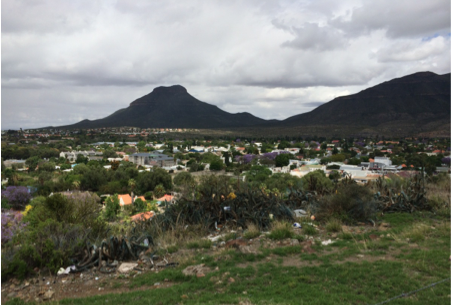
Graff-Reinet viewed from the black township.

Graff-Reinet viewed from the black township just outside of the center of town.

Graaff-Reinet is an old English settlement and still carries much of the charm of days long past. It is also larger (at least the town proper) than De Aar. The pastor at present is Fr. Kazimierz Gabriel, SCJ, who is originally from Poland. He has a green thumb and enjoys, among other things, to grow roses.

The purpose of our visit was a meeting of the parish council with the bishop. Bishop Adam and Fr. Gabriel thought it was a very profitable experience for all concerned.

After the meeting broke up the three of us went out to eat dinner. The place Fr. Gabriel chose was about a 10-minute walk from the rectory. It was a small restaurant with an interesting menu. I had the chance to order ostrich steak, but opted for Karoo Style Lamb Chops. Since Bishop Adam took the ostrich I had the chance to taste it. It really does have a flavor close to steaks — for once you didn’t hear: “Tastes just like chicken.”

This morning I had the chance to take a walk around town and capture a few pictures. Even though this was an English Settlement the biggest church in town belongs to the Dutch Reformed Church. Our own Catholic church pales in comparison. This being the first of the month another thing I noticed was the large number of people lined up at the banks and ATM machines — pay day!

After my walk the bishop and I had breakfast. At the table he told me the story of the recent storm that took off the roof of St. Teresa’s Church located in the “colored” section of town. One of the glaring leftovers of the apartheid era is the division of towns into three parts: white, colored and black. The lines have been blurred and you can find colored and blacks in the formally all white sections, but I think it would be hard pressed to find whites in the other two.

Fr. Angel took the two of us up to see St. Teresa’s; it is just about ready to reopen as a new roof has been put on and the painting inside is all but complete. By the time Bishop Adam returns at the end of November the outside will be painted and ready for the parish to celebrate a grand reopening.

Since tomorrow is All Souls Day we also took the opportunity to visit the grave of Fr. James Howley, SCJ, a member of the British-Irish Province who died suddenly of a heart attack in April of 1987. I never met him, but certainly knew his story and what good friends he was with Fr. Joe Nugent, another member of the British-Irish Province, who worked in South Africa for many years, and who I got to know well during my time on the General Council.

Then it was time for us to move on. Before getting back to De Aar for evening Mass, Bishop Adam wanted to show me Middleburg and visit Fr. Gabriel Jayaraj, one of two young Indian SCJs working in the De Aar Diocese. I met Fr. Gabriel two years ago when I was passing through South Africa on may way to the ordination of Archbishop Claudio Dalla Zuanna, SCJ, in Mozambique. I will get a chance to meet all the priests in the diocese on Monday when Bishop Adam holds a diocesan senate meeting.


Returning to South Africa


Screen Shot 2013-10-31 at 1.13.06 PM

As a part of his sabbatical Fr. Tom Cassidy, SCJ, is traveling to the countries for which he had responsibility when he was on General Council. On October 28 the former provincial superior left for South Africa.

During his travels Fr. Tom will maintain a journal. Entries will be posted on the province blog. He starts with the following:

I first visited South Africa in 1987 when it was an apartheid state. Unlike today it required a hard-to-get visa to enter the country, and because I am a priest it was even more difficult to get one; in fact, my visa was granted just the day before I was to travel. I’m guessing this visit is about my eighth since then and a lot has changed in the country.

It’s going on noon here in De Aar, my first morning in South Africa. The trip from Milwaukee was long.

Fr. Tom Cassidy

Fr. Tom Cassidy

It included a bus ride Monday afternoon from Milwaukee to Chicago, a flight from Chicago to Frankfurt that took eight hours, a ten-hour overnight flight to Johannesburg and finally a flight to Bloemfontein.

At Bloemfontein I was met by Bishop Adam Musialek, SCJ and Fr. Paul Koscielny, SCJ. A few more hours in the car and I was in De Aar at 6 p.m.

I was surprised to find Fr. Paul at the airport along with Bishop Adam. Paul explained he had a doctor’s appointment and since I was being picked up by the bishop the two of them came together. I forgot that a couple of years ago Paul fell off a roof and damaged his leg. He still has pins in the leg but told me it now looks like they will come out in the next few months.

When we got to Colesberg to drop Paul off at the rectory both Bishop Adam and Fr. Paul told me the story of what happened to the previous pastor, Fr. Gerry Fitzsimons. As they told the story I recalled learning about it back in the States. He was found stabbed to death in the rectory after being reported missing. His car was stolen and it was the car’s license plate that led to the capture of his assailant. With that sad tale in my head we said goodbye to Paul and headed to De Aar about an hour’s drive from Colesberg and my final destination of my long journey from Milwaukee to De Aar.

At present there is an eight hour time difference between Milwaukee and De Aar. Since South Africa does not go on summer time when the clocks in the US fall back it will revert to a seven hour difference. And since I am now south of the equator De Aar is in the middle of spring. At this time of year warm days and cool nights — good sleeping weather.

This afternoon I will travel with Bishop Adam to Graaff-Reinet as he has a 6:00 p.m. meeting. We’ll stay overnight before returning.

The bishop's residence and offices in De Aar, South Africa.

The bishop’s residence and offices in De Aar, South Africa.

Blessing of the new Mother House in Poland

As noted previously, Fr. Tom Cassidy, now on sabbatical after completing his second term as provincial superior of the US Province, is writing a journal during his trip to Poland. During his sabbatical Fr. Tom is spending time in many of the locations for which he had responsibility when he was on General Council. Next spring he will spend extended time in Asia, helping in the missions of India and the Philippines. Here, writes about the dedication of the SCJs new conference center which the US Province helped to fund:

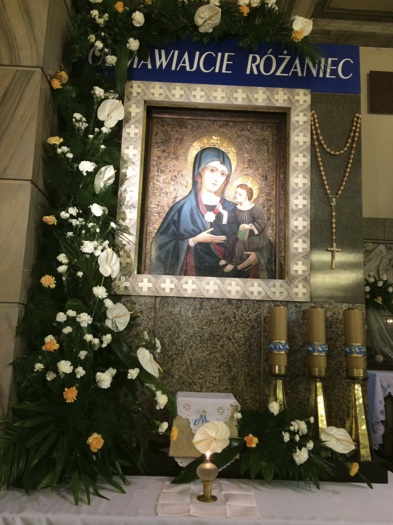
The church next to the newly remodeled conference center has a shrine to Mary:  "Blogostawionego Macieraynstwa" according to Fr. Tom.

The church next to the newly remodeled conference center has a shrine to Mary: “Blogostawionego Macieraynstwa” according to Fr. Tom.

Today the Domus Mater (Mother House) was dedicated and blessed by one of the auxiliary bishops of Krakow. Originally the cardinal had agreed to be the main celebrant but at the last minute had to cancel and promised to send one of his three auxiliary bishops to fill in for him. In addition to me representing the United States both the German and Franco-European provincials were present as each had contributed to the renovation of Domus Mater as a conference center.

The building is done in what I’d call a “Modern European” style. For anyone who has been to Italy and seen our Villa Aurelia (small hotel adjacent to the general curia) the style would be similar, but with new technological innovations such as electronic keys. There are 33 guest rooms that can accommodate up to 66 people. Of course there are several rooms for meetings and one large hall as well. Part of the building also houses the SCJ community. I believe it numbers 11. In addition there are 10 rooms for elderly SCJs, and in this case I’m thinking more along the lines of nursing care. These rooms are not quite finished.

The morning began with breakfast served from 07:30 to 08:30 and at 09:00 a conference was held in the church. This was necessitated by the size of the crowd attending today’s blessing. The hour-long talk was by a medical doctor and with my all but non-existent Polish went over my head, though I could at last figure out it had to do with the bioethics of human reproduction.

After the conference there was a half hour break to prepare for Mass. Artur, our Polish Provincial, gave an introduction and the Mass then proceeded as usual with the bishop as main celebrant and homilist. Following the Mass, the bishop accompanied by Artur and several others, went about the building blessing it with holy water. After the blessing an excellent meal was served. By the way, I’ve noticed that at big celebrations like this only tea, coffee and juice is served. The laws on drunk driving are very strict with the alcohol level at .02%. As such the slogan: “Don’t drink and drive” takes on a whole new meaning.

After the meal I agreed to meet Fr. Christopher at 2:00 PM for the drive back to Warsaw. There were four of us in the car, but this was a bigger Fiat, more like a wagon then a car so the ride was quite comfortable. Christopher knows a little English but the other two did not. On the walk to the car Christopher apologized for his English saying: I have to translate from Polish into German and then into English. As we began the trip I told him I would listen to a book on my iPhone and they could talk all they wanted in Polish. Actually it turned out to be a quiet trip as the two other passengers spent much of the trip napping.

We arrived back at the provincial house in Warsaw just about at 6:00 PM. The traffic was lighter than I expected. This being the weekend there were fewer trucks on the road, which helped especially along the sections that are still single lanes in each direction.

Unfortunately, in one sense I did not have anytime to tour Krakow, a very beautiful old European city. However, I spent a few days here on my first trip to Poland and have a good feel for the city and its rich history. Tomorrow will be my last trip as Michal Ciemiega and I will travel to visit the famous shrine of Our Lady of Czestochowa.