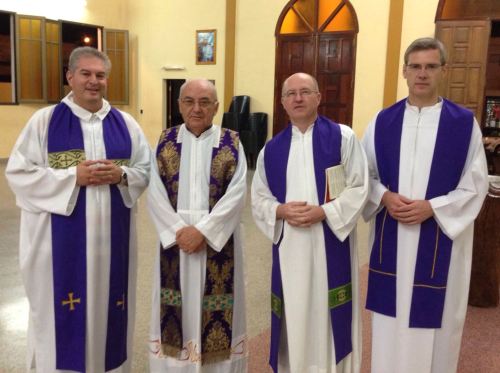
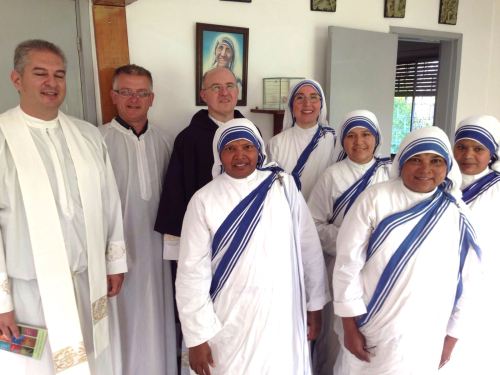
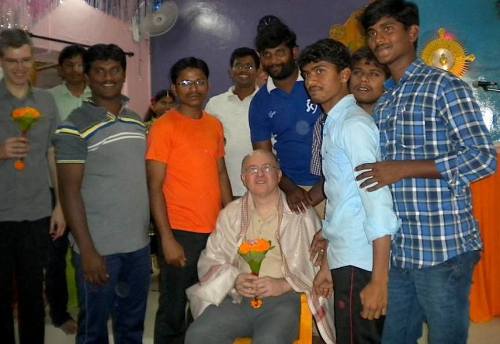
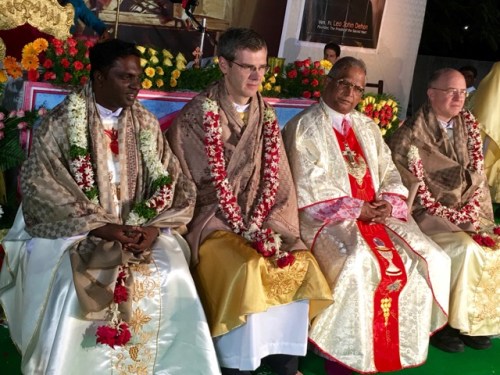
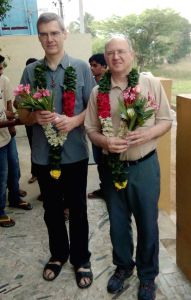
Happy St. Joseph’s Day!

Fr. Tom Cassidy writes from India:

St Joseph India

A St. Joseph’s Day display in India

Just before we begin Holy Week the Church takes time out from the solemnity of Lent for a day of joy in celebrating the feast of St. Joseph. I was surprised to read this morning that devotion to St. Joseph really began in earnest only in the 16th century when the Church officially encouraged his cult, as St. Joseph began to figure as an ideal ‘provider and protector of the Holy Family. Pope Pius XII added a second feast that of St. Joseph the Worker on May 1st._

We have four members of our community named Joseph, but at least one of the brothers is named after an Indian Joseph who is venerated but I don’t think has been beatified, i.e., Br. Mahesh Gotikala, scj (1st year). Actually I would not have known he was a Joseph as the Indian District personnel directory does not list his Christian name.

Many of our brothers do not use, or certainly do not list on any official document, their Christian baptismal name (if they have one). It is harder to do work with the government if officials (especially those with strong Hindu basis) are aware you are a Christian. Names have also from time to time caused brothers grief in applying for a passport or driver’s license. It is very important that all your documents line up with the exact same name and any variance can cause difficulty.

I was made aware of some of the hoops Indians have to go through that I would never face. For example, when one applies for a passport and you give X as your home address the police will be sent to check that this is indeed your official residence. I know of at least one brother who was denied a passport because when the police came to his house he was not home and the neighbors (trying to be helpful I think) gave his nickname to the police officer and since it was different from what was on the officer’s sheet the passport was never issued.

Sticking with applying for a passport, Fr. Louis Mariano Fernandes, scj, had to go to Goa [where he is from] to apply for the renewal of his passport while all I have to do is fill out the form and mail it to the government passport center (if memory serves me it’s in Pittsburgh), or if I’m out of the country and it came time to renew I just go to the nearest US embassy or consulate.

Since the district council decided that third year theologians must get their passport and license the brothers all said “Let us do this at home as it will be much easier then trying to do it here in Eluru.” By the way, I will have to clarify for myself what is meant by license (motorbike or car). Not everyone in the district drives a car but almost every house has a need for at least one car. Certainly at a minimum a license means the ability to legally drive a motorbike.

Last stop: Chile

SCJs in Chile

SCJs in Chile

Fr. Stephan Huffstetter shares his final journal entry from his travels with Fr. Heiner Wilmer for the General Visitation. Fr. Steve’s last stop? Chile. He writes:

Since I was already in South America, I extended the trip by a week to spend time getting to know our confreres in Chile, one of the provinces that I will accompany as General Councilor . After five weeks traveling together, Fr. Heiner flew east to Africa, and I headed west. Normally I choose an aisle seat so I can stretch out and move around but since this was brand new territory for me, I booked a window seat and marveled looking out the window at the landscapes below. The flight first crossed vast Argentine farm and grasslands. The land abruptly rose as we approached the majestic rocky peaks of the Andes. Being summer, only the highest of summits remained snowcapped. Then we passed into the broad valley and sprawling Metropolis of Santiago, home to some seven million of Chile’s 17 million citizens.

While I was waiting to go through passport control, the flight left me dry and I approached one of the pop machines. The $ symbol Chileans use for their peso is the same that you see for US dollars. When I saw the posted price of $1,000, I felt sticker shock, and decided I really was not very thirsty! With the exchange rate, it would have actually cost me a more reasonable $1.46.

The SCJs in Chile number only 17, but make a good impact with their schools and parishes in the Santiago area. They also opened a new mission 10 hours to the south in the city of Valdivia, but I did not get to see that community on this visit. Dutch missionaries founded the province, and the elders in the community are from Holland and Luxembourg. Some came when they were newly ordained and have worked in Chile for over 50 years. During the Pinochet military coup during the 70s many were expelled from the country for a time because their work with the poor got them in trouble with the regime. The younger members are mostly Chileans, with international help from our provinces in Brazil and Poland.

My first full day included a trip to the Dehonian Retreat Center, which offers space and many programs for spiritual development. The Pastoral Leadership team from San Juan Evangelista School was gathered for orientation and planning for the new school year. My visit coincides with the end of summer vacation, and in another week, the students return to the classroom. I sat in on some of their sharing and strategic planning, joined them for mass and then enjoyed the cook out and social after their work was finished.

Chile 2The Cure de Ars is our parish in San Miguel, a commune located in an older, southern part of the city. Two priests serve 25,000 parishioners, though weekly attendance not nearly that high. They have a main church and four chapels spread throughout the neighborhood. I saw a large group of young families coming out of the church after the Saturday baptismal class. Fr. Herman took me for a drive and tour of the area. He explained how they focus on training adult catechists to facilitate small Basic Ecclesial Communities (BEC) in order to touch the lives of people where they live. Part of the parish is mid-level working class, and part is rather poor, with the attendant drug and social problems. One of the chapels had a kitchen attached where parishioners cook food to take to the streets for the homeless. Like many urban areas, change is coming rapidly as blocks of smaller homes are razed and 25 story high-rise apartments rapidly sprout up.

The other parish we serve is Nuestra Senora de Fatima, in San Bernardo. San Bernardo is 20 minutes south of Santiago. Thirty years ago when it became the see for a new diocese, it was a railroad town surrounded by lots of country. Today it has 300,000 people and continues to grow. The area houses and stores are multi-colored, with lots of street art or graffiti, depending on your point of view. I concelebrated Sunday mass with Fr. Johny, the provincial, whose altar servers were well-trained and attentive, and a group of guitar singers led lively music from the front pew. I dusted off my Spanish skills as I mingled with parishioners outside after the mass. With my work in administration, I often miss the small talk and interaction that goes along with being a parish priest.

A standard feature of most towns in a central city square – the Plaza de Arms – where historically the citizen militia could gather if the town was ever in danger of attack. Now the plazas provide a nice green space under ancient shady trees. The mild summer weather here has been great for enjoying a stroll, and for people watching, since the plazas are the center of so much social and commercial activity. This week most of the shoppers have back to school needs on their minds, and stores have tables set up outside selling notebooks and pens and every kind of school supply.

Dehonians sponsor two “Collegios” which serve students from Pre-K through the age of 18 when they are ready to begin university studies. Both Sagrado Corazon and San. Juan Evangelista have over 1000 students, and large sprawling campuses. When I visited, the teachers and staff were scurrying around campus getting everything ready for next week’s start to the school year.

Sagrado Corazon is in San Bernardo. The campus is spacious, spread over two city blocks, with many programs and facilities. We had mass with the faculty who are preparing for the first day of school next week. While part of the town is middle class, other poorer areas contain public housing projects. The school has been trying to find more scholarship monies for those in need. Many families sacrifice to provide their children with the kind of education that will lead them to professional careers, and the school strives to promote Christian values so graduates will be agents of positive change in society. Half a dozen SCJs form the local community. Two priests serve the pastoral needs in the school and help in parishes as needed. Two brothers work in the school administration and are passionate about instilling Dehonian values in the school. Two candidates from the local area study philosophy at the Catholic University and help part time in the school while being full time members of the local community.

San Juan Evangelista is located in the commune of Las Condes, a wealthier part of town. The staff were in the auditorium hearing the director, Brother Jorge, give the opening of the year updates and pep talk. When they broke into smaller working groups, I had a chance to tour the school. I worked in school administration for nine years, and one of my favorite activities is just to walk around campus, inquire how people are doing, and learn about what is going on. They have started intensive efforts to integrate English as a secondary language into the curriculum, which I learned about in English of course! With the rest of the departments I asked simple questions in Spanish and listened and learned about their approaches. The counselors spoke of the family and relational problems that affect all young people. Campus ministry has a strong presence and set out goals for spiritual development in the coming year. Those responsible of discipline also provide a much needed service in working with kids in trouble.

The community suggested that for me to understand Chile, I should do some touring. Since I thoroughly enjoy learning about history and culture, and had Brother Claudio and Herman, one of our candidates, willing to act as tour guides, I was happy to oblige. Sunday afternoon we drove an hour east to the town of Los Andes, home of Chile’s first saint. Theresa of Los Andes was a Carmelite sister who died at the young age of 20, yet modeled a life of prayer and union with God. A sanctuary draws many pilgrims, and I learned that 80,000 young people come for the annual fall youth festival. All the fresh flowers surrounding Theresa’s tomb, and all the people kneeling in prayer amazed me. The chapel was open for the sacrament of reconciliation, good any time of the year, but especially fitting during this season of Lent. After a good lunch with local foods, we drove further into town to the original convent, which is now a museum.

Before joining the SCJs as a candidate, Jorge studied tourism and hotel management. He was a superb guide to the central part of Santiago, and could tell me much about its history and highlights. The Santiago Cathedral has many prayerful spots and beautiful artwork, but what caught my eye was a marble pair of folded hands sculpted into the baptismal font. When you touched the hands the holy water flowed out. Like most national capitols, there are plenty of impressive government buildings. What stood out for me was a large complex that was once a military bunker has been transformed into a center for the arts, with a museum, theater and children’s workshop.

Chile 3A final excursion was to the port town of Valparaiso, on the Pacific Coast. Along the way we passed avocado and olive orchards, and miles of vineyards in wine country. We stopped in Casablanca to visit the Sanctuario Purisima Virgen de Lo Vasquez. Valparaiso is so alive with the bustling activity of shipping, naval, and cruise ships arriving into port. We took a hundred year old ancient wooden cable car/elevator up the steep slope leading down to the sea, and discovered an area of colorful arts and craft shops, and museums. The view from above was breath taking. I also enjoyed walking along the lovely white sandy beaches of neighboring Vina del Mar.

Since the purpose of this visit was not official business, but to get to know the province and congregation better, I was well satisfied. While the group may be small, they are filled with great hope, and I look forward to discovering ways I can support the good work they do.


Newly ordained celebrate Mass of Thanksgiving with student communities

March 2 A

Fr. Tom Cassidy writes from India:

Yesterday three of the four newly ordained priests came to Christu Dehon Nivas to celebrate a Mass of Thanksgiving with our community. Too bad our superior, Fr. Louis Mariano Fernandes, scj, had to be away in Goa as he taught these three men when they entered the minor seminary and began their long journey to becoming, first an SCJ, and then on February 6, 2016, ordained as priests. They will continue serving in the parishes where they have worked as deacons until May when they’ll be given their first assignments with the community.

For the last few weeks they have been traveling around the district celebrating in our various communities a Mass of Thanksgiving. Fr. Kishore has worked at our minor seminary in Gorantla and Fr. Ravi at our minor seminary in Kumbalangi and having them come home is always a big moment for the students. It likewise was an honor and a joy to have the three of them come to our community. They are not strangers to our brothers either as their paths have crossed numerous times during their years of formation.

March 2 BDepending on what community the newly ordained celebrate their Mass of Thanksgiving, various parts of the liturgy are divided up between them. For our celebration Fr. Ravi was the main celebrant, Fr. Kishore gave the introduction and Fr. Suresh the homily. Fr. Suresh worked as a deacon at our own Sacred Heart Parish in Vempadu and consequently had lots of interaction with our brothers as a number of them do their Sunday ministry at Sacred Heart or one of  its substations.

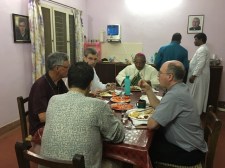
Normally we have Mass in the morning but today in joining with our newly ordained brothers it was moved to 6:45 pm with dinner set for 8:00 pm. It also gave John, our cook, and his wife, Rekha, the opportunity to attend the Mass. I’m sure it was a proud moment for the two of them as he and his wife are important formators in their own right through their service to the community by not only putting food on our table but by their steady witness to their own life of faith.

It was good that we planned the Mass to take an hour giving us a few minutes to spare before dinner at 8:00 pm. It also gave John time to do a few last minute details needed to get the food on our buffet line. As you might imagine for a special occasion like this fish was the order of the day. However before the fish, biryani rice, vegetable and soup could be served we had to honor custom.

As the senior priest in the house with Fr. Mariano still in Goa I had the duty to welcome our guests to our table and begin the HEARTY WELCOME that includes, as any long time reader by now knows: (1) a short speech, (2)  song, (3) cake cutting and feeding, (4) flowers, and (5) instead of a card we had gifts for each. Many of the brothers then either took part in the right of cake feeding or a “manly embrace” (or both).

Sometimes I feel we play guess what cake is coming to dinner? Fr. Joseph Gopu Reddy, scj, or Br. Meghanand Chakravarthy Bandanadham, scj, are responsible for buying the cakes we use for birthdays and other celebrations. I’m never sure what they’ll taste like as it depends on what bakery they use and what type of cake they decide to purchase. Once in a while it’s an ice cream cake. Today it was what I’d call an American wedding cake, i.e., the flavor often favored at US weddings.

A custom in the district at special occasions like this is to have the  guest or guests serve the ice cream for desert. Our three newly ordained did not disappoint and a heaping bowl of ice cream was provided for one and all. I believe the flavor was almond — quite good, I might add.

Serving the poor of Argentina

ARG-URU 8

Fr. Leo ()provincial superior of Argentina) Fr. Steve and Fr. Heiner

Fr. Stephen Huffstetter shares his journal from Argentina, where he and Fr. Heiner Wilmer continue the general visitation:

The SCJ parish of Sagrado Corazon serves a large barrio in Buenos Aires. The church and rectory complex is big, with a school attached, and at one time served as a formation house for the province. The parish takes in a huge area of high-rise low-income housing. They reminded me of projects I saw in Chicago, where concentrating the poor in one area without many support services was a recipe for crime and failure. Because of past theft, and ongoing drug violence, the parish has to be barricaded with locks and iron bars across the gates. When you are committed to working with and among the poor, that can be a sad fact of life.

We traveled north to the Province of Chaco. The landscape of vast plains, grasslands, and groves of palm trees reminded me of a cross between Texas and South Dakota. We drove a narrow two-lane road which stretched for miles cross-country. The side roads were gravel or dirt and we passed few towns (or gas stations) in along the way. We definitely saw more cows than people, and the occasional Vaquero on horseback, tending to the herd.

Four SCJs minister at San Martin. The parish complex is large, with one of the buildings meant for retreats and province gatherings. Our first night a surprising 80 folks showed up for the weekday mass. A young woman just turned 15 and her family came to church for prayer and a blessing as she celebrated her Quincinera. Even on Sunday the main parish mass is at 8:00 pm, after the heat of the day. The priests travel to the outlying mission chapels up to 50 kilometers distance during the day. Fr. Heiner presided and preached on the weekend. After mass people lined up for his blessing as if the Pope had come to visit. Each country has its own way of greeting. In India people tended to bow with folded hands. In Argentina, everyone kisses you on both cheeks.

After mass, we were treated to supper in the parish hall, honoring a group of young adults who had just finished their summer bible program for the outlying communities. I was impressed with the strong involvement of youth in the life of the parish. They and other parish groups told of their work and life in the community. As a gift they presented us with Pope Francis’ favorite beverage, mate leaves, and a special cup from which to drink it.

We had the opportunity to visit families of SCJs, and thank them for nurturing their sons’ vocation. One priest and two seminarians come from the San Martin parish. Vocations are inspired first from the Lord, and secondly through parishioners who evangelize, catechize and nourish the faith through prayer and outreach.

We drove to the town of Formosa, and crossed the Paraguay River into the town of Alberdi. The SCJs have recently opened a new mission in this part of Paraguay. The river is about a half mile across, and boats constantly shuttle back and forth for work or shopping for bargains at the colorful marketplace at the landing in Alberdi. After we went through customs, we boarded a wooden boat that held about 50. I expected Humphrey Bogart to take the wheel of what reminded me of the African Queen of movie fame. The river was swollen with three months of heavy rains, including another soaking thunderstorm that knocked out the electricity the previous night. On the crossing we saw buildings close to the bank that were flooded, and sand bags keeping the waters at bay.

Two SCJ priests, Mario and Caesar, serve the parish in Alberdi. During the rainy season they are unable to reach some of the missions because the roads become impassible. Upon our arrival the group of 15 parishioners who are pastoral animators had a meal waiting for us. Besides sampling tasty local dishes we they shared their efforts at sharing the faith, and their appreciation of SCJ presence. I came away impressed by the lay leadership of these committed people. In his remarks, Fr. Heiner put in a pitch for vocations from the area. In order for new missions to sustain themselves, local vocations are crucial.

As we left San Martin and drove south, we came upon a very moving Memorial to the Martyrs of Margarita Belen. Twenty-two larger than life sized statues depicted people blindfolded and chained, meeting their death by gunfire. The memorial commemorated the 1976 massacre of supporters of the Montoneras, killed by military forces during the systemic violence of the dirty war in the years when so many people disappeared.

Frs. Juan and Marcelo serve Resistencia, the capital of the Chaco Province with a population of 400,000. The central part of the city is quite nice, with wide boulevards with trees and green space in the median. The part of town the Dehonians serve has primarily dirt roads, badly rutted from recent heavy rains. I often heard the clip clop of horse hooves as the charitos clomp through the streets, wagons still much in use to haul produce or garbage or whatever materials needed for work or home improvements.

Fr. Juan took us on a tour of the town. On the flood plane of the Rio Negro, it is illegal to build, but many poorer families have few other choices, and form a village of corrugated iron huts huddled together. The “parish” has 10 chapels and serves a flock of 50,000. Several of the chapels are close to the main parish, which others are on the expanding outskirts of the city. As the area grows, the bishop would built a new parish but has no priests to send, so the workload of our two dedicated men continues to expand. They place lots of effort on training catechists and lay leaders. The parish social outreach is done through Casa Betania, a drop in center for teens after school, where they can find help with their studies, a safe place for recreation, and a nutritious meal. The house also serves as a domestic violence shelter, and stocks clothing for families in need.

We also took a quick trip to Corrientes, an even larger town 15 miles away. Corrientes is older and with many colonial style buildings. The SCJs are exploring the possibility of a new mission in campus ministry somewhere in the region. We crossed the Rio Parana over a long bridge, perhaps a mile or more across, like the Mississippi River. We saw plenty of barges hauling grains and goods down river, and vacationers enjoying holidays on the wide beach.

In the southern hemisphere, summer vacation is winding up, and school is starting again. We attended the opening school mass for the “Semanario Inter Diocesano de la Incarnacion.”  Six of the area dioceses work together to educate some 70 seminarians. Our Fr. Juan teaches sacraments in the school, continuing the Dehonian emphasis on formation of the clergy. The mass was held outdoors, on the soccer (football) field. Nylon stringed classical guitars pounded out an uplifting beat and the harmonies of seminarians made a strong statement of faith. The bishop of Corrientes preached about a dynamic spiritual life, where we all must Eshucar (listen), Obedecer (obey), and Caminar (walk) on our journey toward God. The 12 new seminarians reminded me of another group of 12 apostles, who accepted their limitations and used their talents to spread the good news.

We had two notable evening meals. Fr. Leo, the Argentine provincial and our host, is from Resistencia. His family invited us to share a meal with them in the parish hall. Our second evening we were invited for mass and a cook out with the Companaia misionera, a group of lay Dehonians who have dedicated themselves to full time mission work around the world, and has a small but significant presence in Argentina. They had just finished their annual retreat. Some of the Lay Dehonians from the area also attended. I appreciate how people from all walks of life draw inspiration from Fr. Dehon.

Our last day in Buenos Aires was a day of integration and relaxation. For the first time on the trip we had a chance to play tourists and headed for the barrio La Boca, Colorful houses, once the homes of port workers, now house arts and craft galleries. Streets were lined with cafes where couples danced romantic Argentine Tangos to the delight of onlookers.

We passed through the Plaza de Mayo. Impressive government and cultural buildings and monuments surround the city’s main square. The Plaza also recalls a sad chapter in the country’s history when the mothers of those who “disappeared” at the hands of the military dictatorship came each week to pray, witness, and rally support for their cause.

We closed our last day with evening mass. The Gospel of the day was the story of Lazarus and Dives. Many poor people have crossed my path on this visit: the man washing car windows with a squeegee, the elderly woman with no teeth who begged while we ate ice cream, the teen girls seeking refuge at Casa Betania; and the tattooed man with knife scars across him arm. Our SCJs in Argentina and Uruguay are constantly put in contact with those at the margins. I have been inspired by their willingness to reach out in a spirit of misericordia while serving the needs of God’s people


From India to South America

Heiner and Steve in S America

Fr. Stephen Huffstetter and Fr. Heiner Wilmer continue their general visitations, moving from India to Argentina. Fr. Steve shares his recent journal entry:  

The trip from Chennai, India, to Buenos Aires, Argentina, took about 40 hours door to door. It included an eight-hour layover in London, two breakfasts on each leg, and seven movies. I slept a little, but was extremely glad for a long siesta when we arrived. I have never visited South America before and am very excited.

Fr. Leonardo, the Argentinian provincial, met us at the airport. On the way home to the community house he pulled up to a typical two-story neighborhood house and had us get out for a closer look. It was the house where Jorge Bergolio, now Pope Francis, grew up. Our SCJs in leadership had regular dealings with him when he was the head of the Jesuit college, and the Archbishop of Buenos Aires.

One of my areas of responsibility is our Spanish-speaking South American provinces. My initial visit will help me begin to familiarize myself with the region, and meet our community members with whom I can collaborate on future projects. I studied Spanish when I worked in Texas almost 20 years ago, but did not use it much during my years in South Dakota and have forgotten more than I remember. After studying Italian these past months, I am never sure which language will come out when I try to communicate. I mix and match three languages in a way that makes no sense to anyone but me! I have a lot to learn.

We have traveled by many modes of transportation and the trip from Buenos Aires to Montevideo, Uruguay, was on a boat christened “Francisco”, in honor of our Pope. We parked our car in the belly of the ferry and enjoyed comfortable movie theater seats on board economy class. The large boat also featured a duty free shop where many travelers shopped. My suitcase is already full so I have not been adding souvenirs. The journey across the Rio de La Plata takes a full three hours, but cuts the driving time by more than half.

IMG_1194

We have only a half dozen SCJs in Uruguay, missionaries all originally from Italy. Some of our elders have spent up to half a century serving the church in South America. While few in number the Dehonians have made a significant impact. Besides the pastoral work, we have a history of publishing theological books, and Umbrales, is a respected national periodical.

The SCJs serve in the Gruta de Lourdes, a well-known national shrine in Montevideo. Many pilgrims visit each day, and a few joined us for the Mass which they noticed we were celebrating. On Lourdes’ feast day, with special prayers and devotions, up to 30,000 visitors make pilgrimage to the site. Racks of candles burn in the open air, symbols of people’s hopes and prayers. A well on the grounds provides water for devotional use. We were told how, besides leaving devotional candles, some people now bring clothing and food as an offering for the poor. La Gruta is at the edge of one of the poorer barrios of the city.

Our neighboring mission, Our Lady of Guadalupe, is in the midst of one of the toughest areas of the city, notorious for narco-trafficing. The barrio has many small cinder block houses. Three jails that no one else wants in their neighborhood are located within a few blocks of the church. In an effort to address the problems of the area, the city located a new police station and fire department nearby, and finally put in a nice playground. Security guards from one of the detention centers patrolled the area the morning we walked through.

We also have two schools that serve the educational needs of the barrio. The challenges of running schools in poor neighborhoods are many, as we try to give young people tools they will need in the future. Money is a constant worry because what the students are able to contribute to their education only meets a fraction of the real costs of running a school.

Young people constantly hang around Our Lady of Guadalupe church. Perhaps it is a safe haven in an otherwise tough neighborhood. But we also discovered that most bring the laptops that the government supplies to every student, and tap into the parish Wi-Fi to connect with friends and the wider world. While we made some small talk I wondered what kind of future awaits them. One teen mom nurtured her two-month old baby on the church steps. A heavily tattooed young man had a half dozen deep scars from knife slashes across his arms. I always hope and pray Dehonians can make a positive difference in peoples’ lives, especially for those what have the odds stacked against them.

IMG_1190

Mother Theresa’s Missionaries of Charity have a presence in the neighborhood. The priests offered my services to say mass in English one morning. Thinking that I was the Superior General from Germany, mother superior afterwards complemented me for how well I speak English! We had a laugh, then shared tea and breakfast.

El Pinar is a half hour east of the Capital, close to the coast, and many people have nice summer/weekend homes where they spend their time away from the city. One doesn’t have to go far from the beach to find much poorer houses that are permanent homes for many. Close to the parish church pine trees fill the air with a fresh scent. The fine white sandy beach stretches for miles, and hosts swimmers, wind surfers and sun bathers. The sloping sand dunes reminded me of the Indiana shores of Lake Michigan, near where I grew up. When Fr. Heiner wrote our Administration’s programmatic letter he spoke of following in the footprints of Jesus. In the sand I could clearly see the footsteps of our Superior General as he led the wandering along the beach.

When we celebrated mass in El Pinar, the assembly was a nice mix of children and adults. Our two elder priests stationed there no longer drive, but with parishioners’ help are still able to care for the pastoral needs of the area. People appreciate the access to the sacraments and have active bible study and prayer groups. In the evening the seven families who work together to take care of the maintenance needs of the parish treated us to a cook out. The cooks stacked wood on top of an oil drum cut in half, and piled on mouth watering meats and sausages, carne asada style. Our table was a sheet of plywood set atop two sawhorses. Families added locally grown fruits and vegetables. Everything was bite size, passed around and shared communally. It was so tempting to take just one more bite, that I ate way more than usual.

IMG_1209Driving home along the coast we passed through the wealthier side of Montevideo. High rises line the shore, with a beautiful and well used park between the road and the water. It felt like Lake Shore Drive in Chicago. All societies have wealth gaps. It just seems more pronounced here. Our conversation wandered to the narcotics trade, recounting how many of the wealthy spend their money on recreational drugs for parties, and the poor neighborhoods pay a bigger price with violence and so many people in jail.

Over the course of four days we spent time listening to each confrere, learning of their history, how they are doing, and their suggestions for the future of the district. We have not been able to get vocations from the area, so after many years it is still dependent on missionaries from entities. We learned that Uruguay is one of the most highly secularized countries in Latin America, and many factors work against religion. Four of the men are in their late 70s, some with growing health issues, which necessitates both long and short term planning. But our visit gave me a great appreciation for the day to day work that goes on to touch the lives of people with God’s word of love.

One more from India

Huff in India with flowers

Due to a few internet glitches, we didn’t receive this final journal entry from Fr. Stephen Huffstetter’s visit to India until today. He is now in South America, continuing the general visitations with Fr. Heiner Wilmer.

As a football fan, I always look forward to Super Bowl Sunday. In India, the game actually started at 5 O’clock Monday morning. After mass and breakfast, I picked up the action in the 3rd Quarter. A short while later, the 20 aspirants filled the TV room as well. Their regular schedule includes a half hour of TV watching each morning to improve their English. They usually watch the news but were happy to let me stay with the game. None of them had the slightest idea about the action they were seeing on the screen. None knew where Denver was, though one student knew about Carolina because Deacon Roy’s sister lives there. During the time outs and commercials (which are long and frequent during the Super Bowl) I tried to explain the rules. I don’t think one quarter was enough to get a good grasp, but they liked the tackling and battles for control of the line. They stayed long enough to see a field goal, then went off to begin their other studies.

When we approached the study hall later, I was surprised at how quiet it was. When I stepped in I was even more surprised that no one was supervising or watching. On their own, each was dedicated to learning new words and vocabulary in order to advance in their studies.

Later they exhibited the same concentration in prayer. Before lunch they sat on the sidewalk in front of Mary’s Grotto and recited the rosary.

One aspect of their formation program which impressed me was the involvement of families. Some of the seminarians are beginning after completing 10th standard (grade) so may be as young as 16. Twice a year the families sit with the young men and their formation directors for feedback and evaluation. With this awareness of how their sons are doing, the families can be part of their discernment about a call to religious life. Those who choose not to continue in seminary are at least better educated, and closer to discovering the kind of vocation to which God is calling them.

I also appreciate the way the Indian district integrates India culture into the style of prayer and rhythm of life. We Dehonians value Sint Unum, that all might be one. Yet that begins with respect for the unique gifts of each culture we find ourselves living and working among.

Fr. Heiner and I met with Indian district council to listen to more of their opinions and feedback, then shared our observations about the needs and challenges we heard spoken during our meetings with the individuals in the district. A constant theme was the pride the members take in their growth and vocations. They have youth and energy. A huge challenge is the lack of experienced leadership, and the need for more mentoring and role modeling. It will take time and patience as they face those growing pains. We plan to write a letter to everyone in the district, with a focus on the key areas we repeatedly heard from the members – Administration, Formation, Economy and Mission.

Our trip back to Chennai was aboard a night train. Our compartment had two bunks on each side, with a cloth curtain to separate us from the hall. While not luxurious, the past days’ activities left me tired enough to sleep for about six hours on the trip.

Our last day in India included a little time for sight-seeing. St. Thomas Mount is the site of the apostle’s martyrdom, on a hill overlooking the whole city. In a unique cooperative arrangement three priests from the diocese and two from religious orders are available to serve the needs of the pilgrims who visit. In the church my imagination was captured by an image of Mary I had not seen before. Our Lady of Expectation depicts a very pregnant Blessed Mother, with a full and round belly just days before the labor of birth. I prayed for the expectant moms that I know, and all women ready to share the sacred gift of life.

Before traveling I wanted to get a haircut. My father was a part time barber, and I always feel so relaxed when I settle into a barber chair Fr. Balraj and Fr. Alex walked Fr. Heiner and me down the block to a shop with three chairs, run by a father and his 10 year old son. They explained how we wanted our hair cut, and the barber had us both sit down. The barber started to give Heiner a trim, and the 10 year old proceeded to cut my hair! I was relaxed with the shears, but admit being a little nervous when he took out the razor! My hairline, or lack of it, makes it easier to cut but I think the boy has a good career in the barber business if that’s the path he chooses to follow.

Continuing the journey in India

India 7

Fr. Heiner and Fr. Steve with SCJs in India

Fr. Stephen Huffstetter, former US provincial superior and now general councilor, writes again about his experiences in India where he and Fr. Heiner Wilmer did their first visitation of the new general administration. He writes:

After several days of formation house visits, we experienced some of the SCJ parishes in India. In Kerala, we serve the areas of Koodal and Sooranad. Koodal has perhaps a hundred families, many lowly paid rubber plantation workers. Sooranad is building a new church for its 160 families, raising money locally and doing appeals in larger parishes within the diocese. Many people there work as day laborers, not knowing each day if they will be chosen for work or not.

The parish priests have seen growing attendance and participation by following the advice of Fr. Dehon – “Go to the people.” They visit homes and try to respond to the needs of the communities in many different ways. One of our SCJ brothers has trained in social work in order to help families through their struggles.
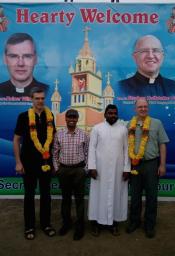
"Hearty welcome!"

“Hearty welcome!”

We spent nine hours on the road, where I got a feel for the population density in India. We drove through seemingly endless urban stretches,  with motorcycles and busses, bicycles and pedestrians weaving in and out of the highway, horns constantly honking. I gazed out the window, taking in the sights and sound and smells. It felt like being inside a movie, trying to grasp the plot and meaning of it all. What are the stories the voices of these people would tell?

Mumbai is a huge, sprawling, world class megalopolis of 25 million! Spectacular and artistic modern buildings rise in close proximity to vast tracks of sprawling slums. Construction is everywhere as the government tries to implement its long term strategic improvement plans.

We met with auxiliary Bishop Savio,  who welcomed us with tea and biscuits. As the Indian district grows, the SCJs are looking to expand into new areas and are in dialogue about what kinds of ministry which flow from our Charism of Love and Reparation would serve the needs of the diocese.

When traveling a a little sight-seeing is always good for the spirit. The hundred year old Gate of India was built to greet ships arriving in the harbor area. The last British troops symbolically departed from the same spot in 1948 after India achieved independence. Across the road was the magnificent hotel that was the tragic site of a terrorist attack just a few years ago.

The church rectory in Vasai only has one guest room, so Fr. Heiner and I experienced the hospitality of one of the parish families. I appreciate talking about culture, history, politics from local folks. We heard stories about family members pictured on the walls around us and got a sense of daily life for people in this part of the world.

Fr. Steve is welcomed by parishioners

Fr. Steve is welcomed by parishioners

Mass in Divine Mercy parish was in English, so Fr. Heiner presided and I was invited to preach. St. Paul’s exhortation about love being patient and kind fits in so well with both SCJ spirituality and our struggles to daily live a Christian life. Dancers led the entrance procession, and the youth choir sang out in lovely harmonies.

After mass 16 members that make up the parish council sat in a circle and after sharing a snack, began to tell us how they see the needs of the church in this area. Though a small parish, people are committed to building up the community with many groups and activities. Though the dreams of a new church seem far beyond their means, they are making small sacrifices and slowly building towards the day that can become a reality.

In the evening we took a drive to the substation, St. Anthony, a tiny worship space on the 2nd floor of a building that looked much like all the concrete homes on the block. We climbed a narrow concrete stairway to reach the upper room. While so different from the grandeur of historic Roman churches, I’ve been visiting, this more clearly called to mind the basics of our faith. This more surely resembled the upper room where Jesus ate with his disciples. On a hot day we were greeted with a glass of cool water, and I thought of the gospel and prayed God would bless them for the hospitality given in Jesus’ name.

An 11th standard (grade) student we met at church was one of the few who knew English, and acted as spokesperson for the community. She wanted us to honor her family with a visit to their home, so we followed. Surrounding the mission were poor and simple cinder block homes, with sewage trickling along a small channel in the concrete. Children’s laughter came from the makeshift cricket filed cleared amid piles of garbage.

We entered a home for the family of five. It was tiny, perhaps 12 by 30 feet. The home was decorated with brightly colored holy pictures on the walls. Half the space was living room, with the couch doubling as a bedroom. The other half was kitchen, where the mother also cooked food to sell in the neighborhood. A small loft was tucked near the peak of the sloping tin roof where the children slept. With so little space to start with, the family’s only transportation, a motorcycle was also inside for safe keeping.

On the way home we drove through a crowded brothel district, with women lined along brick alleyways, trying to attract enough customers to earn their daily bread. Apparently the government does license sex workers, yet life is still harsh and AIDS is a constant danger. A group of Religious Sisters has a center in the area to reach out to those caught in the web, and to care for younger girls and try to keep them from falling into such a life.

Frs. Steve and Heiner with gifts of traditional Indian garments

Frs. Steve and Heiner with gifts of traditional Indian garments

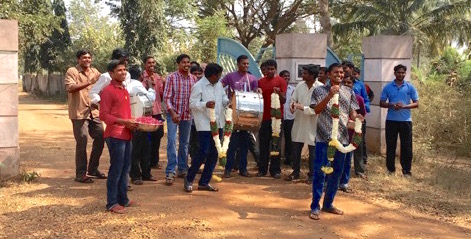
We flew to the state of Andra Pradesh, When we arrived in Eluru all the students were waiting at the gate, with an entourage of drums to lead us to the entrance of our Theology House. After working many years in South Dakota I recalled the importance of drums and also discovered a similar role in Indian culture here.

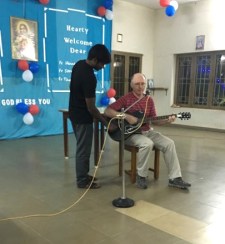
The statue of Jesus sits cross legged in guru position, and in chapel for prayer we take off our shoes as well. Here we have 26 theologians and 3 formators to work with them. After mass and supper the students put on a program with music, dance prayer and presentation. The students had a guitar and asked me to play a song. When I adapted the lyrics of “I’m Gonna Be Somebody” to tell of a longhaired Eluru boy, they let out whoop. Three of the community members shared a February 2 birthday, so they were feted as well. They have a tradition of feeding each other a piece of the birthday cake, much as you would see at a wedding in the States.

At 5:30 the next morning, bells rang to rouse everyone, and one of the priests set a bucket of hot water from the kitchen outside my door. I am spoiled with a hot shower to get me going in the morning, but here I am getting good at sponge baths. Another sign of difference was looking out my window and seeing a monkey scurry up the tree.

With only two days and more than 30 people to interview, we had a packed schedule. We could only give the students about 15 minutes each, but they came prepared and enthusiastically shared their hopes and honestly shared their difficulties. They are proud that the district is young and enthusiastic, yet often feel, as one student told us, “like a young bird that has not yet learned to spread its wings and fly.” I hope I can be supportive as they find their way.

Formation is a difficult ministry. You don’t get the same kind of affirmation as in a parish, so I am grateful for those who are dedicated to this needed service in our congregation. Students in formation go through a healthy independence and rebellion stage that is good but painful on both sides. Theologians wrestle with all kinds of questions about God, religious life, and how we are called to live. Our actions don’t live up to our ideals, and students challenge formators.

One student spoke of there can be two different ways to feel you have disappointed your elders, depending on your relationship with them. Some people you obey out of fear of punishment or consequences. With an inspiring leader you fear disappointing them because you want to make them proud. The latter is the kind of leadership all of us aspire to live.

Welcomed

Welcomed

We visited the parish of Vembadu and its three substations. We were greeted at the main parish by a trio of girls in traditional attire dancing a welcome and leading us into church. Colorful and bright decorations lit up the inside as we learned of the parish activities. Through pastoral visits and consistent attention the Catholic community is growing. We even have a couple of candidates from the village. I have been impressed by the parish work I see so far.

Afterwards we walked down a cow path, children holding our hands and guiding us in the darkness to help us avoid cow patties. At the edge of a rice paddy we dedicated a cornerstone. I even tried my hand at spreading mortar on the bricks will eventually become a safe and fitting for the women of the village to work and develop various cottage industries.

Our novitiate is the Sacred Heart Ashram in Nambur. The covered walkway connecting a circle of buildings reminds me of my novitiate in Victorville California. One significant difference is that here they raise much of their own food, including rabbits and pigs. We have 6 novices and 7 postulants preparing for their entrance into religious life.

In their skit they showed powerful, depicting a suicde the consequence of bullying and harassment

We hit the road again and undertook a long hot and dusty journey to us to the parish in Nolganda, But the time passed profitably, with Frs Anil and Baja Raju telling us about the land and culture and history along the way. Two of our priests are stationed at Our Lady of Fatima, They rent a 2 room flat from a Hindu family who is good to them, but doesn’t want Christian religious activity on the property, which limits the pastoral activity they could do from a traditional rectory. Plans are under way to eventually build a community house, and an orphanage to take care of needy children in the area.

The parish is quite simple, mostly made up of field workers and their families. In this part of the state of Andra Pradesh we passed many fields of chili, cotton and rice paddies, although with drought the rice harvest has been reduced from twice to once a year, putting already poor families at the edge. The government has tried to supply some work to supplement income, but the added pay is also very meager. Some of the workers live under canvas lean-tos.

The novitiate looks like it is out in the country, but the area is rapidly developing. India divided the Andra Pradesh state into two states, and the new capital is expanding. We were told that over the next few years something like 80,000 government jobs will be created. High rises are starting to replace two and three story cinder block homes.

A mile from the novitiate is a university with 7000 students, and modern classroom buildings. We saw some students playing Kabadi on sandy courts, a game like tag but with tackling and full contact that is a national favorite. Engineering and Computer are huge fields here.
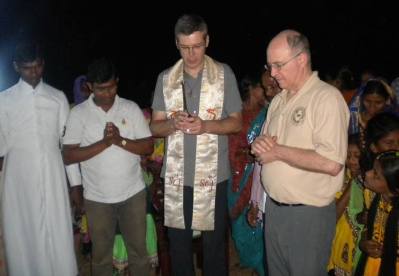
At prayer

At prayer

With the help of US benefactors, the SCJs have built a vibrant, colorful parish. Our reception included acrobats and tight rope walkers, and a woman who could lift a five gallon metal bucket of water with her teeth. We had dancers, flower wreaths and even some fireworks, which drew the wrath of a neighbor worried that his thatch roof might catch on fire. Inside parishioners presented accounts of their activities, including active youth groups, neighborhood outreach and scholarships that allow girls who might otherwise be married very young to stay in school.

We encountered a new wrinkle to the welcoming ceremony when we arrived at the minor seminary in Gorantla. Besides the flower wreathes and sandalwood paste, they washed our feet in memory of what Jesus did. It was very fitting on a day where four priests and two deacons were ordained in an outdoor ceremony on the grounds.

First though we visited a two room schoolhouse for 60 neighborhood children that doubles as a chapel on Sunday. And we met with the bishop of Guntur, Gali Bali, who stayed with us in Rome not long ago. He greeted us as old friends.

The ordination was a joyful celebration, three hours long with song and dance, and a drum procession. Most of the mass, including the homily was in local language. Since I could not understand the words, I paid more attention to the ritual, which made it more reflective. I like that about our Catholic practice.


Ordinations in India

IMG_2286

Fr. Thomas, district superior of India; Fr. Heiner Wilmer, superior general; Bishop Gali Bali and Fr. Stephen Huffstetter, general councilor

Fr. Tom Cassidy writes from India:

Yesterday was ordination day for four of our deacons to the priesthood and two SCJs as deacons. Bishop Gali Bali of Guntur said this was the first time that he has ordained both orders together. It did add a bit of time to the ceremony but I don’t think it really would have alter the three hour ceremony by very much if at all.

Fr. Michael Benedict, scj, the district treasurer, made plans to feed 1,000 people and he told me near the end of the evening that the catering company had to prepare additional food. When we began the Mass at 5:30 pm, I was not sure we’d be feeding 500 people let alone 1,000 but slowly the place filled up so that by the time we reached the end of Mass sometime after 8:30 pm the chairs were full and some had already begun lining up to eat.

Many of our students from Eluru made the trip though they had to take the public bus. That can turn out to be a three-hour trip depending on what bus they are able to catch. It also meant they had a three-hour trip back at the end of the evening. With that in mind except for those brothers staying for Sunday’s Thanksgiving Mass for Frs. Kishore, scj, and Suresh, scj in their home village of Kanaparru the rest left soon after finishing their meal. I think it was around 9:30 pm, which would get them to Eluru around 12:30 am unless they caught an express bus.

It’s now 6:00 pm as I didn’t have time to finish this before we left for the Mass of Thanksgiving by Fr. T. J. Kishore Babu, scj and Fr. G. Surest Babu, scj who hail from Kanaparru about 90 minutes from here. Traffic and the number of small villages we had to go through is what makes for the time rather then any real long distance — more about their Sunday celebration tomorrow.

IMG_2361

Dinner with the bishop

As for the ordinations, they went well. I did notice four things that we would not see in an ordination done in the US. First, the procession in was led by a drum group from the village of Fr. Dumala Raju, scj, and it was loud and large! Second, the offertory procession included not only the bread and wine and cup to be used at the Mass but many people brought fruits, rice, vegetables, communion wafers, etc., as offertory gifts. Third a small group of sisters did a dance offering, light (a candle), incense and flowers at the end of the Eucharistic prayer and before the Our Father. Fourth, before the Mass ended there were many thanks to be given out and guests honored with flowers and a shawl. Finally another dance, this one coming out of the Hindu tradition was performed in front of the honored guests.

After the Mass the mass feeding began. I was asked to have supper with Bishop Gali Bali and Fr. General and Fr. Steve Huffstetter, scj, along with Fr. Thomas Vinod, scj, (district superior) and Fr. Jesús Manuel Baena, scj (rector) of Dehon Premanilayam, minor seminary (Gorantla).

Bishop Gali Bali is two years past retirement age and has been patiently waiting for a new bishop to be appointed. It’s not an easy process in India as so many factors have to be taken into account such as languages, cultural differences, even issues of castes, etc. Fr. General and Fr. Steve will be wrapping up their visit tomorrow. There will be a meeting with the district council in the afternoon and then in the evening they’ll take the overnight Chennai Express train to connect with their flight to Latin America.


A “hearty welcome”

Welcome march

Last week we heard from Fr. Stephen Huffstetter with his first impressions of the Indian District. He and Fr. Heiner Wilmer, superior general, are there for a general visitation. Today Fr. Tom Cassidy writes about Fr. General’s arrival to Christu Dehon Nivas:

Despite the two hour delay in their arrival at Vijayawada all went well with the official welcome by the Christu Dehon Nivas community for Fr Heiner Wilmer, our superior general, Fr. Stephen Huffstetter, the general councilor responsible for India, and Fr. Thomas Vinod, our district superior. It also turned out to be a very long day for them. It began at 2:30 am in Mumbai with a long layover in Hyderabad due to their connecting flight’s late arrival. Fr. Heiner said he ended up having; (1) an American breakfast in Mumbai; (2) followed by a French breakfast at the Mumbai airport and finally (3) an Indian breakfast compliments of SpiceJet Airways for the delayed passengers in Hyderabad.

Huff with guitar

Fr. Steve joins in on the guitar

Given the “rank” of our visitors the always enthusiastic “hearty welcome to India took on an even more festive mood, drums included! The guests were met at the front gate by all the fathers and brothers where the traditional garland was given to each and then we all marched in to the front entrance where the rest of the ceremony took place. This included: (1) a welcome song; (2) incensing of the guest; (3) “Tilaka,” marking their foreheads; (4) an offering of coconut milk, and (5) a word of welcome by the rector (Fr. Mariano).

With the conclusion of these important rituals our guests were shown to their rooms and then all headed to the dinning room for the midday meal. Neither Fr. Heiner nor Fr. Steve had much time to rest as they would start meeting the students (each allowed 15 minutes) starting at 3:00 pm and going until 6:00 pm with a half hour break at 4:30 pm.

Fr. Heiner was asked to be the main celebrant at Mass. Normally Mass is done in the cool of the morning but it was moved to 6:45 pm so that we would have the opportunity to celebrate it with our guests and give Fr. Heiner a chance to share his thoughts on the Gospel of the day. The plan was then to have Fr. Steve be the main celebrant the next day (The Feast of the Presentation and the conclusion of the year long celebration of Consecrated Life).

Following dinner there was a program for the evening for our honored guests and community. In the States SCJs would call this a “convivium.” As you can see in the photos, Fr. Steve even joined in on the guitar.

Welcome banner

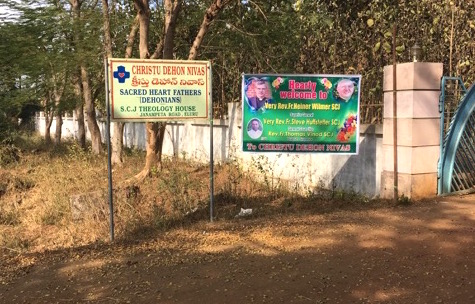
Welcome banners


Former provincial superior on the road as general councilor

Violin welcome

Fr. Heiner and Fr. Steve are welcomed to India by the students at Dehon Jyothi

Fr. Stephen Huffstetter, SCJ, begins his first full year as a member of the General Council with the first visitation of the new administration’s term. The former provincial superior of the US Province joins Fr. Heiner Wilmer, SCJ, general superior, on a visitation of the Indian District. This is Fr. Steve’s first visit to India. He shares the following:

Fr. Heiner last visited India 11 years ago, and many of the SCJs fondly remember the time he spent with them. This is my first visit. When we landed at the Chennai airport we were greeted by five very young Indian SCJs. I might have thought they were students, but I recognized them as members of the District Council and administration team. India is a young and growing district, and it is important to support people placed into key roles before they have had the seasoning that comes with years of experience.

Chennai experienced massive flooding a month ago, and on our way home we saw remnants of refuse washed into piles along the river channels and spilling over into neighborhoods. Some areas of poor homes on the most vulnerable lands washed away completely, with several hundred reported deaths. The SCJs had to leave their house for several days, then spent many hours cleaning and re-cleaning to make the building habitable again.

I was surprised to see how many cows roam the streets; you have to avoid them in traffic as well as pedestrians, auto-rickshaws and the constant flow of motorcycles. Many still had colorful painted horns from a recent Hindu festival.

When we traveled early in the morning I noticed a large number of people sleeping on the sidewalk, homeless and taking on the most difficult and lowest paying jobs in order to survive.

We spent our first full day with the District Council and listened in on their perspectives and ordinary business. They face dual challenges of financing their projects, and providing well-trained people who can help those projects flourish. Many of the parishes we serve are in poor mission areas. While we are proud that they are consistent with our SCJ mission focus, they are unable to be financially self-sufficient and require support from the district and grants from abroad. Thankfully, we have had generous help from other provinces (including the US Province) and from our benefactors. A goal of the council is to work toward greater financial stability within India, which will take some time.

Fr. Heiner encouraged the Indian District to find and articulate its own identity. As our presence develops, what will we as Dehonians in India be known for?

Mass

Fr. Heiner and Fr. Steve are welcomed to India by the students at Dehon Jyothi

On Sunday we concelebrated mass at Christ the King, a parish substation where SCJs often help. Mass was in the Tamil language, and even with a booklet, I couldn’t follow the alphabet containing more than twice the characters that I am used to. Men and women sit on opposite sides of the church, on the floor. Like everyone else, we left our shoes at the church entrance. Flowers and incense were present in abundance, and we had great participation from the assembly. A homily in this part of India is expected to last for at least a half an hour. At the end of mass people flocked forward to ask for a blessing, especially from we foreign visitors.

After two days of meetings we took a break and paid respects at the Basilica of St. Thomas, where the Apostle is buried. In prayer I asked the Lord to see me through my time of doubts, and lead me to a greater faith.

Next we walked to the beach and looked across the magnificent Bay of Bengal. First we came to the area where fishermen and their families live in very basic housing, often canvas stretched over a few wooden boards. As the boats returned, women sat by the road, cleaning and selling the day’s catch. We continued to the wide sandy expanse that we were told is the second largest beach in the world. Many families were out for picnics, playing Frisbee, buying treats and playing carnival type games. I found it odd that with thousands of people everyone wore street clothes. I did not see anyone swimming and only one child had on a bathing suit. Maybe because it’s “winter” and only 75 degrees!

General and Huff welcomed

Frs. Heiner and Steve

Each time we reach a new SCJ house we experience a traditional welcoming: greeted by song, garlands of flowers, and marked on the forehead with soil from the Indian subcontinent. Then we are handed a coconut to drink. Most of the time a hole is already punched in the top and a straw inserted, but I also learned how to open a young coconut by dashing it against a rock.

We have visited three of our formation houses so far. I have heard many stories over the years from members of the US Province who served here for a time in order to build up the district, and smiled when I saw the “Thomas Garvey Memorial Study Hall” in our philosophy house in Aluva. I am a product of SCJ minor seminaries, and started my affiliation with the community at the age of 14. Seeing men as young as 16 playing soccer and basketball, and beginning to discern if God is calling them to religious life and the priesthood brings back memories for me.

In each of the houses the students presented programs of song, dance, music and poetry. One of the students told a few jokes to warm up the crowd and another showed his juggling skills. The dances are energetic and entertaining, just like the ones from a Bollywood movie. Always there are words of thanks and gratitude. People say they are honored to have us here. It is an honor for us to be here among these thankful and grateful communities.

In Aluva for India Republic day, Fr. Heiner reflected how the search for truth was so important to Gandhi, and an essential part of the life of a student. After mass we had a flag raising ceremony. When the flag reached the top of the pole and unfurled, fragrant flower petals floated to the ground.

Fr. Heiner has held Q and A sessions with all of the students. They enthusiastically gathered around to ask questions like,” What would you have been if you hadn’t become a priest, what are your hopes for the Indian District, and why do we have to do 14 years of formation in order to become a Priest of the Sacred Heart?”

Fish prep

Fr. Heiner and Fr. Steve are welcomed to India by the students at Dehon Jyothi

Food is tasty and flavorful, though spicier than I am used to. The combination that works best for me is heavy on the rice and light on the curry. Fish is quite common, and being so close to the sea we have been served many shrimp, crab and fish dishes.

The land we have seen so far is green with vegetation. The philosophy house grows bananas, coconuts and tapioca, raises ducks for meat and cows for milk. Their fish pond also helps to feed the always hungry collegians.

A couple of mornings I was awakened at 5:00 by the blare of loudspeakers from a nearby Hindi temple. Christians are a small minority in the country, but have a strong faith and high rate of church participation.

The aspirant program is in Kumbalanghy in our first house, founded in in 1985. It contains a Portuguese chapel dating back to the 1500s and a good crowd of local people join the community for daily mass.

One of the main purposes of Fr. General’s visit is to meet with individual community members. We learn who they are, and ask how they see the district’s strengths and challenges. We specifically ask what their dreams are for spreading the charism of Fr. Dehon in this culture.