Category Archives: Uncategorized

Last day

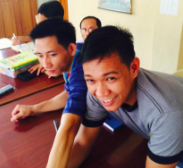
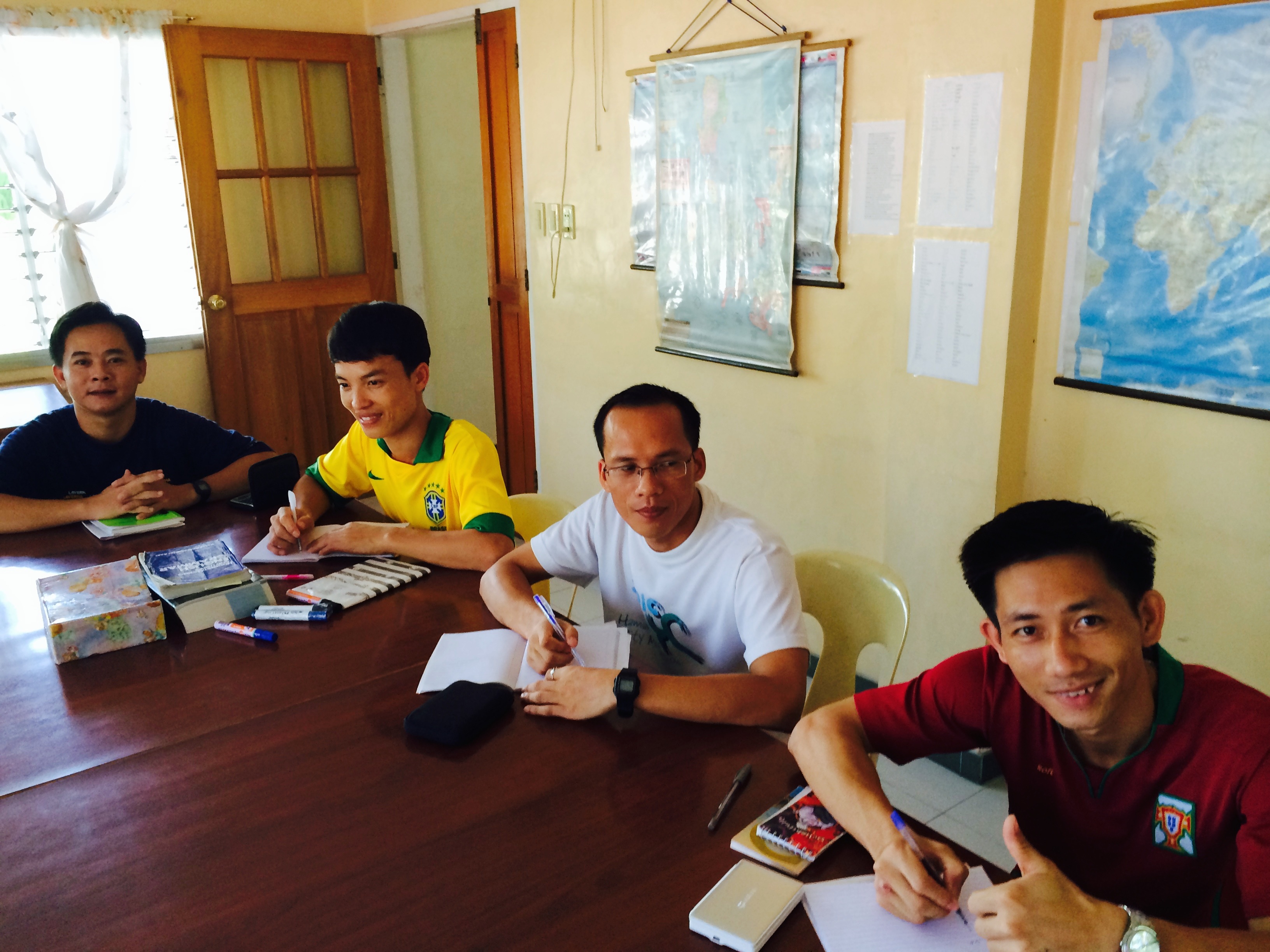
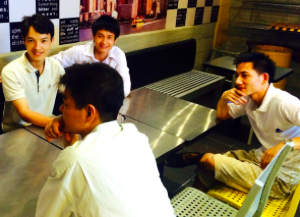
Some of Fr. Tom's students out for a final pizza night with their teacher.

Some of Fr. Tom’s students out for a final pizza night with their teacher.

As noted previously, Fr. Tom Cassidy has been writing blog posts from the Philippines, where he helped with the English program during the past six weeks. This is his final post before heading to his next stop: Vietnam.

Tomorrow I’ll head to Vietnam for the last leg of my Asian journey. While I call this the last day in truth I’ll be here for most of tomorrow as my flight doesn’t leave until 22:10 (10:10 PM). I’m not sure why Cebu Pacific flies so late in the day — my return journey to Manila leaves Ho Chi Minh City (Saigon) at 01:00 (1:00 AM)! One advantage, especially on the return journey, traffic will not be as great a problem though Manila never sleeps and the roads are never really empty of traffic.

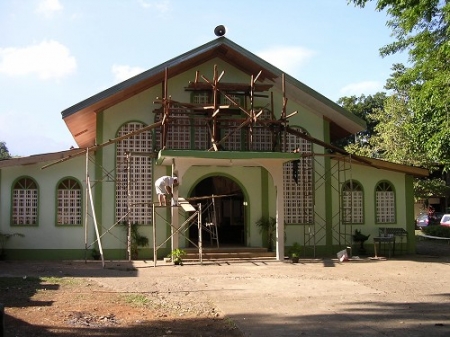
This morning I had two English Masses at a nearby parish of San Lorenzo Ruiz. Actually within a five to ten minute walk from our house I counted three nearby parishes. One of our students guided me to the parish, though with clear directions it would have been very easy to find. I’m told we often help out at this parish and I think it is our own territorial parish as well. We have used the parish church in the past for deacon and priests ordinations.

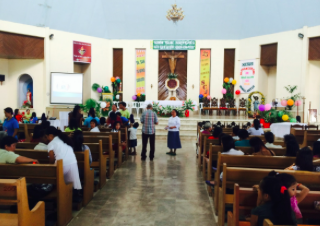
Fr. Tom celebrating Mass in the Philippines

Fr. Tom celebrating Mass in the Philippines

If I read the bulletin board correctly there is a Saturday evening Mass and three on Sunday. The first at 06:00 is in Tagalog and the others (08:00 and 10:00) are in English. As today was the first Sunday of the month what’s pictured here is a blessing on those who have June birthdays. It’s done just before the final blessing and announcements. The photo also gives a good picture of the style of alb/chasuble most priest where due to the heat.

I got home a little after 11:00 AM and looked in on the kitchen. Sundays the regular cooks have the day off so the students are responsible for the meals. Actually breakfast is on your own with everyone going in different directions either for pastoral work or off to a parish for Mass. The noon meal was being prepared by some of our Vietnamese students and the evening meal is in the hands of some of the Filipinos. While there are certainly similarities in their cooking styles there are also marked differences. Noodles play a much bigger role in Vietnamese cooking as does the use of vegetables. Rice is still the staple for both.

As the joke went in Cagayan de Oro so it plays well here too: At noon we’ll have fish and chicken and for supper we’ll have chicken and fish. Other meats will appear but not all that often and of the two pork probably makes it to the table more often then beef.
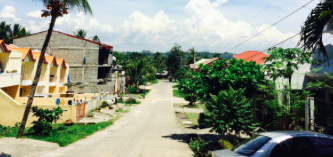
 

Fr. Tom writes: This street is not too far from our formation house in Cagayan de Oro and I often would walk it during my daily walks. I decided to take this picture for two reasons: (1) It shows the morning build up of clouds that often led to our afternoon thunderstorms. (2) It gives some idea of modern Philippine housing. Housing is one difference I noticed from my first trip in 1990. Both roads and housing have shown marked improvement over that time span. However, do keep in mind Cagayan del Oro is a large city and out in rural areas things can be much simpler. I should also note that I could just as easily turned this camera in the opposite direction and shown shacks constructed of wood, metal and bamboo, or what I take to be bamboo. The same is true in Manila (or any other large city) along with nice housing, mansions even, not all that far away are clusters of slums and shacks. Poverty while less then what I saw in 1990 is still a reality for far too many.
Fr. Tom writes adds a bit about the photo above:  “This street is not too far from our formation house in Cagayan de Oro and I often would walk it during my daily walks. I decided to take this picture for two reasons: (1) It shows the morning build up of clouds that often led to our afternoon thunderstorms. (2) It gives some idea of modern Philippine housing. Housing is one difference I noticed from my first trip in 1990. Both roads and housing have shown marked improvement over that time span. However, do keep in mind Cagayan del Oro is a large city and out in rural areas things can be much simpler.

I should also note that I could just as easily turned this camera in the opposite direction and shown shacks constructed of wood, metal and bamboo, or what I take to be bamboo. The same is true in Manila (or any other large city) along with nice housing, mansions even, not all that far away are clusters of slums and shacks. Poverty while less then what I saw in 1990 is still a reality for far too many.


Sampling the treats of Vietnam and the Philippines

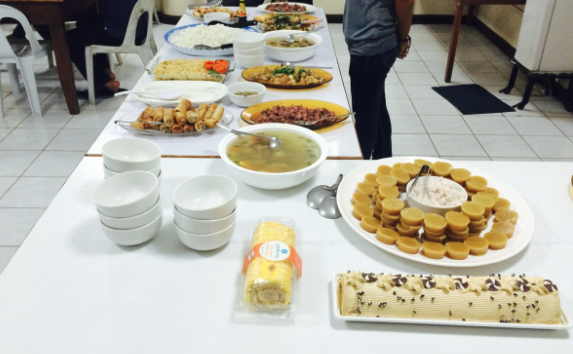
A buffet of Asian dining at the cultural fair in the Philippines

A buffet of Asian dining at the cultural fair in the Philippines

The many cultures of the Philippines and Vietnam

In one of his last posts from the Philippines Fr. Tom Cassidy writes about the community’s recent culture fair in which the foods and traditions of Vietnam and the Philippines were shared.

Our local cultural fair went off without a hitch and I’d say everyone went home full and happy. The event bears some similarities to the cultural fair that caps off the summer ESL program each year at Sacred Heart Seminary and School of Theology (SHSST).

The evening began with a brief presentation using tourist videos of the wonders and beauties of Vietnam and The Philippines. Our master of ceremonies was Br. Joseph Dien Tran, SCJ, who just returned from his Vietnam holidays was drafted by the group to do the honors. Joseph graduated from the English course two years ago when Fr. Johnny Klingler, SCJ, served as its instructor in American English pronunciation.

Although we only had two countries represented, their size and cultural complexities ensured that we would have a rich experience representing the islands of Luzon and Mindanao from the Philippines and the cultural diversity of the north, central and southern corners of Vietnam. Our eight Vietnamese students range from as far north as the Hanoi area (Vincent Le Tiep Van) to almost the southernmost tip of the Mi Kong Delta (Anthony Ngo Minh Cuong) and regions in between.

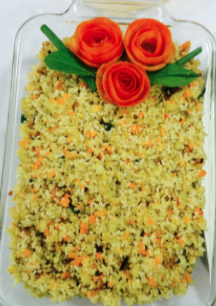
Fried rice by student Peter Nguyen Quoc Cuong

Fried rice by student Peter Nguyen Quoc Cuong

I’ve reported on several occasions of just how passionate Peter Nguyen Quoc Cuong has been about the cuisine of central Vietnam (Quan Binh Province). He’s been selling me the virtues of the Mi Quang Noodles since about the first day of class. Peter worked for four years in his brother’s restaurant and although much to my disappointment he did not make the noodles for our dinner he did produce a great dish of fried rice that as you can see was presented with a bit of flare. He made the flowers out of carrots.

Peter has promised me he’ll make the noodles before I leave on Saturday he’s waiting for one of the students to return on Thursday from the Dehonian Youth Mission who has a stash of Vietnamese noodles needed to properly make Mi Quang Noodles.

As for the other dishes we all enjoyed last evening the two representing the Philippines were made by Argol Chavez from Mindanao who prepared Bicolano. It’s made of coconut milk, pork and chillies and is served as an appetizer. We were warned it is HOT! July Zambrano from Mindanao made a dessert called Poto Cotchinta. It looks something like a flan and is served with shredded coconut.

Every party includes some clean-up

Every party includes some clean-up

In addition to Peter’s contribution, Antonio Nguyen Van Nhat assisted Francis Pham van Phuong in making Cha Gio (fried egg roles) along with a fish dish with sliced tomatoes. Finally John Dang Ngoc Lam made our soup. Both cultures often feature soup as part of a meal.

I think everyone enjoyed the evening. I, for one, always like trying new foods and learning how different cultures both look at food and its role in their society. I always remember Bishop Virginio Bressanelli’s comment about Italians: “Italians,” he said, “are the only people I know who have turned eating into an art form.” I would tend to agree with him. Certainly Italians love nothing more then to sit around a table with good food, good wine and good conversation. I think to a certain degree that same love is part of many Asian cultures.

Fr. Tom with his students

Fr. Tom with his students

Mass at a Philippine Army base

Continuing to learn about the culture and church of the Philippines

The base chapel was filled for morning Mass

The base chapel was filled for morning Mass

As noted previously, Fr. Tom Cassidy, SCJ, is in the Philippines this spring, teaching English. Today he posts about celebrating Mass at a nearby army base:

This morning I was picked up just before 08:00 and driven to a nearby Philippine army base as I was scheduled to celebrate the 08:30 Mass. The base has a regular full-time chaplain, but he is on vacation and Fr. Arthur Guevarra, SCJ, is filling in for him. He asked me a few days ago if I wanted to take one of the two Masses and gave me the choice of 06:30 or 08:30 and opted for the later.

I was accompanied by Deacon Christopher Alburo, SCJ, who was one of the six deacons ordained in Dumalinao on May 13th.

The church was full as it is a pretty good size army base. Our Eucharistic ministers were retired army personnel. One told me he was in for 29 years and all together about 34 years of government service.

I asked about how army pensions worked in the Philippines and he said it depended on years of overall government service. He had both military service time and five years as a teacher. I didn’t have a chance to ask the others but I was told they too were retired military. They do not live on base but nearby.

Since I do not speak the local language the Mass was in English but several of the hymns were in Binisaya. As I have experienced throughout my visit, the congregation sings well, certainly much better then most US parishes where I’ve celebrated Mass. Today we were accompanied by a piano and a small choir of three young men and three young women.

The offertory was s bit different from some of the other parishes I’ve been in as only a small representative group came up with their envelopes rather then all the kids and some adults as I’ve seen elsewhere. However, the desire for a blessing at the end of Mass (especially by the children) was just as much a part of this Mass as any other. The person takes the priest’s hand and touches his/her forehead with it for the blessing.

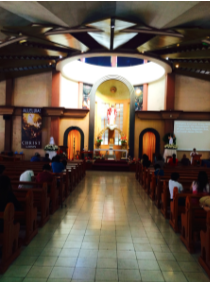
I should say something about church architecture that is very different from any in the States. It all has to do with climate. Every church that I have been in on the island of Mindanao has open walls. Where we would have windows these churches are open to the outside air. They are covered with grill work to keep the church safe when not in use, but still allow as much air to flow in and around the church as is possible.

Vestments too are a bit different, at least those worn by most priests. The chasuble serves as both the alb and chasuble and is made out of a light material. At important celebrations the main celebrants have on a traditional alb and chasuble but most of the time it is the lighter garments.

Finally, everywhere I’ve been the Masses are well attended and by young and old as well. It may be a bit different in Manila or perhaps some other large cities but here on Mindanao the faithful do fill the church for Sundays and important feasts.

Studies put to the test

Staff of the English program including Fr. Tom (second from right) and Fr. Andrew Sudol (far right)

Staff of the English program including Fr. Tom (second from right) and Fr. Andrew Sudol (far right)

Fr. Tom Cassidy writes from the Philippines where he has been part of the teaching team for the English language program there. 

Testing day

Today is preparation day for my 11 students. Tomorrow morning they will take the entrance exam to Xavier University in order to begin their philosophical studies. Actually, eight of the students will take the exam as two entered the university last year and took a limited number of courses and were in the English program this spring to help improve their language skills. The third student has already completed philosophy and will enter the year-long postulant program.

Fr. Tom with students

Fr. Tom with students

All eight students were told last evening they could take the test based on the practice exam they took on Tuesday morning along with the oral exam they had in the afternoon before me and the rest of the formation staff. It was a fun experience, at least for me, though I’m sure for the students it was a tense time, especially having to answer two questions within five minutes before the staff and the rest of the students looking on.

By late tomorrow afternoon we’ll know the results of the exam. Fr. Khoa Nguyen, SCJ,  who took the exam several years ago, is confident our students will do just fine. It is an important moment for them, but not the end of the world. When our program ends a week from tomorrow the students will have a few weeks off before the school year begins. However, over the next two or three years Xavier (and many other universities in the Philippines) will be moving toward a schedule similar to what we have in the States (and to a certain degree Europe). They’ll start school sometime in August and end the second semester in May. Most European schools open in October and end in late June.

Students

Students

Tomorrow evening we will have a “despedida” [farewell party] for Fr. Andrew Sudol, SCJ, who has been on the formation staff here for a number of years (I think at least seven). He will begin a sabbatical year first with a vacation home in Poland and then in the fall participate in a renewal program at Catholic Theological Union in Chicago. He’ll live with our formation community in the US Province.

Turning for a moment to the weather we have had daily rains since our return from Zamboanga del Sur, though today it was more of a sprinkle, at least in our area. We also have had good luck with the power company as well. The other day we lost power just before supper but in about 20 minutes it was back on. I’m going to guess it was either an accident that knocked down a power line or lightning in the area hit a transformer.

Fortunately the rains have been predictable making it easy for me to take my walks. I have also expanded my territory now that I know where our local parish is and the road to it is not well traveled by cars making it a safe way to go. It also is up a pretty good hill that is good for my exercise program.

Six deacons ordained in the Philippines

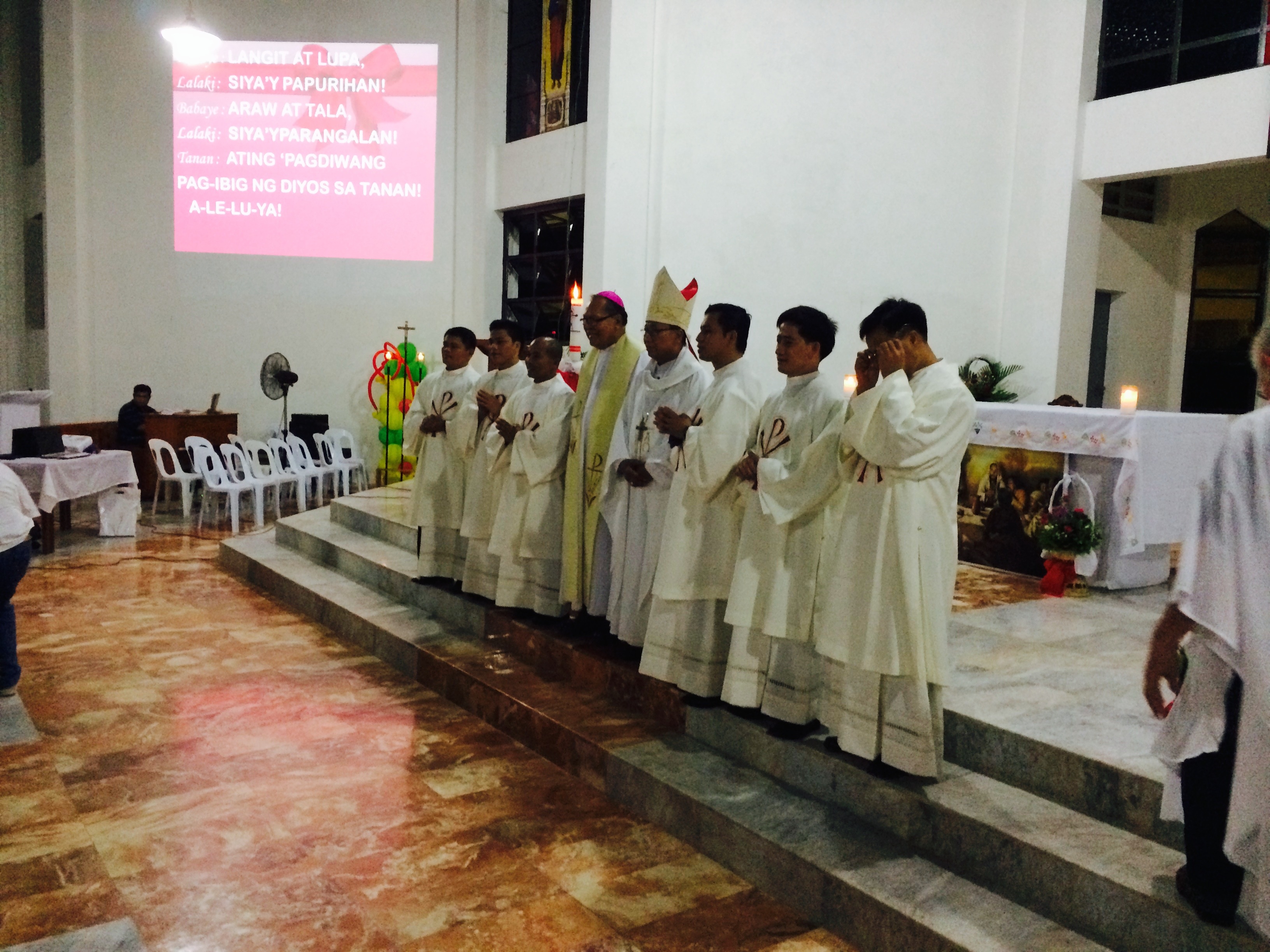
The new deacons with the bishop

The new deacons with the bishop

Posting from the Philippines where he is teaching English this spring, Fr. Tom Cassidy writes about the recent diaconate ordinations in Asia:

With the celebration and deacon ordinations set for 4:00 p.m. on Friday, and yesterday being a six-hour travel day back to Cagayan de Oro, now is the first real chance I have to sit down to write this. It’s now Sunday morning and I will have the 10:00 a.m. English Mass at our parish of the Immaculate Conception, only a five minute walk from here

Friday’s celebrations were simply marvelous! The parishioners of St. Isidore the Farmer did themselves proud in providing a wonderful liturgical atmosphere for the six deacons-to-be and their families. Obviously it was much easier for the four Filipinos to have their families attend the ordination. Though I’m not sure, I believe the majority of them come from the island of Mindanao since that’s where we have our major presence — although two of the three Filipino students I have in my class come from near Manila on Luzon.

That’s not to say their Vietnamese brothers did not have family present and even though English and/or Cebuano are foreign to them they seemed to fit right in enjoying and watching their sons and brothers being ordained deacons by Archbishop Al Sudarso, SCJ, of Palembang, Indonesia.

I wish I had enough bandwidth to embed a short video I took at the start of the Mass. Friday marked the third day in a row where we had heavy rains during the late afternoon, usually between 3:00 p.m. and sunset. Friday saw the heaviest downpour though with less thunder and lightning. The roof of the new church is metal and does not have much, if any soundproofing and the din the heavy downpour made in the church almost drowned out the singing and praying. Luckily the church has a good sound system that could rise above the deluge Mother Nature was dropping from the sky.

Bishop Emanuel Cabajar, CssR, of Pagadian concelebrated the Mass and preached. This time he did it in English. The Mass and ordinations took about two hours. Thanks to the rain the temperature in the church was rather comfortable. While we had fans near us the outlets have as yet been hooked up leaving the fans as mere decorations — thank goodness the rain cooled us down.

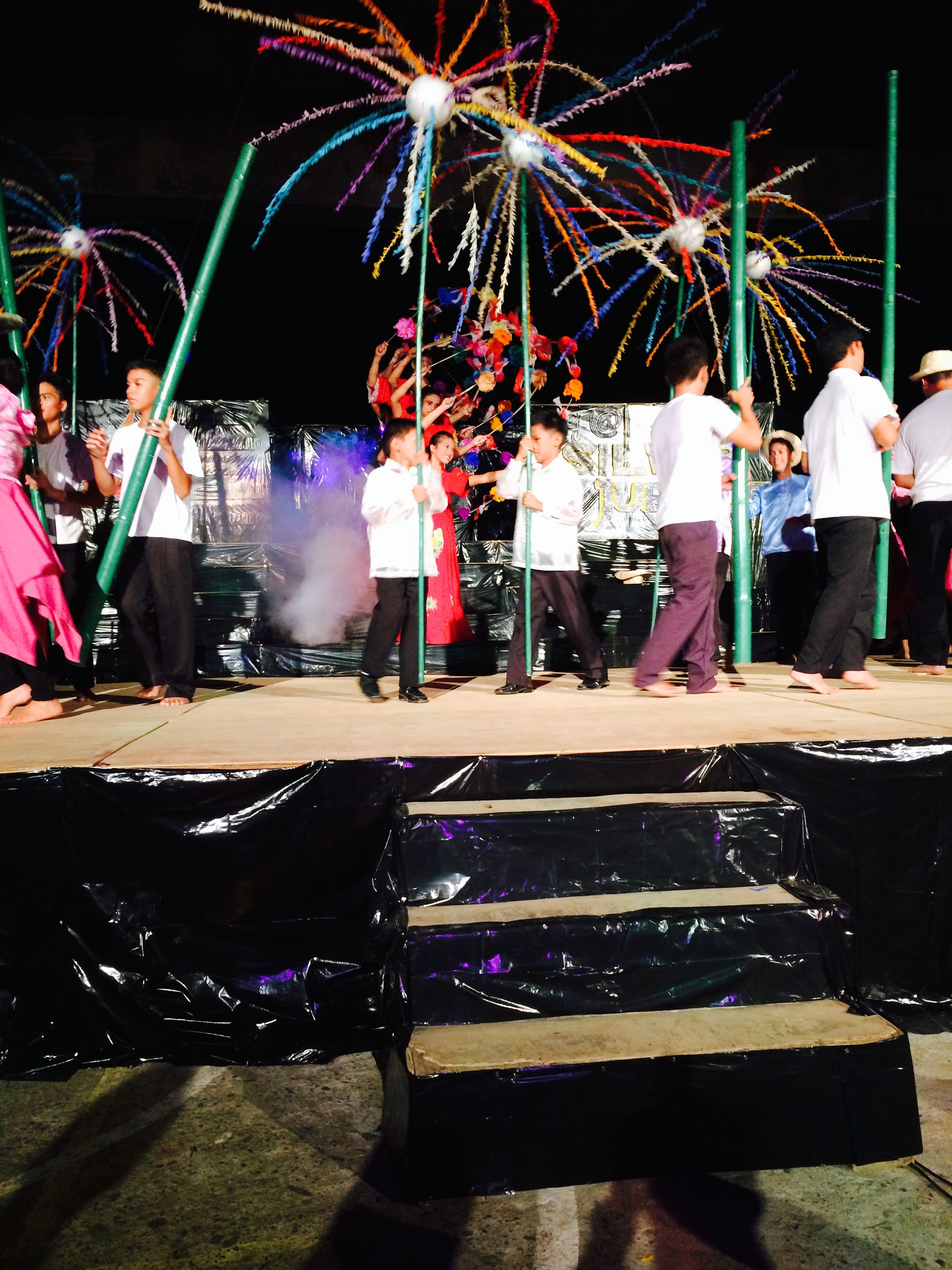
Fireworks and dancing were a part of the ordination celebrations

Fireworks and dancing were a part of the ordination celebrations

After Mass we returned to the old church, which served as our dining hall with the same Pagadian catering service handling the reception. As with the two previous meals they served, this one was heavy on meats and rice but no vegetables. However, there were at least two or three kinds of fruit, especially pineapple and watermelon. As we foreign guests have learned, any celebration would be a disaster if roasted pig were not there in abundance. We had two for the crowd to devour. I went up once or twice to try to get a piece but I couldn’t get near the action. Clearly the Filipinos love their roasted pork and nothing goes to waste!

I was wondering where the show would take place and soon learned it was going to be at the local school gym. Don’t think of a gym in our terms, this is more like a covered outdoor stadium with bleachers on one side, a roof covering the entire expanse with the sides left open — better to keep things cool for fans, players/actors alike.

We were also lucky the rains stopped several hours before we headed over to the gym. You did have to watch where you walked once leaving the main road as it then became a dirt track. Once again my smartphone came in handy not for calling but for seeing – I used its built-in in flashlight.

As for the show itself, the members of St. Isidore the Farmer’s parish and its many chapels did themselves proud. The show opened with an adult choir, that included our own Br. Yohanes Baptista Sismardi, SCJ, singing the Philippine national anthem. This choir would make another appearance during the course of the evening as one of the adult acts.

Immediately after the national anthem a prayer/dance was offered as the benediction for the evening. Dance would play the most important part of the evening’s entertainment.

The show lasted about two hours and interspersed between some of the acts was a narration of the 25-year history of the SCJ presence in the Philippines. During the course of the show we had young girls (maybe between 8 and 10) come by with water and sweets for us to enjoy. As the SCJs were the honored guests we were seated in the front row on chairs in front of the bleachers and close to the stage.

Days of celebrations begin

The parish church in Dumaliano

The parish church in Dumaliano

As noted previously, Fr. Tom Cassidy, SCJ, is in the Philippines assisting with the English program for SCJ students. Today he posts from Dumalinao. Also, Fr. Tom has been doing interviews with his students. They are being posted on the US Province website as they are written. Click here to view them.

Getting used to rainy season

It’s now 7 p.m. as I sit in the dark before my computer. Our electricity has just gone off and I’m waiting for their new generator to kick in. I think yesterday was the first time they used it, and it functioned well when the power went out. I’m told that losing power is rather common around here even more so then what I experienced in Cagayan del Oro. I think we all have to give the power company some slack on this one as we have had a constant heavy rain and thunderstorms for the past three hours. They’ve now ceased and once again you can hear the insects of the night.

Today was the first of our celebration days. This morning at 9:00 we had the Religious Profession Mass with Fr. Frank Pupkowski, SCJ, as regional superior, the principal celebrant. One other important person to note Fr. Rino Venturin, SCJ, the district superior of Vietnam. Our Vietnamese students study both philosophy and theology here in the Philippines.

Because this week also marks the 25th anniversary of our presence in the Philippines a number of SCJs from around the congregation, including several provincials from Europe, were also present today. In the group making their final profession were four Filipinos and two Vietnamese while all five of those making first vows were Filipino. The entire ceremony lasted about two hours and was followed by a meal held on the novitiate grounds. Fortunately the rains did not come until later in the day allowing us all to eat in comfort. Because of the large crowd the meal was catered by a local company that I presume came from Pagadian.

I would love to show you pictures of the vow ceremony but somehow my pictures did not appear in the iPhoto app and I’ve been deleting photos off my phone when I transfer them. Alas I’m afraid their lost forever. Too bad as plenty were taken with the help of Fr. Khoa Nguyen, SCJ, my travel companion from Cagayan del Oro who had a better vantage point to take pictures this morning. I will try to see if I can scrounge up a few photos from one or the other photographers in the house.

I managed to finish my walk just before the rain began a little after 3:00 this afternoon. Staying at the house is the young niece of Fr. Arthur Guevarra, SCJ, who followed me around on my 90 minute walk, well at least for some of it.

Screen Shot 2014-05-14 at 6.06.16 AMToday’s rain was the first of what I would consider to be a typical day in the rainy season. Heavy rain for a time with thunder and lightning to accompany the storm. If there is one difference I noted there is not the strong wind we often associate with thunderstorms in the Midwest.

Tomorrow morning we head to Kumalarang for a 9:00 Mass to kick off the feast day celebration. It is the last of the original three parishes that we SCJs still staff. It is about an hour from here by car. Last evening many went to Margosatubig for a dinner given by one of our former parishioners. As I had just completed a six-hour car ride to get to the novitiate I opted to stay home and rest. Magos and Dimataling were two parishes we had to give up some years ago at a time when some of the rebel groups were kidnapping foreign nationals for ransom. This step was taken after one of our own priests, Fr. Giuseppe Pierantoni, SCJ, an Italian, was kidnapped and held for close to six months before being released.

Sports and the changing of the seasons in the Philippines

As noted previously, Fr. Tom Cassidy is in the Philippines for the next few weeks, teaching English. On April 30 he writes:

philmapCDOToday is the last day of the month and tomorrow we begin May with the Feast of St. Joseph the Worker, and in much of the world its May Day, which compares to our Labor Day celebration back in the States.

After class yesterday the students told me they were going out to play soccer. The players were all Vietnamese plus two from the formation staff. I learned that soccer is not popular with Filipinos, or at least with the three enrolled in our program. I’m not sure what is the most popular sport but as I mentioned in an earlier entry basketball may well be.

Unlike India, where I found at least three channels devoted to cricket, I have not found a similar local TV dedication to a single sport. I have to admit I have not explored the entire spectrum of stations at our disposal. As in India the preferred method of reception is via satellite. I have run across both Fox and ESPN sport channels that devote time to local and international sports. Perhaps the one exception is that neither channel pays much attention to baseball, but certainly to a lot of European soccer and the NBA playoffs.

Keeping up with the Brewers has not been difficult. It is a bit strange to turn on a game after coming to my room following morning prayers and breakfast. Stranger too to keep in mind the game is being played the night before according to my local time setting.

Turning to weather, Cagayan de Oro is at a latitude of 8.4833° N, 124.6500° E meaning we are close to the equator. Sunrise this morning was at 05:26 and will set this evening at 17:51. There is not much change year round so most days, the average daylight hours are just slightly over 12 (today it is 12 hours and 25 minutes). It also means there is very little twilight as once the sun goes down it is almost immediately dark.

Looking ahead to May and the start of the rainy season our days will begin to cool off just a bit. Right now we are running between 32° Celsius (89.6 F) and 35° C (95 F) for highs and 22° C (71.6 F) and 23° C (73.4F) for lows. Towards the end of May the highs will hover between 30° C (86 F) and 32° C(89.6 F) and the lows will be about the same as we have presently. I was told the rains can last into October though as the summer begins to wane the rains lessen as well.

The Philippines are subject to typhoons. According to the internet on average 20 typhoons enter the Philippines each year. Mindanao, as the principal island in the southern part of the country, seems to experience less major storms as most of these seem to go through the center chain of islands.

The SCJs, in conjunction with a number of other religious communities, are working on a project to rebuild homes on Leyte Island for those who lost all in Typhoon Haiyan that struck the central islands last November.

Settling in with the Philippine community

SCJ Formation House, Cagayan de Oro

SCJ Formation House, Cagayan de Oro

As noted previously, Fr. Tom Cassidy is in the Philippines for the next few weeks, teaching English. The following are recent reflections that he wrote for our province blog:

April 25, 2014: SCJ Formation House, Cagayan de Oro:

It is now 09:00 and later today I will meet with the students so I’ll save talking about them until tomorrow. I’ll try to explain the building complex that will be my home until early June. This is indeed a formation community as there are three levels of formation that take place here before the students move on to the novitiate and then to Manila for their theological studies. Here are the levels:

1. Postulants — these men are preparing to enter the novitiate the program in most provinces lasts for a year.

2. Aspirants — these men are studying philosophy at Xavier University and will move up to postulancy upon completing their philosophical studies.

3. Orientation Year — these men are beginners and are being introduced to religious life, the SCJ way of life, and working to develop their English language skills.

The campus grounds are spacious and include garden areas as the buildings form a square and like so many Mediterranean structures, there are interior courtyards. As this is a tropical climate it is filled with plants and greenery.

There are two sports fields available as well: a small soccer field and a basketball court. Basketball is a popular sport in the Philippines along with badminton. Actually, I may be off on badminton as the Indonesian SCJs who have come to the Philippines brought their passion for badminton with them.

In addition to the three formation programs Cagyagan is also where the regional superior has his office. Fr. Frank Pupkowski, SCJ, is the current superior and will complete his first three-year term next spring. I will have to check if their development office is also on campus. Fr. Frank was responsible for it before becoming regional superior. The US Province Development Office assisted the SCJs in the Philippines to establish a similar program here and it has proved to be rather successful in helping the region to aim toward financial self sufficiency.

e ra

A few of Fr. Tom's students

A few of Fr. Tom’s students

April 26, 2014:  First Day of Class

It is now 08:50 on Saturday morning and it seems rather strange to be listening to the Milwaukee Brewers play the Chicago Cubs at Miller Park on Friday night — it’s the bottom of the second as I begin my writing.

I met the students for the first time yesterday in a get-acquainted session. As I indicated previously my task is to work on English pronunciation. In the morning the students have English classes with another teacher.

I met with nine students yesterday and two more will join the group on Monday. When all 11 are present there will be eight Vietnamese and three Filipinos. Each group presents pronunciation issues given their native languages. I suspect all the Vietnamese will have similar issues while that may not be the case with the Filipinos as they come from two different language groups: Cebuano and Tagalog.

They seem like an eager group, but it’s the first day and time will tell how well we work together. I did get one piece of sound advice from Kelly Kornacki, the director of ESL at Sacred Heart School of Theology: use a lot of humor! Having to struggle to learn Italian when I went to Rome in 1991, I think that gives me both empathy for the students and hopefully some ways to help.

I decided to use a book by John Grisham: Theodore Boone Kid Lawyer. The Theodore Boone series is written for children, about the same age as the Harry Potter series. I’ll use a technique that Fr. Bernard Rosinski, SCJ, used last year in having the students record their reading of sections of the book and then going over with them their pronunciation.


April 27, 2014: Mercy Sunday

Sacred Heart Parish

Sacred Heart Parish

About 08:00 Fr. Khoa Nguyen, SCJ, drove me to the Santuario Eucaristico – Sacred Heart Parish about a 10 minute drive from our house into the heart of Cagayan de Oro City. I was asked by Fr. Arthur Guevara, SCJ, to celebrate the 09:00 and 11:00 English Masses. The SCJs were covering the Sunday Masses so the shrine staff could go on retreat for the week.

Actually, almost everyone was out of the house by 09:00 either scheduled to celebrate Mass or for the students to go with one or the other priests to attend Mass. Today is Divine Mercy Sunday and a big day of celebration here and around the world as John XXIII and John Paul II were about to be canonized by Pope Francis. Rome is six hours behind our time so the actual event at the Vatican was still in the future when most Filipinos went to Mass.

Sacred Heart Parish/Shrine has seven Sunday Masses (one on Saturday and six on Sunday). Two are in Cebuano and the rest in English. Neither Mass I had could I claim that the church was packed. This is summer and the nearby university is on break as well, and I’m sure that cut down on the number of people attending. There we lots of kids and youth in attendance.

They have two cute customs for the younger children (from 3 to about 10 or 11). At the offertory the kids bring up their envelopes and hand them to the celebrant and these are added to the collection. Then at the end of Mass just before the final blessing over the congregation the kids come up to the celebrant who gives them a special blessing.

After the 11:00 Mass I went to have lunch with family friends of Fr. Guevara. Fish played an important part of our meal as there were at least three kinds on the table. In addition there was a meat dish that they called a stew. It was more like a semi-clear broth in which the meat was cooked rather then what we would think of as stew back in the States. I particularly liked the spinach-like greens that came in a vinegar based dressing along with onions. It is something I hope to eat again.

Finally, one of the three fish dishes served was a fish delicacy, or at least that’s how Fr. Guevara described it: “The Jaw of the Tuna.” I don’t know if they really consider it a delicacy but it tasted good to me and happily did not have bones to contend with, or at least the pieces I procured.

The family might be typical of many educated Filipinos. A sister is a US citizen living in New York and is a doctor of physical therapy. A brother is a nurse and along with his wife, who is also a nurse, they live and work in a suburb of Belfast, Ireland. The father of the clan is now 77 years old lost his wife to a stroke several years ago but continues to visit his children abroad. He told me he goes to the States about every six months. As for mom and dad, they introduced me to their four daughters; the oldest is now in high school.

First day in the Philippines

From India to the Philippines. After a short break at home for Holy Week and Easter Fr. Tom Cassidy is back in Asia, this time the Philippines, where he will be assisting with the English program there. This is the first of his blog posts from the region. 

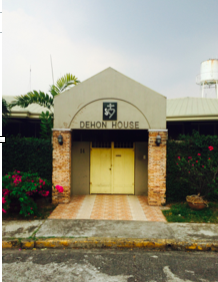
Dehon House, Manila

Dehon House, Manila

It is now late afternoon as I am completing my first day in the Philippines. Today is a recovery day from my travels and tomorrow I’ll fly down to Mindanao to begin my time as English teacher. Actually, if I am correct, it would be better to say Assistant English Teacher. As I understand my job it will be to work on pronunciation with the students, but time will tell as to what my real duties will be. I did come prepared with several texts thanks to Kelly Kornacki who heads the ESL program (English as a Second Language) at Sacred Heart School of Theology. These will form the basis of my work.

I am staying at our scholasticate, Dehon House, where our SCJs live while studying theology here in Manila. If I counted correctly there were 20 students living here during the school year that ended in March. The students are a mixture of Filipinos and Vietnamese. At least up until now all our Vietnamese SCJs have done both their novitiate and theological studies here in the Philippines.

As you may know the Philippines is the only Catholic country in Asia, thanks to  its long colonial period under the Spanish. That in many ways makes Manila the center of Catholic studies in Asia and it is sometimes called the Vatican of the East as it has excellent theological schools and universities. It is also a good place for sabbatical studies and refresher courses.

On the drive from the airport last evening I was told the education system (at least at the university level) is in the process of revamping its scholastic year. Two years from now it will go on a semester system similar to what we have in the States, i.e., a fall semester beginning in late August and a spring semester ending in May. Right now they begin the school year in June and end in March. While I am not aware of all the reasons for the change it will make it easier to attract visiting professors from places like the US and Canada as it will not require interrupting their home schedules.

Right now the house is quiet as most of the students are gone. I was lucky enough to be here just before our SCJ group leaves for a new mission in Asia. Many of them participated in the ESL program at Sacred Heart School of Theology since English will be their common language.

Perhaps it is fitting they are using the Philippines as their jumping off point. Next month will mark the 25th anniversary of our presence in the Philippines. It marked a new way for our SCJs to operate in foreign missions. Prior to that a province would mark out a mission territory and staff and fund it. For example, the US Province had the De Aar Region in South Africa as a mission from after World War II until De Aar and Aliwal North (under the German Province) were joined to form the South African Province.

After the Indonesian Province requested that the congregation expand in Asia a study was done by the general administration and it settled on opening a mission in the Philippines. However, instead of asking a province to take up this responsibility; under the leadership of the general administration volunteers were sought from around the congregation, and they were then sent to Hales Corners to learn English as it would be both their common language, and one needed in the Philippines for higher studies.

I always remember what Bishop Virginio Bressanelli, SCJ, said about this  method (he as general superior). He liked it because instead of Italy or Germany or the US SCJs going to a mission country and in it forming little Italian, German or American islands the fact that the team was international made that less of a possibility. In any case, it has worked well for us as our Philippine Region has steadily grown and has taken on a local flavor as more and more Filipinos are finally professed and ordained.

Our presence here has also allowed us to begin our Vietnam project, which though much younger then our 25 years in the Philippines has also shown much promise. I plan on visiting Vietnam in early June when my teaching stint is finished.

Let me close with a few words about this house. When we began 25 years ago all the SCJs were in Mindanao though it was known sooner or later a presence in Manila would be necessary; first and foremost as the center for theological studies and as the national capital everything tends to flow in and out of the city. After the first five years the community began to accept candidates and the hunt for a place in Manila began in earnest. This property was purchased from another religious community that needed more room. We have expanded it by adding a second building. I asked at the noon meal how many could it hold and was told about 50. Certainly that is more then sufficient for current and projected needs.

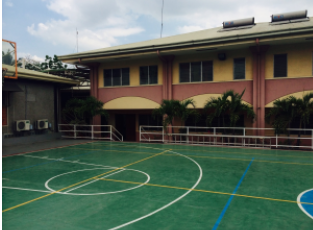
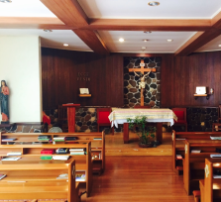
Just like Eluru in India or our own Chicago House of Studies the students live here but go to school at local universities/schools of theology. From a past visit I believe they go to at least two theological schools, but that’s something I’ll have to confirm when I have the chance. I’ll close today with several pictures I took this morning that might give you a little better idea of life here at Dehon House.

A view of the dining room with the kitchen in the distance

The dining room with the kitchen in the distance

Screen Shot 2014-04-23 at 10.21.35 AM

New building and exercise area

Community chapel

Community chapel

Reflecting on time in India

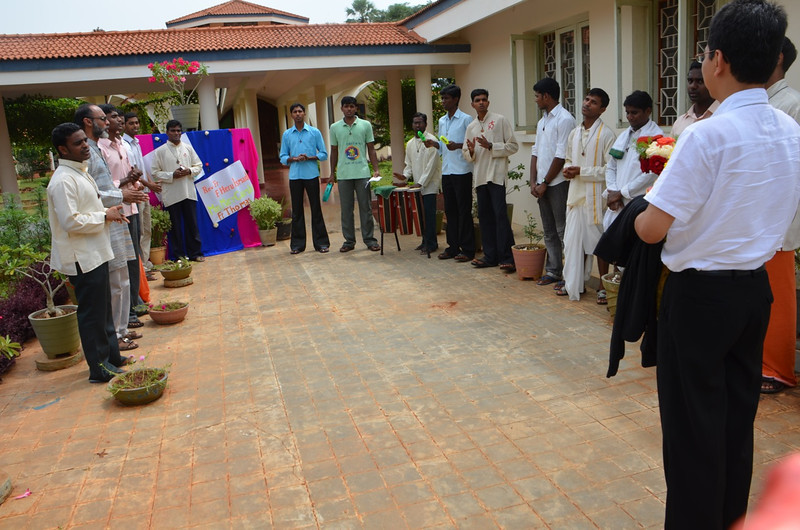
Typical SCJ hospitality is found everywhere in India

Typical SCJ hospitality is found everywhere in India

As noted previously, Fr. Tom Cassidy spent much of the past two months in our Indian District. What follows is his final reflection on his time there, written upon his return to the United States:

I want to take a moment to reflect briefly on my two-month sojourn to India. First of all, let me note these are my own personal reflections and while I tried to be as truthful and accurate as possible in these blog posts, from time to time misinformation has slipped in. Perhaps this is another way of saying that you’re seeing India through the eyes of a tourist, a stranger to its life, culture and customs.

A wise Dutchman, Fr. Case van Passen, SCJ, a missionary in Indonesia for many years, once told me that even after 20-plus years in Indonesia each day brought with it a surprise. It took me some time to truly understand what he was trying to say, but I agree with his observation. Unless you are born into a culture and steeped in its traditions and ways from birth there are aspects to that culture you’ll never fully comprehend.

After two months in India, and this being my second visit, I do have a better sense of its life. India is a vast country composed of many languages and cultures. In fact, as I have said on more then one occasion, I marvel that it has been a functioning democracy for over 60 years. That is not easy with such a diverse population. Perhaps being a land of ancient culture has provided the glue to hold it all together. While there are differing cultures, languages, customs and foods there seems to be an underlying cultural unity to it all.

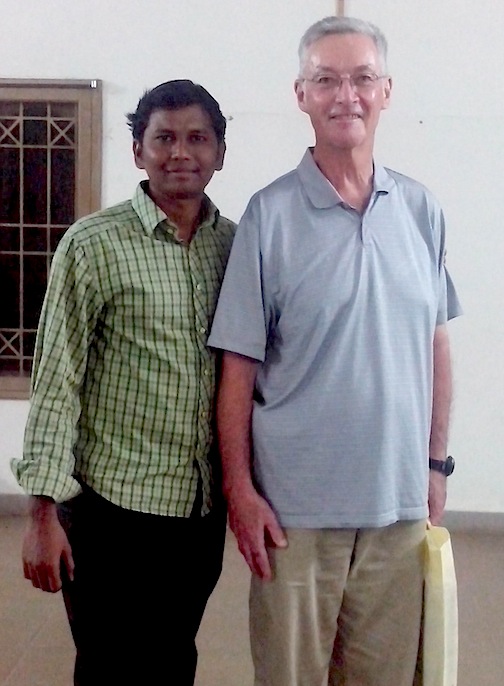
Fr. Tom and Fr. Joseph Gopu

Fr. Tom and Fr. Joseph Gopu

Religiously, the country is dominated by Hindus. I was struck by the fact that while there are 150 million Muslims (one of the largest populations in any single country) it is but a small percentage out of a population of 1.2 billion people. Christianity and more precisely, Catholics, are a much smaller percentage, about 1.6% in 2009.

However, Christianity is not a “Johnny-Come-Lately” to India. Indians trace their faith to the Apostle St. Thomas. One of the highlights for me was the opportunity to celebrate Mass at his tomb where he is believed to be buried. It’s located in the coastal city of Chennai. 

Religious tensions are not unknown in India. One of the factors to pay attention to in the upcoming parliamentary elections is the strength of the Hindu BJP party. There is a real possibility they will take power from the Congress Party and will have the opportunity to form the next government. From what I have read and been told, most likely, given the number of parties vying for seats, neither the BJP or Congress will gain enough seats to form a government on their own and will thus have to bargain with the small parties to form a coalition government. That may be best hope for religious tranquility for the next five years.

I spent most of my time at our theological house of studies in Eluru. It gave me the opportunity to know both our current first and second year theologians and the postulants heading for the novitiate. I thoroughly enjoyed living with these young men. They were most receptive to my presence and made me feel right at home. I was reminded that hospitality is a hallmark of SCJs. What I marvel at in this regard is, to the best of my knowledge, no classes are offered anywhere in the congregation on hospitality but we sure do practice it.

I was impressed with the quality of these men, both the theologians and postulants. It amazed me how easily they get around from place to place via public transportation. If I have one regret it would be not having the opportunity to use a bus to travel from one place to another. Several times we had trips from Eluru to Nambur or Guntur and lacking vehicles to carry us all many would use public transport (an auto rickshaw from our house to bus station, etc.) to get to our destination.

This year marks the 20th anniversary of the SCJs arrival in India. Circumstances have thrust the responsibility for their growth and success on to their shoulders. Just what the future might look like only God knows. I was interviewed by Fr. Vilmar, SCJ, for The Mustard Seed, a publication of the Indian District, and in that interview I said that I believe something the Indian SCJs have to figure out is: What do they want to be known for? Or to put it another way, when someone asks who you are and you say “I am an SCJ” or “I am a Dehonian” will they readily recognize who you are and what you do?

Let me close by saying how privileged I feel for having made this journey; it has indeed been a blest time for me. I learned a lot and hope in turn that my presence was of value to them. I do believe that by rubbing shoulders with one another for two months something of me has rubbed off on them, and I know something of them has rubbed off on me.